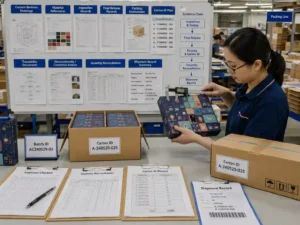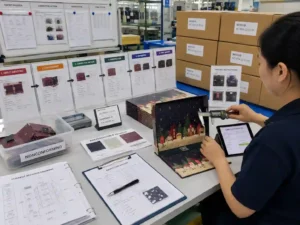
How to Make Advent Calendar Boxes Stronger for Shipping
Many advent calendar box problems appear after production, not during sample approval. A box may look attractive on a desk, but still arrive with crushed corners, loose drawers, bent doors, damaged inserts, or shifted products after long-distance transport.
For overseas brands, wholesalers, gift companies, and retail buyers, making strong advent calendar boxes shipping-ready starts before bulk production. Structure, greyboard thickness, inserts, artwork surface, master carton planning, and inspection standards all affect the final delivery condition.
This guide explains how to plan stronger custom advent calendar boxes for export packing, e-commerce gift sets, retail campaigns, and seasonal launches.
Why Advent Calendar Boxes Need Extra Shipping Strength
Advent calendar packaging is more complex than a simple rigid gift box. It may include drawers, numbered doors, pull tabs, inner trays, paperboard dividers, product cavities, magnetic closures, sleeves, ribbons, or printed wrap paper. Each extra part can become a weak point if the box is not engineered for shipping.
Buyers often ask for a premium appearance first. That is understandable. However, for strong advent calendar boxes shipping performance should be considered at the same time as artwork, opening experience, and product layout.
A good export-ready calendar box should protect the products, keep the structure square, maintain clean printed surfaces, and fit into master cartons without too much empty space. If your project includes heavy cosmetics, glass jars, candles, snacks, toys, stationery, or multiple small gifts, the structure needs to be planned carefully.
Giftpackpro works with overseas buyers who need custom seasonal paper packaging for bulk production. As a custom advent calendar boxes manufacturer, the factory-side discussion should include box structure, insert material, product weight, packing method, carton size, pallet plan, and quality control requirements before quotation.
Start with the Right Box Structure
The first step is choosing a structure that matches the product weight, product shape, sales channel, and shipping route. A display-style calendar used for a retail shelf may need different reinforcement compared with a mailer-ready gift set sold through e-commerce.
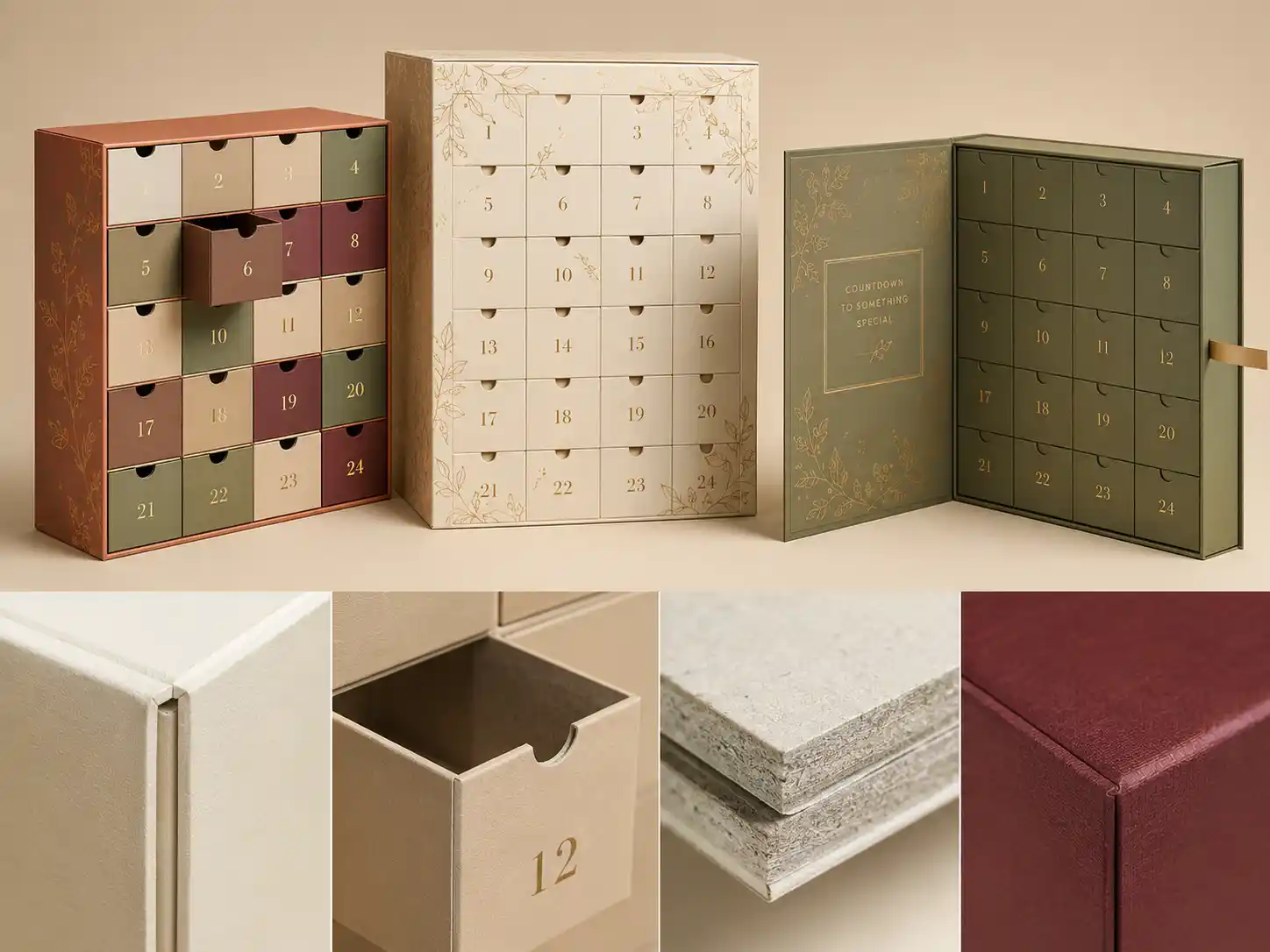
Common advent calendar box structures include drawer-style boxes, door-opening boxes, book-style rigid boxes, sleeve boxes, and hybrid structures with trays or compartments. Each option has different strength points.
Drawer-Style Advent Calendar Boxes
Drawer-style boxes are popular for beauty, jewelry, small toys, stationery, and premium promotional kits. They look high-end and allow buyers to separate items clearly. For stronger shipping, the outer frame must be rigid enough to prevent drawer misalignment.
Important strength details include drawer wall thickness, outer frame thickness, tightness tolerance, pull-tab fixing, and whether the drawers are packed empty or pre-filled. If drawers are too loose, they may slide during transport. If they are too tight, they may deform after loading.
Numbered Door Advent Calendar Boxes
Door-style calendars are often used for snacks, chocolates, small gifts, samples, and campaign items. The main risk is that doors may bend, tear, or open too easily if the paperboard and perforation design are not balanced.
To make this structure stronger, buyers should confirm door paper thickness, perforation depth, insert support behind each door, and how much pressure the front panel can handle inside the master carton.
Book-Style Rigid Advent Calendar Boxes
Book-style rigid calendar boxes usually have a premium retail look. They can support strong visual branding and a better unboxing experience. However, the hinge, magnet position, tray fixing, and side walls must be tested carefully.
If the box is heavy, the hinge area needs reinforcement. If magnets are used, the closure should be strong enough to stay closed during handling but not so strong that the buyer damages the surface when opening it.
Choose Greyboard Thickness Based on Weight and Size
Greyboard thickness is one of the most important factors for strong advent calendar boxes shipping performance. A small light paper gift set does not need the same board thickness as a large cosmetics or candle calendar. Using the thickest board is not always the best choice because it can increase weight, cost, carton size, and shipping cost.
For rigid advent calendar boxes, common greyboard thickness may range from about 1.5 mm to 3.0 mm depending on the structure and size. The final choice should be confirmed through sampling, product loading, and carton testing instead of guessing from photos.
| Project Situation | Common Risk | Recommended Planning Point |
|---|---|---|
| Small stationery or toy calendar | Loose items moving inside the box | Focus on insert fit, cavity size, and outer carton protection |
| Beauty sample advent calendar | Drawer shifting, surface scuffing, or crushed corners | Use stronger outer frame, accurate drawer tolerance, and protective packing |
| Candle, jar, or glass product calendar | Heavy loading, impact damage, and corner compression | Review thicker greyboard, reinforced inserts, and master carton strength |
| E-commerce gift set calendar | More handling during parcel delivery | Plan individual protection, drop-risk checks, and tighter carton layout |
| Retail shelf campaign calendar | Display surface damage before sale | Protect printed faces, corners, and front panels during export packing |
Design Inserts to Stop Product Movement
A strong outer box is not enough if the products move inside. Many shipping complaints come from poor insert planning. Products may hit each other, push against paper doors, damage printed panels, or make the box look messy after opening.
Insert design should match the exact product dimensions, not just the product category. A lipstick, glass bottle, mini toy, chocolate, candle, or jewelry pouch all need different cavity shapes and support points.
Paperboard Inserts
Paperboard inserts are common for lightweight products and projects that need recyclable paper-based packaging. They can be cost-effective and easy to print or match with the box design. For strength, the folding lines, locking points, and cavity depth should be tested with real product samples.
EVA, Foam, or Molded Pulp Inserts
For heavier or fragile products, EVA, foam, or molded pulp may provide stronger holding support. These materials can reduce movement, but buyers should check cost, appearance, sustainability goals, and destination-market requirements.
If sustainability is important to your brand, it is useful to review responsible paper sourcing and material claims. For example, buyers can learn more about forest certification from the official FSC website.
Do Not Approve Inserts from Empty Samples Only
An empty sample can show structure and artwork, but it cannot prove shipping strength. The insert should be tested with actual products or accurate product dummies. Product weight, diameter, height, and surface finish all affect the final fit.
When requesting custom advent calendar box services, send product dimensions, unit weight, product photos, and any fragile areas. This allows the packaging team to recommend a better insert solution before tooling and sample production.
Control Surface Finishing and Printed Wrap Strength
Shipping strength is not only about the inner structure. Printed surfaces can also be damaged during packing, loading, and handling. Matte lamination, gloss lamination, soft-touch film, spot UV, foil stamping, embossing, and textured paper all behave differently.
For export shipments, buyers should think about scuff resistance, corner wrapping, glue strength, and how the finish reacts to friction inside cartons. A premium surface may need extra protection, such as tissue paper, sleeves, corner protectors, or separated packing layers.
If the advent calendar box uses dark artwork, metallic foil, or large solid color areas, scratches and rubbing marks may become more visible. Ask for a sample review under realistic lighting, not only a digital mockup.

Use Sampling to Find Weak Points Early
A good sample process helps buyers avoid expensive problems during bulk production. For strong advent calendar boxes shipping tests should not be left until the final inspection stage.
There are usually several useful sample stages. A blank sample can confirm size, structure, insert fit, and opening method. A printed sample can confirm artwork position, color, surface finish, and branding details. A loaded sample can show whether the box performs well with real products inside.
During sample review, check these points:
- Do drawers slide smoothly without becoming loose?
- Do numbered doors open cleanly without tearing the main panel?
- Does the insert hold each product after shaking or tilting?
- Do corners stay square after handling?
- Does the lid, sleeve, magnet, or closure remain aligned?
- Is there enough protection between the product and printed surface?
Buyers can review more planning topics through Giftpackpro’s advent calendar box buying guides, especially when comparing structure, inserts, sampling, production time, and export packing options.
Plan Master Cartons Before Bulk Production
Master carton planning is often ignored until the box design is finished. This can create problems. If the gift box is large, heavy, or irregular, the final master carton may become too big, too heavy, or difficult to palletize.
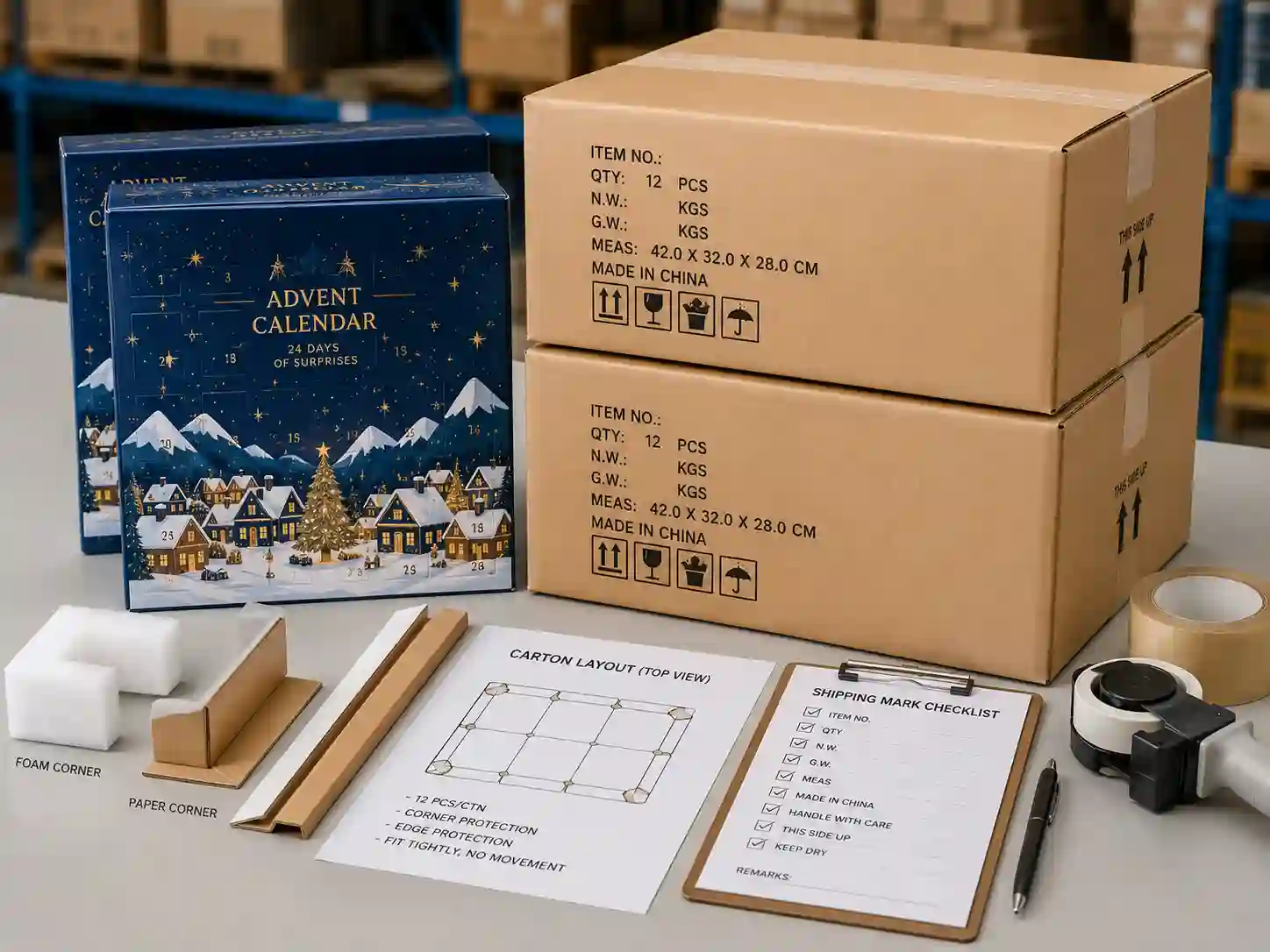
To improve shipping strength, the master carton should be planned together with the product box. Carton size, carton board strength, packing quantity, product direction, corner protection, and pallet pattern all matter.
Avoid Too Much Empty Space
Empty space inside the carton allows movement. Movement causes corner damage, rubbing, and compression. If the carton is too loose, use dividers, fillers, or a revised carton layout. If the carton is too tight, workers may force boxes inside and damage the printed surface.
Confirm Carton Weight for Manual Handling
Very heavy cartons increase the risk of dropping, rough handling, and stacking damage. For large advent calendar boxes, it may be better to reduce the number of units per carton instead of forcing more pieces into one master carton.
Use Clear Shipping Marks
Shipping marks should be easy to identify in the warehouse. Generic carton labels may include item number, quantity, carton number, gross weight, net weight, carton size, and handling marks. Avoid unnecessary brand exposure if the shipment requires neutral export packing.
For buyers who need factory support with carton planning, palletizing, and pre-shipment packing review, Giftpackpro’s custom advent calendar box services can include export packing suggestions based on the box structure and order quantity.
Check Quality Control Points for Stronger Shipping
Quality control should cover both appearance and function. A calendar box may pass a visual check but still fail during shipping if the structure is weak or the insert is loose.
Useful QC points include board thickness, box dimensions, drawer tolerance, door cutting, magnet position, glue strength, insert fit, surface cleanliness, color consistency, carton packing, and random loaded checks.
Factories that work with export orders often follow documented inspection steps. Buyers who use ISO-related supplier evaluation systems can learn about quality management principles from the official ISO 9001 quality management page.
When evaluating a supplier, ask how they control incoming paper material, printing, lamination, die cutting, hand assembly, insert fitting, final inspection, and export packing. A practical factory answer is more useful than a general promise.
You can also review the Giftpackpro packaging factory page to understand factory positioning before sending technical project details.
Prepare Better Quote Information for Shipping-Ready Boxes
A strong shipping-ready quotation needs more than a box size and artwork file. If the supplier does not understand the product weight, packing method, or shipping channel, the first price may not match the real project requirement.
Before asking for a quote, prepare these details:
- Box structure: drawer, door, book-style, sleeve, or custom design
- Finished box size and product cavity layout
- Product dimensions and unit weight for each item
- Estimated order quantity and target MOQ
- Artwork requirements, printing method, and surface finishing
- Insert material preference: paperboard, EVA, foam, molded pulp, or other option
- Sales channel: retail shelf, e-commerce, wholesale gift set, or promotional campaign
- Export packing requirement, carton label requirement, and destination market
- Sample deadline, bulk production deadline, and shipping schedule
If you are still comparing box types, review available custom advent calendar box products first. This can help you choose a structure before requesting tooling, samples, and production pricing.
For complex projects, the best approach is to send a clear brief and ask the supplier to quote both the box and the export packing method. This reduces later changes and helps avoid underestimating the cost of stronger packaging.
Common Buyer Questions About Strong Advent Calendar Boxes Shipping
Can a thicker board solve all shipping problems?
No. Thicker board can improve rigidity, but it cannot solve poor insert fit, weak carton packing, bad product layout, or rough handling. Strong advent calendar boxes shipping performance depends on the full packaging system.
Should we choose assembled packing or flat packing?
It depends on the structure and project goal. Some rigid advent calendar boxes must be shipped assembled to protect the shape and finish. Some paperboard components may support flat packing to reduce volume. Ask the supplier to compare cost, assembly time, risk, and carton volume.
How early should we start if shipping strength is important?
Start during the design and sampling stage. If you wait until mass production is finished, changes to board thickness, insert structure, carton layout, or surface protection may cause delays and extra cost.
What should we send to get accurate advice?
Send product dimensions, product weight, box style reference, artwork direction, order quantity, destination market, and shipping method. If products are fragile, heavy, sharp-edged, or high-value, mention that clearly.
Final Advice for Export-Ready Advent Calendar Boxes
To make stronger advent calendar boxes for shipping, do not treat the box as only a printed marketing item. Treat it as a complete export packaging system. The outer structure, greyboard, inserts, surface finishing, master carton, pallet plan, and QC checklist should work together.
For B2B buyers, this planning helps reduce damage risk, improve retail presentation, and make the final quotation more accurate. It also helps the factory understand whether the project needs a simple seasonal box, a premium rigid gift set, or a more protective export-ready structure.
If you are planning a custom calendar box project, you can request a custom quote with product details, artwork requirements, sample schedule, MOQ target, and shipping expectations. Giftpackpro can then review the structure, insert, production process, and export packing plan before bulk production.