Quick answer: Packaging lot traceability for multi-component calendar boxes should connect each controlled component batch to the assembly lot and, where practical, the finished-carton identification. The system should let QC trace a defect backward to affected materials and forward to potentially affected finished units. The required records normally include component lot IDs, material issue records, assembly travelers, inspection results, rework records, and finished-lot identification. Traceability depth should be defined before production according to component risk and project requirements.
What should packaging lot traceability achieve?
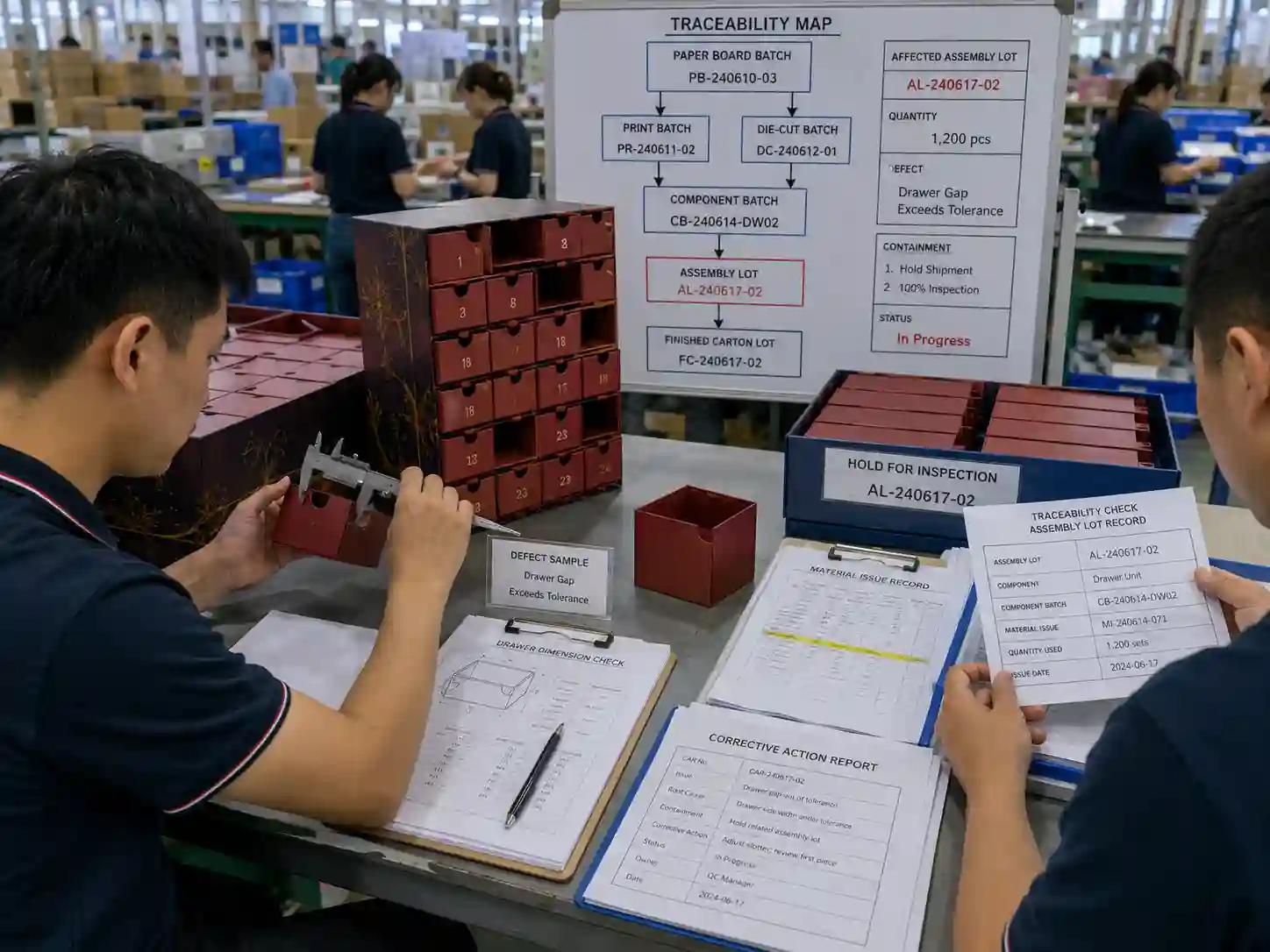
A useful traceability system should answer three questions: which controlled components entered an assembly lot, which finished units may contain those components, and what inspection or corrective-action records apply to that population.
This is especially important for calendar boxes because one finished pack can combine an outer housing, multiple drawers or doors, inserts, ribbons, magnets, printed panels, wrapped boards, and other separately produced components. A defect discovered in one part should not automatically force an assumption that every finished box has the same problem.
Traceability provides the evidence needed to define the affected population more accurately. It does not replace inspection; it connects inspection evidence to production history.
Which calendar box components should receive lot control?
Lot control should be risk-based rather than applied mechanically to every consumable. Components that can create functional, visual, safety-related, or systematic assembly defects generally need stronger identification.
| Component or record | Typical traceability purpose | Evidence to retain |
|---|---|---|
| Outer housing and wrapped panels | Trace board, wrapping, print, dimensional, or surface defects | Component lot ID, inspection record, material issue record |
| Drawers, doors, or compartments | Trace fit, sequence, print-version, cutting, or gluing problems | Batch ID, version reference, in-process QC result |
| Inserts or internal trays | Trace fit, position, deformation, or product-retention issues | Lot ID, drawing revision, inspection result |
| Ribbons, magnets, pull tabs, or functional accessories | Trace attachment or functional failures | Material lot, incoming/in-process check, issue record |
| Assembly lot | Connect multiple component batches to a defined production population | Assembly traveler, date/shift or defined lot code, QC records |
| Finished cartons | Support forward tracing and containment | Finished-lot or carton identification and packing record |
The exact control level is project-dependent. For example, a generic protective sheet may not require the same traceability depth as a printed drawer set whose artwork changes between versions. The buyer and supplier should agree which components are traceability-critical before mass assembly.
How should component lots connect to the assembly lot?
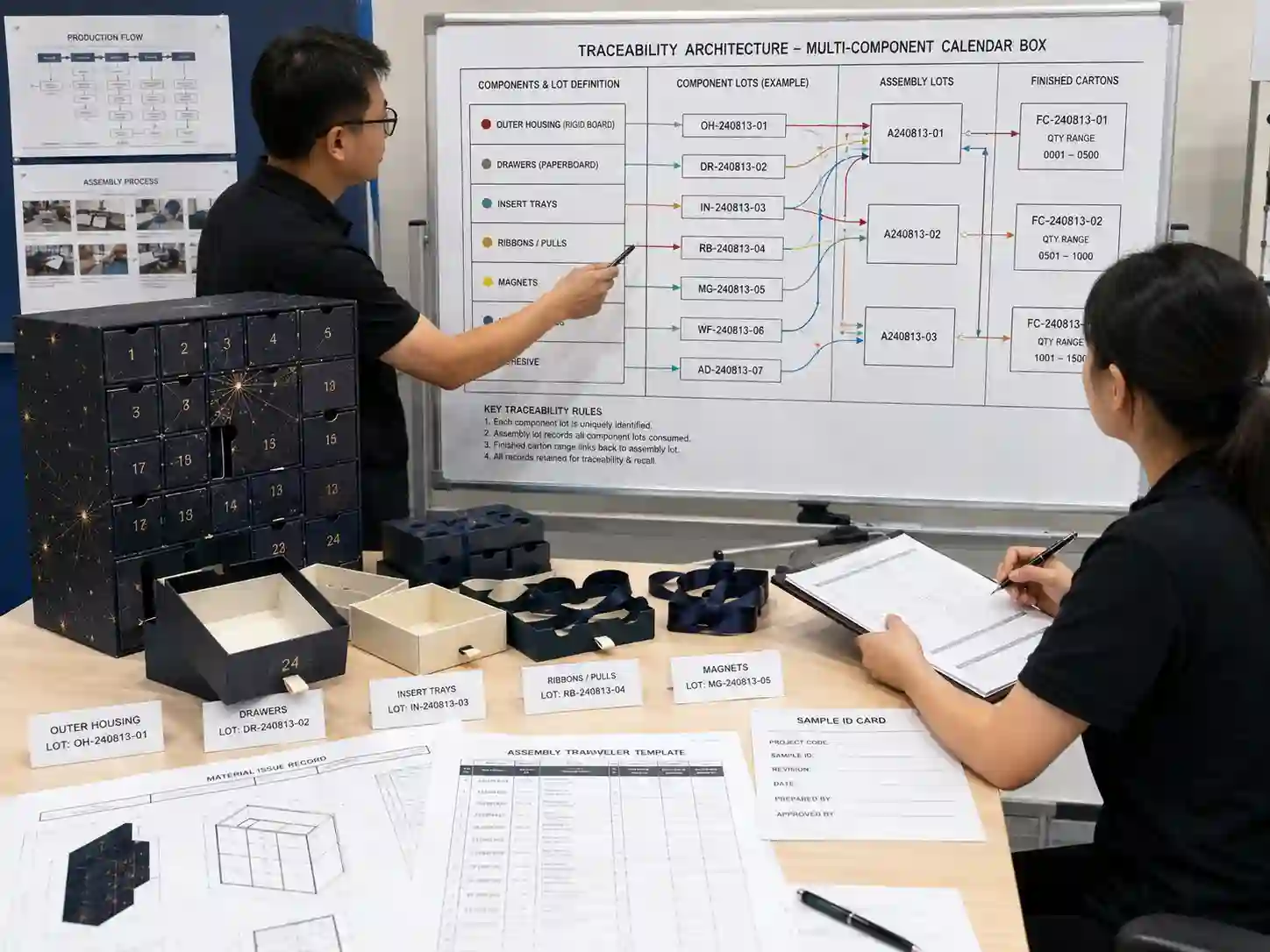
The assembly record should create a documented link between the component batches issued to production and the defined assembly population. This link is the core of multi-component traceability.
A practical production traveler or equivalent controlled record can identify the assembly lot and record the component lot numbers issued against it. If a component batch changes during the assembly run, the change should be recorded rather than allowing the entire run to become an undocumented mixture.
What is a practical traceability example?
Consider an assembly lot identified internally as Assembly Lot A240. Its production record shows that it used housing batch H17, drawer batch D32, insert batch I08, and ribbon batch R11.
QC later finds repeated drawer friction. Measurement records show that several drawers from D32 exceed the approved dimensional condition. The traceability path should allow the team to move from the defect to D32, identify which assembly lots received D32, locate the corresponding finished cartons, contain that population, and inspect or rework it according to the approved disposition.
If D32 was also issued to Assembly Lot A241, that lot becomes part of the investigation. If A242 used drawer batch D33 instead, records provide evidence for treating it separately unless inspection indicates a broader cause.
This is more useful than tracing only by production date because the affected component can cross assembly boundaries.
How should lot boundaries be defined?
A lot should represent a production population that can be identified consistently and investigated later. The definition may be based on component batch, production run, material issue, shift, assembly period, or another controlled production boundary.
There is no single lot size appropriate for every calendar project. Very broad lots reduce traceability resolution, while excessively small lots create administrative complexity without necessarily improving quality control.
Before production, the supplier should document what causes a new lot or sub-lot. Typical triggers can include:
- a change to a controlled component batch;
- a change in approved artwork or structural revision;
- a material substitution or approved material change;
- a significant production interruption where separation is required;
- a change that affects the ability to identify the affected production population.
These triggers are project-dependent recommendations rather than universal rules. The approved control plan should state which ones apply.
What records are needed to make traceability verifiable?
Traceability is only useful when identifiers can be followed through actual records. A lot number printed on a label has limited value if there is no documented relationship between that number, component issuance, assembly, inspection, and finished packing.
A practical record chain can include:
- component identification and receiving or production batch record;
- approved drawing, artwork, specification, or revision reference where relevant;
- component inspection or in-process inspection record;
- material issue record showing which batch entered assembly;
- assembly traveler linking components to the assembly lot;
- in-process and final QC results;
- rework, segregation, concession, or disposition records when applicable;
- finished-lot and carton identification used for forward tracing.
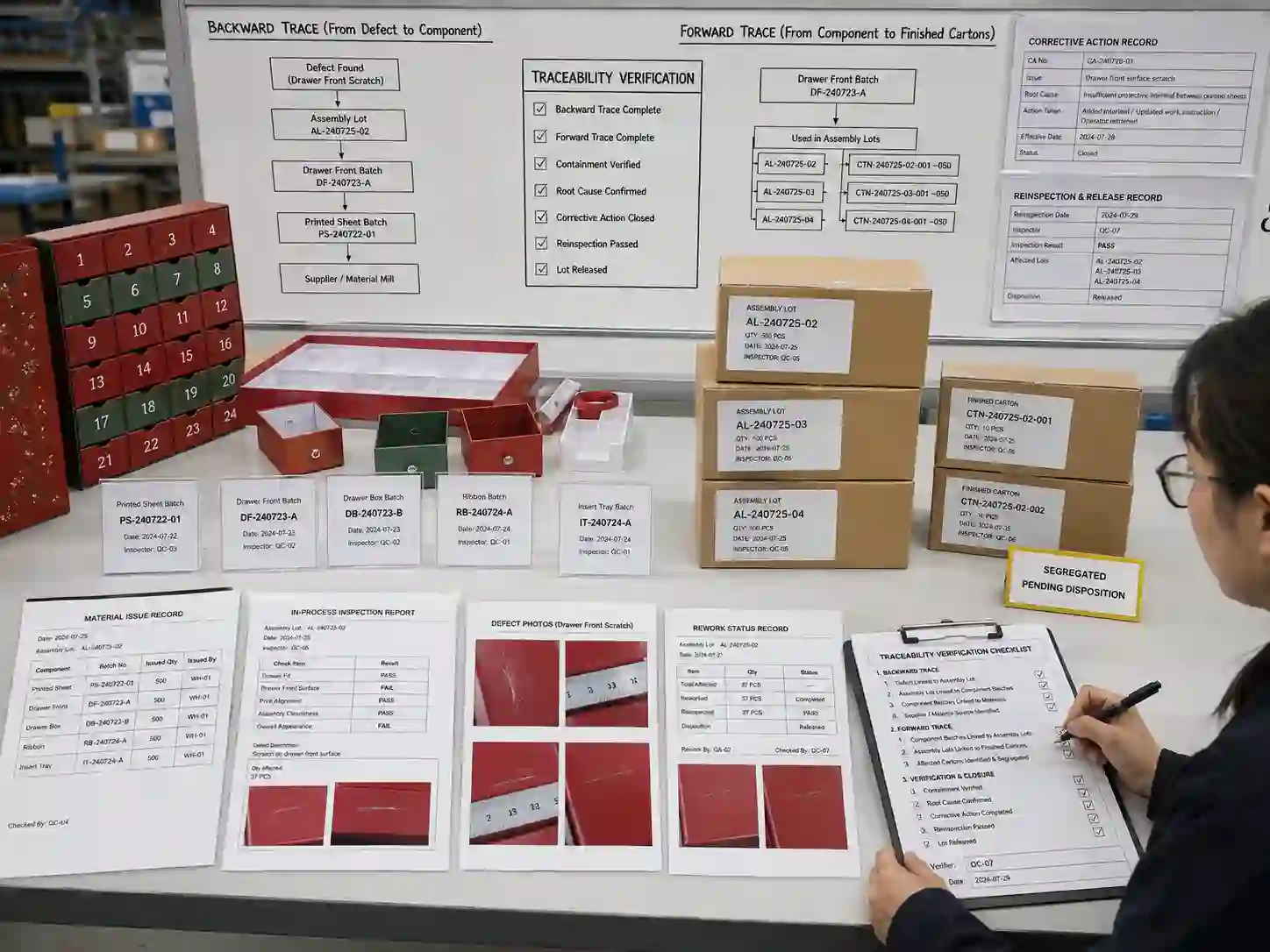
A buyer or inspector can verify the system by selecting a finished lot and asking the supplier to trace backward to controlled component batches. The reverse exercise should also be possible: select a component batch and determine which assembly lots or finished cartons received it.
How should QC use traceability when a defect is found?
QC should first document the defect objectively, identify the unit and lot involved, and then use production records to establish the potentially affected population. Containment should be based on traceability evidence plus the nature of the defect.
| Investigation step | QC question | Expected evidence |
|---|---|---|
| Confirm defect | What exactly failed? | Inspection result, measurement, defect sample, or photograph |
| Identify component | Which part is associated with the failure? | Component description, drawing reference, batch ID |
| Trace backward | Which material or process batch produced it? | Component lot and production/inspection records |
| Trace forward | Where else was that batch used? | Material issue and assembly records |
| Contain | Which units require hold or additional inspection? | Assembly and finished-lot identification |
| Correct and verify | Was the cause removed before release? | Corrective-action, rework, and reinspection records |
The defect itself determines how far the investigation must extend. A single handling scratch with an identifiable local cause may require different containment from repeated dimensional failures associated with one drawer batch.
What traceability failures should inspectors look for?
Inspectors should look for breaks in the record chain, not simply confirm that labels exist. The following conditions can make containment unreliable:
- component batches are mixed at assembly without recording the transition;
- lot labels are removed before their identity is transferred to the next production record;
- assembly travelers list component descriptions but not controlled batch identifiers;
- reworked units return to normal production without documented status;
- different artwork or structural revisions share indistinguishable identification;
- finished cartons cannot be linked to an assembly population;
- QC reports contain defect evidence but no production-lot reference;
- replacement components are introduced without updating material issue records.
These conditions do not prove that the product is defective. They indicate that the scope of a later quality problem may be difficult to establish.
How should traceability connect with corrective action?
Corrective action should use traceability to identify both the suspected source and the population requiring verification. Records should show what was contained, what was corrected, and what evidence supported release.
For example, if a ribbon attachment failure is associated with a particular ribbon lot or assembly operation, the investigation may review incoming material, attachment method, workstation records, and affected assembly lots. After correction, reinspection records should distinguish verified product from units still on hold.
Traceability therefore supports both containment and effectiveness verification. It should not be treated as a substitute for root-cause analysis.
Which traceability requirements should the buyer approve?
The buyer should approve requirements that affect project-specific identification depth, while the supplier should maintain the production records needed to execute the agreed system.
Before production, useful approval points include which components require lot control, how assembly lots are defined, how version changes are separated, what finished identification must remain available, and what traceability records are expected when investigating a defect.
For complex structures, these requirements can be reviewed alongside the project’s controlled drawings and production documentation. Buyers evaluating manufacturing arrangements can also review custom advent calendar box services, custom advent calendar box products, and information about the Giftpackpro packaging factory.
What is the simplest way to test whether the system works?
Perform a two-direction traceability exercise. Start with one finished production lot and trace backward to its controlled components, then start with one component batch and trace forward to every relevant assembly population.
The exercise should rely on retained production records rather than staff memory. If the records cannot establish the relationship without assumptions, the traceability architecture should be corrected before it is needed for an actual defect investigation.
Frequently asked questions about calendar box lot traceability
Does every drawer need an individual serial number?
Usually not. Lot traceability is different from unit serialization. Drawers can normally be controlled as identifiable batches unless the project risk or buyer specification requires unit-level identification.
Should the lot code be visible on the retail-facing calendar?
Not necessarily. The required location depends on the agreed identification system. Traceability may be maintained through carton labels and controlled production records, provided the finished population can still be identified reliably.
What happens when two component lots are used in one assembly run?
The transition should be recorded so the affected assembly population can be reconstructed. Depending on the control plan, this may require a sub-lot, a traveler entry, a material-change record, or another documented boundary.
How can a sourcing or quality team verify traceability before shipment?
Request a traceability exercise using actual production records. Select a finished lot for backward tracing and a controlled component batch for forward tracing, then verify that material issue, assembly, QC, rework, and packing records agree.
For projects requiring defined component-to-assembly traceability, request a custom quote and include your required lot-control, inspection, and production-record expectations for review.