How to Choose Finishing Options for Advent Calendar Boxes
Choosing the right advent calendar box finishing options is not only about appearance. For B2B buyers, finishing affects paper selection, insert fit, product protection, sample approval, bulk production stability, export packing, and final quotation.
This guide is written for brands, wholesalers, gift companies, retail buyers, and purchasing teams preparing custom seasonal packaging projects. It explains how printing, lamination, foil stamping, embossing, insert materials, compartments, and fit testing should work together before production starts.
If you are still comparing structures, you can review Giftpackpro as a custom advent calendar boxes manufacturer and browse our custom advent calendar box products before confirming artwork and finishing details.
Why Finishing Options Must Match the Box Structure
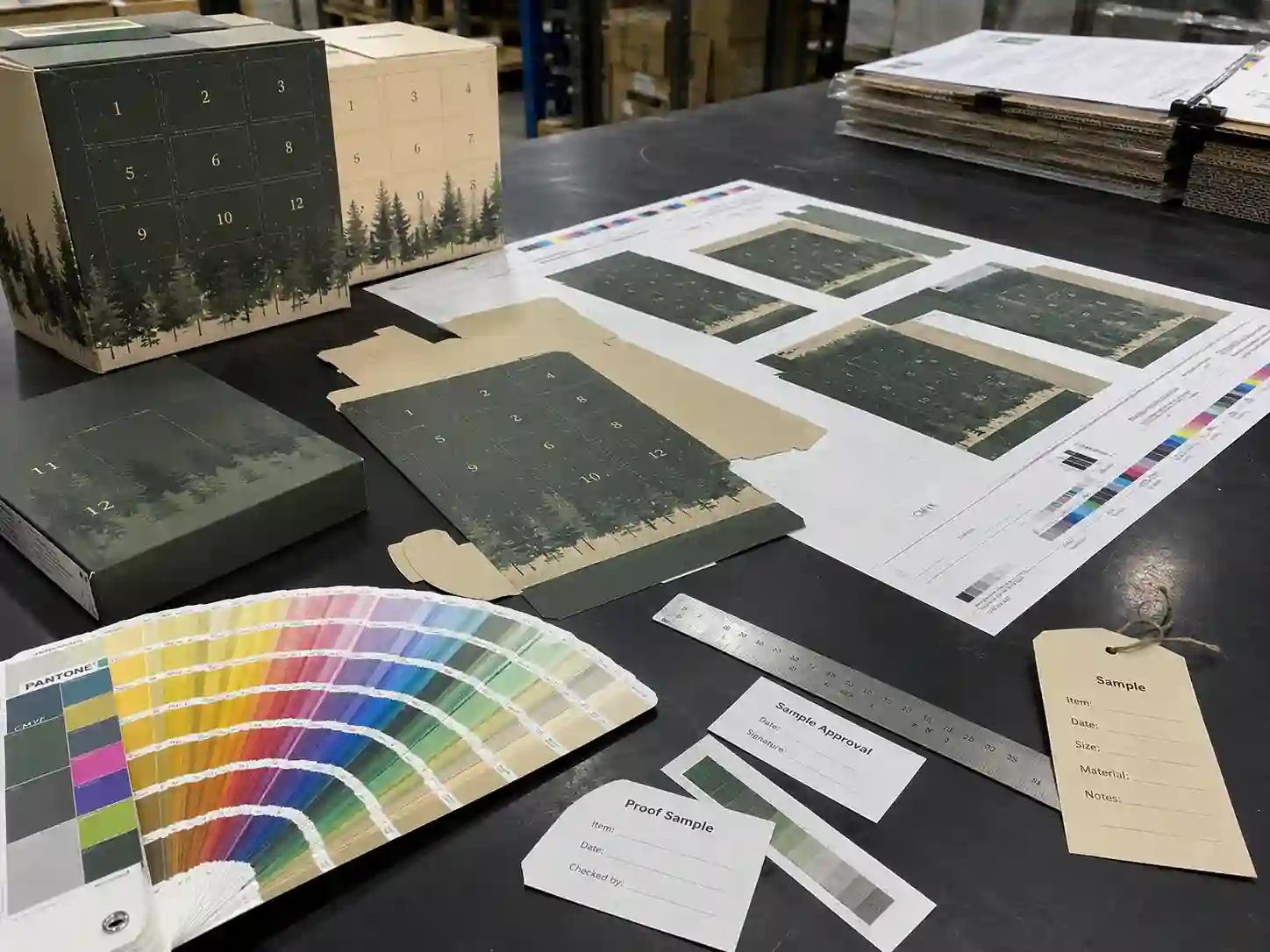
Advent calendar boxes usually contain multiple compartments, drawers, doors, trays, or inner inserts. A finish that looks good on a flat proof may not work well if the box has many folds, tight drawer gaps, or small numbered windows.
For example, a rigid drawer advent calendar may support foil stamping and soft-touch lamination better than a thin folding carton style. A paperboard door calendar may need stronger crease control so the printed surface does not crack when each door opens.
Common Structure and Application Questions
Before selecting finishing, buyers should confirm the product type, box structure, insert style, and retail usage. A beauty advent calendar with glass bottles needs different surface protection and insert planning than a lightweight stationery or snack calendar.
Useful questions include:
- Will the box use drawers, doors, a book-style opening, or a sleeve structure?
- Are the products fragile, heavy, irregular, or easy to scratch?
- Will the calendar be displayed on a shelf, countertop, pallet display, or e-commerce packing line?
- Does the artwork include dark colors, metallic areas, small text, or many numbered panels?
- Does the buyer need FSC-certified paper or documented quality control requirements? More information about responsible forestry standards is available from the Forest Stewardship Council.
Main Printing and Surface Finishing Options
Most advent calendar packaging uses CMYK offset printing, Pantone color matching, or a combination of both. For overseas buyers, the key is to confirm color expectations before the pre-production sample, not after bulk printing.
CMYK Printing
CMYK printing is suitable for full-color retail artwork, gradients, lifestyle graphics, and seasonal patterns. It is practical for medium and large production runs because it supports rich image detail and consistent repeat production.
Pantone Color Matching
Pantone colors are useful when the brand requires a specific logo color or background shade. Buyers should provide Pantone codes, brand guidelines, and approved artwork files when requesting custom advent calendar box services.
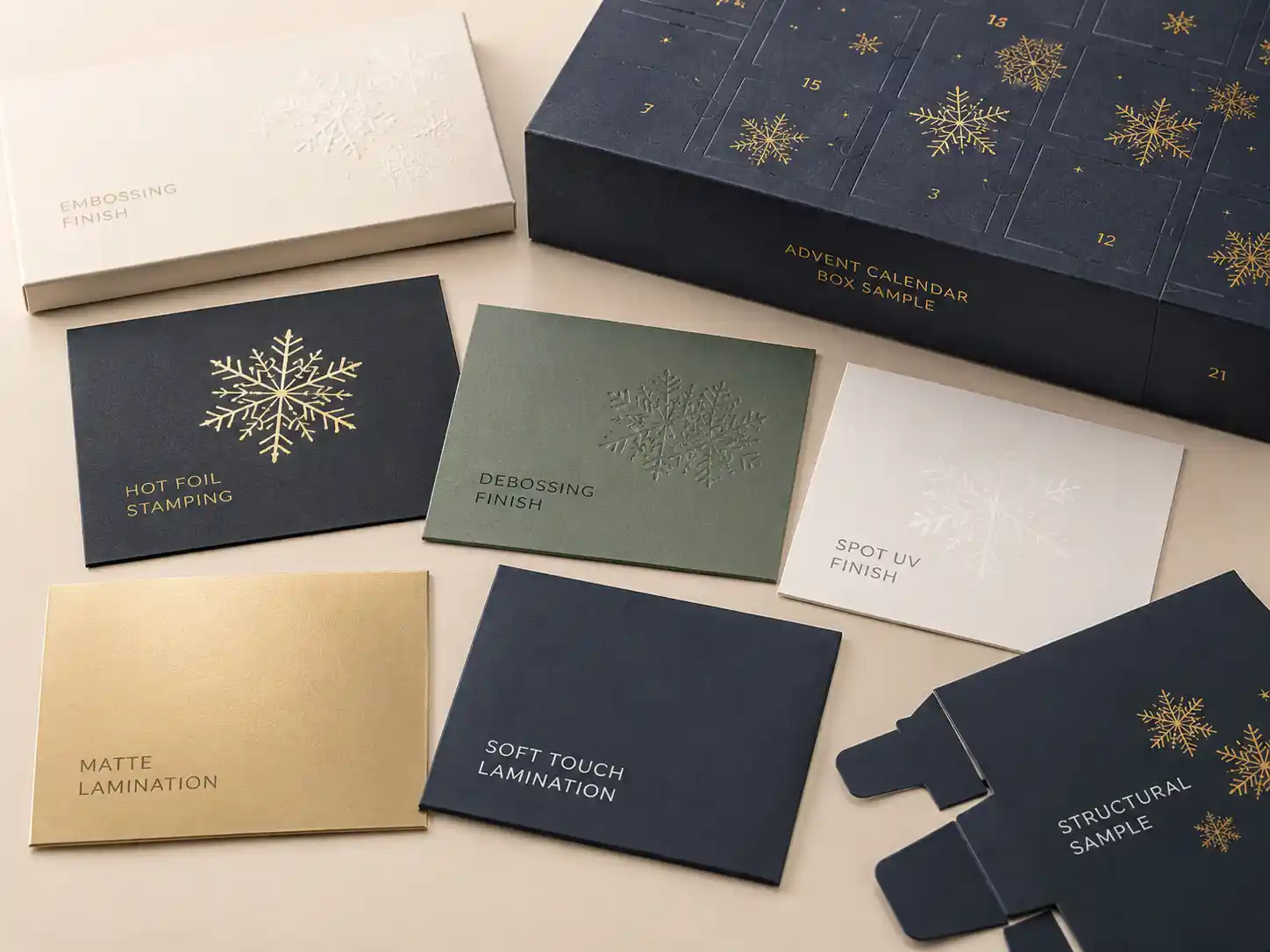
Matte Lamination
Matte lamination gives a clean premium look and reduces glare. It is commonly used for beauty, fragrance, skincare, tea, candle, and gift packaging projects. It also adds surface protection during handling and export packing.
Gloss Lamination
Gloss lamination makes colors look brighter and is useful when retail impact is more important than a soft luxury feel. It can work well for candy, toys, promotional gifts, and colorful seasonal sets.
Soft-Touch Lamination
Soft-touch lamination gives a smooth premium surface. It is often selected for higher-end rigid advent calendars, but buyers should test it carefully if the box will be handled frequently, packed tightly, or shipped long distances.
Foil Stamping
Foil stamping is used for logos, numbers, borders, and decorative details. Gold, silver, rose gold, and holographic foil can improve shelf appeal, but foil areas should not be too close to folds, cut lines, or small opening doors.
Embossing and Debossing
Embossing raises part of the surface, while debossing presses it inward. These finishes work best on logos, simple patterns, and large decorative elements. Very small text or thin lines may not show clearly after tooling.
Spot UV
Spot UV highlights selected parts of the artwork, such as numbers, product icons, logos, or decorative patterns. It is often paired with matte lamination for contrast.
How Insert Materials Affect Finishing Decisions
Finishing options should be selected together with the insert material. Inserts control product fit, protection, opening experience, and packing speed. A beautiful outer finish can still fail if the insert cannot hold the products securely.
| Insert Material | Best For | Finishing and Fit Notes |
|---|---|---|
| Paperboard Insert | Lightweight products, cosmetics samples, stationery, small gifts | Cost-effective and recyclable. Works well with printed compartments, but needs accurate die-cutting and folding tests. |
| EVA Insert | Glass bottles, fragrance, premium cosmetics, fragile sets | Strong product holding and clean presentation. Requires exact product dimensions and sample fit testing. |
| Foam Insert | Fragile products, irregular shapes, heavier gift items | Good cushioning. Thickness and density affect both protection and box height. |
| Molded Pulp Insert | Eco-focused projects, candles, jars, small containers | Practical for sustainability-focused packaging. Mold cost and tolerance should be checked early. |
| Compartment Divider | Multi-SKU calendars, snack packs, promotional gift sets | Good for organizing many items. Must match product sequence, artwork numbers, and packing workflow. |
Paperboard Inserts
Paperboard inserts are common for custom advent calendar boxes because they are flexible, printable, and cost-efficient. They work well for light products, flat samples, small retail items, and sets with many compartments.
However, paperboard inserts need proper structure design. If the board is too thin, products may move during shipping. If the board is too thick, the drawer or door may not close smoothly.
EVA and Foam Inserts
EVA and foam inserts are used when the buyer needs stronger product holding. They are useful for glass bottles, fragrance samples, skincare jars, candles, or fragile promotional gifts.
For these materials, buyers should provide exact product dimensions, weight, bottle shape, cap size, and any fragile points. Small dimensional differences can affect the fit, especially when the product must sit upright inside a drawer or compartment.
Molded Pulp Inserts
Molded pulp is a useful option for brands that want a more natural packaging feel. It can protect small containers and reduce plastic use. Buyers should confirm whether the pulp insert surface, color, and tolerance meet their retail expectations before approving the sample.
Compartment Design for Product Fit
Advent calendar packaging often contains 12, 24, or more product spaces. Each compartment should be designed around the real product, not only around the visual layout.
A strong compartment plan should include:
- Product length, width, height, and weight
- Product opening direction and removal method
- Fragile areas such as caps, glass edges, pumps, or corners
- Numbering sequence and packing order
- Clearance between product and compartment wall
- Extra protection for long-distance export shipping
If your project contains mixed products, the safest approach is to create a product-by-product fit list before requesting a quotation. This helps the factory calculate material usage, insert tooling, sampling time, and packing method more accurately.
Customization Process: From Artwork to Approved Sample
Finishing selection should be part of the full development process. Giftpackpro usually recommends confirming structure, product fit, artwork, finishing, sample requirements, MOQ, lead time, and packing method together.
Buyers can start from custom advent calendar box services when they need help with structure, insert planning, printing, sample development, and bulk production preparation.
Step 1: Confirm Structure and Product List
Start with the box type, product quantity, product dimensions, and target retail use. A drawer calendar, door calendar, rigid gift box, or folding carton calendar will each have different finishing limits.
Step 2: Prepare Artwork Files
Artwork should be provided in editable format when possible. Include CMYK settings, Pantone codes, logo files, font outlines, bleed area, safety area, and finishing layers for foil, embossing, debossing, or spot UV.
Step 3: Choose Finishing Options
Select finishes based on the product category and buyer budget. A beauty calendar may use matte lamination, foil stamping, and EVA inserts. A promotional gift calendar may use CMYK printing, gloss lamination, and paperboard compartments.
Step 4: Make a Prototype or Printed Sample
A white sample checks structure and product fit. A printed sample checks artwork, color, finishing, insert layout, and opening performance. For overseas B2B projects, a printed sample is often worth approving before bulk production.
Step 5: Approve Production Standard
After sample approval, the buyer and factory should confirm the production standard. This may include color tolerance, foil position, lamination type, insert material, carton packing, drop test requirements, and inspection points.
How to Select Finishing Based on Product Category
Beauty and Skincare Advent Calendars
Beauty and skincare projects often require a premium surface. Matte lamination, soft-touch lamination, foil stamping, and embossing are common choices. EVA or foam inserts may be needed if the set includes glass bottles, jars, or pump products.
Candle and Fragrance Advent Calendars
These products can be fragile and heavy. The finishing should not only look premium but also support a strong box structure. Thicker greyboard, reinforced drawers, EVA inserts, foam inserts, or molded pulp trays may be needed.
Snack and Food Gift Calendars
Snack calendars often use bright CMYK printing and gloss or matte lamination. If direct food contact is involved, buyers should separate food-contact packaging requirements from outer display packaging. For general reference, buyers can review official FDA food-contact substance guidance when planning food-related packaging compliance.
Stationery, Toys, and Promotional Gifts
These projects often need flexible compartment design. Paperboard inserts, dividers, and printed trays can help control cost while keeping the unboxing sequence clear.
Quality Control Points for Finishing Options
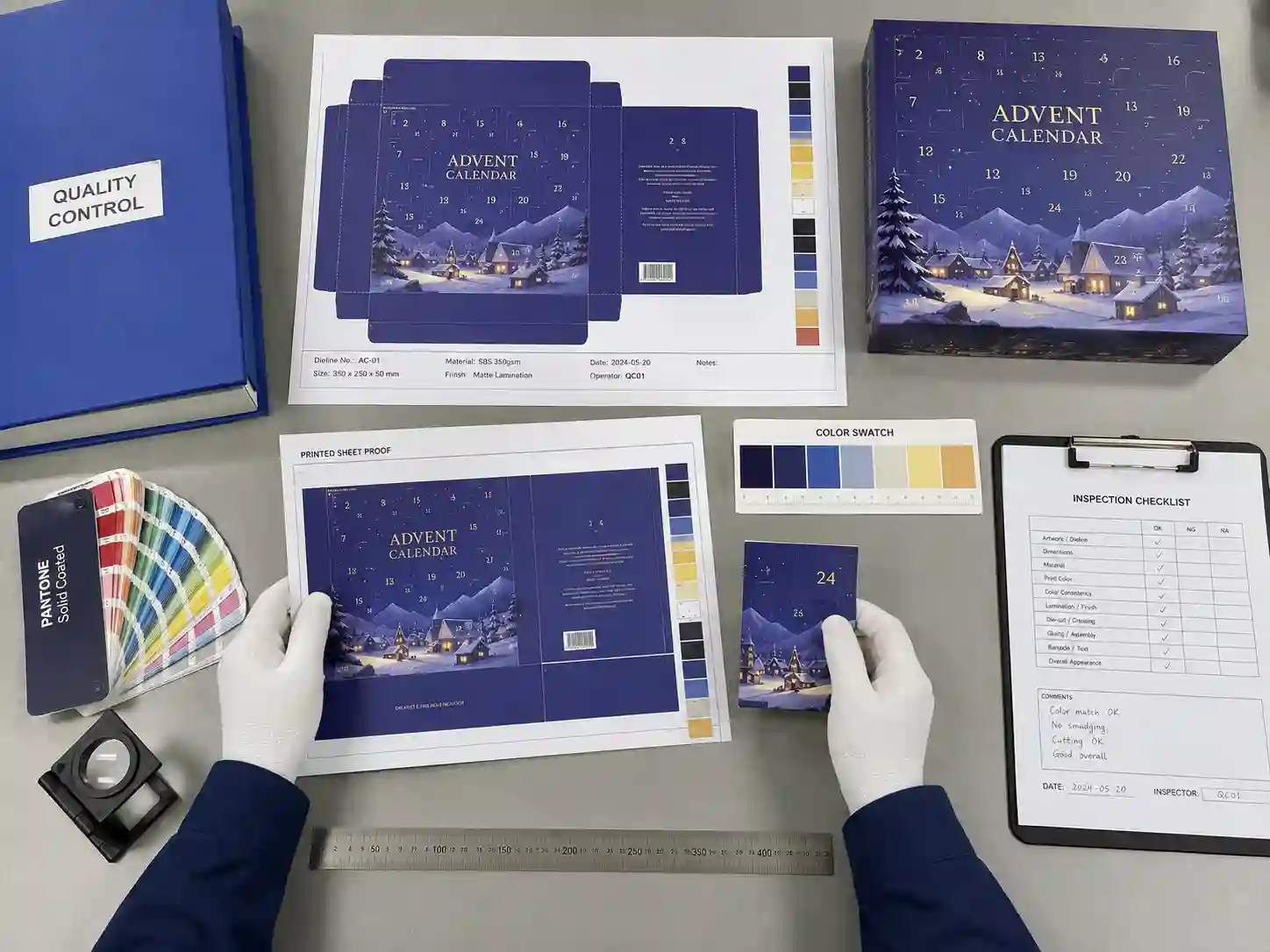
Quality control should be planned before mass production. Finishing problems can become expensive if they are discovered after printing, die-cutting, or assembly.
Giftpackpro packaging teams usually check color consistency, lamination adhesion, foil position, embossing depth, drawer movement, door opening performance, insert fit, and export carton packing. Buyers can learn more about factory capabilities from the Giftpackpro packaging factory page.
Color Consistency
Color should be checked under neutral lighting, not only under warm office lights. Buyers should confirm whether the approval standard is based on Pantone codes, digital proof, printed proof, or signed sample.
Foil and Embossing Position
Foil and embossing should align with artwork and die-cut lines. For numbered advent calendar doors, small position shifts can be very visible, so registration control matters.
Lamination and Surface Protection
Lamination should be checked for bubbles, scratches, peeling, wrinkles, and edge cracking. This is especially important for dark artwork and premium retail packaging.
Insert Fit Testing
Fit testing should use real product samples whenever possible. The team should check whether products move, tilt, scratch, or become difficult to remove. For fragile products, the sample should also be reviewed for cushioning and export handling risks.
Assembly and Packing Test
A finish may look good but slow down assembly. During sample review, check whether drawers slide smoothly, doors open cleanly, inserts load efficiently, and cartons can be packed without damaging corners or foil areas.
Quote-Preparation Advice for B2B Buyers
A clear quotation request helps the factory provide accurate cost, MOQ, and lead time. It also reduces back-and-forth communication before sampling.
When contacting Giftpackpro, prepare the following details:
- Box structure or reference style
- Target size or product dimensions
- Product quantity and product weight
- Insert preference: paperboard, EVA, foam, molded pulp, or divider compartments
- Printing method: CMYK, Pantone, or both
- Finishing options: matte lamination, gloss lamination, soft-touch, foil, embossing, debossing, or spot UV
- Estimated order quantity and target delivery date
- Export destination and packing requirements
- Need for white sample, printed sample, or pre-production sample
You can also review more advent calendar box buying guides to compare structure, insert, printing, and production planning topics before finalizing your packaging brief.
Common Mistakes to Avoid
Choosing Finishing Before Product Fit
Some buyers choose foil, embossing, or soft-touch lamination first, then discover later that the structure or insert does not fit the product. Product fit should be confirmed before final surface decoration.
Using Too Many Finishes
More finishing does not always mean better packaging. Too many effects can increase cost, extend lead time, and create production risks. A clean combination of good printing, one surface finish, and one highlight effect is often more practical.
Ignoring Export Packing
Advent calendar boxes are often large, detailed, and easy to damage at corners. Buyers should confirm master carton size, packing method, corner protection, pallet plan, and inspection standard before shipment.
Approving Only Digital Mockups
Digital mockups are useful for layout review, but they cannot fully show paper texture, foil reflection, embossing depth, drawer movement, or insert fit. For important retail projects, a physical sample is safer.
Final Checklist Before Confirming Finishing Options
Before moving to sample or bulk production, confirm the following checklist with your packaging supplier:
- Box structure is confirmed
- Product dimensions and weights are complete
- Insert material and compartment layout are approved
- Artwork files include bleed, safety area, and finishing layers
- CMYK and Pantone color requirements are clear
- Foil, embossing, debossing, spot UV, and lamination areas are marked
- Sample type and approval standard are agreed
- MOQ, lead time, packing method, and export requirements are confirmed
Good advent calendar box finishing options should support both retail appearance and production reliability. If you are preparing a new project, send your product list, artwork direction, size target, and insert requirements to request a custom quote. Giftpackpro can help review the structure, finishing plan, sample process, and bulk production details before your order moves forward.