How to Customize Advent Calendar Boxes for Your Brand
To customize advent calendar boxes for a brand project, buyers need more than an attractive seasonal layout. The box must match product size, insert structure, artwork files, production tolerance, assembly method, export packing, and retail presentation requirements.
For B2B buyers, the main question is not only “What does the box look like?” It is also “Can the factory repeat this structure consistently in bulk production?”
This guide explains how overseas brands, wholesalers, gift companies, retail buyers, and purchasing teams can manage advent calendar box customization from structure planning to quality control and quotation preparation.
Start with the Product and Sales Channel
Before you customize advent calendar boxes, define what the box needs to hold and where it will be sold. A calendar box for skincare samples, chocolate, candles, stationery, toys, tea, or small accessories will require different compartment sizes, board strength, inserts, opening methods, and packing protection.
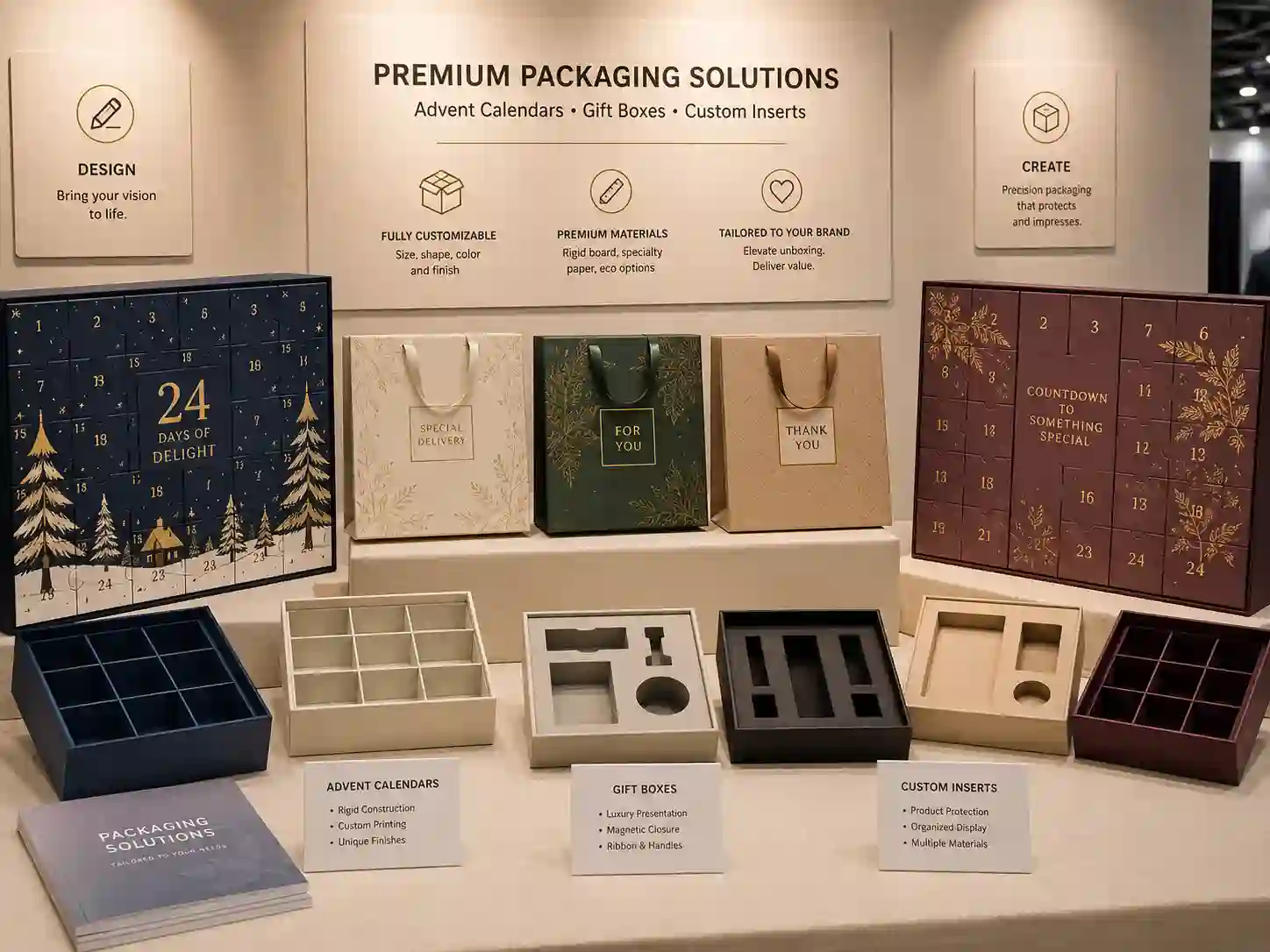
Buyers can review different structures through custom advent calendar box products before deciding whether the project needs drawers, doors, trays, sleeves, magnetic closure, rigid board, folding carton board, or paperboard inserts.

Key application questions before production
Ask these questions before artwork or sampling begins:
- How many compartments are needed?
- What is the size and weight of each product?
- Will the products be packed by the factory or by the buyer later?
- Does the box need to stand on a retail shelf, ship as a gift set, or be packed into a master carton?
- Does the structure need to support repeated opening and closing?
- Are there any food-contact, recycling, or chain-store packing requirements?
If the project includes paper materials from responsible sources, buyers may also check official information from FSC when preparing sourcing requirements.
Choose the Right Box Structure
Structure is the foundation of every custom calendar box. A beautiful design can fail if the insert is loose, the doors tear easily, the drawers are too tight, or the outer board is not strong enough for export shipping.
Common B2B structures include:
- Door-style advent calendar boxes: useful for flat or lightweight products.
- Drawer advent calendar boxes: suitable for premium gift sets and repeat opening.
- Rigid advent calendar boxes: preferred for higher-value seasonal campaigns.
- Folding paperboard calendar boxes: useful for cost-sensitive or high-volume projects.
- Insert-based compartment boxes: suitable when product placement and protection are key.
A custom advent calendar boxes manufacturer should review the product dimensions, weight, retail channel, and packing method before confirming the structure. This avoids late revisions during sampling or bulk production.
Plan Inserts Before Finalizing Artwork
Insert fit is one of the most important quality points when buyers customize advent calendar boxes. If the insert is too loose, products may move during shipping. If it is too tight, workers may spend too much time loading products, or customers may find the compartments difficult to open.
Common insert options
Paperboard inserts are widely used for seasonal gift packaging because they are printable, foldable, and suitable for many product types. For heavier or fragile items, EVA, foam, molded pulp, or reinforced paperboard structures may be considered depending on the project requirements.
Giftpackpro can help buyers compare structure, insert layout, material thickness, and sample options through custom advent calendar box services. This is useful when the buyer has many SKUs but needs one clean retail-ready presentation.
Prepare Artwork Files for Production
Artwork preparation should happen after the structure and dieline are confirmed. If artwork is designed before the structure is locked, door positions, drawer edges, bleed areas, folding lines, and compartment numbers may shift later.
For bulk production, buyers should prepare:
- Final editable artwork files, usually AI or PDF format.
- Confirmed dieline with cut lines, fold lines, and glue areas.
- Pantone or CMYK color references.
- Logo placement rules and safe zones.
- Surface finishing requirements such as matte lamination, gloss lamination, hot stamping, embossing, debossing, or spot UV.
- Barcode, recycling mark, importer details, or retail compliance information if needed.
Printing checks should include color consistency, registration, lamination quality, finishing alignment, number sequence, and whether small text remains readable after production.
Production Steps for Custom Advent Calendar Boxes
When buyers customize advent calendar boxes, the production process usually includes structure confirmation, material preparation, printing, surface finishing, die-cutting, folding, gluing, insert assembly, inspection, and export packing.
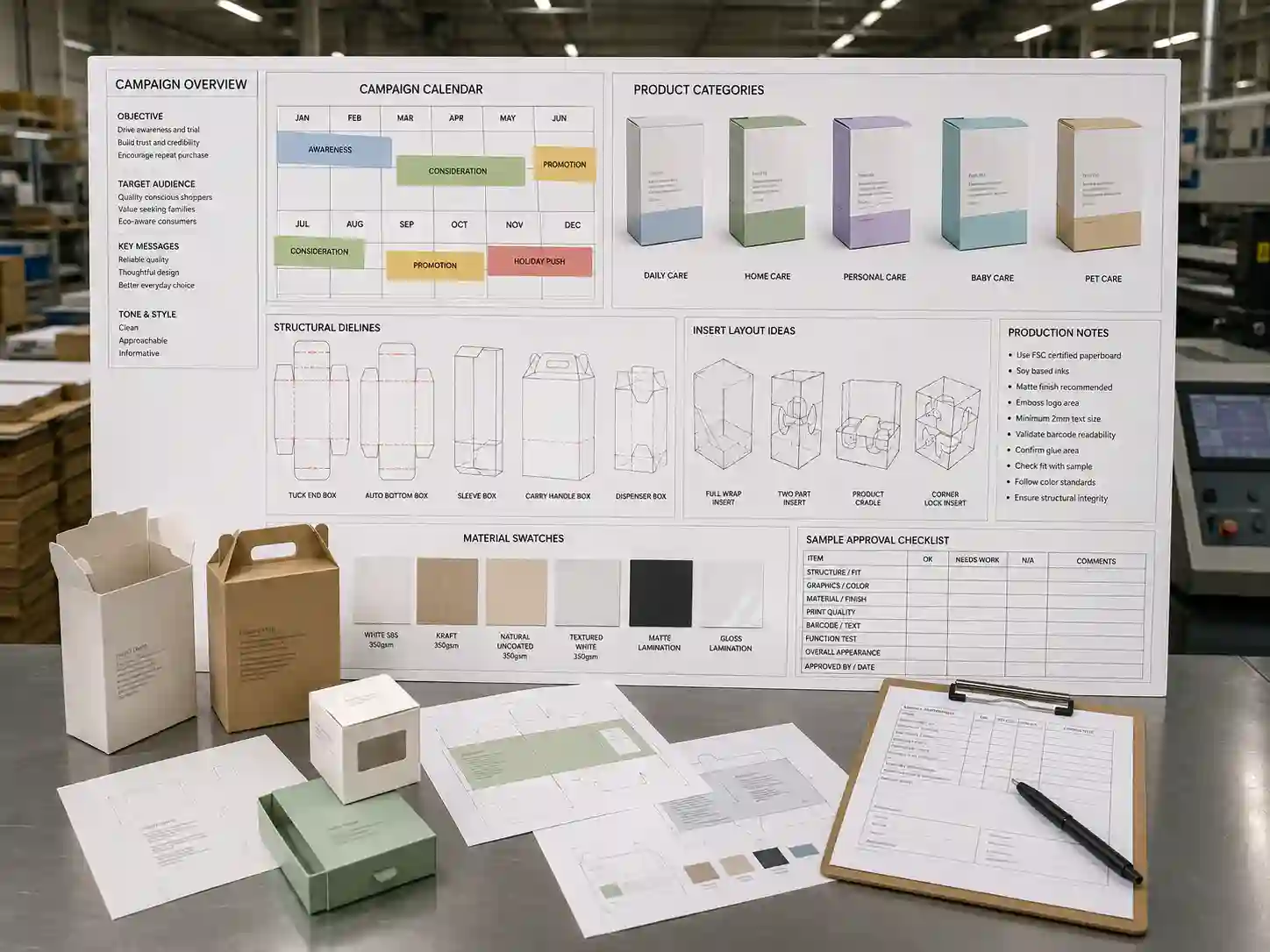
Typical production workflow
| Production Step | Main Control Point | Buyer Preparation |
|---|---|---|
| Structure confirmation | Box size, compartment count, opening method, board thickness | Provide product size, weight, and sales channel |
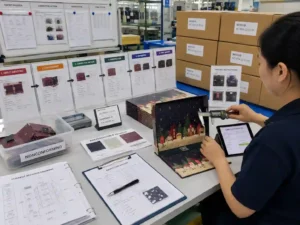
| Sample approval | Insert fit, door opening, drawer movement, surface finish | Check the sample with real products before approval |
| Printing | Color accuracy, registration, text clarity, barcode readability | Confirm artwork, color reference, and proof standard |
| Die-cutting and creasing | Cutting accuracy, fold line depth, door position, edge quality | Approve final dieline before bulk production |
| Assembly | Glue strength, drawer fit, insert alignment, opening control | Confirm packing method and product loading sequence |
| Final inspection | Appearance, structure, quantity, carton marks, export packing | Share inspection checklist and shipping requirements |
This workflow helps reduce mistakes during bulk production. It also gives purchasing teams a clear way to compare factory quotations beyond unit price.
Assembly Control During Bulk Production
Assembly control is especially important for calendar boxes because there are many small parts. A 12-day or 24-day structure may include multiple doors, drawers, inserts, sleeves, partitions, backing panels, and outer shells.
The production team should control:
- Glue position and glue amount.
- Drawer sliding resistance.
- Door perforation strength.
- Insert alignment inside the box.
- Flatness of the finished structure.
- Correct sequence for numbered compartments.
- Clean edges without visible glue marks.
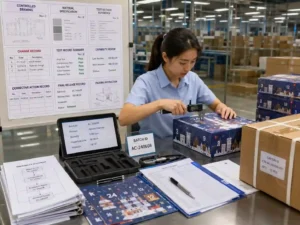
For complex projects, buyers should ask whether the factory will use a first-piece approval system before full assembly. The first approved unit becomes the reference for production workers and QC staff.
Quality Control Points Buyers Should Check
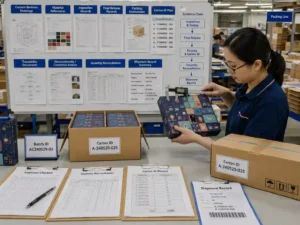
Quality control should not happen only at the end. It should be built into material checking, printing inspection, die-cutting control, assembly inspection, and final packing review.
Printing and surface inspection
Printing inspection should check color difference, missing ink, scratches, lamination bubbles, hot stamping alignment, embossing depth, and surface cleanliness. If the calendar box uses a premium seasonal design, small defects on the front panel can affect retail presentation.
Insert fit and product protection
Insert fit should be tested with real products or accurate product dummies. The product should not shake heavily inside the compartment, and the insert should not deform when loaded. For heavier products, extra support may be needed under the tray or around the edge.
Durability and handling
Durability checks can include opening and closing tests, drawer pull tests, corner pressure checks, glue strength checks, and carton drop-test style review for export packing. Buyers can also refer to official packaging and quality management standards such as ISO 9001 quality management when building internal supplier evaluation rules.
Export Packing and Shipment Preparation
Export packing affects the final condition of the goods when they arrive at the warehouse or retail distribution center. A good sample is not enough if the master carton, inner protection, pallet method, or carton mark is not controlled.
When working with the Giftpackpro packaging factory, buyers can discuss whether the advent calendar boxes should be shipped flat-packed, semi-assembled, fully assembled, or loaded with products before shipment. Each method changes labor cost, carton size, shipping volume, and damage risk.
Export packing checklist
- Master carton size and carton weight.
- Inner polybag, tissue paper, corner protection, or divider requirements.
- Carton marks, SKU labels, barcode labels, and PO numbers.
- Pallet size, stacking height, and stretch film requirements.
- Whether the buyer needs photos before shipment.
- Whether third-party inspection is required before loading.
Buyers can read more related topics in the advent calendar box buying guides, especially when comparing structure, sampling, MOQ, and production lead time.
Quote Preparation Advice for B2B Buyers
A clear quotation request helps the supplier price the project accurately. If the RFQ only says “customize advent calendar boxes,” the supplier must guess the structure, material, printing, insert, packing, and quantity. This often leads to slow replies or inaccurate pricing.
For a faster and more reliable quote, prepare the following information:
- Box style or reference structure.
- Open size and finished size.
- Number of compartments.
- Product dimensions and weight for each compartment.
- Material preference, such as rigid board, paperboard, or corrugated board.
- Printing method and surface finishing.
- Insert material and loading method.
- Order quantity and expected delivery date.
- Destination country or port.
- Flat-packed, assembled, or product-loaded packing requirement.
If you already have a dieline or sample photo, include it when you request a custom quote. If you do not have a dieline yet, the supplier can recommend a starting structure based on your product list and target retail channel.
When Should Buyers Start Production Planning?
Advent calendar projects should start earlier than ordinary gift boxes because they often include more parts, more artwork details, more sampling revisions, and stricter assembly control. A simple paperboard calendar may move faster, while a rigid drawer calendar with many inserts and finishes needs more review time.
For overseas buyers, the schedule should include structure design, blank sample, printed sample, artwork approval, material purchase, printing, finishing, assembly, QC, export packing, shipping, and customs clearance. Leaving enough time reduces rush fees, air freight pressure, and last-minute quality risk.
Work with a Supplier That Understands Production Control
To customize advent calendar boxes successfully, buyers should evaluate more than design style. The supplier should understand structure engineering, insert fit, artwork checking, printing control, assembly tolerance, final inspection, and export packing.
Giftpackpro supports overseas brands, wholesalers, gift companies, retail buyers, and purchasing teams with practical seasonal paper packaging solutions. Buyers can compare available custom advent calendar box products, review custom advent calendar box services, learn from advent calendar box buying guides, and request a custom quote when project details are ready.
A well-controlled calendar box project should look good, hold products securely, assemble efficiently, pass inspection, and arrive in sale-ready condition. That is the real goal when brands customize advent calendar boxes for seasonal B2B packaging projects.