
Quick answer: Insert fit matters in advent calendar packaging because the insert controls product protection, presentation, assembly efficiency, and shipping performance. A correctly designed insert keeps products positioned inside each cavity, prevents movement during transport, supports premium unboxing, and reduces production problems. For B2B buyers ordering custom advent calendar boxes, insert selection should be confirmed together with box structure, product dimensions, dieline design, sampling, and QC testing before mass production begins.
For brands, wholesalers, and retail buyers, insert fit is not only an internal packaging detail. It directly affects quotation accuracy, production risk, customer experience, and export reliability. A supplier that checks insert performance during prototype development can help avoid loose products, blocked drawers, damaged doors, and expensive production adjustments.
Why does insert fit matter in advent calendar packaging?
Insert fit matters because every product cavity must match the actual product size, shape, weight, and opening experience. Poor insert design can cause products to shift, become difficult to remove, or create pressure points that damage the box structure.
Custom advent calendar boxes often contain multiple products with different dimensions. Beauty samples, pet treats, candles, accessories, stationery, food items, and promotional gifts all require different cavity designs. The insert is the connection between the product and the outer packaging structure.
- Product protection: Inserts reduce movement and impact during handling and shipping.
- Visual presentation: Correct alignment creates a cleaner retail appearance when doors, drawers, or compartments are opened.
- Assembly efficiency: Proper tolerance prevents factory workers from forcing products into cavities.
- Shipping reliability: Stable inserts reduce damage caused by vibration, compression, and carton movement.
Factory tip: A packaging supplier should evaluate insert fit using the actual product sample whenever possible. Designing only from product drawings may miss real-world differences such as cap height, soft packaging deformation, or irregular shapes.
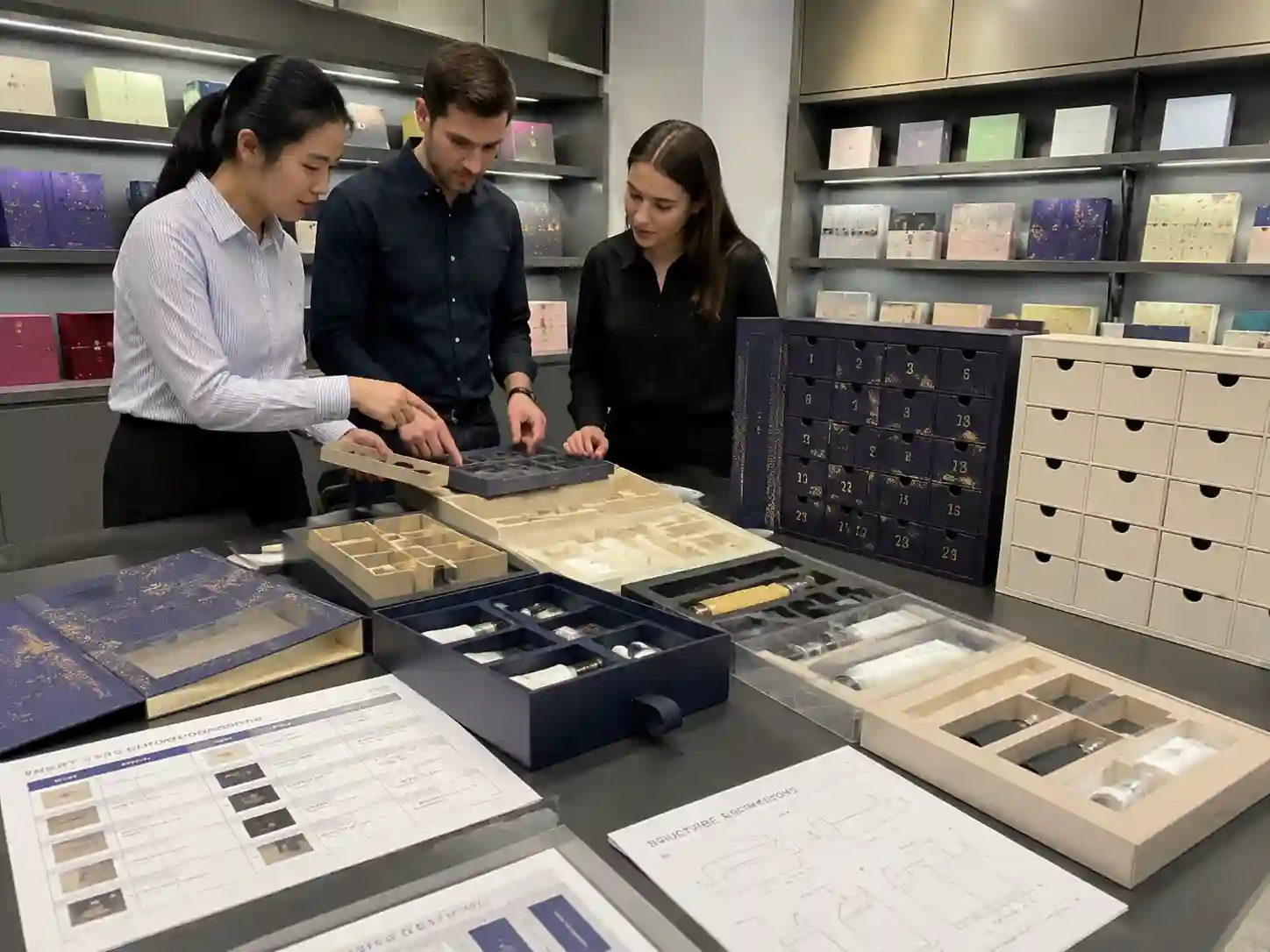
Which advent calendar box structures require careful insert planning?
The best insert solution depends on the box structure. Rigid boxes, drawer boxes, door-opening boxes, folding cartons, and fold-out structures create different requirements for cavity placement, opening clearance, and internal support.
| Box Structure | Insert Fit Considerations | Common Buyer Concerns |
|---|---|---|
| Rigid advent calendar box | Usually supports premium inserts such as PET trays, EVA, foam, or molded pulp. Requires accurate internal dimensions because rigid panels have limited flexibility. | Higher cost, premium appearance, weight, shipping protection. |
| Drawer advent calendar box | Requires clearance testing between drawer walls, inserts, and products. Cavities must not create friction during opening. | Drawer movement, product access, alignment. |
| Door-opening advent calendar box | Insert height and position must allow doors to close evenly without pressure. | Door bulging, uneven gaps, blocked compartments. |
| Folding carton advent calendar box | Paper inserts or folded supports are often used to control cost and reduce shipping weight. | Material strength, folding accuracy, lower protection. |
| Fold-out advent calendar structure | Requires careful layout planning because products are distributed across multiple panels. | Panel balance, opening experience, storage size. |
How should buyers choose between paper inserts, PET trays, EVA, foam, and molded pulp?
The correct insert material depends on product weight, protection needs, appearance expectations, and target cost. There is no single insert material suitable for every advent calendar project.
| Insert Type | Best For | Buyer Considerations |
|---|---|---|
| Paper insert | Lightweight products and cost-sensitive projects. | Lower material cost, recyclable positioning, requires accurate folding and strength testing. |
| PET tray | Products needing clear visibility and precise cavity shapes. | Good dimensional accuracy, requires cavity testing and product compatibility review. |
| EVA insert | Premium gifts, cosmetics, accessories, and delicate items. | Soft protection and luxury feel, higher material cost. |
| Foam insert | Products requiring cushioning and shock absorption. | Good protection but requires consideration of thickness and presentation. |
| Molded pulp insert | Projects requiring formed paper-based support. | Suitable for sustainable packaging strategies but requires tooling evaluation. |
Buyer tip: When requesting quotations, provide product samples or detailed product dimensions including length, width, height, weight, and fragile areas. This allows suppliers to recommend realistic insert options instead of estimating from incomplete information.
How does insert design affect dieline and packaging structure?
Insert design should be developed together with the packaging dieline, not added after the box design is finished. The insert changes internal dimensions, panel strength requirements, and assembly tolerances.
During packaging development, engineers usually check:
- Cavity size and product tolerance.
- Distance between cavities and outer box walls.
- Drawer clearance or door-opening space.
- Insert height compared with lid, door, or folding panel depth.
- Weight distribution across the box structure.
- Whether the insert creates pressure on printed surfaces.
For example, a rigid box with a thick EVA insert may require deeper construction than a folding carton using a paper insert. A drawer box may need extra internal clearance because a tight insert can increase pulling resistance.
Factory tip: Professional suppliers normally review the box dieline, insert drawing, and product sample together before producing a prototype. This prevents structural conflicts that are difficult to fix after mass production begins.
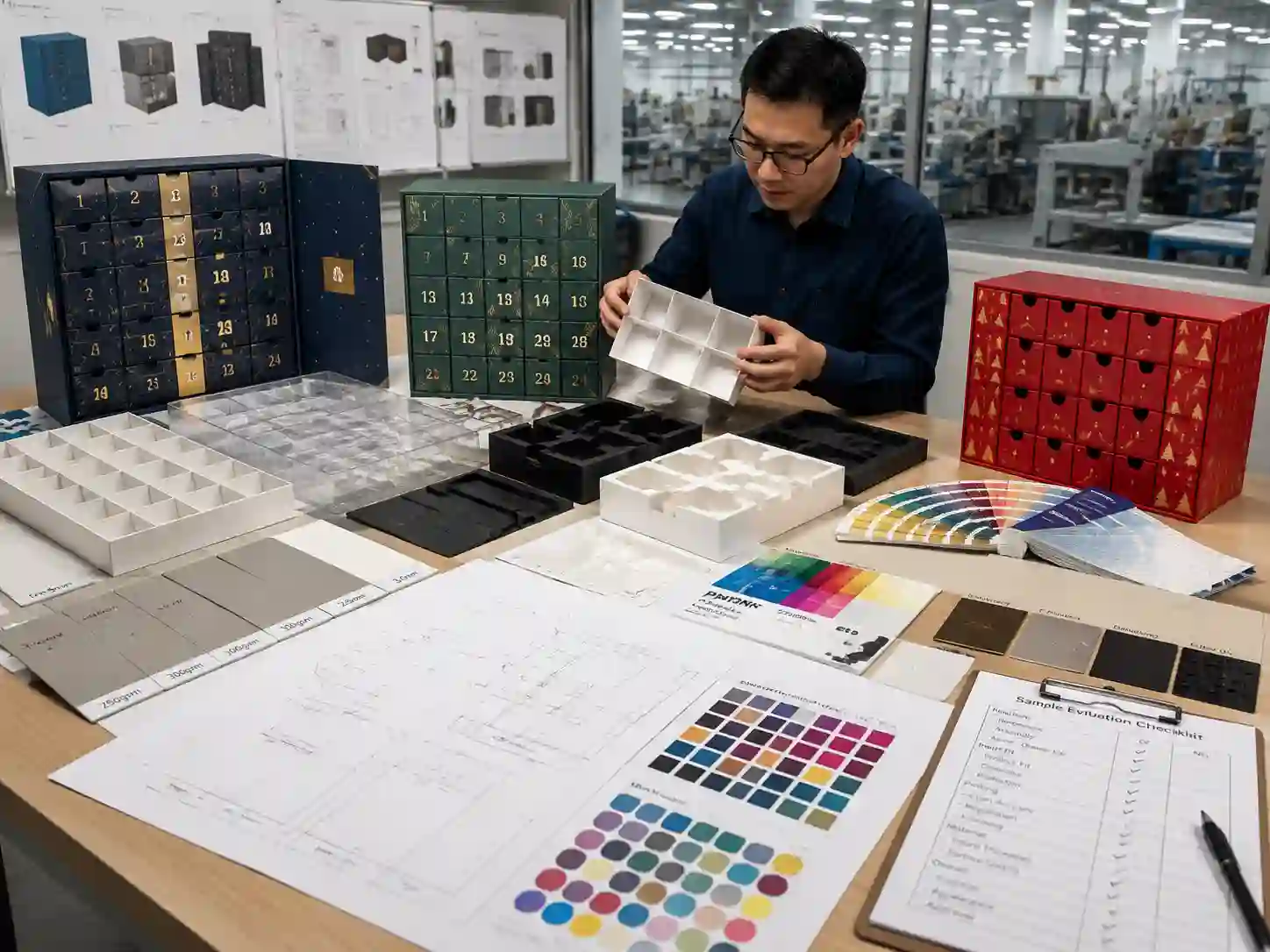
What should buyers check during advent calendar packaging sampling?
Sampling is the stage where insert fit problems should be discovered. A pre-production sample should simulate the final product, materials, printing method, and assembly process as closely as possible.
Sample approval checklist for insert fit
- Does every product enter and remove from the cavity smoothly?
- Does the insert hold products securely when the box is moved?
- Are drawers opening without excessive resistance?
- Do door-opening panels close flat without pushing against products?
- Are product numbers, windows, and compartments aligned correctly?
- Does the insert maintain its shape after repeated opening tests?
- Does the final package fit correctly inside the export carton?
A sample review should also include printing and finishing checks. CMYK printing, Pantone color references, foil stamping, embossing, spot UV, matte lamination, and gloss lamination can affect how the final packaging looks and feels. The insert must support the entire customer-facing design, not only the internal product position.
How do insert problems increase production cost and lead time?
Insert problems increase cost because they often require redesign, new samples, additional tooling, or production adjustments. Early insert testing reduces unexpected changes during bulk manufacturing.
| Problem | Possible Cause | Production Impact |
|---|---|---|
| Products move inside cavities | Insert cavity too large or wrong material selection. | Extra development time and possible redesign. |
| Products cannot fit | Incorrect dimensions or insufficient tolerance. | Sample rejection and production delay. |
| Drawer cannot open smoothly | Insert thickness exceeds available space. | Structural modification required. |
| Doors cannot close flat | Insert height conflicts with outer panels. | New prototype testing needed. |
MOQ, material availability, tooling requirements, and sampling rounds all influence the final production schedule. Buyers should confirm these points before approving artwork and starting mass production.
How should buyers compare suppliers for insert fit quality?
Buyers should compare suppliers by their development process, not only by unit price. A reliable supplier explains how they test structures, inserts, samples, and production quality before shipment.
When comparing suppliers, ask:
- Can the supplier create custom dielines for different box structures?
- Can they recommend suitable insert materials based on the product?
- Do they provide prototypes before bulk production?
- How do they check insert alignment during QC?
- Can they support export packing requirements?
- Can they prepare detailed quotations showing structure, materials, finishing, MOQ, and lead time?
Giftpackpro provides custom advent calendar boxes manufacturer solutions for buyers who need support from structure planning to production. Buyers can review different custom advent calendar box products and discuss suitable insert options based on product requirements.
What information should buyers prepare before requesting a quotation?
A complete RFQ helps suppliers provide a more accurate quotation and reduces unnecessary sampling changes.
Buyer quotation preparation checklist
- Product type, dimensions, weight, and quantity per compartment.
- Preferred box structure: rigid box, drawer box, door-opening box, folding carton, or fold-out style.
- Insert preference or product protection requirements.
- Artwork files, logo placement, color requirements, and finishing expectations.
- Target MOQ and estimated annual order volume.
- Required delivery date and destination country.
- Export carton, pallet, and shipping requirements.
Buyers can review more advent calendar box buying guides or contact custom advent calendar box services for assistance with structure selection, sampling, and production planning.
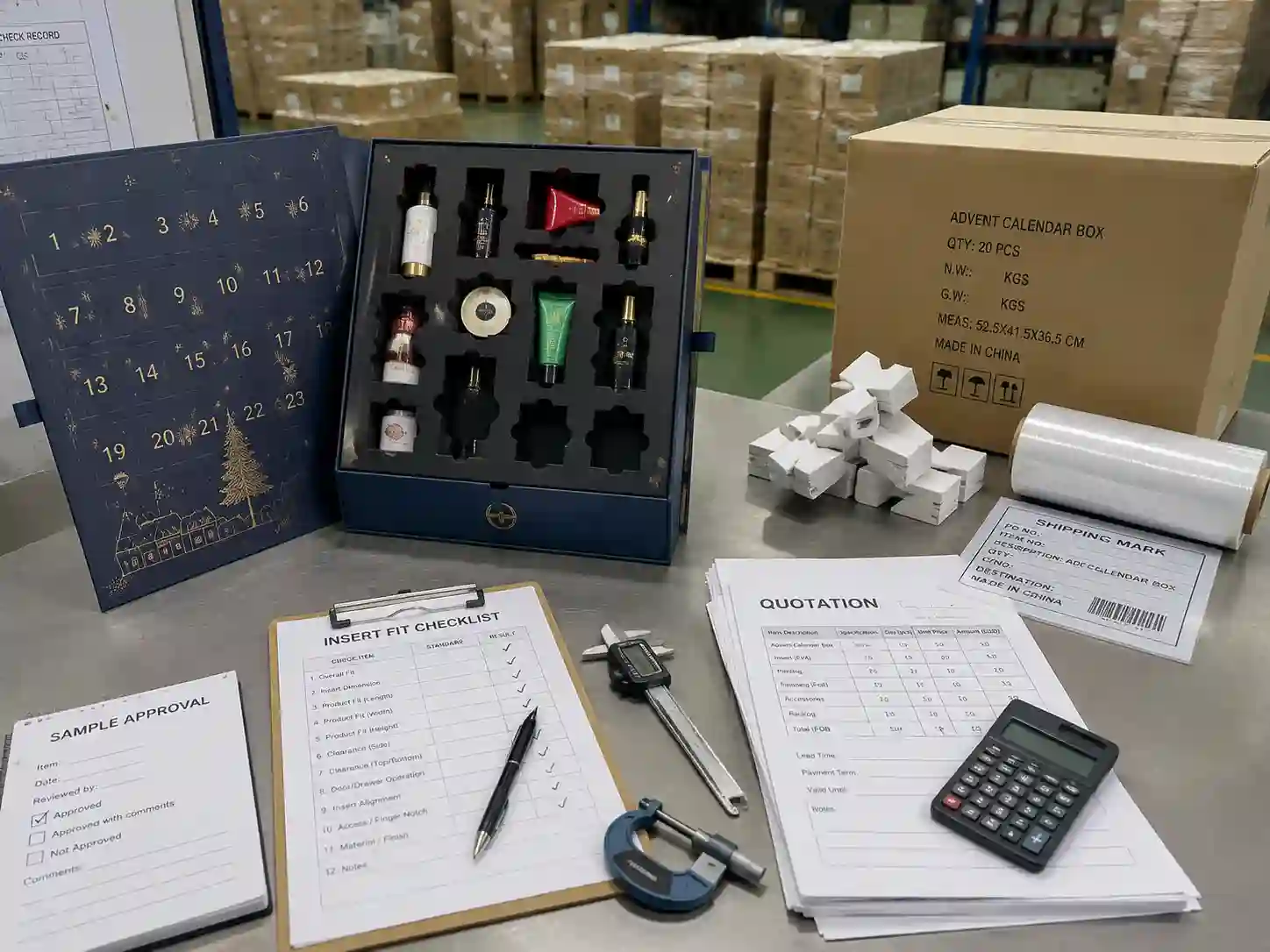
How does QC verify insert fit before shipment?
QC checks confirm that approved samples match bulk production standards. Insert inspection should include dimensions, product placement, assembly performance, and shipping preparation.
- Measure insert cavity dimensions against approved specifications.
- Check product fitting consistency across production samples.
- Inspect box alignment, drawer movement, and door closure.
- Verify printing quality and finishing consistency.
- Confirm export cartons, corner protection, pallet arrangement, and shipping marks.
QC tip: Buyers should request photos, inspection records, or approval samples before shipment when managing international orders. Clear QC communication reduces disputes caused by different expectations.
For international shipments, buyers may also review packaging transport guidance from organizations such as ISTA packaging testing resources when planning shipping protection requirements.
FAQ: Insert fit in advent calendar packaging
Can one insert design fit different products?
Usually not. Different product dimensions, weights, and shapes require different cavity designs. A flexible insert system may work for similar products, but mixed product sets normally need custom layouts.
Is a more expensive insert always better?
No. The best insert balances protection, presentation, cost, and production requirements. A paper insert may be suitable for lightweight products, while EVA or foam may be better for premium or fragile items.
Should insert design be completed before artwork?
Insert and structure decisions should be confirmed before final artwork approval because compartment layout, panel size, and opening areas can affect printed design placement.
Why is a prototype sample important?
A prototype reveals real problems with fitting, clearance, assembly, and appearance that cannot always be identified through drawings alone.
Prepare your insert fit requirements before ordering custom advent calendar boxes
Insert fit is one of the most important engineering decisions in custom advent calendar packaging because it connects product protection, structure, customer presentation, and production reliability. Buyers who confirm inserts, dielines, materials, samples, QC standards, and export packing early can reduce production risks and improve quotation accuracy.
Before requesting a sample or quotation from Giftpackpro, prepare your product dimensions, preferred structure, insert expectations, artwork requirements, quantity, and delivery plan. You can request a custom quote and work with the Giftpackpro packaging factory team on a suitable packaging solution.


