
Quick answer: Advent calendar boxes collapse during shipping mainly because the packaging structure, material strength, insert support, assembly tolerance, or export packing method was not designed for the actual transportation conditions. Buyers can reduce shipping failures by selecting the right box structure, confirming paperboard or greyboard thickness, testing inserts, approving prototypes, checking compression strength, and using suitable export cartons and pallet protection. For custom advent calendar boxes, shipping performance should be considered during the design stage, not after mass production.
For overseas brands, wholesalers, and retail buyers, a visually attractive advent calendar package is only successful when it arrives in perfect condition. A damaged drawer, crushed corner, warped panel, or loose insert can create costly replacement issues during seasonal campaigns.
Why do some advent calendar boxes collapse during shipping?
Advent calendar boxes collapse during shipping when the box structure cannot handle stacking pressure, transportation vibration, humidity changes, or product weight. The most common causes are weak board selection, insufficient internal support, poor assembly tolerance, and unsuitable export packing.
Unlike standard gift boxes, advent calendar packaging often contains multiple compartments, drawers, doors, and internal inserts. These features create additional stress points because the package must maintain its shape while supporting many individual products.
| Shipping failure cause | Packaging problem | Buyer prevention method |
|---|---|---|
| Collapsed corners | Insufficient greyboard thickness or weak corner construction | Review structural samples and confirm board specifications before bulk production |
| Warped panels | Material imbalance, moisture exposure, or unsuitable paper covering | Test materials and check finished samples under realistic conditions |
| Drawer damage | Drawer box clearance too tight or internal support too weak | Perform drawer function checks before mass production |
| Loose products inside | Incorrect insert design or cavity size | Approve product-fit inserts using actual products |
| Carton crushing | Poor export carton selection or insufficient protection | Confirm carton strength, dividers, and pallet loading plan |

Which advent calendar box structures are more resistant to shipping pressure?
The most shipping-resistant structure depends on product weight, size, retail channel, and required presentation quality. Rigid structures usually provide higher protection, while folding cartons offer advantages in cost and logistics efficiency.
Should buyers choose rigid boxes, drawer boxes, or folding cartons?
| Structure | Shipping performance | Best application | Main consideration |
|---|---|---|---|
| Rigid box | High strength and premium protection | Luxury cosmetics, corporate gifts, premium seasonal sets | Higher material and shipping cost |
| Drawer box | Good when drawer support and alignment are correct | Beauty products, gift sets, retail campaigns | Drawer clearance and internal reinforcement are critical |
| Door-opening box | Depends heavily on hinge, door panel, and insert design | Interactive product displays | Door alignment must be tested carefully |
| Folding carton | Lightweight but less rigid | High-volume campaigns and cost-sensitive projects | Requires correct paperboard grade and reinforcement |
Buyer tip: The strongest-looking structure is not always the best shipping solution. A drawer advent calendar box with poor internal support can fail, while a well-designed folding carton with correct paperboard and inserts may perform successfully for lighter products.
When comparing suppliers, buyers should review more than finished appearance. Ask suppliers to explain the dieline, board thickness, reinforcement areas, folding direction, assembly method, and transportation considerations.
How do inserts prevent advent calendar packaging from collapsing?
Inserts protect products and strengthen the internal structure by distributing pressure inside the box. A correctly designed insert prevents products from moving, reduces impact damage, and supports the outer packaging during shipping.
Common insert options include:
- Paper inserts: Suitable for lightweight products and sustainable packaging projects where internal support requirements are moderate.
- PET trays: Useful for cosmetics, small bottles, and products requiring precise cavity positioning.
- EVA inserts: Suitable for premium items requiring cushioning and a secure product presentation.
- Foam inserts: Used when impact protection and product separation are important.
- Molded pulp inserts: Considered for buyers seeking fiber-based protective solutions.
A common mistake is designing inserts only for appearance. Factory-side testing should confirm that each product fits correctly, can be removed easily, and does not create excessive pressure against the outer box panels.
What material choices affect shipping durability?
Material selection directly affects whether custom advent calendar boxes survive transportation. Buyers should evaluate board strength, covering paper quality, finishing effects, and environmental conditions before approving production.
- Greyboard: Determines the rigidity of many premium rigid box structures. Thickness selection affects panel strength and corner durability.
- Paperboard: Influences folding carton stiffness, printing quality, and resistance to bending.
- Cover paper: Affects surface appearance and how well the package maintains its shape after wrapping.
- Lamination: Matte lamination and gloss lamination can improve surface protection but must match the structure and application.
Factory tip: A packaging supplier should check the relationship between board thickness, box size, product weight, and stacking method. Increasing material thickness alone does not solve structural problems if the design itself is incorrect.

How should artwork and finishing be checked before production?
Printing and finishing decisions can influence shipping quality because surface treatments and construction details must work together. Buyers should confirm artwork, printing proofs, and finishing samples before mass production.
Important checks include:
- CMYK color accuracy and Pantone color matching requirements.
- Foil stamping position and adhesion testing.
- Embossing depth and pressure effect on board strength.
- Spot UV registration accuracy.
- Alignment between printed panels, drawers, and doors.
A pre-production sample should represent the final structure, including printing, inserts, finishing, and assembly. Reviewing only flat artwork files cannot reveal shipping risks such as weak corners, loose drawers, or poor product positioning.
What sampling process helps prevent shipping failures?
The best prevention method is a complete prototype review before bulk production. Sampling allows buyers and factories to identify structural problems before large quantities are manufactured.
- Confirm product dimensions and weight.
- Create the dieline and structure proposal.
- Produce a prototype sample.
- Test insert fit and product movement.
- Check assembly tolerance and opening functions.
- Review printing and finishing samples.
- Approve the final pre-production sample.
For buyers comparing suppliers, ask whether the supplier provides structural recommendations during sampling or only produces according to customer files. A factory with engineering support can often identify shipping risks earlier.
How can buyers compare suppliers for stronger advent calendar packaging?
Buyers should compare suppliers based on engineering ability, sampling control, production communication, QC process, and export experience rather than quotation price alone.
| Supplier comparison factor | Questions buyers should ask |
|---|---|
| Structure capability | Can the supplier recommend rigid box, drawer box, door-opening box, or folding carton solutions? |
| Sampling process | Does the sample include actual inserts, finishing, and assembly details? |
| Quality control | Are dimensions, printing, assembly, and packaging checked before shipment? |
| Export experience | Can the supplier provide suitable export carton and pallet packing recommendations? |
| Communication | Can the supplier clearly explain material, MOQ, lead time, and quotation details? |
Giftpackpro supports buyers looking for custom advent calendar boxes manufacturer solutions with production planning focused on structure, inserts, sampling, and shipping requirements.
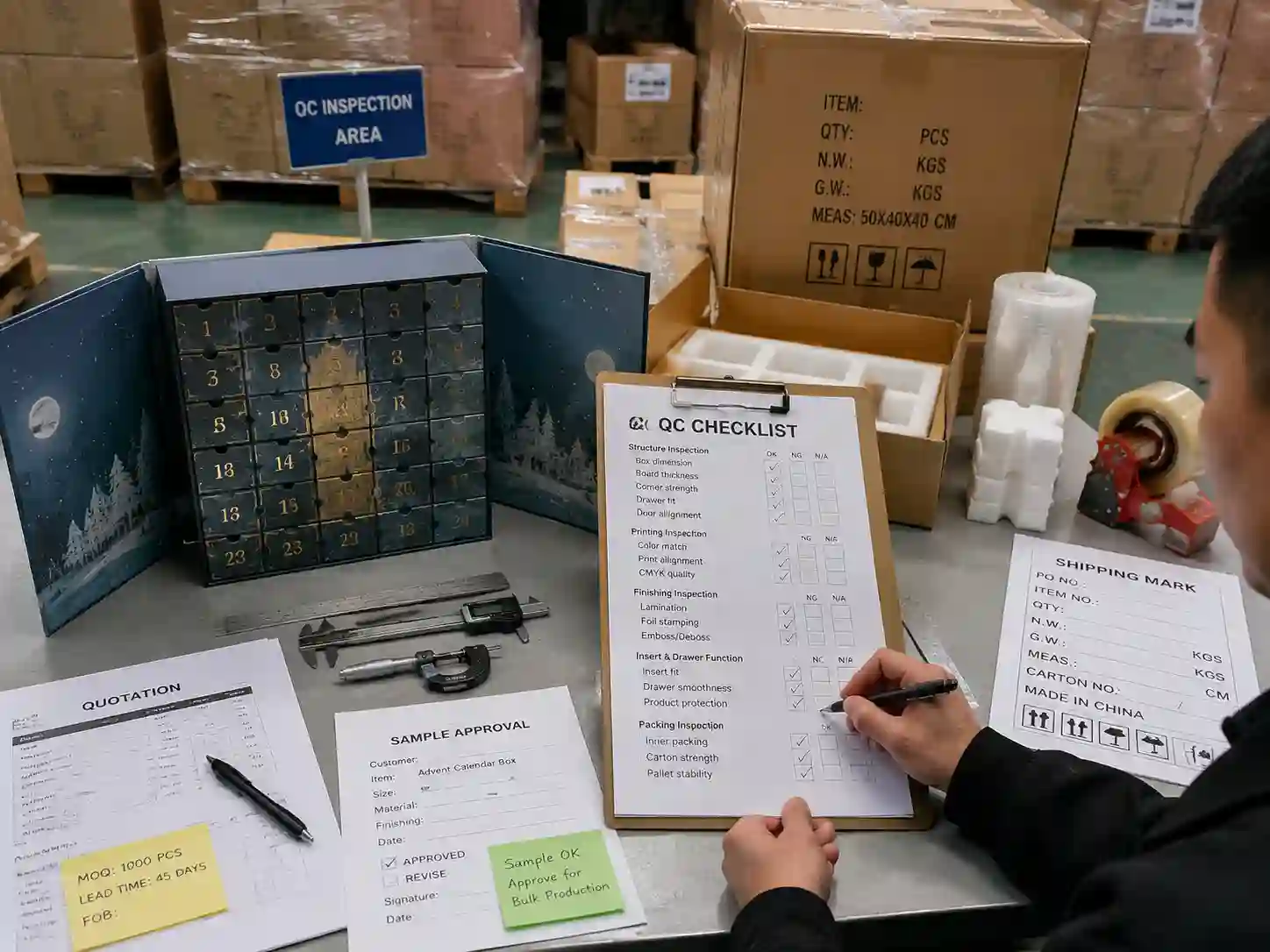
What QC checks should buyers complete before shipment?
Quality control should confirm that finished advent calendar boxes can handle normal storage and transportation conditions. Final inspection should cover both appearance and structural performance.
- Check box dimensions against approved specifications.
- Inspect corner strength and panel flatness.
- Test drawer movement and door-opening performance.
- Confirm insert positioning and product protection.
- Compare printing against approved CMYK or Pantone references.
- Check finishing quality including foil, embossing, and coating.
- Verify export cartons, shipping marks, and pallet preparation.
QC tip: The approved sample should become the inspection reference. Comparing bulk production only against digital artwork may miss structural differences.
How should export packing prevent advent calendar box damage?
Export packing protects the finished packaging after production. Even a strong box can fail if cartons, pallet loading, and protection materials are unsuitable.
Buyers should discuss:
- Master carton size and stacking strength.
- Corner protectors and internal dividers.
- Plastic wrapping or moisture protection when required.
- Pallet arrangement and warehouse handling.
- Shipping marks including carton numbers and product information.
For international shipments, buyers can also review transportation testing guidance from organizations such as ISTA packaging testing resources when defining shipping requirements.
What information should buyers prepare before requesting a quotation?
A complete RFQ helps suppliers provide more accurate pricing and production recommendations. Buyers should prepare:
- Product type and target market.
- Box structure preference or reference images.
- Box dimensions and product measurements.
- Insert requirements and product quantity per box.
- Printing artwork status.
- Finishing requirements such as foil stamping, embossing, or spot UV.
- Estimated order quantity and MOQ expectations.
- Required delivery date and shipping destination.
Buyers can review custom advent calendar box services to understand typical development steps before preparing a packaging project.
Decision guide: How can buyers reduce advent calendar shipping risks?
- If products are heavy: Prioritize rigid structures, stronger inserts, and reinforced export packing.
- If products are fragile: Focus on EVA, foam, PET tray, or molded pulp protection.
- If the project is high volume: Balance material cost, MOQ, production capacity, and shipping efficiency.
- If the launch date is fixed: Start sampling earlier and include time for prototype adjustments.
- If importing internationally: Confirm carton design, pallet plan, and shipping marks before production.
FAQ: Advent calendar boxes collapse during shipping
Can stronger materials completely prevent shipping damage?
No. Stronger materials improve protection, but shipping performance depends on the complete system: structure, inserts, assembly accuracy, product weight, cartons, and transportation conditions.
Are rigid advent calendar boxes always better for shipping?
Rigid boxes usually provide higher protection, but the correct structure depends on product requirements, budget, logistics method, and retail positioning.
Should buyers request a sample before placing a bulk order?
Yes. A prototype or pre-production sample allows buyers to confirm dimensions, inserts, printing, finishing, and assembly before committing to mass production.
Why is the quotation higher for stronger shipping protection?
Higher durability may require upgraded board materials, additional inserts, more complex assembly, improved QC procedures, and stronger export packing.
Prepare your advent calendar box project before requesting a quote
To reduce shipping risks, buyers should prepare product dimensions, structure preferences, insert requirements, artwork status, quantity, destination, and target timeline before contacting a supplier.
Giftpackpro helps overseas buyers evaluate custom advent calendar box products, review packaging structures, and prepare production plans based on real manufacturing requirements. You can also explore more advent calendar box buying guides or contact the Giftpackpro packaging factory team to discuss your project.
Request a custom quote with your box size, product information, quantity, and shipping requirements to receive a more accurate packaging recommendation.


