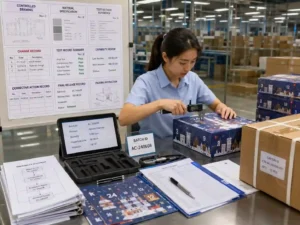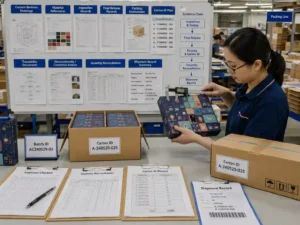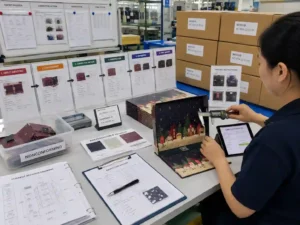
Quick answer: Artwork needs a dieline for advent calendar boxes because the dieline defines the exact cutting, folding, gluing, opening, and printing areas before production begins. For B2B buyers, an approved dieline prevents artwork misalignment, incorrect compartment sizes, insert fitting problems, and costly sampling delays. A packaging supplier uses the dieline together with material selection, insert design, printing files, and structural specifications to create a reliable prototype before mass production.
For brands, wholesalers, and retail buyers ordering custom advent calendar boxes manufacturer solutions, the dieline is the technical connection between creative artwork and a manufacturable package. Without it, even high-quality graphics may not match the physical box structure.

Why does artwork need a dieline for advent calendar boxes?
A dieline is required because advent calendar boxes contain multiple panels, folds, doors, drawers, compartments, and insert areas that must align with the final structure. The dieline shows where artwork will appear after cutting, folding, and assembly.
Unlike simple packaging formats, custom advent calendar boxes often combine several engineering elements:
- Front panels with numbered doors or opening sections
- Drawer systems requiring precise front and side alignment
- Rigid box structures with wrapped paper and greyboard layers
- Internal compartments for individual products
- Paper, PET, EVA, foam, or molded pulp inserts
- Special finishing areas such as foil stamping, embossing, or spot UV
Buyer tip: Artwork should be created after the packaging structure is confirmed. A supplier cannot accurately check artwork placement until the dieline, material thickness, and assembly method are approved.
What information does an advent calendar box dieline include?
An advent calendar box dieline provides the production map that connects artwork, structure, and manufacturing. It normally includes cutting lines, folding lines, glue areas, safety margins, and panel dimensions.
| Dieline Element | Why It Matters for Buyers | Common Risk Without Checking |
|---|---|---|
| Cut lines | Define the final outer shape and panel edges | Artwork may be trimmed incorrectly |
| Fold lines | Show how panels become the finished box | Images or text may fold into wrong positions |
| Glue areas | Prevent important artwork from being covered | Printed areas may disappear during assembly |
| Insert position | Ensures products fit inside compartments | Doors, drawers, or trays may not function correctly |
| Bleed and safe area | Allows production tolerance during cutting | White edges or uneven borders may appear |
How does the dieline affect different advent calendar box structures?
The dieline requirements change depending on the box construction. Buyers should select the structure first because each format creates different artwork limitations.
| Box Structure | Dieline Consideration | Best Fit For |
|---|---|---|
| Rigid advent calendar box | Requires wrapping areas, greyboard thickness allowance, and accurate panel positioning | Luxury products, cosmetics, premium gifts |
| Drawer advent calendar box | Requires drawer front alignment, sliding clearance, and internal tray positioning | Beauty products, small accessories, retail gift sets |
| Door-opening advent calendar box | Requires hinge direction, door spacing, perforation control, and opening access | Products needing visible daily compartments |
| Folding carton advent calendar box | Requires precise folding lines and paperboard strength calculation | Large-volume seasonal promotions |
For example, a drawer advent calendar box may look simple from the outside, but the artwork must account for drawer fronts, side walls, finger access areas, and the position of internal inserts. A small alignment error can make the printed design appear uneven after assembly.
What should buyers check before approving artwork for a dieline?
Before approving artwork, buyers should confirm that the design matches the physical packaging structure, not only the flat graphic file.
- Confirm the correct dieline version from the packaging supplier.
- Check front, back, side, top, and bottom panel artwork placement.
- Verify that numbers, patterns, and decorative elements align after folding.
- Keep important graphics away from glue areas and cutting edges.
- Review CMYK settings and printing requirements.
- Confirm whether Pantone colors are required for brand consistency.
- Check finishing locations for foil stamping, embossing, matte lamination, gloss lamination, or spot UV.
Factory tip: Many artwork problems are discovered during sampling because designers review flat files while factories assemble three-dimensional products. A physical sample review is the safest way to confirm the final appearance.
How do inserts affect the artwork dieline for advent calendar packaging?
Insert design and artwork development must be coordinated because the insert determines product position, visible openings, and internal pressure points.
Common insert options include:
- Paper inserts: Cost-effective for lightweight products and printed retail packaging.
- PET trays: Suitable when clear visibility and precise product positioning are required.
- EVA inserts: Useful for protecting fragile or premium products with custom-cut cavities.
- Foam inserts: Provide cushioning for delicate items.
- Molded pulp inserts: Offer a paper-based protective option for certain applications.
The insert cavity size affects the visible product position inside the box. If the insert is too tight, products may become difficult to remove. If it is too loose, items may move during transportation.
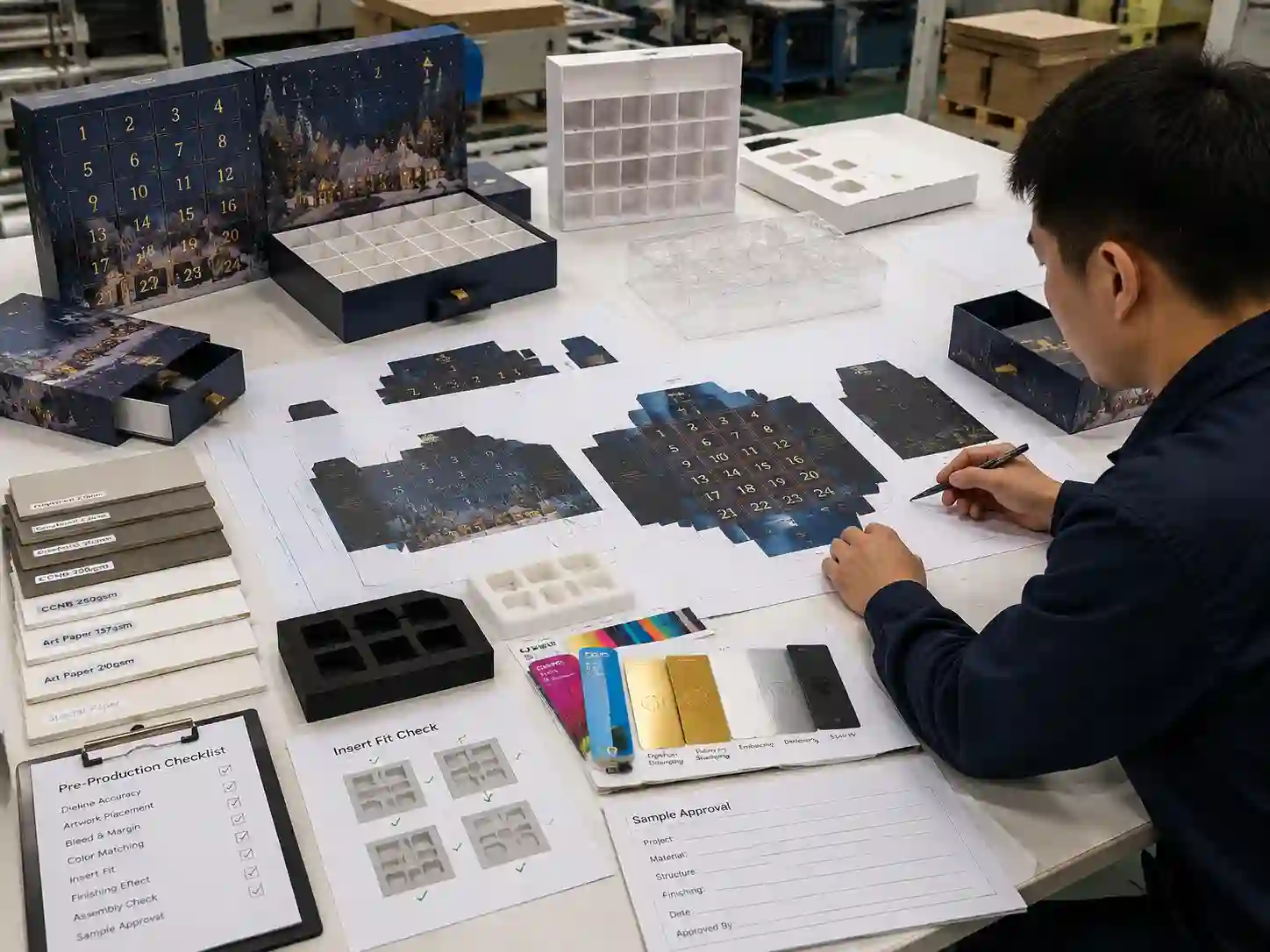
How does sampling verify artwork and dieline accuracy?
A prototype sample is the practical test that confirms whether artwork, structure, and inserts work together before bulk production. Buyers should not rely only on digital approval.
A typical sampling process includes:
- Supplier prepares the structural dieline based on box requirements.
- Buyer reviews dimensions, opening style, and insert requirements.
- Artwork is placed onto the approved dieline.
- Printing proof and finishing details are checked.
- Prototype sample is produced and assembled.
- Buyer evaluates appearance, function, and product fit.
- Final adjustments are completed before mass production.
During sample approval, buyers should inspect:
- Panel alignment after folding
- Door opening performance
- Drawer movement and clearance
- Insert stability
- Product protection
- Printing quality and color consistency
- Finishing accuracy
Giftpackpro supports buyers through custom advent calendar box services covering structure development, sampling, printing coordination, and production preparation.
Which materials influence artwork and dieline decisions?
Material selection changes the final dimensions because thickness, stiffness, and wrapping methods affect the production layout.
| Material | Dieline Impact | Buyer Consideration |
|---|---|---|
| Paperboard | Requires folding tolerance and crease planning | Suitable for efficient production and retail packaging |
| Greyboard | Adds thickness and requires wrapping allowance | Common for premium rigid structures |
| EVA/Foam | Changes internal cavity dimensions | Important for fragile products |
| PET tray | Requires accurate cavity placement | Useful for product visibility and protection |
How should buyers compare suppliers for dieline and artwork support?
Buyers should compare suppliers based on engineering capability, not only printing price. A reliable packaging partner should help convert artwork into a production-ready package.
When evaluating suppliers, check:
- Experience with custom advent calendar boxes
- Ability to create or review structural dielines
- Sample approval process
- Material recommendation experience
- Insert development capability
- Printing and finishing quality control
- Export packing preparation
- Communication during production
You can review additional custom advent calendar box products and understand available structures before preparing a project brief.
What should buyers prepare before requesting a quotation?
A complete RFQ helps suppliers provide a more accurate quotation, sample plan, MOQ estimate, and production schedule.
Artwork and specification checklist
- Box structure preference: rigid box, drawer box, door-opening box, or folding carton
- Finished box dimensions
- Product size, weight, and quantity per compartment
- Insert material preference
- Artwork files or design references
- Printing requirements including CMYK or Pantone colors
- Finishing requirements
- Target order quantity and MOQ expectations
- Required delivery date
- Export destination and packing requirements
Buyer tip: Providing product samples, CAD drawings, reference images, or accurate measurements helps suppliers avoid incorrect dieline development.
How do QC checks prevent artwork and production problems?
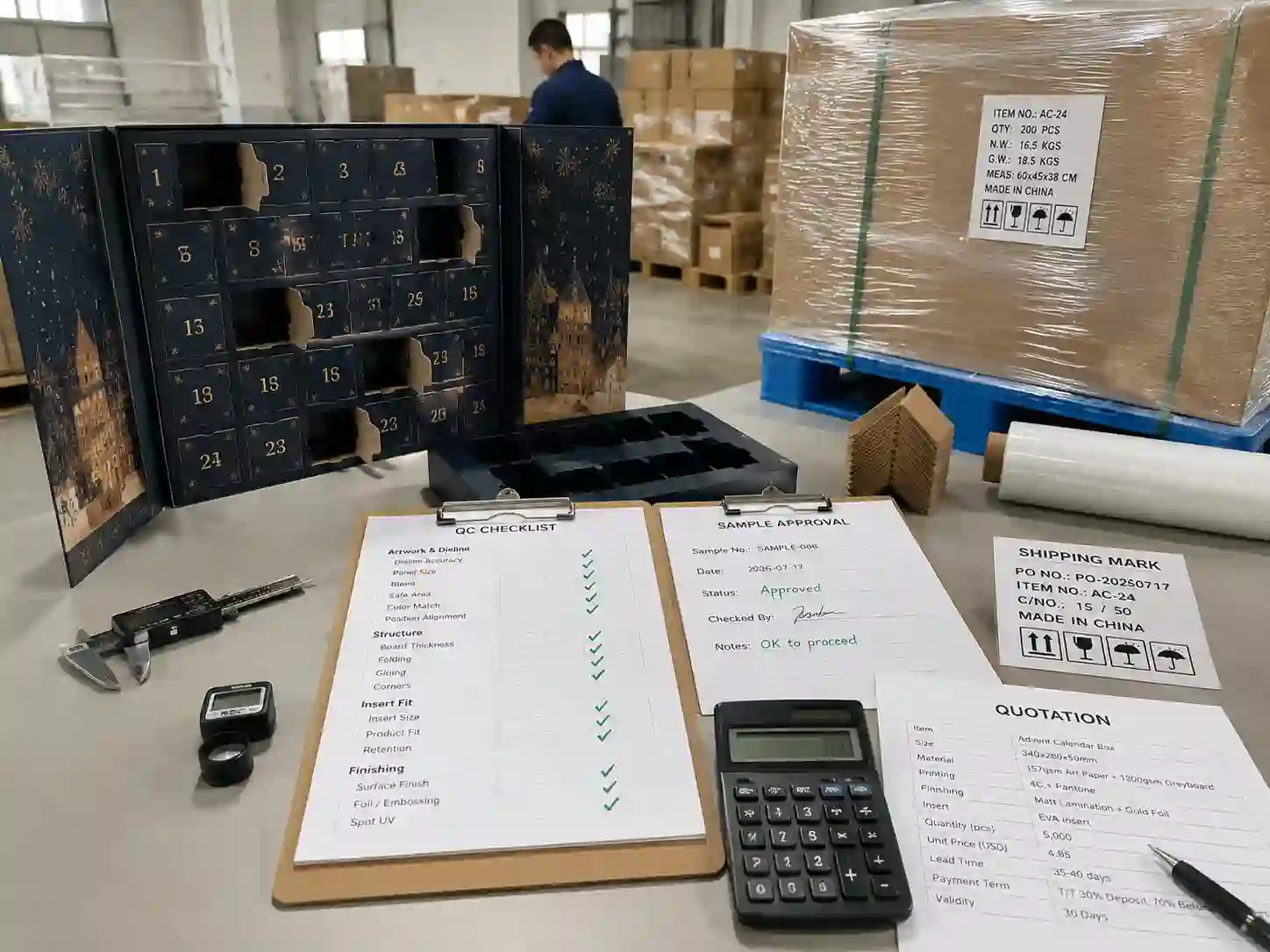
Quality control should verify the connection between approved artwork, the dieline, the sample, and bulk production. A box can look correct digitally but fail during assembly if tolerances are not controlled.
Important QC checkpoints include:
- Dieline version confirmation before printing
- Artwork registration and panel alignment
- Color comparison with approved proof
- Insert fit testing
- Opening and closing function testing
- Structural strength inspection
- Final packing inspection
For international shipments, buyers should also confirm export cartons, corner protection, pallet arrangements, and shipping marks. Packaging damage often starts from incorrect carton selection or insufficient protection during transportation.
What common mistakes should buyers avoid with advent calendar box artwork?
The most common mistakes happen when artwork is finalized before structure and dieline approval.
- Designing graphics before confirming the final box structure.
- Ignoring material thickness during artwork preparation.
- Using incorrect dieline versions.
- Placing important graphics near folds or glue areas.
- Skipping physical sample testing.
- Changing inserts after artwork approval without checking alignment.
- Approving printing without a production sample review.
Frequently asked questions about artwork dieline advent calendar boxes
Can a supplier create the dieline for an advent calendar box?
Yes. Many packaging factories create or adjust dielines based on structure, dimensions, materials, and product requirements. Buyers should confirm the dieline before artwork production begins.
Can artwork be changed after the sample is made?
Minor artwork changes are possible, but major structural or layout changes may require another sample because artwork placement depends on the physical box design.
Does a higher MOQ reduce dieline and sampling costs?
Usually, larger production quantities can spread development costs across more units, but MOQ depends on structure, materials, printing methods, and supplier capabilities.
Why is a pre-production sample important?
A pre-production sample confirms that the approved artwork, dieline, materials, inserts, and finishing details can be reproduced correctly before mass production.
Final decision guide: when should buyers invest more time in dieline review?
Buyers should spend more time reviewing artwork dielines when the advent calendar box includes premium structures, multiple compartments, fragile products, special finishing, or international shipping requirements.
| Project Situation | Recommended Action |
|---|---|
| Luxury rigid advent calendar box | Complete dieline review and physical sample approval |
| Fragile products with EVA or foam inserts | Perform product-fit testing before bulk production |
| Large retail order | Confirm printing proof, QC plan, and export packing |
| New supplier relationship | Review factory capability and sampling process |
The purpose of an artwork dieline for advent calendar boxes is not only to prepare printing files. It is the foundation that connects design, structure, inserts, production quality, and shipping performance.
Before requesting pricing, buyers can review more advent calendar box buying guides, prepare product details, and contact request a custom quote with artwork requirements, structure preferences, insert needs, quantity, and delivery expectations. Giftpackpro helps brands and purchasing teams develop production-ready seasonal packaging from concept through bulk manufacturing.
Learn more about the Giftpackpro packaging factory and its approach to custom packaging development, sampling, and quality control.