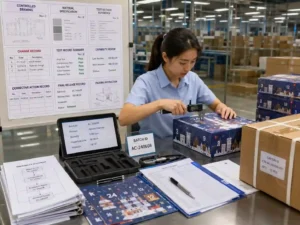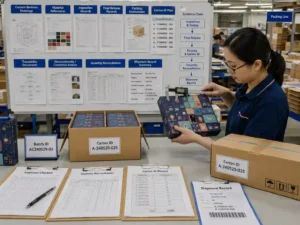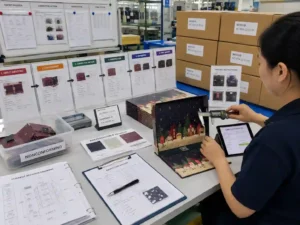
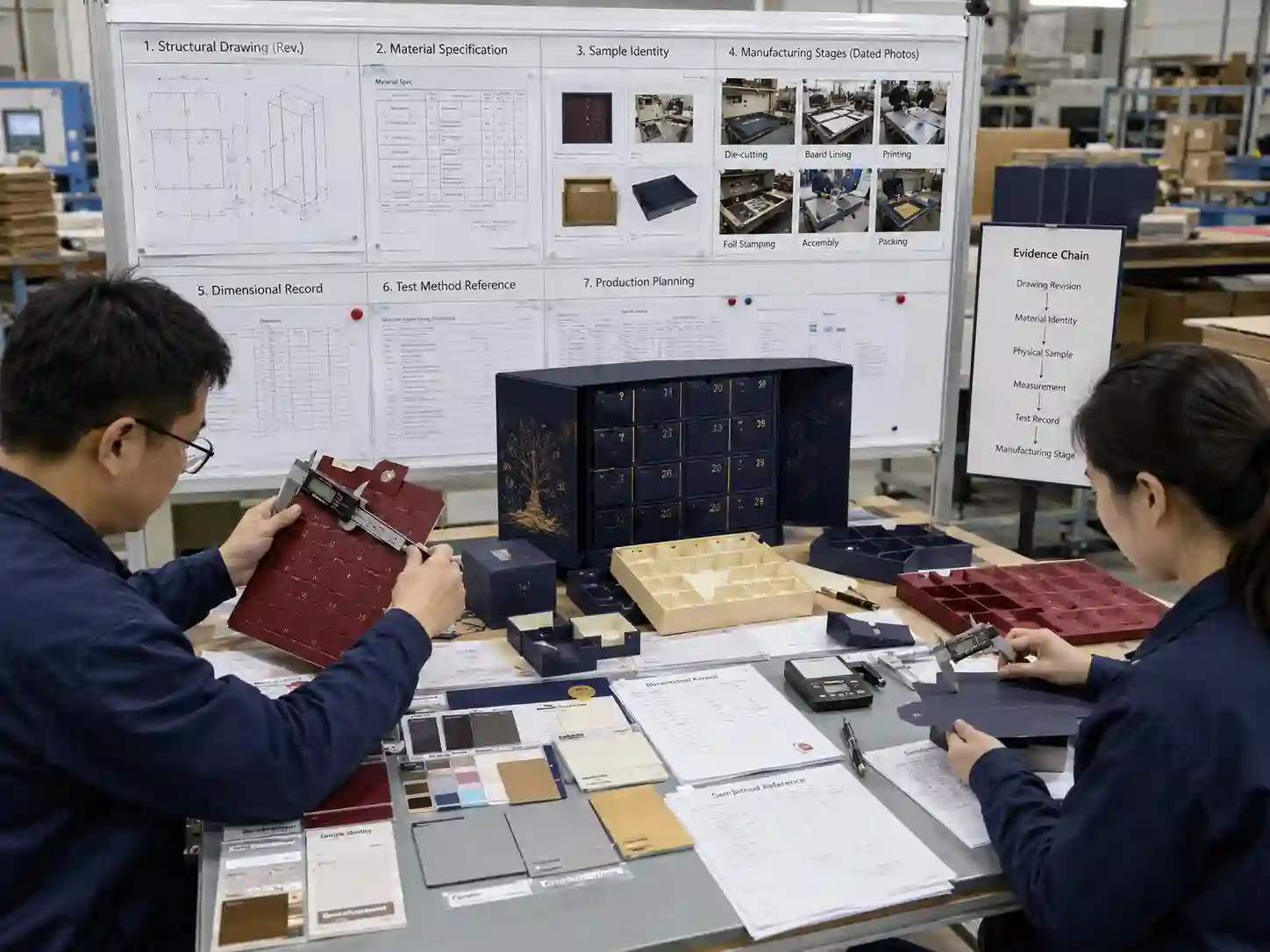
Quick answer: To verify packaging case study authenticity, buyers should look for a connected evidence chain rather than polished photographs alone. A credible case study should link an identifiable packaging project to controlled drawings or specifications, material records, dated production evidence, measurable QC results, traceability information, and final packing records. The strongest evidence shows that the photographed packaging was actually manufactured, inspected, corrected where necessary, and released under documented production controls.
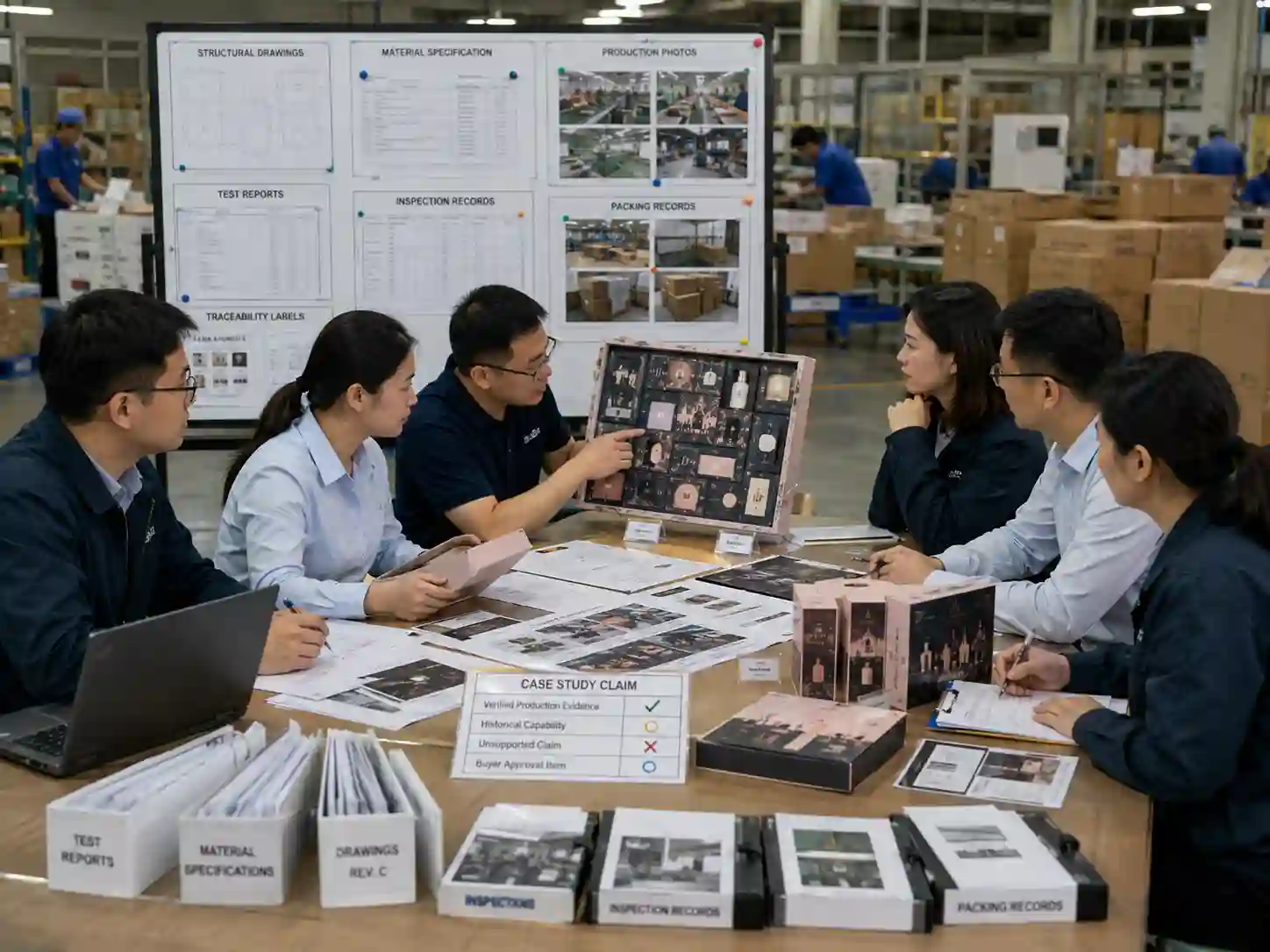
What proves that a packaging case study came from real production?
The most convincing proof is consistency between several independent records from the same identifiable project. A photograph of a finished advent calendar may demonstrate appearance, but it does not by itself establish who manufactured it, which materials were used, whether it entered bulk production, or whether the stated performance claims were tested.
Buyers should therefore ask whether the case study can be traced from the stated requirement through manufacturing and inspection to the packed production batch. Useful evidence may include a revision-controlled structural drawing, component or material specification, approved sample reference, dated production photographs, inspection records, batch identifiers, corrective-action records and packing documentation.
The individual documents matter less than their relationship. If the drawing refers to one construction, the QC sheet another size, and the photographs cannot be associated with either record, the evidence chain remains weak.
Which evidence should buyers compare?
Buyers should compare records that describe the product from different stages of the manufacturing process. Agreement between those records makes a case study substantially more useful for capability assessment.
| Evidence | What to verify | What it can support |
|---|---|---|
| Structural drawing | Project identity, revision, dimensions and component structure | Whether the documented construction matches the case-study product |
| Material specification | Material type, component application and controlled specification | Whether material claims relate to an identifiable requirement |
| Production photographs | Date, manufacturing stage, recognizable components and batch context | Evidence that relevant manufacturing operations occurred |
| Inspection record | Measured characteristic, specification, result, date and sample identity | Evidence that important requirements were physically checked |
| Traceability record | Connection between materials, components, production lot and inspection | Whether documents belong to the same production history |
| Corrective-action record | Problem, disposition, correction and verification | Evidence of production control when something went wrong |
| Packing record | Finished product identity, packing method and release status | Evidence that production progressed to completed packed goods |
Not every project will use the same document format. The buyer’s objective is not to demand a particular template but to establish whether significant claims can be connected to identifiable production evidence.
How should buyers verify packaging case study authenticity step by step?
Start with the specific claim that matters to the sourcing decision and work backward to its supporting evidence. Avoid trying to validate an entire case study from one attractive presentation.
- Identify the claimed capability. Determine whether the case study is demonstrating complex assembly, material control, dimensional accuracy, special finishing, product fit, packing performance or another capability.
- Find the controlled requirement. Ask what drawing, specification, approved sample or production instruction defined the requirement.
- Connect the requirement to a physical product. The product or component shown in photographs or inspection evidence should be identifiable as belonging to the relevant project or production example.
- Check measurable results. Where the claim concerns dimensions, fit, material characteristics or another measurable feature, look for the measurement method, specification and recorded result.
- Check production-stage evidence. Dated photographs or manufacturing records should show relevant stages rather than only completed presentation samples.
- Follow traceability to final packing. Where available, compare sample, lot, batch or carton identities across inspection and packing documents.
- Review exceptions. If defects occurred, examine whether the records show disposition, correction, reinspection and release instead of presenting an unrealistically perfect history.
This method separates evidence of historical capability from a promise about a new order. A factory may genuinely have produced one sophisticated construction previously, while a new project can still require different materials, dimensions, tests or process controls.
How can photographs be checked instead of simply trusted?
Production photographs become more credible when they can be linked to documents, stages and identifiable components. Buyers should look for evidence that photographs belong to the stated manufacturing sequence rather than treating any factory photograph as proof.
For example, a useful case-study sequence might show printed sheets, converted components, assembly, in-process inspection and packed cartons. Visible component geometry should correspond reasonably with the controlled drawing, while inspection photographs should show the characteristic being checked.
Generic machinery photographs provide much weaker evidence. A die-cutting machine somewhere in a factory does not prove that the case-study product ran on that equipment. Similarly, photographs of packed cartons do not establish construction quality unless the cartons can be connected to the relevant product and production record.
What should dated evidence contain?
A date becomes useful when accompanied by context. Depending on the supplier’s recording system, this may include a project reference, sample identity, batch number, inspection sheet reference or recognizable production stage.
Buyers should not expect suppliers to disclose confidential customer artwork or commercially sensitive information publicly. Identifying information can be redacted while retaining enough controlled references to demonstrate that the records belong together.
What does strong versus weak case-study documentation look like?
Strong documentation connects claims to records that can be cross-checked. Weak documentation usually asks the buyer to infer production capability from isolated images or descriptive statements.
| Weak documentation | Stronger documentation |
|---|---|
| “We produced this complicated calendar.” | A controlled drawing, identifiable production-stage photographs and corresponding inspection records show the construction being manufactured. |
| “Premium thick board was used.” | The material statement is linked to a component specification or identifiable material record. |
| “QC checked every important dimension.” | The record identifies the characteristic, applicable requirement, measuring method or instrument, result and inspection stage. |
| “The production had no problems.” | Where a nonconformity occurred, its disposition, correction and verification are documented. |
| Photos of anonymous cartons. | Packing evidence can be connected to the relevant finished product or production lot. |
Why are corrective-action records useful evidence?
A documented production problem can make a case study more credible when it shows how the supplier detected, contained and resolved the issue. Real manufacturing frequently involves variation, so evidence of controlled correction may be more informative than a presentation showing only perfect finished pieces.
A useful corrective-action example should identify the observed nonconformity, the affected product or batch, the required disposition, the correction taken and the subsequent verification. Depending on the issue, that verification could involve remeasurement, reinspection, replacement of components or approval of a revised process.
Buyers should distinguish this historical evidence from guarantees about future production. A previous corrective action demonstrates how one event was handled; the controls required for another project remain dependent on its construction and risk profile.
How should material and test claims be verified?
Material and performance statements should be tied to specific evidence when they influence supplier selection. The appropriate evidence depends on what the case study actually claims.
If a case study mentions board construction, for example, buyers can look for a controlled material specification connected to the relevant component. If it states that an engineering test was performed, the supporting record should identify what was tested, the applicable sample, the method or test condition and the recorded result.
A test report from an unrelated product should not automatically be treated as evidence for the case-study product. Similarly, a general material datasheet may describe a material family without proving that the identified production batch used that exact material.
What should buyers check when evaluating traceability?
Traceability should make it possible to move between key records without relying entirely on verbal explanation. The precise system varies by factory, but the references should provide a reasonably consistent chain.
- Does the drawing or specification identify the relevant project or component?
- Can the physical sample or production evidence be linked to that reference?
- Can inspection results be connected to the same sample, lot or production stage?
- Are material records consistent with the documented construction?
- Can corrective-action records identify affected and reverified production?
- Can final packing evidence be connected to the inspected finished goods?
One missing reference does not automatically make a case study false. However, several disconnected documents significantly reduce its value as supplier evidence.
Which conclusions are facts, project-dependent recommendations, or buyer approvals?
Buyers should keep these three categories separate when reviewing a case study. Doing so prevents demonstrated historical capability from being mistaken for automatic approval of a new specification.
Verifiable facts include recorded drawing revisions, material references, measured results, dated production evidence, documented nonconformities and packing records. These should be supported by identifiable records.
Project-dependent recommendations include which dimensions require inspection, what tests are appropriate, how much traceability is necessary and which manufacturing stages need additional controls. These choices depend on construction, materials, product load, tolerance sensitivity and other project requirements.
Buyer approvals include acceptance of the final specification, approved sample, agreed evidence package or project-specific deviations. A historical case study can inform these decisions but should not replace them.
What case-study evidence should be checked before supplier approval?
Before relying on a case study as capability evidence, buyers should be able to answer four questions: Is the product identifiable? Are the requirements controlled? Are production and QC records connected to those requirements? Does the evidence reach far enough through manufacturing to support the capability being claimed?
This review can complement broader due diligence on the Giftpackpro packaging factory and technical discussions about custom advent calendar box services. Additional procurement and verification topics are available in the advent calendar box buying guides.
FAQs about verifying packaging case studies
Does a production photograph prove that a supplier manufactured the packaging?
No. A photograph is useful evidence only when context connects it to the relevant product, manufacturing stage and supporting records. Isolated photographs cannot establish the complete production history.
Should buyers require confidential customer names in case studies?
Usually not. Commercially sensitive details can be redacted while preserving controlled project references, dates, component identities and document relationships needed for verification.
Is a historical case study enough to approve a new advent calendar project?
No. Historical evidence can demonstrate relevant experience or capability, but a new construction may require project-specific drawings, material approval, sampling, measurements, tests and buyer decisions.
What is the biggest warning sign in packaging case-study evidence?
A major warning sign is a collection of strong claims supported only by finished-product photographs. Credible evidence should connect at least the important claims to controlled specifications, actual production activity and verification records.
For a specific advent calendar project, request a custom quote and ask which drawings, material specifications, production records and QC evidence can be provided for capability review.