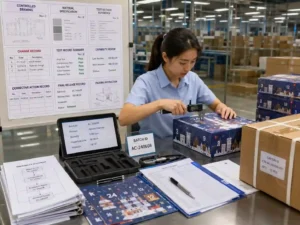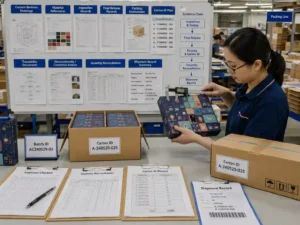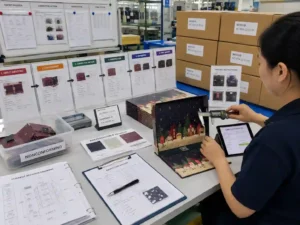
Quick answer: Buyers should request multi component packaging traceability records that connect the approved specification to identifiable materials, components, production batches, inspections, nonconformities and finished packed goods. For an advent calendar or similar multi-part paper package, useful records normally include current drawing revisions, material references, component or batch identities, production and QC records, corrective-action evidence where applicable, and final packing identification. The objective is a traceable evidence chain, not simply a folder of unrelated documents.
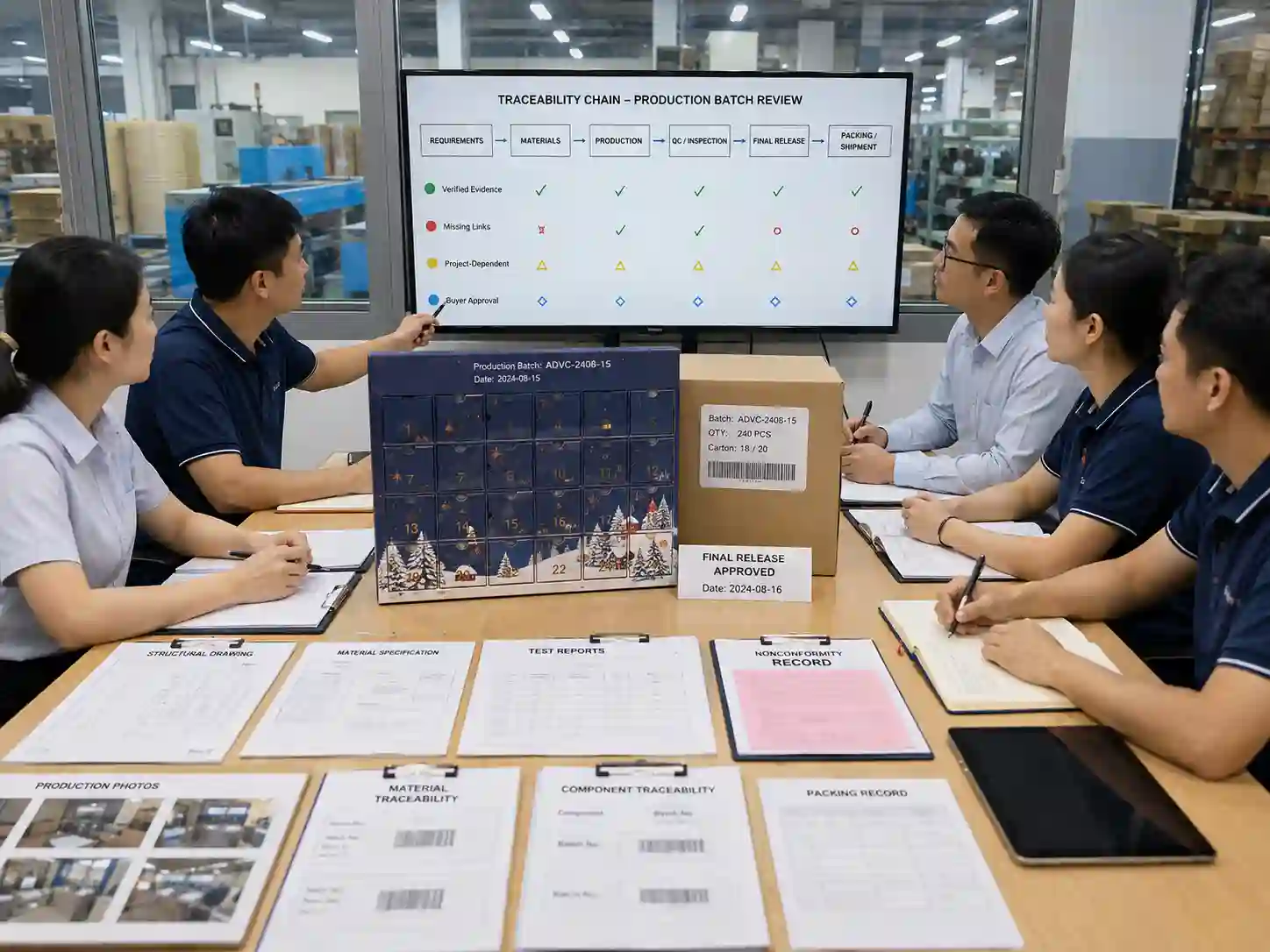
What should multi component packaging traceability records allow a buyer to verify?
Good records should let a buyer trace a finished packaging batch backward to the requirements and materials used to produce it. They should also make it possible to determine which production was inspected, what was found and what happened when a problem occurred.
This matters because a multi-component package may combine rigid box structures, paper wraps, dividers, drawers, doors, inserts, magnets, ribbons, printed pieces and other project-specific parts. A record referring only to the final carton or purchase order may not identify which component, material or revision was actually involved.
The practical traceability chain is usually:
approved requirement → identified material or component → production record → inspection or test result → nonconformity and correction where applicable → finished batch → packing record.
The exact identifiers and record formats vary by factory and project. Buyers do not need every supplier to use identical forms, but the records should contain enough common references to reconstruct this chain.
Which traceability records should buyers request?
Request records according to the risks and complexity of the order rather than asking for documentation without a defined purpose. The following evidence categories cover the main traceability points for a multi-component packaging project.
| Record | What it should identify | What the buyer can verify |
|---|---|---|
| Controlled drawings and specifications | Project, component, revision and applicable requirements | Which requirement production was expected to follow |
| Material records | Material description, specification and applicable receiving or batch reference | Which specified material was associated with production |
| Component or work-in-process records | Component identity, production stage and relevant batch or job reference | Whether individual parts can be connected to the finished assembly |
| Production records | Job, date, operation, quantity or other factory-controlled production identity | When and under which identified production run goods were made |
| Inspection and test records | Sample or batch identity, characteristic checked, method, result and disposition | Whether a reported result belongs to the relevant production |
| Nonconformity and corrective-action records | Affected material or batch, defect, containment, disposition and verification | How an identified problem was controlled |
| Final release records | Finished batch or lot and applicable final inspection status | Which production was accepted for packing or shipment |
| Packing records | Finished-goods identity, carton or packing reference and packed quantity where applicable | How approved finished goods connect to packed cartons |
How should drawings and specifications be linked to production?
The production record should identify the applicable drawing or specification revision rather than relying on a drawing filename with no revision control. This helps prevent an obsolete structure, dimension or material requirement from being mistaken for the approved version.
For a multi-component advent calendar, the controlled information may cover the outer structure, drawers or doors, inserts, internal partitions and other relevant parts. Buyers should check whether the same component names or reference numbers appear consistently across drawings, production documents and inspection records.
A drawing marked as approved is useful evidence of a requirement. It is not, by itself, evidence that bulk production followed that requirement. That connection requires production and inspection records.
What material traceability evidence is useful?
Material evidence should connect a controlled material requirement to the material identified for the applicable production. The level of detail needed depends on the material, supplier controls and consequences of substitution.
For paper packaging, relevant records might identify board grade or thickness requirements, covering paper, printed material, adhesive or other specified components where those characteristics are important to the project.
Buyers should distinguish three different types of information:
- Verifiable fact: a record shows that an identified material or batch was received, measured, inspected or assigned to an identified production job.
- Project-dependent requirement: which materials require batch-level traceability, incoming inspection or additional testing depends on the package and its risks.
- Buyer approval: acceptance of a particular material specification or permitted substitution should be documented separately when buyer authorization is required.
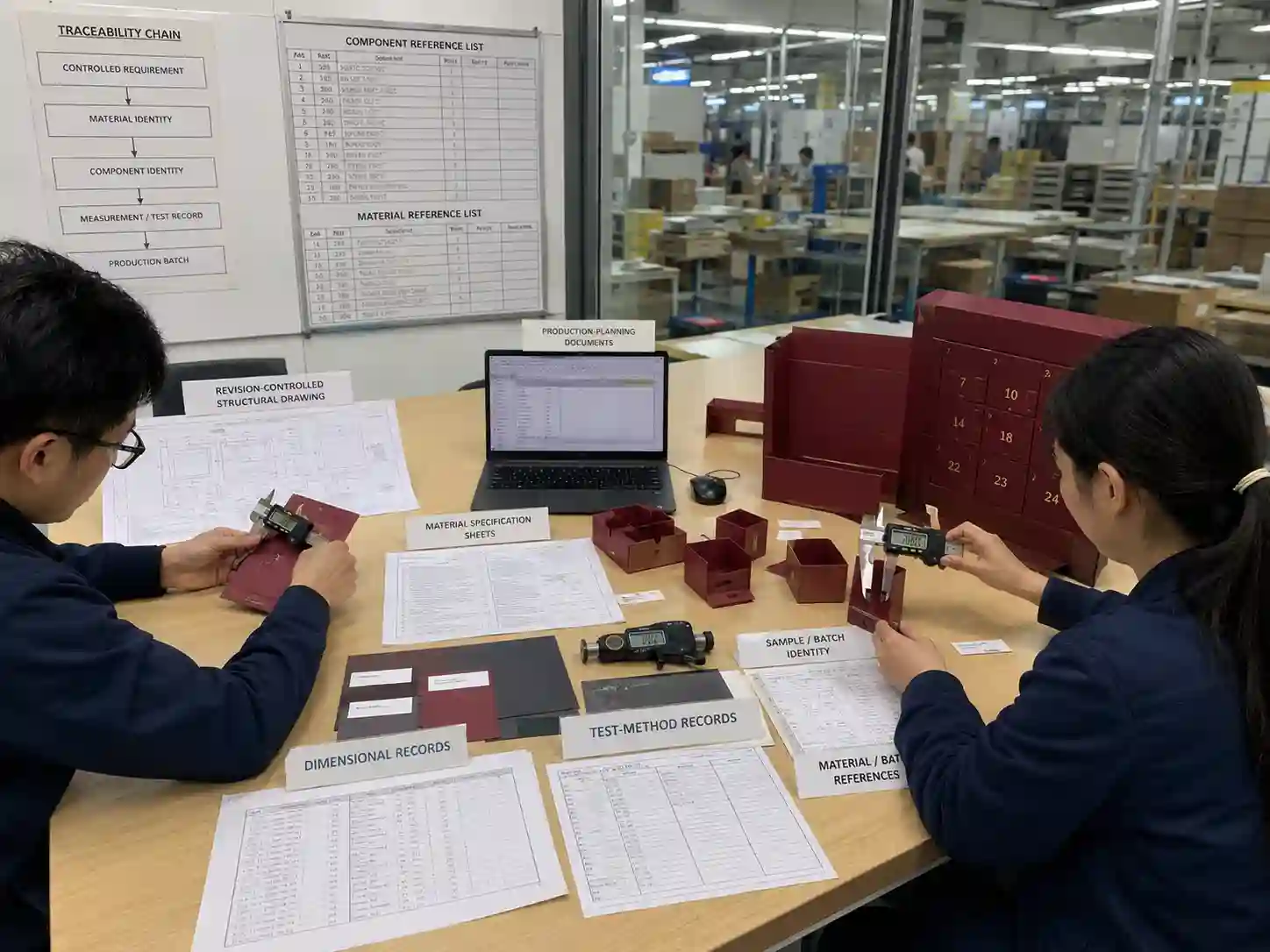
A supplier’s general material specification sheet can support the evidence chain, but it becomes more useful when its material reference also appears in incoming inspection, production or batch documentation.
How should inspection and test records preserve traceability?
An inspection result is useful only when the buyer can determine what was inspected and which requirement was applied. Records should therefore identify the applicable sample, component or production batch as well as the characteristic checked.
Depending on the project, an inspection sheet may record dimensions, alignment, fit, assembly condition, appearance or functional checks. A measurement such as board thickness or compartment dimension should ideally identify the specification or drawing against which the result was evaluated.
What should buyers look for on an inspection record?
Look for enough information to reconstruct the inspection rather than accepting a pass/fail statement with no context.
- Project or job identity.
- Component, sample, lot or batch reference.
- Inspection date or production stage.
- Applicable drawing, specification or inspection requirement.
- Characteristic inspected and measurement method where relevant.
- Actual measurements or observations when these are necessary to support the conclusion.
- Acceptance status and authorized disposition.
Not every check requires a numerical measurement. However, dimensional claims should normally be supported by dimensional evidence, while functional or visual characteristics need an appropriate documented inspection method.
How should nonconforming components remain traceable?
A nonconformity record should identify the affected component or production and follow it through containment, disposition and verification. Without that link, a corrective-action report may describe a problem without proving which goods were affected or whether corrected production was subsequently accepted.
For example, suppose an internal component is found outside a controlled dimension. Strong documentation could connect the defect to an identified production batch, record the affected quantity or scope, document segregation or rework, identify the applicable drawing requirement and show the subsequent verification result.
The buyer should not assume that every defect requires a formal corrective-action report. The required response should be proportionate to the defect, recurrence risk and agreed quality controls.
What does strong versus weak traceability documentation look like?
| Weak documentation | Stronger documentation |
|---|---|
| Photo of a measuring tool with no product identity | Photo or record connected to an identified component, batch and applicable requirement |
| Material specification with no connection to the order | Controlled specification linked through a material reference to applicable production records |
| QC sheet marked “PASS” only | Inspection record identifying what was checked, against which requirement and for which production |
| Corrective-action report with no affected batch | Nonconformity linked to affected production, disposition and subsequent verification |
| Photos of packed cartons with no identity | Packing evidence showing an identifiable connection between released finished goods and packed cartons |
How should final packing evidence connect to traceability?
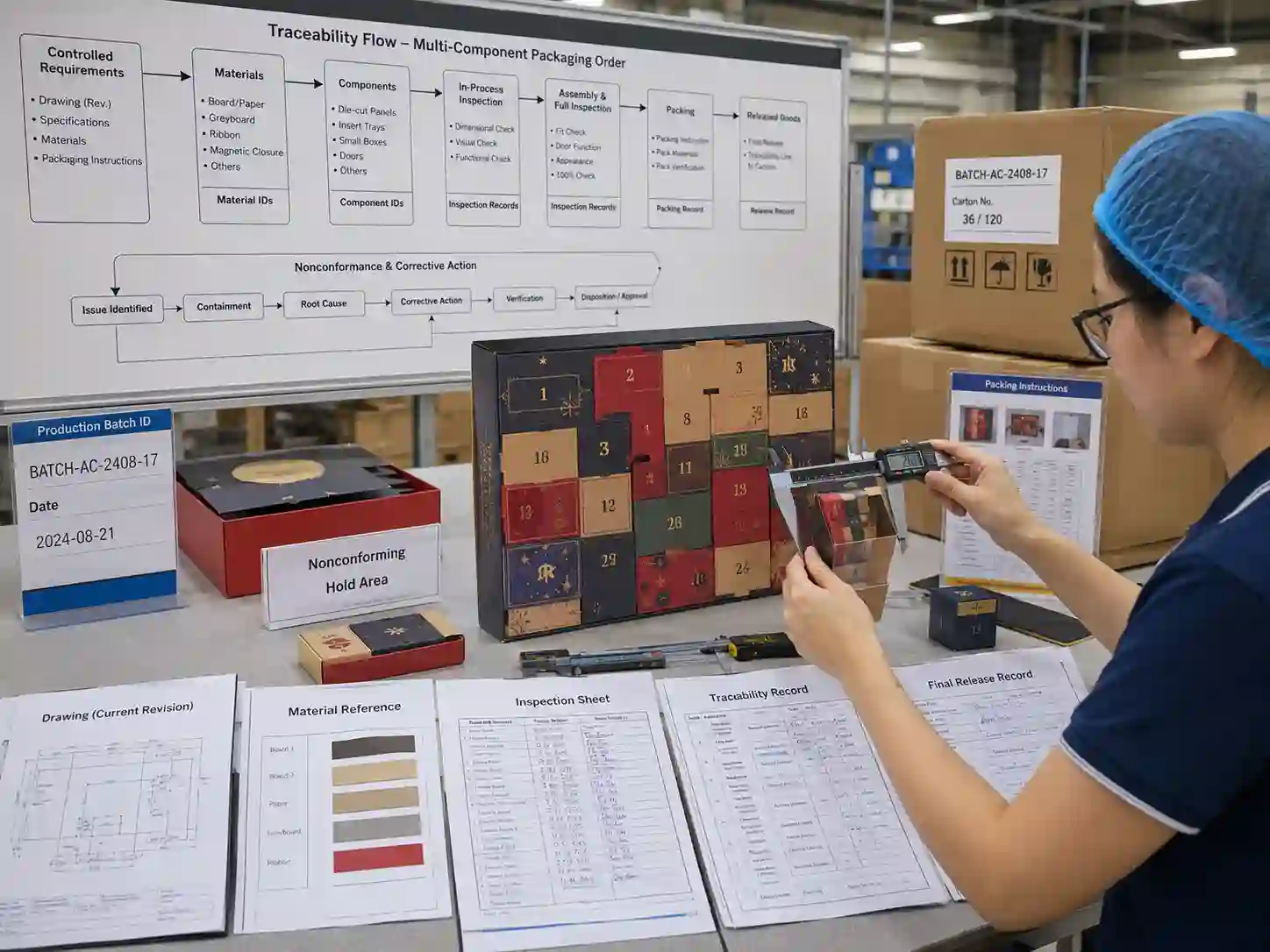
Packing evidence should preserve the identity of approved finished production as it moves into cartons. Buyers should be able to determine that the documented packed goods correspond to the production that passed the applicable release checks.
Useful evidence can include finished-goods references, carton identification, packing records and dated photographs when photographs form part of the agreed documentation. The necessary detail depends on how many variants, components, production batches or destinations are involved.
This is different from a broad export-packing assessment. For traceability purposes, the question is narrower: can the supplier connect the packed goods to an identified and released production batch?
How can buyers verify the records before relying on them?
Cross-check identifiers across several documents instead of reviewing each record independently. A credible traceability system should preserve consistent references as the order moves from controlled requirements through production, QC and packing.
- Select one important finished component or packed batch.
- Find its final inspection or release record.
- Trace it backward to its production identity.
- Confirm the applicable drawing and specification revision.
- Check whether relevant material references can be identified.
- Review an associated inspection or test record and confirm that its sample or batch identity matches.
- If a nonconformity occurred, follow its identity through segregation, disposition, correction and re-verification.
- Confirm that final packing records preserve the identity of the released goods.
This sample-based reconstruction is often more informative than receiving a large document package that contains many records but few usable links between them.
Which traceability requirements should be agreed before production?
Buyers should define critical traceability expectations before bulk production when the project requires records beyond the supplier’s standard system. Retrospectively reconstructing missing identities can weaken the reliability of the evidence.
The agreed scope may specify which components require individual references, which materials need batch identification, which QC records must show actual measurements, how revisions are controlled and which documents should be retained or provided at defined approval stages.
These are project-dependent controls. A simple package and a complex 24-compartment structure do not necessarily require the same documentation depth.
For broader supplier capability context, buyers can review the Giftpackpro packaging factory and custom advent calendar box services. Additional evidence-focused procurement topics are available in the advent calendar box buying guides.
What is the minimum practical verification checklist?
At minimum, verify that important records share enough identifiers to connect requirements, production, inspection and finished goods. Add deeper controls where a component or material presents greater project risk.
- Current drawing and specification revisions are identifiable.
- Important components use consistent names or reference numbers.
- Relevant material records can be connected to the production job or batch.
- QC records identify the product, component, sample or batch inspected.
- Measurements can be compared with the applicable controlled requirement.
- Nonconforming production remains identifiable through disposition and re-verification.
- Final release evidence identifies the accepted production.
- Packing records connect released goods with identifiable packed cartons.
- Dates, batch references and document revisions do not conflict across the evidence set.
Frequently asked questions about packaging traceability records
Are production photos sufficient traceability evidence?
No. Photos can support traceability when they are dated or otherwise identified and linked to a component, process stage or batch, but photographs alone may not establish the applicable specification, measurement result or release decision.
Does every packaging component need its own batch number?
Not necessarily. The appropriate identification level depends on project complexity, component risk and the supplier’s production-control system. Buyers should focus on whether critical components can be traced reliably rather than requiring unnecessary identifiers.
How long should packaging traceability records be retained?
There is no single retention period appropriate to every packaging project. Buyers and suppliers should define retention according to contractual requirements, product risk, repeat-order needs and any applicable quality or regulatory obligations.
Should buyers request every factory record for every order?
Usually not. Request the records necessary to verify critical requirements and preserve the agreed evidence chain. A focused set of traceable documents is more useful than a large collection of unrelated production paperwork.
If you need to define traceability evidence for a multi-component seasonal packaging project, request a custom quote and include the components, specifications and records that require buyer verification.