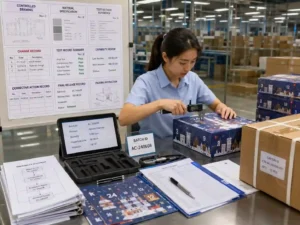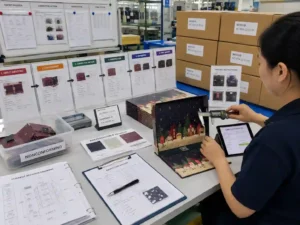
Quick answer: A useful production process page should show more than a sequence of factory photographs. Strong advent calendar manufacturing process evidence connects controlled requirements to identifiable materials, production stages, inspections, corrective actions, and final packing records. Buyers should be able to see what was made, which drawing or specification applied, how critical characteristics were checked, how records were linked to the production batch, and which decisions still require project-specific approval.
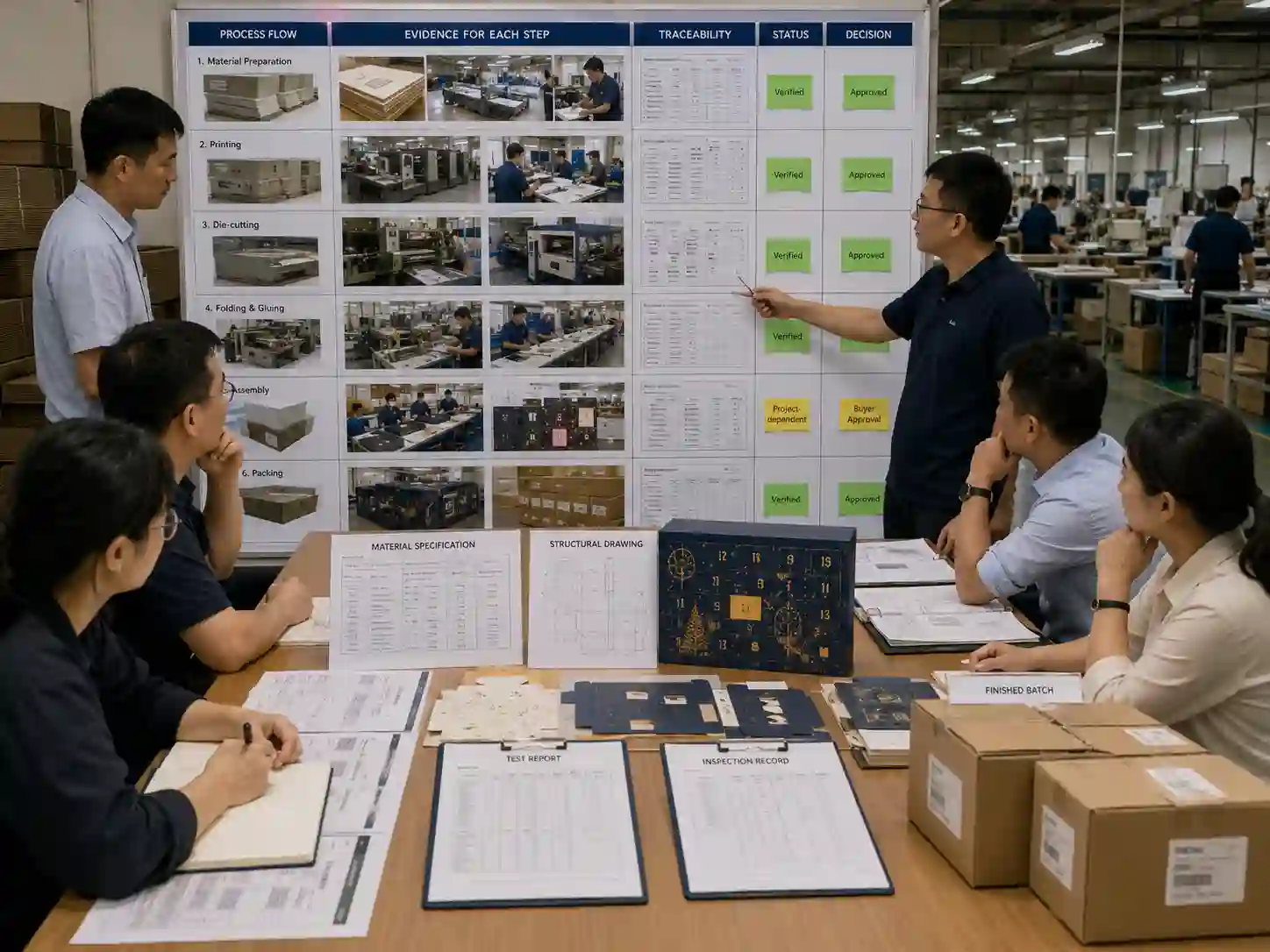
What should a production process page actually prove?
It should prove that the supplier has a controlled method for turning an approved packaging specification into repeatable finished advent calendar boxes. The page should therefore show relationships between requirements, physical production, measurements, records, and release decisions rather than simply displaying machinery or finished cartons.
For a multi-component advent calendar, useful evidence may cover rigid-board components, printed wraps, doors or drawers, dividers, inserts, accessories, assembly operations, inspection points, and finished packing. Not every project uses the same construction, so the page should distinguish demonstrated factory practices from features that are specific to one design.
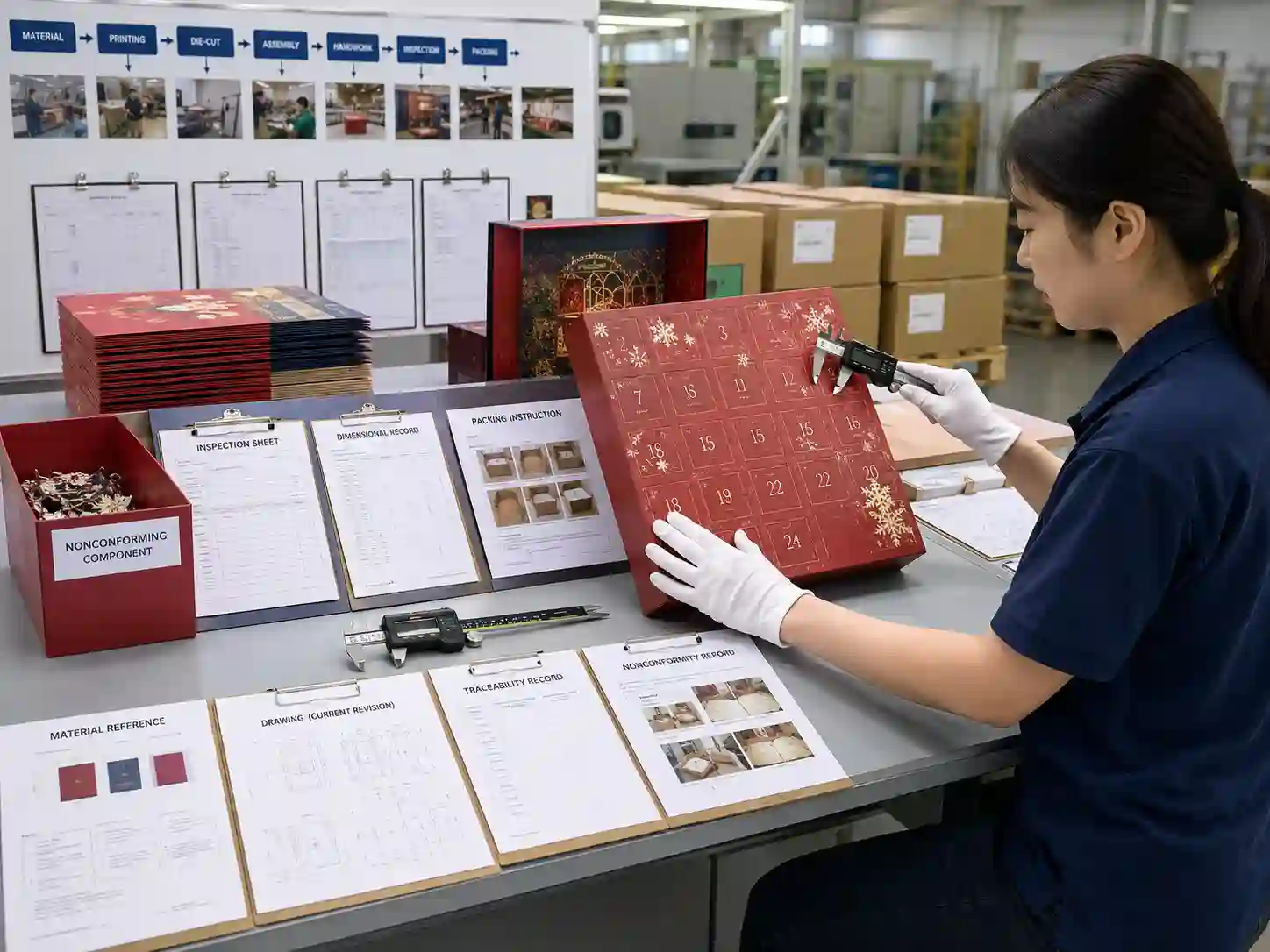
A credible process page also makes its evidence identifiable. Dated photographs, drawing revisions, sample identities, material references, inspection records, and batch or work-order references are more useful than unlabeled factory images because a buyer can understand what the evidence applies to.
What advent calendar manufacturing process evidence should be shown?
The strongest evidence follows the product through manufacturing instead of treating each photograph as an isolated claim. Buyers should be able to trace a logical chain from the controlled requirement to material verification, production, inspection, corrective action where necessary, and final release.
| Process area | Useful evidence | What the buyer can verify |
|---|---|---|
| Controlled requirements | Current-revision drawings, component references, material specifications, approved sample identity | Which requirements production is expected to follow |
| Incoming materials | Material identification, receiving records, specification references, relevant measurements | Whether identifiable materials can be connected to the project requirements |
| Component production | Dated process photos, work-order or batch references, component identities | Whether the evidence relates to the claimed construction and manufacturing stage |
| Assembly | Assembly instructions, in-process checks, identified samples, dimensional records | How multiple components are controlled as they become a finished calendar |
| Quality control | Inspection sheets, measurement methods, acceptance criteria, defect records | What is checked and how results are evaluated |
| Corrective action | Nonconformity record, segregation evidence, rework or correction record, reinspection | How a detected problem is controlled before release |
| Finished packing | Packing instruction, carton identity, quantity records, final inspection or release record | Whether approved production remains identifiable through packing |
How should drawings and material specifications appear on the page?
Drawings and specifications should establish the controlled requirement behind the photographs and measurements. A process page does not need to publish confidential artwork or proprietary dimensions, but it should demonstrate that manufacturing works from identified, revision-controlled information.
For example, a photograph of greyboard beside a digital thickness gauge is stronger when the evidence identifies the relevant component and controlled material requirement. The measurement should not be presented as a universal specification for every advent calendar.
The same principle applies to paper, adhesives, magnets, ribbons, inserts, printed components, or other materials when they are part of the construction. The applicable requirements vary with structure, product weight, finishing, intended use, and approved design.
What should remain project-dependent?
Board grade and thickness, insert material, dimensions, tolerances, test methods, inspection frequency, and some acceptance criteria can all vary by project. A supplier should avoid presenting one previous production example as a mandatory specification for every future order.
Buyer-approved drawings, specifications, artwork, samples, and agreed acceptance requirements should remain clearly separated from general descriptions of factory capability.
How should production photographs be documented?
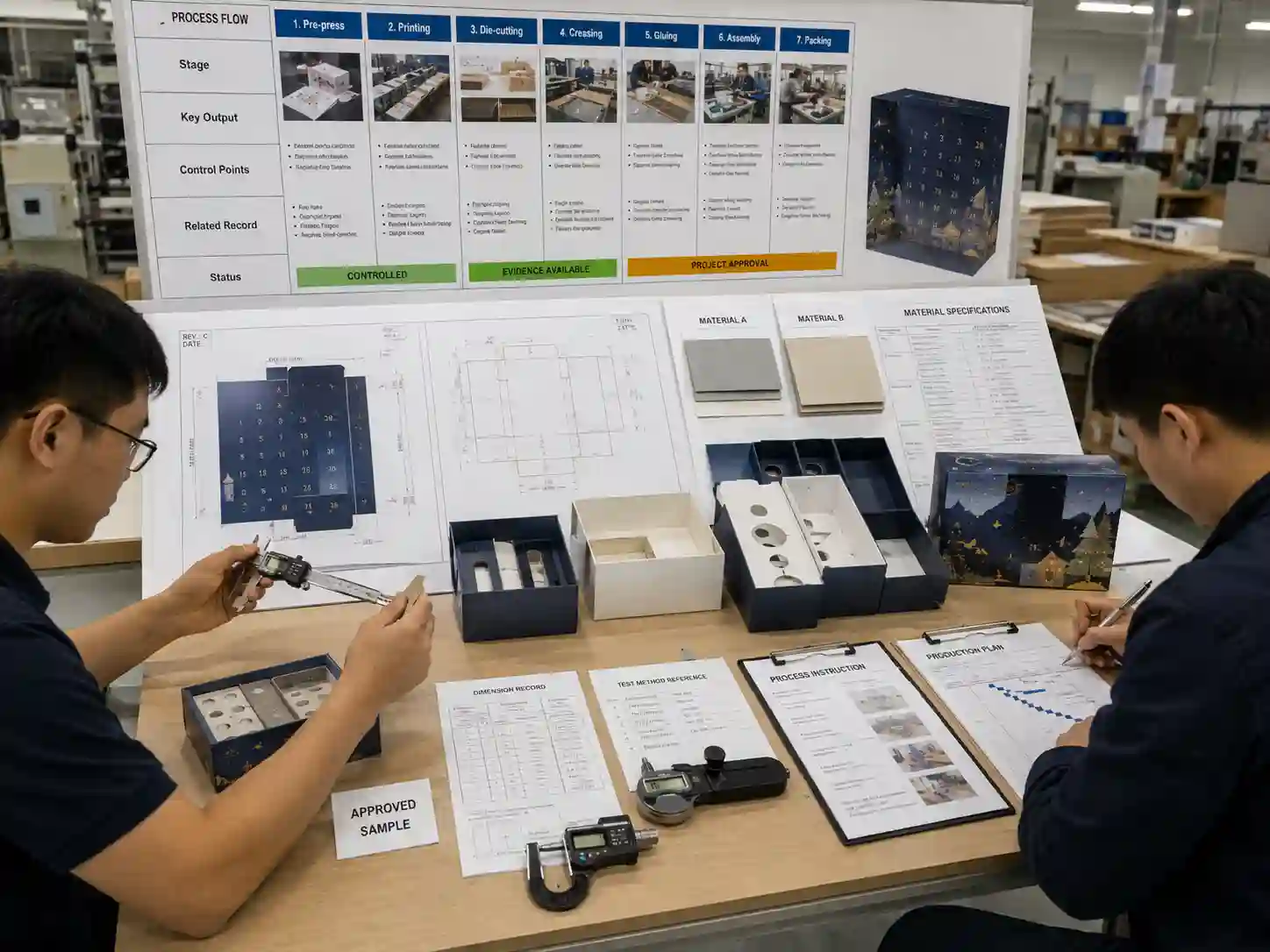
Production photographs should answer when, where in the process, and to which identifiable product or batch the evidence relates. A large gallery of unlabeled machine photographs provides little verification value.
Useful production evidence can show material preparation, component forming, mounting or wrapping, assembly, in-process inspection, finished inspection, and packing where those stages genuinely apply to the illustrated construction. Images should be dated or linked to dated records when the date is relevant to the claim.
Photographs should also show enough context to distinguish an approved sample, production trial, work in progress, rejected component, reworked unit, and released bulk product. These states should not be mixed together without explanation.
How should inspection and measurement evidence be presented?
Inspection evidence should connect a measurable characteristic to a controlled requirement and an identifiable sample or batch. A photograph of a caliper or thickness gauge alone does not demonstrate process control.
Where relevant, the page can show the measurement tool, measurement location, recorded result, applicable specification or tolerance, inspection stage, sample identity, and disposition. The exact inspection method and sampling frequency should be based on the project and agreed quality plan rather than implied as universal.
What is the difference between strong and weak process documentation?
Strong documentation creates traceability between the claim and its supporting evidence. Weak documentation asks the buyer to infer capability from attractive factory photographs.
| Weak documentation | Stronger documentation |
|---|---|
| Photo of stacked board with no identity | Identified material linked to a component specification or incoming-material record |
| Worker measuring an unidentified box | Measurement of an identified component against a referenced drawing requirement |
| Caption stating “strict QC” | Inspection record showing the characteristic checked, method, result, and disposition |
| Random factory production photos | Dated evidence organized by relevant manufacturing stage and production identity |
| Photo of defective material | Nonconformity, segregation, correction, and reinspection shown as one evidence chain |
| Finished shipping cartons | Identified cartons linked to packing instructions, quantity records, and production identity |
Should the page show nonconformities and corrective action?
When corrective-action capability is being claimed, showing a controlled problem can be more informative than showing only perfect finished products. The evidence should demonstrate how the issue was identified, contained, corrected, verified, and prevented from being released unresolved.
For example, an out-of-spec component could be shown with an inspection record and segregation identity. Subsequent evidence could show the corrected component and reinspection result. Confidential commercial information can be redacted without removing the identifiers needed to understand the sequence.
This is particularly useful when reviewing a supplier because defect detection alone does not prove control. The important question is whether the supplier can connect the finding to a disposition and documented verification.
How should traceability continue into final packing?
Final packing evidence should preserve the connection between finished cartons and the production being documented. Buyers should be able to understand how an inspected advent calendar progresses from finished-product approval into an identifiable packed batch.
Depending on the project, supporting evidence might include packing instructions, carton or batch identities, quantity records, inspection status, and dated packing photographs. Detailed export-packing design is a separate subject; on a manufacturing-process page, the purpose is primarily to demonstrate continuity of identity and control.
What should buyers verify before relying on a process page?
Buyers should test whether the page contains an evidence chain rather than treating publication itself as proof. A concise verification review can reveal whether manufacturing claims are supported by controlled records.
- Check whether the demonstrated product or component is clearly identifiable.
- Confirm that drawings or specifications show revision or document control where relevant.
- Check whether material evidence can be connected to specific packaging components.
- Look for actual measurement or inspection records rather than statements such as “high quality.”
- Confirm that photographs and records refer to identifiable production stages.
- Check whether nonconforming material is distinguishable from approved or released material.
- Look for reinspection or verification when corrective action is shown.
- Confirm that finished packing retains a traceable connection to the relevant production.
- Separate demonstrated historical capability from requirements that still need approval for the current project.
Which claims are facts, recommendations, or buyer approvals?
A well-structured page should make these three categories easy to distinguish. This prevents historical evidence from being mistaken for an approved specification for a new order.
| Category | Typical examples |
|---|---|
| Verifiable evidence | Identified drawings, dated production records, recorded measurements, inspection sheets, traceability references, packing records |
| Project-dependent recommendation | Proposed material construction, measurement points, inspection frequency, test method, tolerance approach |
| Buyer approval | Final specification, artwork, approved sample, agreed acceptance criteria, authorized design changes |
This separation is important during supplier evaluation. Historical evidence can demonstrate that a process has been performed, but it does not automatically establish the requirements for a different calendar structure or product load.
How can buyers use the page during supplier capability review?
Use the page as a starting point for document requests and targeted questions, not as a substitute for project-specific verification. Select several important manufacturing claims and ask the supplier to demonstrate how each one connects to controlled evidence.
For example, if a page claims material verification, ask how the material specification, incoming material identity, measurement record, and production batch are linked. If it claims in-process QC, ask which characteristics are checked and what happens when a result falls outside the applicable requirement.
Buyers comparing physical constructions can also review custom advent calendar box products and the broader custom advent calendar box services. For factory context and related supplier information, see the Giftpackpro packaging factory.
FAQs about manufacturing process evidence
Does a factory video count as sufficient manufacturing evidence?
No single video establishes the complete evidence chain. Video can provide useful process context, but important claims are easier to verify when the footage can be connected to identifiable drawings, materials, production records, measurements, inspection results, or batch information.
Does every production process page need to publish full QC records?
No. Commercially sensitive information may need to remain private, and detailed records may be supplied during qualification or order review. Public evidence should still be specific enough to demonstrate what records exist, what they control, and how they relate to identifiable production.
Can evidence from a previous advent calendar prove capability for a new design?
It can support a capability assessment, but it does not automatically validate the new design. Buyers should compare the demonstrated construction, materials, processes, tolerances, product load, and inspection requirements with the proposed project and identify any new validation required.
What is the final test of a credible production process page?
The final test is traceability: can a buyer follow an important manufacturing claim from a controlled requirement through identifiable material, physical production, inspection, corrective action where applicable, and final verification? If the links are visible and the project-dependent decisions are clearly separated from established evidence, the page becomes a useful supplier-evaluation resource rather than a factory photo gallery.
For a project-specific capability review, request a custom quote and provide the relevant product dimensions, construction requirements, drawings, or available packaging specifications for review.