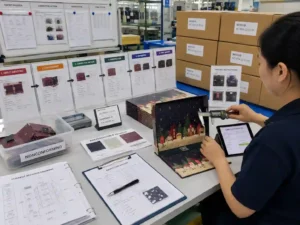
Quick answer: Subscription advent calendar boxes should be engineered around product dimensions, opening sequence, insert retention, assembly method, retail presentation, and international shipping risk. Buyers normally choose between rigid door-opening boxes, drawer boxes, book-style boxes, folding cartons, and modular structures. The best option is not simply the most premium-looking design; it is the structure that protects every subscription item, can be assembled consistently, fits the target MOQ and budget, and survives export handling. Before approving mass production, confirm the dieline, loaded insert test, printing proof, pre-production sample, master-carton specification, pallet plan, shipping marks, and inspection standard.
What should buyers understand before choosing subscription advent calendar boxes?
Buyers should first define the product assortment, packing location, sales channel, campaign quantity, shipping route, and acceptable assembly workload. These factors determine whether the box should be shipped flat, partly assembled, or fully assembled.
Unlike a standard subscription mailer, an advent calendar contains multiple compartments that must remain aligned through assembly, warehouse handling, parcel delivery, and repeated customer opening. A small error in compartment depth, drawer clearance, door perforation, or insert fit can affect the entire opening experience.
A useful packaging brief should identify:
- The number of compartments and whether all products have the same dimensions.
- The largest, heaviest, tallest, and most fragile item.
- Whether products will be packed at the box factory, a contract packer, or the buyer’s warehouse.
- Whether finished calendars will ship individually, in retail cases, or to an e-commerce fulfillment center.
- The target retail price and the percentage of budget allocated to packaging.
- The required delivery date, including time for samples, mass production, packing, and ocean or air freight.
Buyer tip: Do not request a quotation using only an external box size and a reference photo. Suppliers need product dimensions, compartment quantities, insert requirements, printing coverage, finishing details, order quantity, packing method, and destination to calculate a meaningful price.
Which subscription advent calendar box structure is best for the campaign?
The best structure balances presentation, product weight, assembly time, shipping volume, and damage risk. Rigid boxes generally create a more substantial presentation, while folding cartons reduce freight volume and may simplify large-volume distribution.
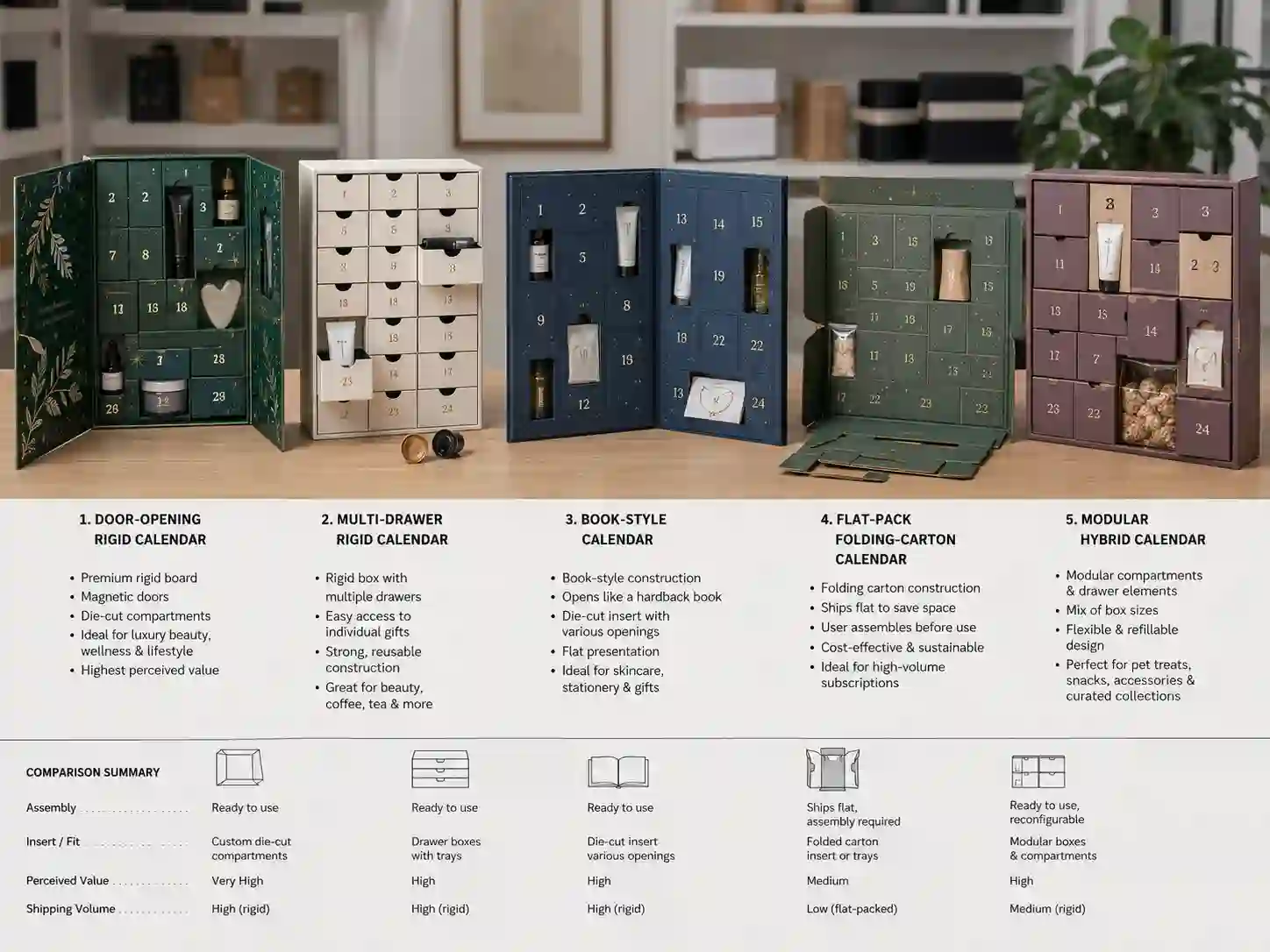
| Structure | Best suited to | Main advantages | Export-packing considerations |
|---|---|---|---|
| Rigid door-opening box | Beauty minis, wellness products, jewelry, premium food sachets, mixed gift sets | Strong presentation, large artwork area, controlled reveal sequence | Usually shipped assembled; doors, hinges, magnets, and internal trays require corner and compression protection |
| Multi-drawer rigid box | Small products with different dimensions or a reusable presentation requirement | Good product separation, easy loading, premium opening action | Drawer movement must be restrained during transit; assembled volume and carton weight can be high |
| Book-style rigid box | Curated subscription sets, stationery, jewelry cards, samples, accessories | Clear opening sequence and premium shelf appearance | Spine, hinge paper, magnetic closure, and lid alignment must be tested after packed-product loading |
| Folding-carton calendar | Higher-volume campaigns, lightweight products, cost-controlled retail programs | Can be flat packed, lower freight volume, faster carton converting | Requires clear assembly instructions and controlled folding to prevent warped panels or misaligned doors |
| Modular or hybrid box | Subscription campaigns with interchangeable product groups or regional assortments | Flexible compartment configuration and easier assortment changes | More components increase packing errors; carton counts and component labels must be carefully controlled |
For buyers comparing options from a custom advent calendar boxes manufacturer, ask for both the unit price and the packed-volume estimate. A lower-cost assembled structure may become more expensive after master cartons, pallet space, and freight are included.
When is flat packing the better option?
Flat packing is usually suitable for folding-carton calendars, foldable sleeves, collapsible rigid structures, and separate paper inserts. It reduces cubic volume but transfers more assembly work to the buyer or contract packer.
Choose flat packing when the local packing team has suitable fixtures, trained operators, sufficient workspace, and an approved assembly instruction. The supplier should provide a folding sequence, adhesive or locking guidance, component identification, and a completed reference sample.
When should boxes be shipped assembled?
Assembled packing is preferable when alignment is difficult to reproduce, the box uses rigid greyboard, drawers require precise clearance, or doors and magnets must be factory adjusted. It is also useful when the buyer wants the supplier to complete product loading or final assembly.
The trade-off is higher shipping volume. Buyers should compare the number of finished boxes per export carton, gross carton weight, pallet quantity, and container utilization before final approval.
How should inserts be engineered for mixed subscription products?
The insert should hold each item in its intended orientation without excessive movement, crushing, abrasion, or difficult removal. Because subscription calendars often combine different products, the insert should be developed from actual production samples or verified product drawings rather than approximate dimensions.
Critical engineering details include cavity length, width, depth, finger access, product center of gravity, closure clearance, and tolerance for labels, caps, sachet seals, cords, or secondary wrapping. Heavy items should not be placed where they can pull the insert away from the outer box during vertical handling.
How do common insert materials compare?
| Insert type | Typical use | Buyer considerations |
|---|---|---|
| Folded paper insert | Cartons, sachets, stationery, lightweight accessories | Printable and efficient for flat packing, but tabs and supports must be tested under loaded weight |
| PET tray | Bottles, capsules, small containers, products requiring accurate cavities | Good shape control and visibility; confirm tray thickness, cavity draft, anti-scratch requirements, and local recycling expectations |
| EVA insert | Jewelry, glass containers, premium accessories, sensitive products | Provides secure retention and a clean presentation, but material density, odor, surface finish, and color consistency should be approved |
| Foam support | Fragile components, heavy products, protective transport applications | Useful for cushioning, although buyers should review appearance, material restrictions, and recyclability goals |
| Molded pulp | Products needing shaped protection with a fiber-based appearance | Suitable for some sustainability programs; tooling, surface texture, moisture response, and dimensional tolerance need evaluation |
Factory tip: A compartment that fits an empty bottle may fail after the production label, shrink sleeve, cap decoration, or protective bag is added. Test the complete sale-ready product, including any secondary packaging.
Which materials and tolerances affect shipping performance?
Outer structure strength, insert support, board grain direction, adhesive coverage, and assembly tolerance all influence whether the calendar remains square after export shipping. Material selection should reflect packed weight and stacking pressure, not appearance alone.
Rigid subscription advent calendar boxes commonly combine greyboard with printed wrapping paper. Buyers should confirm the greyboard thickness, wrapping-paper specification, hinge construction, corner formation, and moisture control. Folding cartons are normally produced from paperboard selected according to box size, product load, print requirements, and folding performance.
Important tolerances include:
- Drawer clearance that permits smooth opening without excessive side movement.
- Door size and perforation strength that prevent premature opening.
- Insert dimensions that allow controlled loading without bowing the outer box.
- Lid, sleeve, and magnetic-closure alignment after all products are inserted.
- Finished-box dimensions that remain compatible with retail cases and master cartons.
Discuss these details during the supplier’s custom advent calendar box services process rather than waiting until final inspection. Structural problems are less expensive to correct at dieline or blank-sample stage than after printing and assembly.
How should artwork and printing be prepared for multi-panel calendars?
Artwork should be placed on the final approved dieline and checked panel by panel. Numbering, door positions, drawer fronts, folds, wrap joints, reading direction, and hidden glue areas must be reviewed before plates or tooling are released.

CMYK printing is commonly used for photographic or multi-color artwork, while Pantone references can improve control of important brand colors. However, color can change with paper shade, lamination, ink coverage, and surface finishing. Buyers should approve a printed proof or physical sample on production-equivalent material whenever color is commercially important.
Foil stamping, embossing, spot UV, matte lamination, and gloss lamination should be evaluated together rather than as isolated effects. Fine foil lines may not reproduce well across deep folds, embossing may affect the reverse side of thinner stock, and heavy spot UV coverage can alter folding or gluing performance.
Artwork approval checklist
- Use the supplier’s final dieline, including bleed, cut, crease, glue, and safe-area markings.
- Confirm that every compartment number appears once and follows the correct opening sequence.
- Check artwork direction on doors, drawers, side panels, sleeves, and internal surfaces.
- Identify CMYK and Pantone elements clearly.
- Mark foil stamping, embossing, debossing, spot UV, and varnish on separate production layers.
- Outline fonts and provide linked images at suitable resolution.
- Keep barcodes and regulatory information away from folds, joints, textures, and reflective finishes.
- Approve the final digital proof and retain a signed or dated reference.
Buyers can review representative custom advent calendar box products to compare structures, but the production dieline must still be developed around the actual subscription assortment.
Which samples should be approved before mass production?
At minimum, buyers should approve structure, product fit, artwork position, color expectations, finishing, opening function, and export packing. One sample type may not answer every question, so a staged sampling process is often more efficient.
- Blank prototype: Tests size, door or drawer action, insert fit, product loading, assembly sequence, and overall proportions.
- Printed sample: Tests artwork placement, colors, surface finishing, numbering, and visual presentation.
- Loaded sample: Confirms that all real products fit and that the packed box closes correctly.
- Pre-production sample: Represents the approved materials, structure, printing, finishing, insert, and assembly method before full mass production.
- Packing sample: Demonstrates the protective bag, tissue, pads, dividers, export carton, shipping marks, and pallet arrangement.
Quotable purchasing rule: Sample approval should cover the loaded packaging system, not only an empty presentation box. Product weight can change drawer movement, panel alignment, magnet closure, and carton compression performance.
How do MOQ, cost, and lead time change with the specification?
MOQ and cost depend on structure, material usage, tooling, printing setup, finishing, assembly labor, insert complexity, and export-packing method. Buyers should avoid comparing quotations that do not use the same specification.
Major cost drivers include:
- Rigid greyboard construction versus folding paperboard.
- Number of drawers, doors, cavities, and separate components.
- Hand wrapping, hand assembly, magnet installation, ribbon fitting, and product loading.
- Custom PET, EVA, foam, or molded-pulp tooling.
- Special papers, Pantone colors, foil stamping, embossing, and spot UV.
- Flat-packed versus assembled export packing.
- Individual protective bags, tissue, paper pads, corner protectors, dividers, and reinforced cartons.
- Inspection level, testing requirements, and destination-specific labeling.
Lead time should be divided into artwork and engineering, sampling, sample revision, material preparation, printing, converting, assembly, QC, export packing, and transportation. A complex subscription calendar should not be scheduled as though it were a standard folding carton.
How should export cartons and palletizing be specified?
Export packing should prevent abrasion, crushed corners, deformation, moisture exposure, component loss, and movement inside the master carton. The carton specification must be based on finished packed-box dimensions and weight.
Typical protective elements include a clean protective bag, tissue or paper wrapping, top and bottom pads, side pads, partitions, corner protectors, void fill where necessary, and a correctly sized corrugated export carton. Overly loose cartons allow movement, while excessively tight cartons can transfer compression directly to decorative surfaces.
Master-carton decisions buyers should confirm
- Quantity of calendars per carton.
- Calendar orientation inside the carton.
- Internal dimensions and acceptable empty space.
- Corrugated-board grade or performance specification.
- Maximum gross weight suitable for manual handling and destination requirements.
- Use of dividers, pads, corner protection, or moisture barriers.
- Carton-sealing method and tape requirements.
- Carton drop, vibration, or transport-testing expectations.
Where distribution risk is high, buyers may discuss a test program based on the shipping route and handling system. The International Safe Transit Association provides official information about packaged-product testing approaches.
What makes a practical pallet plan?
A practical pallet plan minimizes carton overhang, controls total height and weight, supports forklift handling, and keeps cartons stable during transport. The supplier should show cartons per layer, number of layers, total cartons per pallet, pallet dimensions, gross weight, and stretch-wrapping method.
Corner boards, top boards, strapping, anti-slip sheets, and stretch wrap may be appropriate depending on carton strength and logistics conditions. Buyers should also confirm whether pallets must meet destination requirements for wood treatment, pallet size, warehouse entry, or container loading.
What information belongs on shipping marks?
Shipping marks should help warehouses identify, count, route, and handle cartons without exposing unnecessary commercial information. Confirm the content and layout before carton printing or label production.
- Consignee or project reference.
- Purchase-order number.
- Item or SKU number.
- Product description using generic wording where appropriate.
- Quantity per carton.
- Carton number, such as 1 of 40.
- Net and gross weight.
- Carton dimensions.
- Country-of-origin wording where required.
- Handling marks, barcode area, and warehouse labels.
For barcode planning, buyers can consult the official GS1 barcode standards information and confirm requirements with the receiving retailer or fulfillment center.
What QC points reduce damage before shipment?
QC should verify both cosmetic quality and functional performance. A visually acceptable calendar can still fail if drawers bind, doors tear incorrectly, inserts lift, products move, or master cartons collapse under stacking.
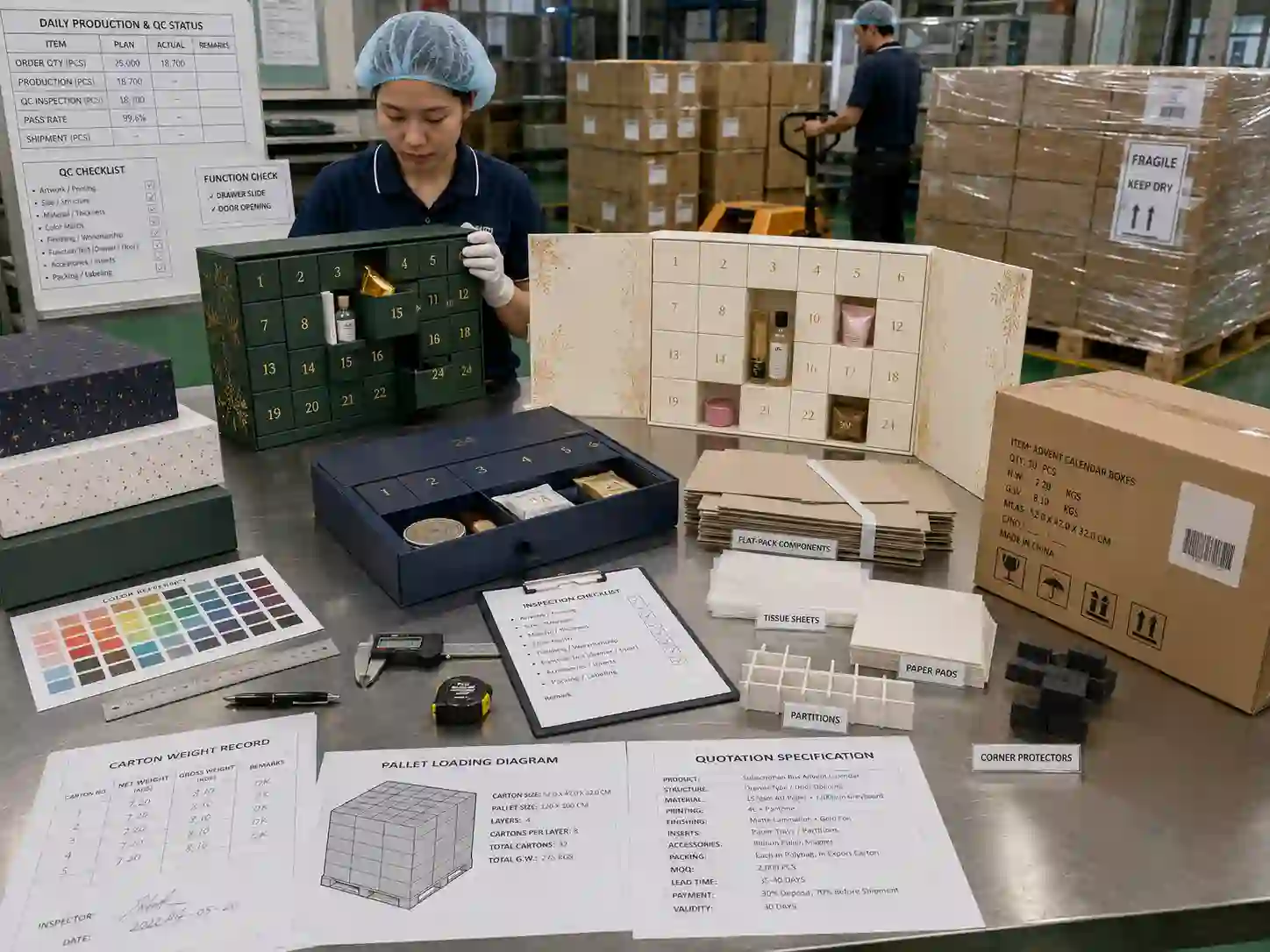
Practical pre-shipment QC checklist
- Compare mass-production units with the signed pre-production sample.
- Measure finished box, insert, drawer, and compartment dimensions.
- Check printing content, color range, registration, numbering, and surface finish.
- Inspect corners, edges, wrapping joints, glue marks, scratches, dents, and contamination.
- Open and close sampled doors, drawers, lids, sleeves, and magnetic closures.
- Load real or approved dummy products into sampled units.
- Confirm finger access and product-removal convenience.
- Check that inserts remain seated during controlled inversion and handling.
- Verify individual protection and quantity per export carton.
- Confirm carton dimensions, gross weight, sealing, labels, shipping marks, and carton numbering.
- Review pallet pattern, edge protection, stretch wrap, and container-loading plan.
- Record defects, corrective action, reinspection results, and approved shipment quantity.
QC tip: Inspection samples should be selected from different assembly periods and carton locations. Checking only the first completed units may miss changes caused by operator variation, adhesive setting, material batches, or packing pressure.
Buyers evaluating the Giftpackpro packaging factory or another supplier should ask how approved samples, inspection records, defect limits, rework, carton checks, and shipment release are controlled.
How should buyers compare suppliers and quotations?
Compare suppliers using matched specifications, documented sample procedures, product-fit engineering, production controls, and export-packing competence. The cheapest unit quotation is not necessarily the lowest delivered-cost option.
Supplier decision guide
| Decision area | What a capable supplier should provide | Warning sign |
|---|---|---|
| Structural development | Dieline review, blank prototype, compartment planning, and tolerance discussion | Price offered before product sizes or packing method are understood |
| Insert engineering | Loaded fit test using actual products or verified drawings | Insert selected only from a reference photo |
| Artwork control | Final dieline, proof approval, finishing layers, and numbering check | No documented proof or unclear version control |
| Sampling | Clear sample type, material assumptions, revision process, cost, and timing | Prototype described as identical to production without qualification |
| Mass-production QC | Approved sample reference, dimensional checks, function tests, and inspection records | Quality discussed only in general terms |
| Export packing | Carton quantity, dimensions, weight, protection, marks, pallet plan, and loading data | Freight volume estimated before the final packed sample exists |
More purchasing topics are available in Giftpackpro’s advent calendar box buying guides.
What information should be prepared for an accurate quotation?
A complete RFQ helps suppliers quote the same packaging system and reduces revisions. Include confirmed details where available and clearly label anything that is still estimated.
- Required box style or reference structure.
- Number of compartments, doors, or drawers.
- Dimensions and weight of every product.
- Photos or physical samples of the products.
- Required outer dimensions, if restricted by retail shelving or fulfillment rules.
- Preferred paperboard, greyboard, insert material, and sustainability goals.
- Printing coverage, CMYK or Pantone requirements, and finishing.
- Order quantity and possible quantity breaks.
- Required blank, printed, loaded, or pre-production samples.
- Product-loading responsibility and assembly location.
- Flat-packed, partly assembled, or fully assembled delivery preference.
- Individual protection, master-carton, shipping-mark, and pallet requirements.
- Delivery destination, target shipment date, and preferred transport method.
- Retailer, e-commerce, labeling, barcode, testing, or compliance requirements.
Which common mistakes should buyers avoid?
The most common mistakes are approving an empty sample, underestimating assembly labor, ignoring export volume, and changing products after the insert has been tooled.
- Finalizing the dieline before all product dimensions are confirmed.
- Using nominal bottle sizes instead of maximum finished dimensions.
- Placing heavy products behind weak doors or unsupported paper compartments.
- Approving colors from a monitor without considering paper and lamination.
- Adding foil, embossing, or spot UV after structural approval without retesting.
- Comparing quotations with different board, inserts, assembly, and packing assumptions.
- Choosing flat packing without calculating local assembly time and error rates.
- Choosing assembled packing without checking freight volume and pallet efficiency.
- Failing to approve shipping marks and warehouse labels before production.
- Allowing mass production to begin without a documented pre-production sample.
Frequently asked questions about subscription advent calendar boxes
Can rigid subscription advent calendar boxes be flat packed?
Traditional rigid boxes are usually shipped assembled because greyboard panels are wrapped and fixed during production. Some collapsible or hybrid rigid structures can be supplied flat, but they require additional joints, locking systems, magnets, or assembly steps that should be tested before quotation approval.
Are paper inserts strong enough for a mixed product assortment?
Paper inserts can support many lightweight or medium-weight products when the board grade, folds, tabs, and load paths are correctly engineered. Heavy bottles, glass items, or products with uneven weight may require reinforced paper structures, PET trays, EVA, foam, molded pulp, or a hybrid insert.
How many units should be packed in one export carton?
There is no universal quantity. It depends on the finished box size, packed weight, structure strength, handling limits, and pallet pattern. The correct quantity should be confirmed using the final packed sample rather than an early size estimate.
Should buyers request palletized or loose-carton shipping?
Palletizing improves handling stability and warehouse efficiency but uses additional space and adds pallet cost. Loose loading may improve container utilization for suitable cartons, although it can increase handling and compression risk. The decision should reflect carton strength, route, unloading method, and destination warehouse rules.
When should transport testing be completed?
Testing should be completed after the finished packaging, product load, protective materials, export carton, and sealing method are confirmed. Testing an empty box or an unrepresentative carton does not validate the final shipping configuration.
How early should a seasonal subscription calendar project begin?
Begin early enough to complete product measurement, dieline development, sampling, revisions, artwork approval, material purchasing, mass production, QC, export packing, and freight before the campaign launch. Complex rigid or multi-component calendars need more development and assembly time than standard cartons.
Prepare the specification before requesting a sample or quotation
For a useful sample or quotation, prepare the product list, dimensions, weights, compartment plan, preferred structure, artwork concept, order quantity, required delivery date, packing location, export method, and destination. Giftpackpro can then evaluate structure, inserts, materials, printing, sampling, assembly, QC, and export-carton requirements as one connected packaging system.
Well-engineered subscription advent calendar boxes should protect the assortment, support efficient packing, present the campaign clearly, and arrive ready for retail or fulfillment. Buyers with a defined product list and shipping brief can request a custom quote for sampling and production review.