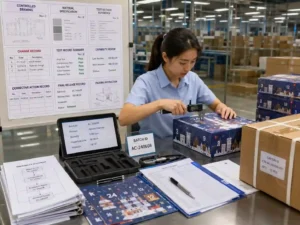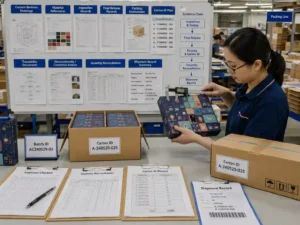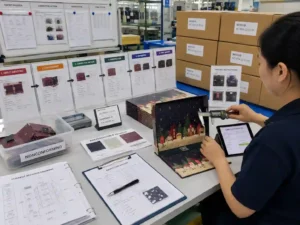
Quick answer: How are custom advent calendar boxes made? A packaging factory first confirms the products, compartment count, box dimensions, retail presentation, shipping method, and target cost. Engineers then create a structural dieline, select paperboard or greyboard, design product-specific inserts, and produce a blank or printed prototype. After the buyer approves the structure, artwork, materials, finishes, and loaded product fit, the factory proceeds with printing, surface finishing, die-cutting, rigid-box wrapping or carton folding, insert assembly, final packing, and quality inspection. For importers, the most important controls are complete RFQ information, an approved pre-production sample, measurable QC standards, realistic lead time, and export packing that protects the finished calendars.
What should buyers understand before ordering custom advent calendar boxes?
Buyers should treat an advent calendar as an engineered multi-component packaging system, not simply as a printed outer box. Its performance depends on how the shell, doors, drawers, compartments, inserts, products, decorative finishes, and shipping protection work together.
A typical project may combine a rigid box shell, several folding-carton drawers, a paper or plastic insert, pull ribbons, magnets, printed number panels, decorative wrapping paper, and an export carton. Every component adds manufacturing steps, tolerances, assembly labor, and potential quality risks.
Before contacting a custom advent calendar boxes manufacturer, define the commercial purpose of the package. A luxury retail launch may justify a wrapped greyboard structure with drawers and foil stamping. A high-volume promotional campaign may require a lighter folding-carton calendar that ships flat and uses less assembly labor.
Buyer tip: Select the structure after confirming the actual products and distribution route. Choosing an impressive box before checking product dimensions, total loaded weight, fulfillment method, and freight cost often leads to unnecessary redesign.
How are custom advent calendar boxes made step by step?
Custom advent calendar production normally follows a controlled sequence: product data collection, structural engineering, insert development, prototyping, artwork preparation, sample approval, material purchasing, printing, converting, assembly, QC, and export packing.
- Product information is collected. The factory reviews each product’s dimensions, weight, orientation, fragility, packaging material, and preferred compartment number.
- A structure is selected. The buyer and supplier compare rigid door-opening, drawer, book-style, folding-carton, or hybrid constructions.
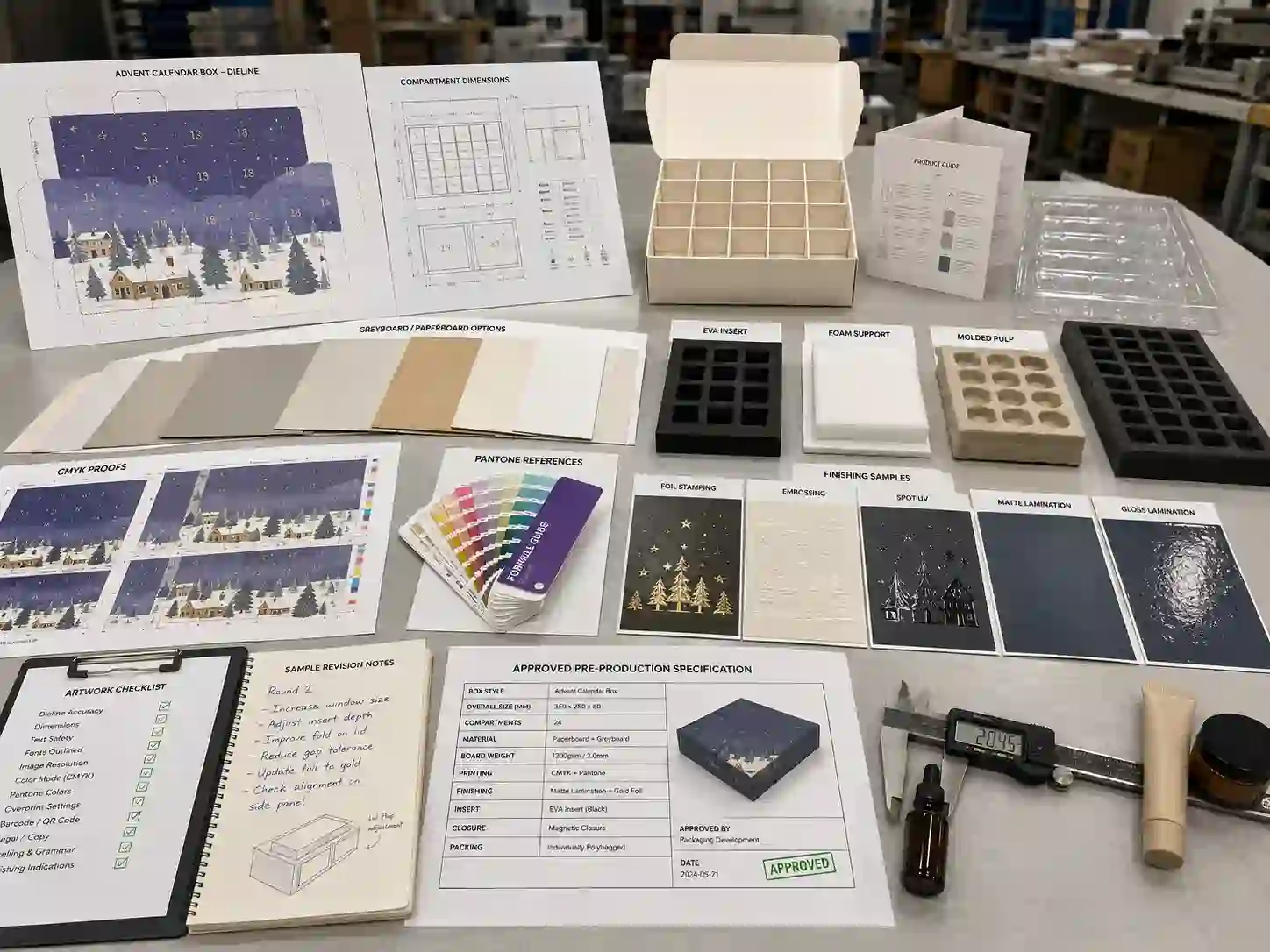
- The dieline is engineered. Packaging engineers calculate panel dimensions, board thickness allowances, drawer clearance, folding positions, and insert cavities.
- Insert fit is tested. Real products or accurate dummy samples are placed into paper, PET, EVA, foam, or molded-pulp inserts.
- A prototype is produced. This may be a plain structural sample, a digitally printed sample, or a production-standard pre-production sample.
- Artwork and finishes are approved. The buyer checks CMYK printing, Pantone colors, numbered doors, text placement, barcodes, foil stamping, embossing, spot UV, and lamination.
- Materials are purchased and printed. The supplier orders the specified paper, greyboard, magnets, ribbons, insert materials, and other components.
- Components are converted and assembled. Printed sheets are laminated, die-cut, folded, wrapped, glued, fitted with inserts, and assembled into complete calendars.
- QC inspections are performed. Inspectors check dimensions, appearance, door or drawer operation, adhesion, product fit, quantity, and packing.
- Finished boxes are export-packed. Calendars are protected with tissue, pads, partitions, corner protection, reinforced cartons, shipping marks, and pallets where required.
Which advent calendar structure is best for the project?
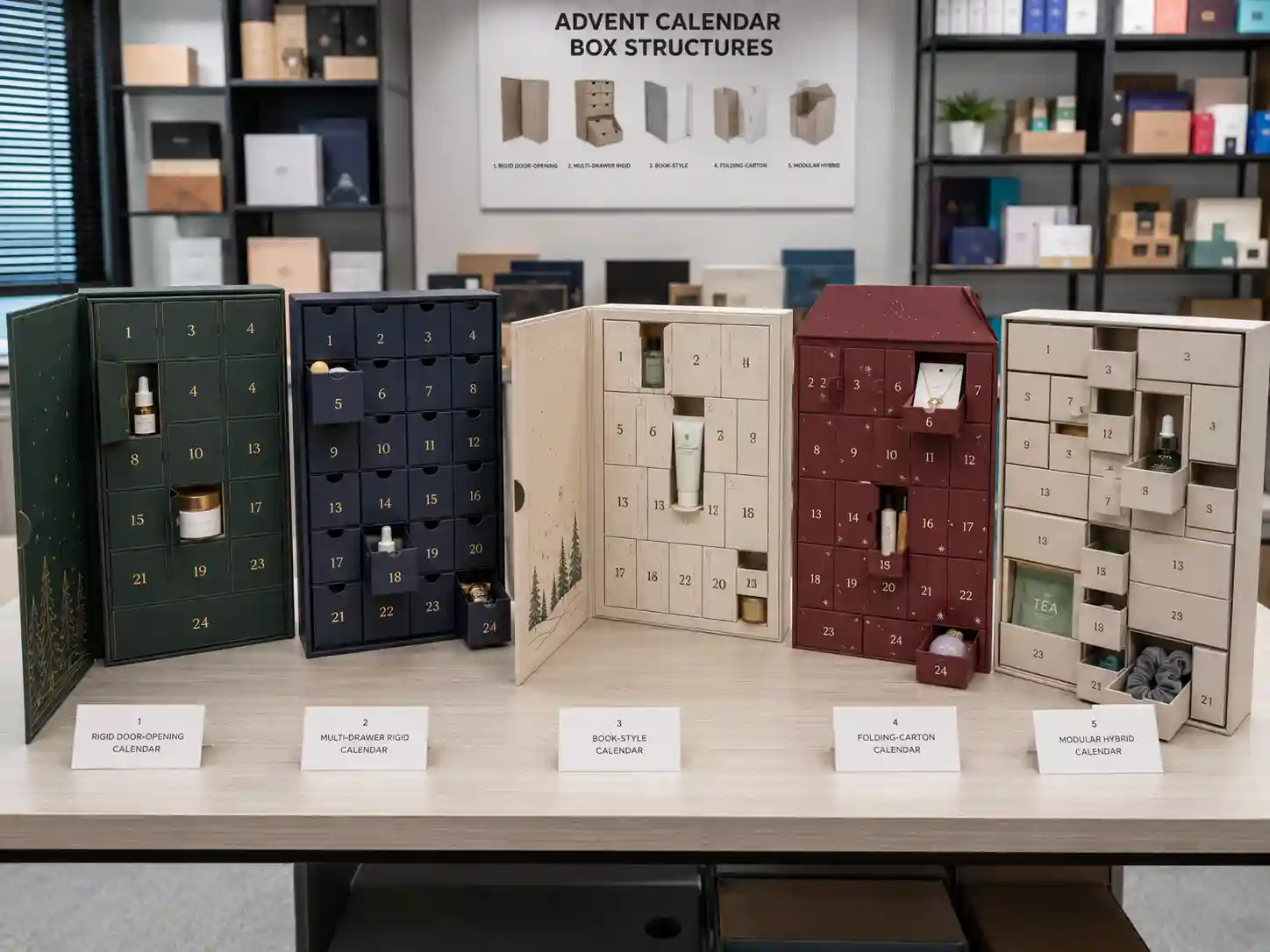
The best structure balances presentation, product protection, assembly requirements, shipping volume, target quantity, and retail price positioning. Buyers should compare structural options using the same product set and packing assumptions.
| Structure | How it is made | Best suited to | Main purchasing consideration |
|---|---|---|---|
| Rigid door-opening box | Greyboard panels are wrapped with printed paper and fitted with an internal compartment system and numbered doors. | Premium cosmetics, jewelry, wellness products, and gift collections | Strong presentation but higher material, labor, and assembled shipping costs |
| Multi-drawer rigid box | A rigid outer shell holds individual folding-carton or wrapped drawers, often with ribbon or paper pull tabs. | Mixed product sizes and high-value product launches | Drawer clearance, alignment, pull strength, and assembly labor must be controlled |
| Book-style calendar | Two rigid or folding panels are connected with a spine and closed with magnets, ribbons, or locking tabs. | Story-led product sets and premium presentation | Spine strength, magnetic closure, loaded balance, and flatness require testing |
| Folding-carton calendar | Printed paperboard is die-cut, creased, folded, and glued around an internal tray or compartment grid. | Promotional campaigns and higher-volume retail programs | More economical and easier to flat-pack, but generally less rigid |
| Hybrid modular calendar | A rigid or corrugated outer case holds removable cartons, sleeves, drawers, or trays. | E-commerce, subscription products, and reusable gift packaging | Component count and packing efficiency must be calculated carefully |
How much clearance do doors and drawers need?
Clearance must account for board thickness, paper wrapping, glue buildup, dimensional variation, and surface finishes. A drawer that slides correctly in a handmade sample may become tight during mass production if its paper grain, wrapping overlap, or glue application changes.
The supplier should test several production-representative units rather than approve drawer movement from one prototype. Door perforations, thumb notches, ribbon pulls, and magnetic closures should also be checked after the calendar is fully loaded.
Factory tip: Ask the supplier to record the approved internal dimensions and functional tolerances on the specification sheet. Descriptions such as “drawer should open smoothly” are less useful than measurable dimensions and an approved reference sample.
How are inserts engineered around the actual products?
An insert should hold each item securely without making packing difficult or damaging the retail product. The design must consider the product’s widest point, cap or closure, center of gravity, extraction direction, and movement during transportation.
Accurate product-fit development usually requires physical products, production-equivalent samples, or reliable 3D drawings. The supplier should not rely only on the nominal size printed on a product specification sheet, because flexible sachets, crimped tubes, wrapped food items, and irregular accessories often need extra clearance.
Which insert material should buyers choose?
- Folded paper insert: Recyclable-looking, printable, and suitable for lightweight products. Tabs and locking structures must be tested for repeated handling.
- PET tray: Provides accurate cavities and clear product presentation. Buyers should confirm thickness, color, recycled-content requirements, and local packaging obligations.
- EVA insert: Gives a clean premium appearance and precise holding force for jewelry, bottles, and accessories. Density, odor, surface finish, and cavity accuracy should be specified.
- Foam insert: Useful for cushioning fragile or irregular items, but the material type and sustainability expectations should be reviewed for the destination market.
- Molded pulp: Offers protective three-dimensional cavities and a fiber-based appearance. Tooling, surface texture, dimensional variation, and minimum order requirements may be higher than for folded paper.
A mixed insert system may be more practical than using one material throughout. For example, a paper grid can separate the compartments while small PET or EVA supports stabilize tall bottles.
Quotable purchasing rule: The insert should be approved with the complete loaded product set, not only as an empty tray. Loaded testing reveals pressure points, tipping, rattling, difficult removal, and weight distribution problems that cannot be seen in an unloaded sample.
What materials and printing processes are used?
Material selection depends on whether the calendar is a rigid box, folding carton, drawer system, or hybrid package. Common materials include coated paper, specialty paper, kraft paper, solid bleached paperboard, greyboard, corrugated board, PET, EVA, foam, molded pulp, magnets, ribbons, and adhesives.
Rigid boxes typically use greyboard wrapped with printed or specialty paper. Folding cartons use paperboard that is printed, laminated or coated, die-cut, folded, and glued. Board thickness should be selected according to the box span, loaded weight, compartment design, and stacking conditions rather than appearance alone.
How should artwork and color be controlled?
The buyer supplies artwork using the factory’s final dieline. The supplier should check bleed, safe zones, image resolution, panel direction, numbered-door order, barcodes, small text, foil layers, embossing plates, spot UV areas, and white-ink requirements.
CMYK printing is suitable for process artwork and photographic images. Pantone references are useful when a brand color needs closer visual control, although the final result can still vary with paper color, lamination, ink density, and surface finish.
Matte lamination generally reduces glare and supports a premium appearance, while gloss lamination increases shine and color saturation. Foil stamping, embossing, debossing, and spot UV add visual contrast but require separate tooling, setup, registration control, and inspection.
Buyer tip: Approve a physical color reference whenever color is commercially important. A screen image or emailed PDF cannot accurately represent paper tone, metallic foil, lamination, or production ink density.
Which samples should be approved before mass production?
Most custom projects benefit from more than one sampling stage. The appropriate sequence depends on structural complexity, order value, launch timing, and the buyer’s risk tolerance.
- Blank structural sample: Tests dimensions, opening method, compartments, insert fit, and overall construction without final offset printing.
- Digitally printed prototype: Reviews layout, approximate color, text, numbering, and visual presentation. It may not reproduce production foil, paper, or offset-printing results exactly.
- Pre-production sample: Uses production-intent materials, printing, finishes, insert construction, and assembly methods. This should become the main approval reference for mass production.
- Loaded packing sample: Includes the real products and protective materials so the buyer can check fit, removal, balance, closure, and shipping readiness.
Sample approval should be documented. The approval record should identify the sample version, dimensions, board specifications, paper, printing method, finish, insert material, accessory details, packing method, and any accepted deviations.
Buyers can review the supplier’s available custom advent calendar box services and compare representative custom advent calendar box products before deciding which sample level is appropriate.
How should buyers compare China factories and quotations?
Compare suppliers using a normalized specification, not the lowest total shown on a quotation. Two prices cannot be evaluated fairly when they use different board thicknesses, insert materials, finishes, packing quantities, quality standards, or shipping terms.
Use this supplier comparison checklist
- Does the supplier ask for product dimensions, weights, photos, and packing orientation?
- Can it explain the proposed structure and identify likely production risks?
- Does the quotation state paper, board thickness, insert material, printing, finishes, accessories, and packing?
- Are tooling, sample, mold, printing plate, and delivery charges separated?
- Is the MOQ based on the full box or on individual components?
- Does the supplier distinguish sample lead time, material preparation, production time, and shipping time?
- Will the pre-production sample be approved before mass production?
- Are inspection standards and acceptable tolerances documented?
- Can the supplier provide clear production updates and revision records?
- Are payment terms, Incoterms, carton quantities, gross weight, and quotation validity stated?
- Can the buyer or an appointed inspector conduct an inspection before shipment?
- Does the supplier demonstrate practical export-packing experience?
Buyers may also review the background and production focus of the Giftpackpro packaging factory when evaluating whether a supplier’s capabilities match the project.
What reliability signals matter more than a polished sales presentation?
Reliable factories usually provide specific technical questions, revision-controlled dielines, written sample comments, detailed material descriptions, realistic scheduling, and traceable approval records. They should be willing to identify risks instead of agreeing to every request without engineering review.
Certification claims should be verified against current documents, scope, facility name, and validity dates. For fiber-sourcing requirements, buyers can review information from the official Forest Stewardship Council and then confirm whether the supplier’s proposed material and chain-of-custody documentation meet the project requirement.
What determines MOQ, price, and lead time?
MOQ and cost are determined by the complete manufacturing route, not just the external box dimensions. A complicated calendar may include several independently produced components, each with its own material minimum, tooling setup, printing waste, and assembly process.
Major cost drivers include:
- Rigid versus folding-carton construction
- Calendar size and total loaded weight
- Number of doors, drawers, trays, or removable cartons
- Greyboard and paperboard grade or thickness
- Insert material and tooling requirements
- Printing coverage and color-control requirements
- Foil stamping, embossing, spot UV, and lamination
- Magnets, ribbons, handles, windows, or other accessories
- Manual wrapping, gluing, compartment assembly, and product loading
- Individual protection, master-carton strength, and pallet requirements
Lead time should be separated into structural development, prototype production, buyer review, material purchasing, printing, converting, assembly, inspection, packing, and transportation. Late artwork approval or changing product dimensions after sample approval can affect the whole schedule.
Decision guide: Choose a rigid structure when premium presentation, reuse, and shelf impact justify higher labor and freight. Choose a folding-carton structure when flat packing, faster assembly, lower unit weight, and higher-volume distribution are more important. Choose a hybrid when the project requires both premium presentation and replaceable or modular product compartments.
How is quality controlled during mass production?
Quality control should cover incoming materials, printing, die-cut components, assembly, loaded function, finished appearance, quantity, and export packing. Final inspection alone may not identify defects hidden inside completed boxes.
Typical inspection points include:
- Paper color, texture, grain direction, and visible defects
- Greyboard or paperboard thickness and flatness
- Printed color against the approved reference
- Foil, embossing, spot UV, and lamination registration
- Die-cutting position, crease quality, and perforation strength
- Outer dimensions and compartment dimensions
- Drawer sliding, door opening, magnetic closure, and ribbon attachment
- Insert cavity position and holding strength
- Glue marks, exposed board edges, scratches, dents, and warped panels
- Loaded product fit, removal, rattling, and weight balance
- Carton quantity, shipping marks, barcode area, and pallet configuration
QC tip: Include functional tests in the inspection criteria. A calendar can look acceptable while still failing because doors tear, drawers jam, magnets misalign, inserts release products, or the loaded box does not close evenly.
How should finished calendars be packed for export?
Export packing should prevent abrasion, crushing, moisture exposure, component movement, and pallet damage while keeping freight volume under control. The correct method depends on whether the calendars ship assembled, partially assembled, or flat.
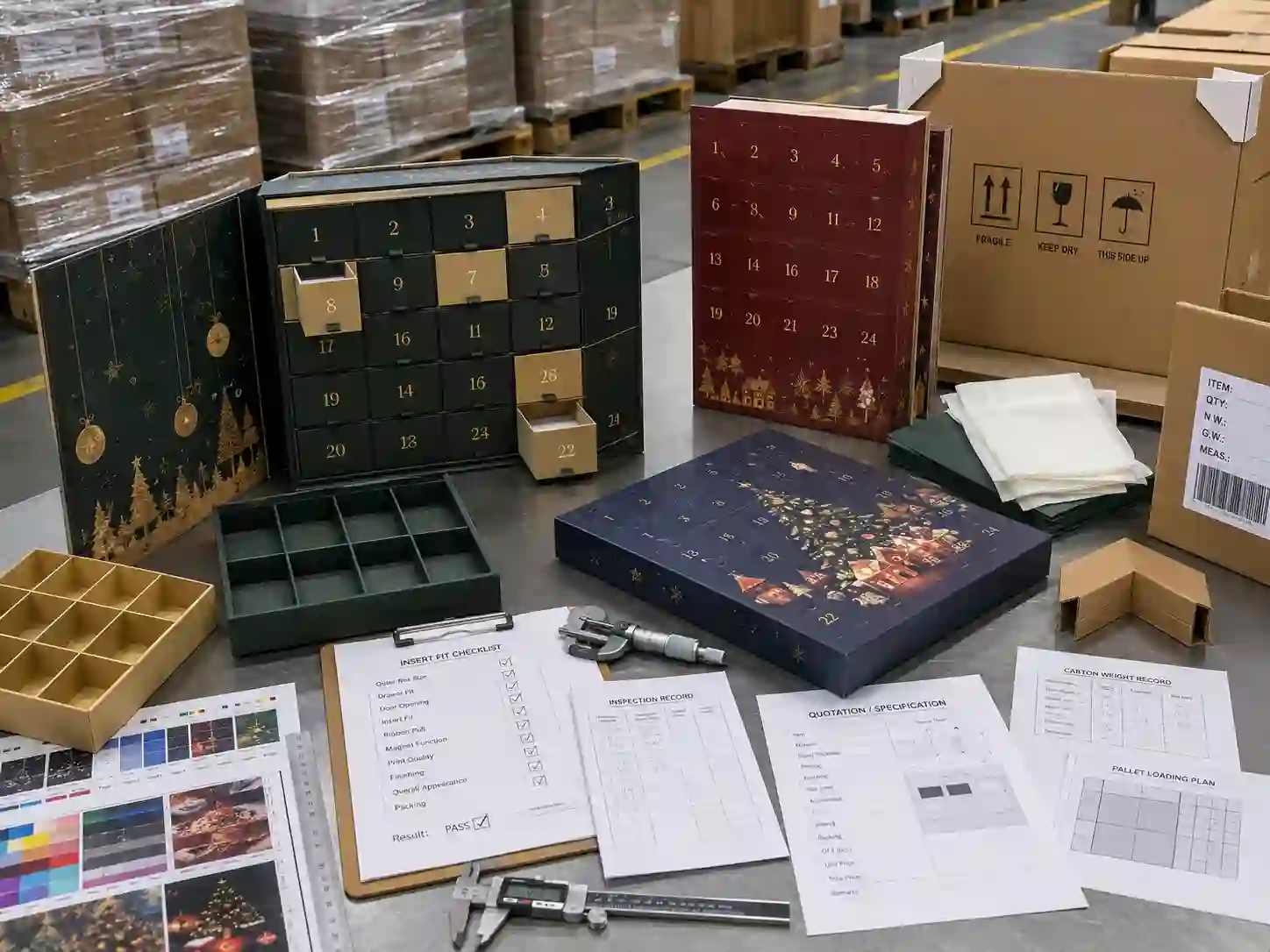
Finished rigid boxes may need tissue sheets, paper pads, protective bags, corner protectors, partitions, and reinforced export cartons. Folding cartons can often ship flat, but printed surfaces and creased panels still require protection against rubbing and compression.
Master cartons should specify the quantity, net weight, gross weight, carton dimensions, product description, purchase-order reference, destination marks, handling symbols, and barcode or label area required by the buyer. Palletized shipments may require corner boards, top sheets, strapping, and stretch wrap.
For projects requiring transport testing, buyers can review the official resources of the International Safe Transit Association and agree with the supplier or testing provider on a suitable test protocol. The selected test should reflect the actual package, pallet pattern, transport route, and distribution environment.
What information should be included in an RFQ?
A complete RFQ produces a more accurate quotation and makes supplier comparison easier. Buyers should prepare the following information before requesting prices:
- Required quantity and possible reorder quantities
- Target delivery date and destination country
- Preferred box style or reference images
- Number of compartments, doors, drawers, or cartons
- Product dimensions, weight, photos, and orientation for every item
- Required outer dimensions or retail-shelf limitations
- Preferred paper, board, insert, and sustainability requirements
- Artwork status and printing-color requirements
- Required foil, embossing, spot UV, lamination, magnets, ribbons, or windows
- Whether products will be packed at the box factory, another facility, or the destination
- Flat-pack or assembled delivery preference
- Individual protection, master-carton, pallet, and shipping-mark requirements
- Requested sample type and approval deadline
- Inspection, testing, documentation, and compliance requirements
- Preferred Incoterm, port, currency, and payment terms
For additional purchasing topics, buyers can review Giftpackpro’s advent calendar box buying guides.
Which common sourcing mistakes should buyers avoid?
The most common mistakes result from incomplete product information, informal sample approval, and quotations that do not use the same specification.
- Designing from estimated product sizes: Small dimension errors can make inserts unusable or prevent drawers from closing.
- Approving an empty box only: The loaded calendar may sag, tip, rattle, or become difficult to open.
- Changing products after insert approval: Even a minor bottle-cap or sachet-size change may require a new insert.
- Comparing total prices without specifications: A lower quotation may use thinner board, simpler inserts, fewer finishes, or weaker packing.
- Ignoring assembled shipping volume: Premium rigid calendars can occupy substantial container or airfreight space.
- Leaving QC language subjective: Appearance and function standards should refer to approved samples, dimensions, and agreed inspection criteria.
- Compressing the schedule: Structural revisions, artwork approval, printing, manual assembly, and export packing all require realistic time.
- Paying without confirming milestones: Payment terms should be connected to clear quotation, sample, production, inspection, and shipment stages.
Frequently asked questions
How long does it take to make custom advent calendar boxes?
The total schedule depends on structural complexity, sample revisions, materials, finishing processes, order quantity, and assembly labor. Buyers should request separate estimates for engineering, sampling, material preparation, mass production, inspection, and transportation rather than relying on one combined lead-time figure.
Do buyers need to send physical products to the factory?
Physical products are strongly recommended for irregular, flexible, fragile, heavy, or high-value items. Accurate dummy samples or 3D data may be used earlier, but the final loaded sample should be checked with production-equivalent products whenever possible.
Can custom advent calendar boxes be shipped flat?
Many folding-carton and modular structures can be shipped flat or partially assembled. Wrapped rigid boxes normally ship assembled, although some hybrid rigid structures can reduce volume. The buyer should compare freight savings against destination assembly labor and quality-control requirements.
What is the difference between a prototype and a pre-production sample?
A prototype primarily verifies design, dimensions, appearance, or fit. A pre-production sample is intended to represent the approved production materials, printing, finishes, construction, accessories, and packing method more closely.
How should payment terms be evaluated?
Payment terms should be reviewed together with the supplier’s legal entity, bank details, production milestones, inspection rights, order value, and commercial history. Buyers should verify any changed bank instructions through a separate trusted communication channel before transferring funds.
What should a detailed quotation show?
A useful quotation should state quantity, unit price, material specifications, dimensions, printing, finishes, insert, accessories, packing, tooling, sample fees, lead time, payment terms, trade terms, quotation validity, and exclusions. Optional structures or finishes should be priced separately where possible.
Prepare the project before requesting a sample or quotation
Understanding how are custom advent calendar boxes made helps buyers compare factories on engineering ability, sample control, communication, QC, export packing, and reliability—not only unit price. Prepare the product list, exact dimensions, compartment plan, quantity, artwork status, finish requirements, delivery destination, target date, and packing method before contacting Giftpackpro.
Buyers with a defined project can request a custom quote and provide product samples, drawings, reference images, or a preliminary specification. Giftpackpro can then review the structure, insert options, sample route, production requirements, and export-packing plan needed for a practical quotation.