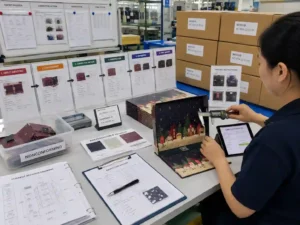
Quick answer: To design reliable subscription advent calendar boxes, begin with the actual products, fulfillment method, opening sequence, retail channel, and shipping conditions—not the graphics. Select a rigid box, drawer box, door-opening box, folding carton, or hybrid structure according to product weight and campaign positioning. Engineer every compartment around measured product dimensions, approve a loaded pre-production sample, and define measurable QC tolerances before mass production. Buyers should also confirm printing references, assembly tests, export-carton specifications, inspection criteria, MOQ, lead time, and quotation assumptions with the supplier before issuing a purchase order.
Subscription campaigns create packaging challenges that ordinary gift boxes do not. The box may contain products with different heights, weights, materials, and levels of fragility, while every compartment must remain attractive and functional throughout the opening period. A successful design therefore combines presentation, product retention, production repeatability, fulfillment efficiency, and transport durability.
What should buyers define before designing subscription advent calendar boxes?
Buyers should define the product assortment, launch quantity, sales channel, opening experience, shipping route, target cost, and required delivery date before choosing a structure. These decisions determine nearly every later specification, including compartment size, insert material, board thickness, printing process, assembly method, and export packing.
Prepare a product schedule containing the following information for every item:
- Product name or internal item code
- Maximum length, width, and height, including caps and external wrapping
- Net and gross weight
- Orientation inside the compartment
- Fragility, leakage, scratching, or crushing risks
- Whether the product is already packed in a sachet, carton, bottle, tube, pouch, or card
- Required compartment number and opening sequence
- Whether the item must be visible, hidden, upright, or easy to remove
Do not design cavities from nominal catalog dimensions alone. A bottle listed as 30 mm wide may have a cap, label seam, shrink sleeve, or decorative feature that increases its usable packing dimension. Physical samples are more reliable than specifications when engineering inserts.
Buyer tip: Group products into size families before creating the layout. Repeating two or three cavity sizes is usually easier to manufacture and assemble than producing 24 completely different compartment geometries.
Which box structure is suitable for a subscription campaign?
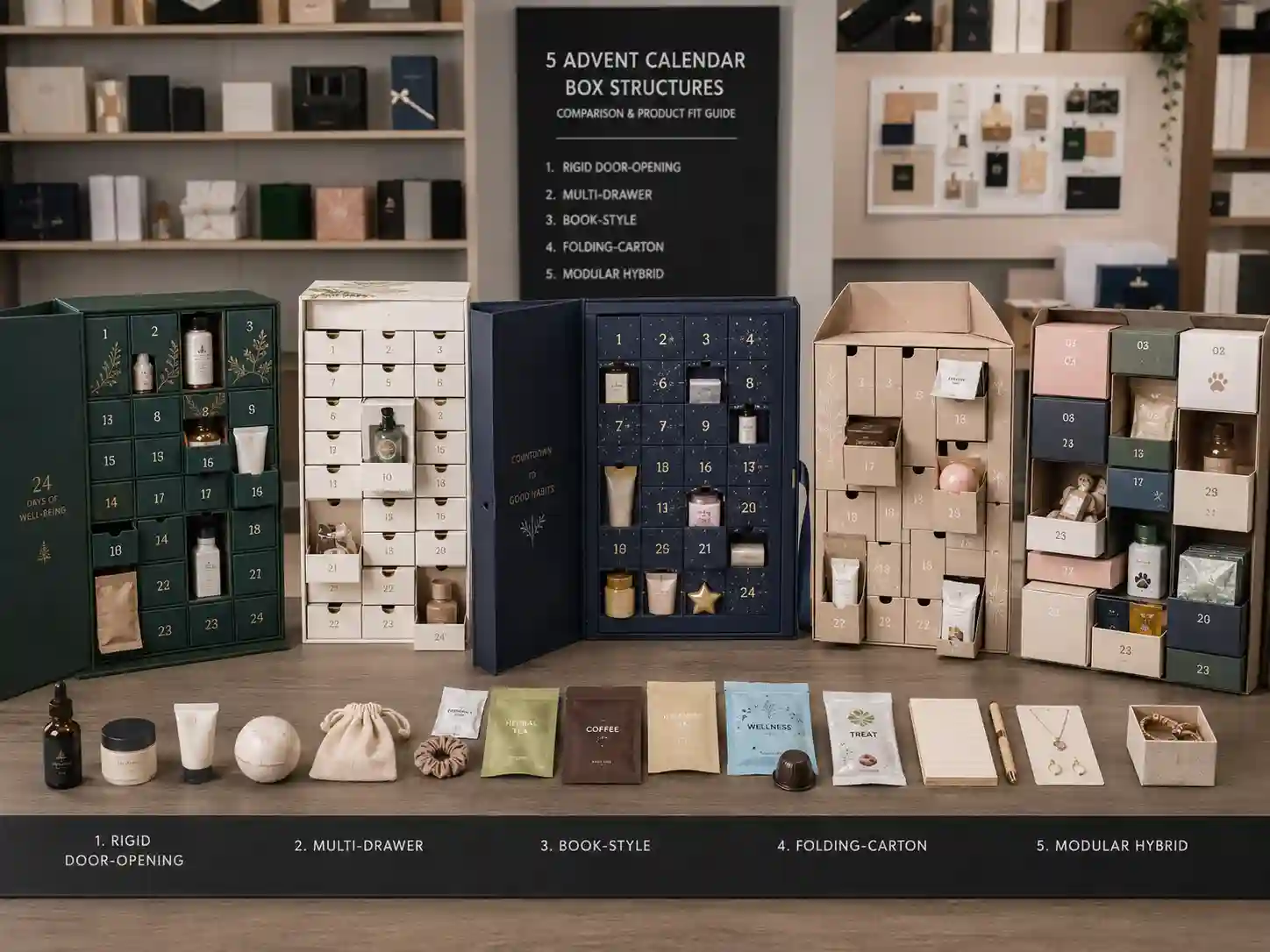
The appropriate structure depends on product weight, perceived value, opening sequence, campaign duration, fulfillment method, and target budget. Rigid structures generally provide stronger presentation and load support, while folding cartons reduce material use, packing volume, and unit cost.
| Structure | Best suited to | Production and QC priorities | Buyer considerations |
|---|---|---|---|
| Rigid door-opening box | Premium beauty, wellness, jewelry, tea, stationery, and mixed gift subscriptions | Door alignment, hinge strength, magnet position, compartment registration, greyboard wrapping | Strong presentation but higher labor, packing volume, and assembly cost |
| Multi-drawer box | Heavier products, repeated item sizes, collectible campaigns, refill concepts | Drawer sliding clearance, handle attachment, sleeve fit, divider strength | Durable and reusable, but tolerances must be controlled carefully |
| Book-style rigid box | Curated subscription sets requiring a premium reveal | Spine folding, cover closure, magnet alignment, tray attachment | Offers a large artwork area and organized presentation |
| Folding-carton calendar | Higher-volume retail, promotional subscriptions, lightweight products | Creasing, die-cut doors, locking tabs, glue control, carton squareness | Lower freight volume and faster assembly, but less load-bearing strength |
| Hybrid modular box | Campaigns combining mailer shipping, removable trays, or replaceable modules | Module fit, tray movement, outer-shell compression, assembly sequence | Flexible for fulfillment, although additional components can increase complexity |
A door-opening calendar is not automatically stronger than a drawer calendar, and a rigid box is not automatically suitable for every premium campaign. Structural performance depends on board grade, box dimensions, internal support, compartment layout, adhesive application, and the distribution of product weight.
How should compartments and inserts be engineered for mixed subscription products?
Each insert must retain the product during handling while still allowing the customer to remove it without damage. The correct solution may use a paper insert, PET tray, EVA insert, foam support, molded pulp tray, internal carton, or a combination of materials.
How much clearance should be allowed around products?
Clearance should be based on material behavior, product tolerance, surface sensitivity, and the expected packing process. A paperboard cavity may need room for folding and manual loading, whereas a thermoformed PET cavity can follow a product shape more closely. Excessive clearance allows products to rotate or collide; insufficient clearance slows assembly and may scratch labels or crush secondary cartons.
Ask the supplier to document the intended fit rather than relying on descriptions such as “tight” or “loose.” The approved sample should establish:
- Maximum permitted product movement inside each cavity
- Acceptable loading and removal force
- Orientation after simulated handling
- Clearance around caps, pumps, seals, and delicate decoration
- Protection between heavy and lightweight items
- Support beneath large cavities to prevent insert collapse
How do common insert materials compare?
Folded paper inserts are printable, compact to ship, and suitable for many lightweight products, but complex cavities may require tabs, bridges, or additional supports. Clear PET trays offer accurate cavity shapes and product visibility, although buyers should verify material thickness, recycled-content requirements, and disposal expectations in the destination market.
EVA inserts provide a clean premium appearance and stable retention for jewelry, accessories, and delicate items. Foam can provide cushioning but requires careful evaluation of density, odor, surface contact, and recyclability. Molded pulp can support sustainability objectives and irregular products, but tooling, surface texture, minimum quantity, and dimensional variation should be reviewed during sampling.
Factory tip: Test the complete loaded box, not only the empty insert. A tray that appears stable on a table may flex after all products are loaded or after the calendar is lifted vertically.
What materials and specifications control durability?
Durability is controlled by the complete construction system: outer paper, paperboard or greyboard thickness, insert design, reinforcement, adhesive coverage, opening hardware, and export packing. Quoting only the external dimensions and printing finish is not enough to reproduce a reliable box.
For a rigid box, the specification should identify greyboard thickness, wrapping paper type, wrapped-edge treatment, internal lining, hinge construction, magnets or ribbon hardware, and the method used to attach the insert. For a folding carton, specify paperboard grade, caliper, grain direction, crease design, locking method, glue areas, and whether the carton is supplied flat or assembled.
Buyers requesting responsibly sourced paper can ask suppliers to verify their chain-of-custody documentation and the exact claim that may be printed. The Forest Stewardship Council paper and packaging guidance provides official information about FSC-certified materials and labeling.
How should artwork and printing be controlled before mass production?
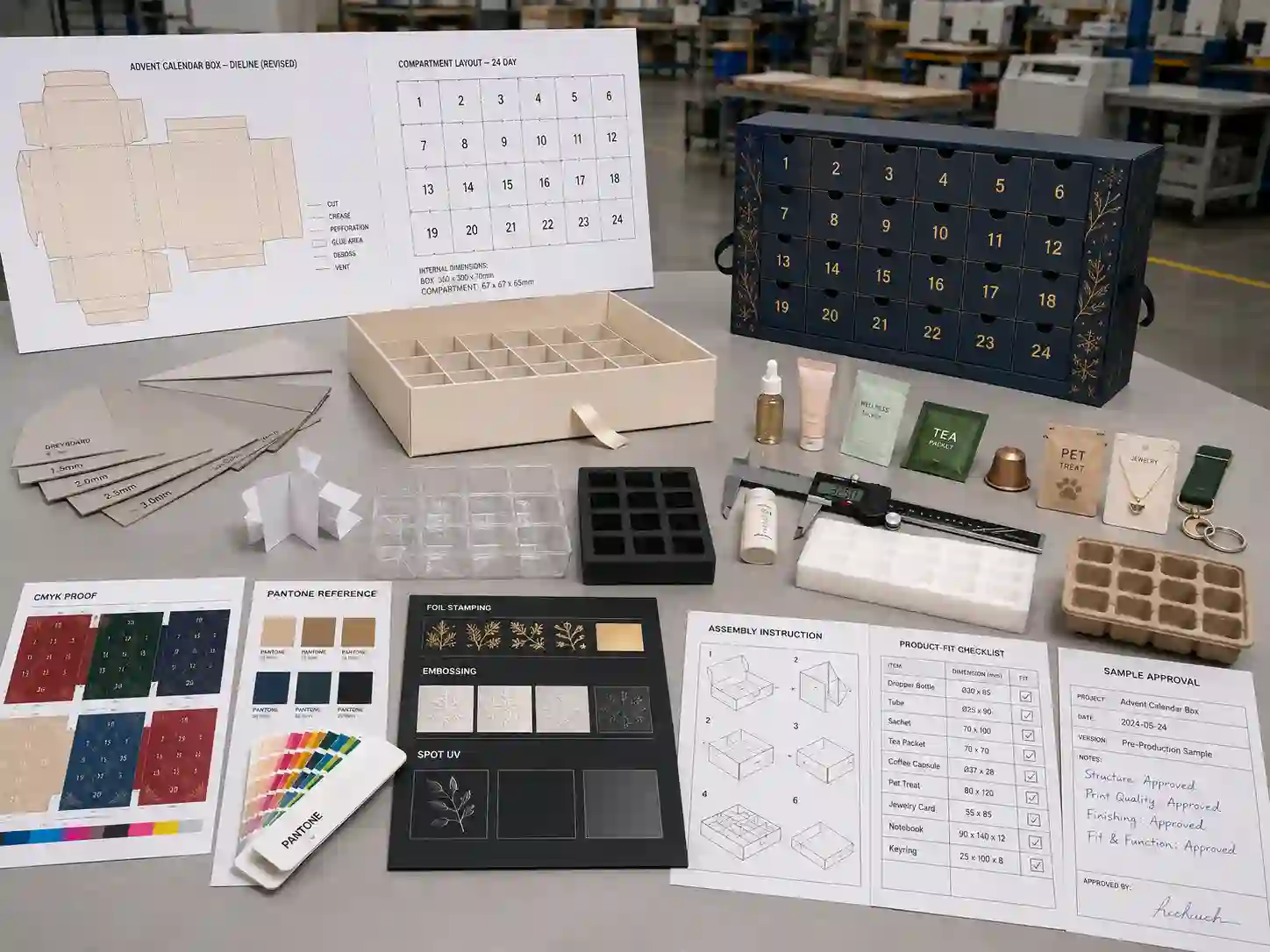
Artwork should be checked against the final production dieline, approved structure, and physical sample. Printing approval must define measurable references for color, finish position, compartment numbering, text accuracy, barcodes, and regulatory information.
A complete artwork review should include:
- Confirm that the dieline version matches the latest approved structure.
- Keep critical text, numbers, and logos away from cut lines, creases, wrapped corners, and door perforations.
- Verify CMYK images, Pantone references, overprint settings, bleed, image resolution, and embedded fonts.
- Check that every numbered door, drawer, or compartment corresponds to the correct product-loading plan.
- Define the location and tolerance of foil stamping, embossing, debossing, and spot UV.
- Confirm whether matte lamination or gloss lamination affects color appearance, scuff resistance, folding, or adhesive performance.
- Test barcodes at final printed size and on the intended surface.
A screen PDF is suitable for checking layout but is not a dependable final color standard. Buyers should agree whether production color will be judged against a Pantone reference, contract proof, press sheet, printed sample, or approved pre-production sample.
QC tip: Foil, embossing, and spot UV should be inspected for both appearance and registration. A decorative finish may look acceptable in isolation but interfere with a crease, door edge, barcode quiet zone, or glued surface.
What production steps should buyers expect?
Production normally moves from material preparation and printing through surface finishing, die cutting, rigid-box forming or carton conversion, insert production, hand assembly, inspection, packing, and shipment. The order may vary by structure, but each stage should have an approved reference and an identified inspection point.
- Incoming material control: Confirm paper, paperboard, greyboard, insert stock, magnets, ribbons, adhesives, and finishing materials against the purchase specification.
- Printing: Check color density, Pantone matching, text clarity, numbering, front-to-back registration, and visible defects.
- Surface finishing: Inspect lamination, foil stamping, embossing, spot UV, varnish, and scratch-sensitive surfaces.
- Die cutting and creasing: Confirm dimensions, cut cleanliness, crease depth, perforation strength, and stripping accuracy.
- Box forming: Control squareness, wrapped corners, board exposure, bubbles, wrinkles, glue marks, hinge movement, and closure alignment.
- Insert production: Check cavity dimensions, folding direction, tray thickness, support points, and product-contact surfaces.
- Final assembly: Verify insert placement, drawer order, door numbering, accessories, and all manual attachment operations.
- Final QC and packing: Inspect appearance, function, quantity, carton protection, labels, shipping marks, and pallet configuration.
Labor-intensive calendars require especially clear work instructions. Workers should not decide compartment order, ribbon length, magnet direction, or insert orientation from memory. Approved samples, visual assembly guides, and first-piece checks reduce variation between production lines and shifts.
Which quality-control points matter most during assembly?
The most important assembly controls are compartment registration, closure function, product fit, adhesive cleanliness, alignment, and repeated-use durability. These checks should be performed during production rather than postponed until the finished quantity is packed.
Practical production QC checklist
- External dimensions and box squareness match the approved tolerance.
- Doors open cleanly without tearing adjacent panels.
- Drawers slide without jamming, falling out, or rubbing printed surfaces.
- Magnets close consistently and are installed with the correct polarity.
- Book-style covers and hinges withstand repeated opening.
- All compartment numbers are present, legible, correctly oriented, and in sequence.
- Products remain in their assigned cavities after handling and inversion tests.
- Heavy products do not deform the insert or pull internal walls away from the box.
- Paper wrapping has no exposed greyboard, bubbles, wrinkles, tears, or excessive glue.
- Foil, embossing, spot UV, and lamination match the approved reference.
- Barcodes and variable labels are placed and scanned as required.
- Accessories, instruction cards, sleeves, ribbons, and protective sheets are complete.
Sampling frequency should reflect the order size, defect risk, manual operations, and buyer requirements. Instead of asking only whether the factory “does QC,” buyers should request the inspection checklist, defect classification, sampling plan, acceptable tolerances, and reporting format.
How should samples be approved before mass production?
Buyers should separate structural approval, print approval, and mass-production approval. One attractive prototype does not prove that the design can be manufactured consistently at the ordered quantity.
A blank sample is useful for confirming dimensions, opening sequence, compartment layout, insert fit, and assembly logic. A printed sample adds artwork, color, materials, and decorative finishes. A pre-production sample should use production-intent materials and processes as closely as practical and becomes the main reference for mass production.
The approval record should state:
- Sample version and date
- Dieline and artwork revision numbers
- Approved materials and finishes
- Product-fit test result for every compartment
- Accepted deviations or corrections still required
- Color and finishing references
- Packing method and carton configuration
- Names or departments authorizing production
Buyer tip: Keep one sealed approval sample with the buyer and one signed reference at the factory. Photographs are useful for communication, but they should not replace a physical reference when texture, fit, movement, or color is critical.
How can buyers evaluate durability before shipment?
Durability tests should reproduce the likely risks of assembly, warehousing, parcel delivery, retail handling, and repeated opening. The required test level depends on whether the calendar travels inside a master carton, ships directly to a subscriber, or enters an e-commerce fulfillment network.
Useful checks may include loaded-box handling, edge and corner inspection, repeated door or drawer cycling, compression review, vibration simulation, drop testing, carton stacking, and environmental conditioning where humidity or temperature may affect paper structures. Testing should use the actual products or weight-equivalent dummies with the correct center of gravity.
Buyers planning formal transport validation can review test procedures published by the International Safe Transit Association and select a protocol appropriate to the distribution route. The test method, sample quantity, pass criteria, and tested packaging configuration should be agreed before testing begins.
How do MOQ, cost, and lead time change with the design?
MOQ, cost, and lead time increase as the design adds unique components, manual assembly, specialized tooling, premium finishes, and multiple production processes. A compact folding carton with repeated cavities will normally be simpler to scale than a rigid calendar containing individually wrapped drawers, ribbons, magnets, several insert materials, and multiple foil colors.
Major cost drivers include:
- Finished dimensions and total paper or board consumption
- Greyboard thickness and rigid-box labor
- Number of drawers, doors, dividers, trays, and accessory parts
- Insert tooling and the quantity of unique cavity shapes
- CMYK coverage, Pantone inks, foil stamping, embossing, spot UV, and lamination
- Manual loading, numbering, gluing, ribbon fitting, and product kitting
- Quality requirements, inspection level, testing, and reporting
- Individual protection, export cartons, palletization, and shipping marks
Ask suppliers to separate sample lead time, material procurement, printing, conversion, assembly, inspection, and export packing in the schedule. Seasonal projects need contingency for artwork revisions, sample corrections, product arrival, and transport—not only the advertised manufacturing time.
How should buyers compare potential suppliers?
Compare suppliers using their technical response, sample quality, production controls, communication accuracy, capacity planning, and packing proposal—not only the lowest unit price. A reliable supplier should identify missing information and explain how the structure will be controlled in mass production.
Supplier decision guide
| Decision factor | Evidence to request | Warning sign |
|---|---|---|
| Engineering capability | Annotated dieline, cavity plan, material specification, tolerance proposal | Quotation issued without reviewing product dimensions or weights |
| Sampling control | Blank sample, printed prototype, revision record, pre-production approval process | Supplier treats a digital rendering as final structural approval |
| Production repeatability | Assembly instructions, first-piece checks, in-process inspection points | No explanation of how manual operations are standardized |
| Printing control | Color reference method, proof options, finishing tolerance | Promises an exact screen-color match without a physical reference |
| QC capability | Inspection checklist, defect criteria, dimensional and function tests | Only a general statement that all products are inspected |
| Export readiness | Carton specification, protection method, pallet plan, shipping-mark confirmation | No consideration of loaded weight, carton compression, or shipping route |
Buyers can review Giftpackpro’s custom advent calendar box services, compare example custom advent calendar box products, and learn more about the Giftpackpro packaging factory before discussing a project with a custom advent calendar boxes manufacturer.
What export-packing details should be confirmed?
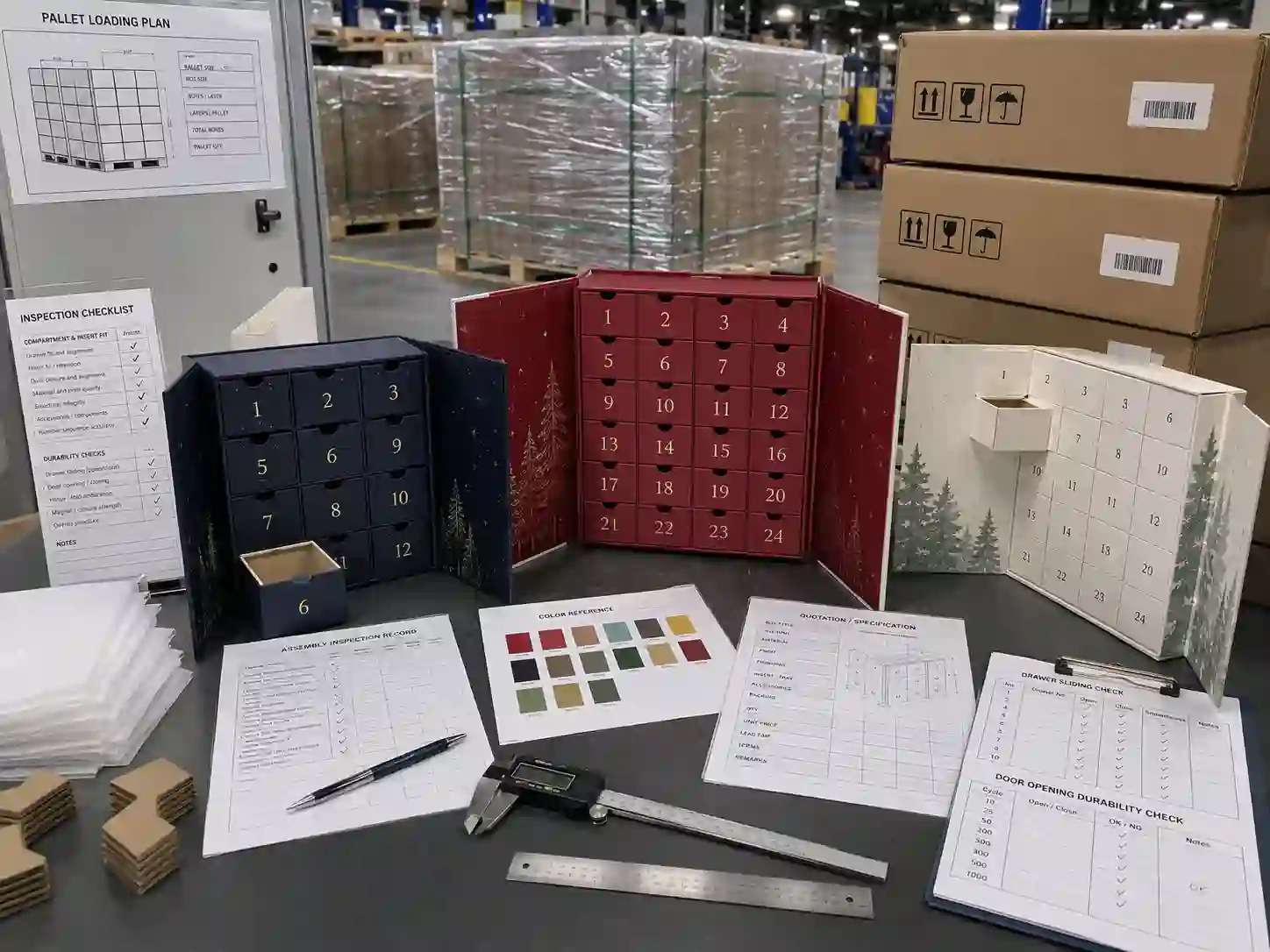
Export packing should prevent scuffing, edge damage, moisture exposure, crushing, and movement while keeping carton weight practical for handling. The correct method depends on whether boxes are shipped empty, flat, assembled, product-loaded, individually mailed, or delivered to a fulfillment center.
Confirm the following before approving production:
- Individual tissue, sleeve, polybag, paper wrap, or protective sheet requirements
- Paper pads, dividers, corner protectors, and void-filling method
- Export-carton material, dimensions, gross weight, and box quantity
- Product orientation inside the carton
- Maximum carton stacking and pallet height
- Pallet material or treatment requirements for the destination
- Stretch wrapping, strapping, edge boards, and moisture protection
- Shipping marks, purchase-order numbers, carton numbers, and barcode labels
- Whether the approved packing configuration must be used for transport testing
A durable presentation box can still arrive damaged if it moves inside an oversized export carton. Carton protection and packing density must be evaluated together with the finished box structure.
What information is needed for an accurate quotation?
An accurate quotation requires more than the external box size and order quantity. Provide a complete RFQ package so suppliers quote the same construction, quality level, and packing scope.
RFQ preparation checklist
- Required quantity and possible reorder quantities
- Target delivery date and destination country or port
- Product list with dimensions, weights, photographs, and physical samples when available
- Preferred structure or reference photographs
- Compartment count and opening sequence
- Material, sustainability, and insert preferences
- Artwork files, color requirements, and finishing details
- Blank sample, printed sample, and pre-production sample requirements
- Product-loading or kitting responsibility
- QC tolerances, inspection requirements, and testing expectations
- Individual packing, export-carton, pallet, and shipping-mark requirements
- Quotation terms required, such as tooling, sample, unit, packing, and freight costs
State whether the quotation should cover empty packaging or fully assembled and product-loaded calendars. This single difference can change labor planning, factory space, lead time, quality responsibility, and shipping volume significantly.
Which common design and production mistakes should buyers avoid?
The most costly mistakes usually occur when artwork is approved before structural testing, product dimensions are incomplete, or the project enters production without measurable standards.
- Choosing a box style before calculating total loaded weight
- Using identical cavity clearance for bottles, sachets, cartons, and cards
- Approving an empty insert without testing the fully loaded calendar
- Ignoring drawer clearance after wrapping paper and lamination are applied
- Placing numbers or graphics across doors, folds, perforations, or wrapped edges
- Using too many unique components without considering assembly time and error risk
- Approving color only from a monitor
- Changing products after the insert tooling or dieline has been approved
- Leaving QC tolerances and defect standards undefined
- Requesting a price without specifying export packing or pallet requirements
- Planning production from the launch date without allowing time for sample revisions
Frequently asked questions about subscription advent calendar boxes
Should the structure be designed before the artwork?
Yes. Approve the product layout, insert, opening method, dimensions, and manufacturing dieline before finalizing artwork. Structural changes can move cut lines, doors, folds, glue areas, and visible panels.
Is a rigid box always better for subscription campaigns?
No. A rigid box provides strong presentation and support, but it also increases material, labor, freight volume, and assembly requirements. A well-engineered folding carton may be more appropriate for lightweight products and higher-volume campaigns.
What sample should be approved before production?
Approve a loaded pre-production sample whenever practical. It should represent the intended materials, printing, finishing, insert fit, opening function, and packing method closely enough to serve as the production reference.
Can one insert material hold every product type?
Sometimes, but mixed subscriptions often need combined solutions. A folded paper insert may organize most items while PET, EVA, foam, molded pulp, or small internal cartons provide additional retention for selected products.
How can buyers reduce production defects?
Freeze product dimensions early, use controlled dieline revisions, approve physical references, define tolerances, create visual assembly instructions, and inspect first pieces before full assembly begins.
When should export packing be tested?
Test it after the box, insert, products or weight dummies, individual protection, export carton, and pallet configuration are finalized. Changing the carton quantity or orientation can change transport performance.
Prepare your project for sampling and quotation
For an efficient review of subscription advent calendar boxes, prepare your product dimensions and weights, target quantity, preferred structure, compartment plan, artwork requirements, destination, delivery date, QC expectations, and export-packing needs. Giftpackpro can then assess the dieline, insert method, materials, sample stages, production controls, MOQ, lead time, and quotation scope.
Explore additional advent calendar box buying guides or request a custom quote with your RFQ files and product information. A complete technical brief allows the supplier to identify risks before sampling and build quality controls into the project before mass production begins.