
Quick answer: Subscription advent calendar boxes combine a multi-compartment unboxing format with a curated product assortment designed for subscription brands, seasonal launches, influencer kits, and limited-edition campaigns. Buyers should select the structure only after confirming product dimensions, total loaded weight, opening sequence, insert requirements, fulfillment method, and shipping conditions. Before mass production, approve a blank structural sample, a printed sample, and, when the project is complex, a fully loaded pre-production sample. The most reliable quotation is based on a confirmed dieline, material specification, insert layout, artwork files, order quantity, packing method, delivery destination, and required launch date.
Unlike a standard monthly mailer, an advent calendar must hold many individual products in a controlled arrangement while maintaining a consistent opening experience. That makes product-fit engineering, prototype testing, assembly tolerance, and export protection especially important for subscription companies managing several SKUs in one campaign.
When do subscription advent calendar boxes make commercial sense?
Subscription advent calendar boxes are most suitable when a brand wants to turn a curated assortment into a structured, limited-edition campaign rather than ship products loose in a standard subscription carton. They are commonly used for beauty minis, wellness products, tea, coffee, confectionery, stationery, accessories, pet products, small gifts, and mixed discovery sets.
The format works particularly well for subscription businesses because they already have experience combining multiple SKUs, coordinating inventory, and communicating a recurring discovery concept. An advent calendar converts those strengths into a premium retail, e-commerce, or member-exclusive product.
- Member retention campaigns: A premium calendar can reward existing subscribers or support annual membership renewals.
- Seasonal acquisition: A limited-edition calendar can introduce new customers to several products in one purchase.
- Brand collaboration: Compartments can hold products from multiple participating suppliers, provided all dimensions and delivery dates are controlled.
- Influencer and PR kits: A lower-volume premium structure may be used for media outreach, launch events, or key-account presentations.
- Retail and e-commerce sales: The calendar can be supplied as a shelf-ready product, a direct-to-consumer shipper, or a gift set packed inside an outer transit carton.
Buyer tip: Confirm whether the calendar is primarily a presentation box, an e-commerce shipping pack, or both. A decorative rigid box may still require a separate corrugated mailer to survive parcel delivery.
Which structure is best for subscription advent calendar boxes?
The best structure depends on product depth, total weight, target price, packing method, and the desired opening experience. Rigid drawer and door-opening structures offer a premium presentation, while folding carton formats reduce unit weight, storage volume, and assembly cost.
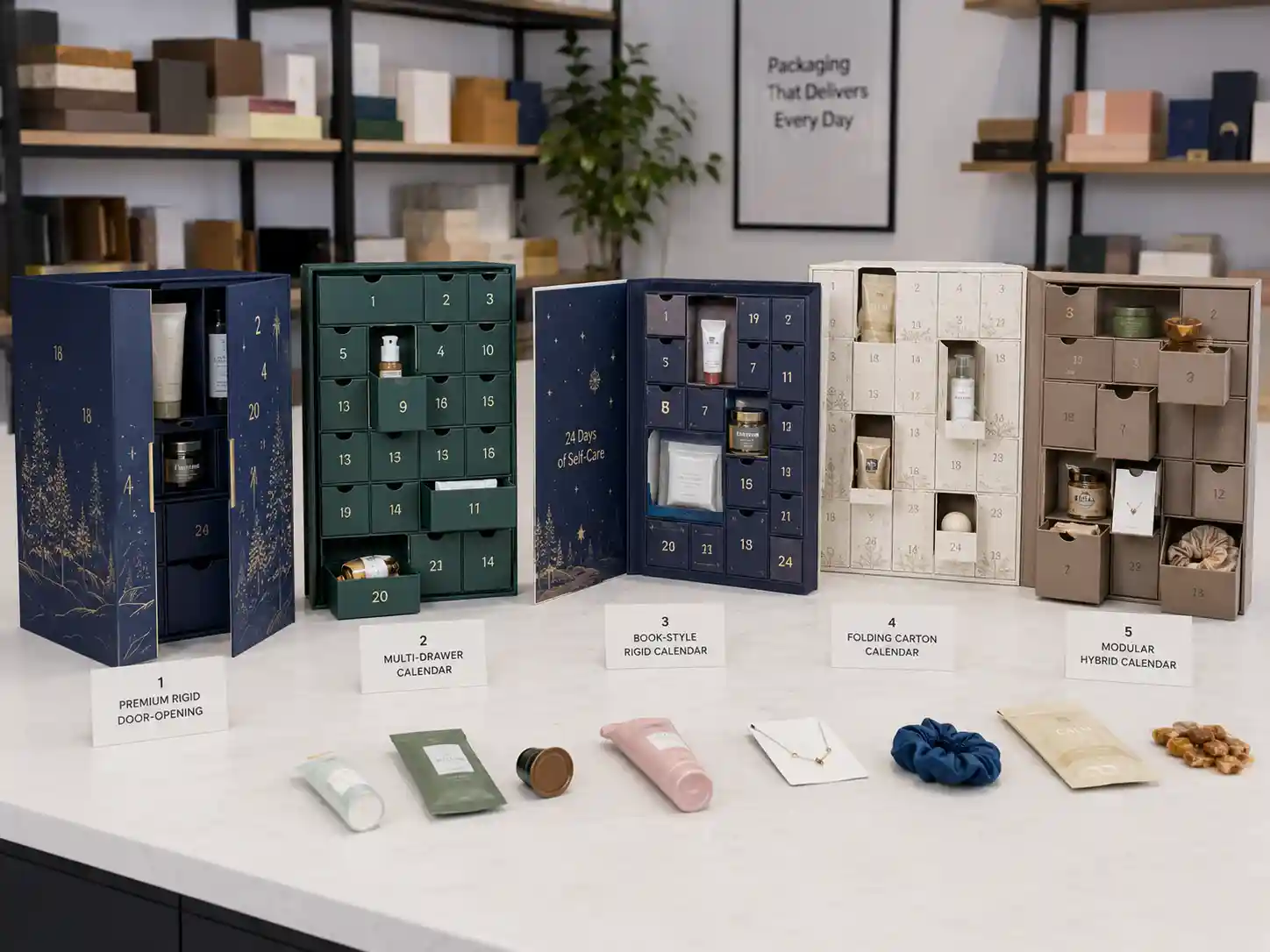
| Structure | Best suited to | Main advantages | Points to test during sampling |
|---|---|---|---|
| Rigid door-opening box | Premium beauty, wellness, jewelry, and mixed gift subscriptions | Strong presentation, large graphic area, controlled daily opening sequence | Door alignment, hinge strength, magnet position, compartment access, loaded-box sagging |
| Multi-drawer rigid box | Products with different heights, weights, or category groupings | Individual removable drawers, reusable appearance, flexible assortment planning | Drawer clearance, ribbon-pull strength, friction, tipping risk, weight distribution |
| Book-style rigid box | Compact premium sets and influencer kits | Protective outer cover, clean presentation, suitable for molded or paper inserts | Spine tolerance, lid closing force, insert compression, magnet closure |
| Folding carton calendar | Higher-volume retail or e-commerce campaigns | Lower material use, efficient flat packing, reduced freight volume | Panel bowing, perforation performance, glue strength, assembly time, crush resistance |
| Hybrid rigid shell with inner cartons | Subscription assortments packed by different vendors or fulfillment teams | Replaceable inner modules, easier SKU separation, premium exterior | Module consistency, cumulative tolerance, loading sequence, carton movement in transit |
A 24-compartment calendar does not automatically require 24 identical spaces. Subscription assortments often include sample sachets, small bottles, tubes, cards, wrapped products, and one or two higher-value items. Designing several compartment sizes can improve product fit and reduce unnecessary box volume.
Factory tip: A larger calendar is not always stronger. Increasing the overall footprint without revising the greyboard thickness, internal dividers, hinge construction, and outer carton protection can create bowing or corner damage.
How should buyers engineer inserts for a mixed subscription assortment?
The insert should be selected after measuring every product in its final selling condition, including caps, wrappers, pouches, labels, and protective bags. For a mixed subscription assortment, the insert must prevent movement without making products difficult to remove.
Paper inserts and compartment dividers
Folded paperboard inserts are suitable for lightweight products and campaigns that prioritize recyclability, efficient storage, and printing flexibility. They can create individual wells, cross-dividers, trays, or small inner cartons. However, narrow folds and tall unsupported walls must be tested because repeated handling can distort the layout.
PET trays
A clear or colored PET tray provides accurate cavities and good product visibility. It is useful for cosmetic minis, small bottles, capsules, and products requiring repeatable positioning. Buyers should confirm tray thickness, cavity depth, flange width, release angle, and whether the tray is visible after a door is opened.
EVA and foam inserts
EVA insert and foam solutions provide strong product retention for fragile, premium, or irregular items. They can be cut to detailed shapes but may increase material cost and reduce the packaging’s paper-based appearance. Surface scratching, odor, color transfer, and compression recovery should be checked during prototype review.
Molded pulp inserts
Molded pulp can support sustainability-oriented projects and protect products with suitable geometry. It usually requires more tooling and dimensional allowance than a precision-cut foam insert. Texture, edge definition, cavity tolerance, color consistency, and minimum production quantity should be reviewed with the supplier.
Practical product-fit rule: Do not approve an insert using product dimensions from a spreadsheet alone. Test actual production products or verified 3D samples because caps, seals, folded sachets, and wrapper seams often exceed the nominal dimensions.
What information is needed before the first prototype?
A supplier can build a more accurate prototype when the buyer provides a complete product matrix, structural objective, visual references, and packing plan. Missing product data is one of the main causes of repeated revisions.
Prepare the following information before requesting custom advent calendar box services:
- Product name, SKU code, quantity per calendar, and final packed dimensions for every item.
- Individual product weight and total estimated loaded weight.
- Preferred opening sequence and compartment numbering plan.
- Required box style, approximate external size, and presentation direction.
- Product restrictions, including fragile caps, glass containers, food-contact concerns, or leakage risk.
- Preferred insert material and sustainability objectives.
- Artwork status, brand color references, and required finishes.
- Target order quantity, destination market, and required delivery date.
- Whether calendars will be packed by the factory, the buyer, or a third-party fulfillment center.
- Whether the finished box must pass parcel, pallet, retail-display, or other distribution tests.
Buyers can review different custom advent calendar box products before choosing a prototype direction. A structure reference helps communication, but the final design still needs to be engineered around the actual assortment.
Which sample stages should a buyer approve?
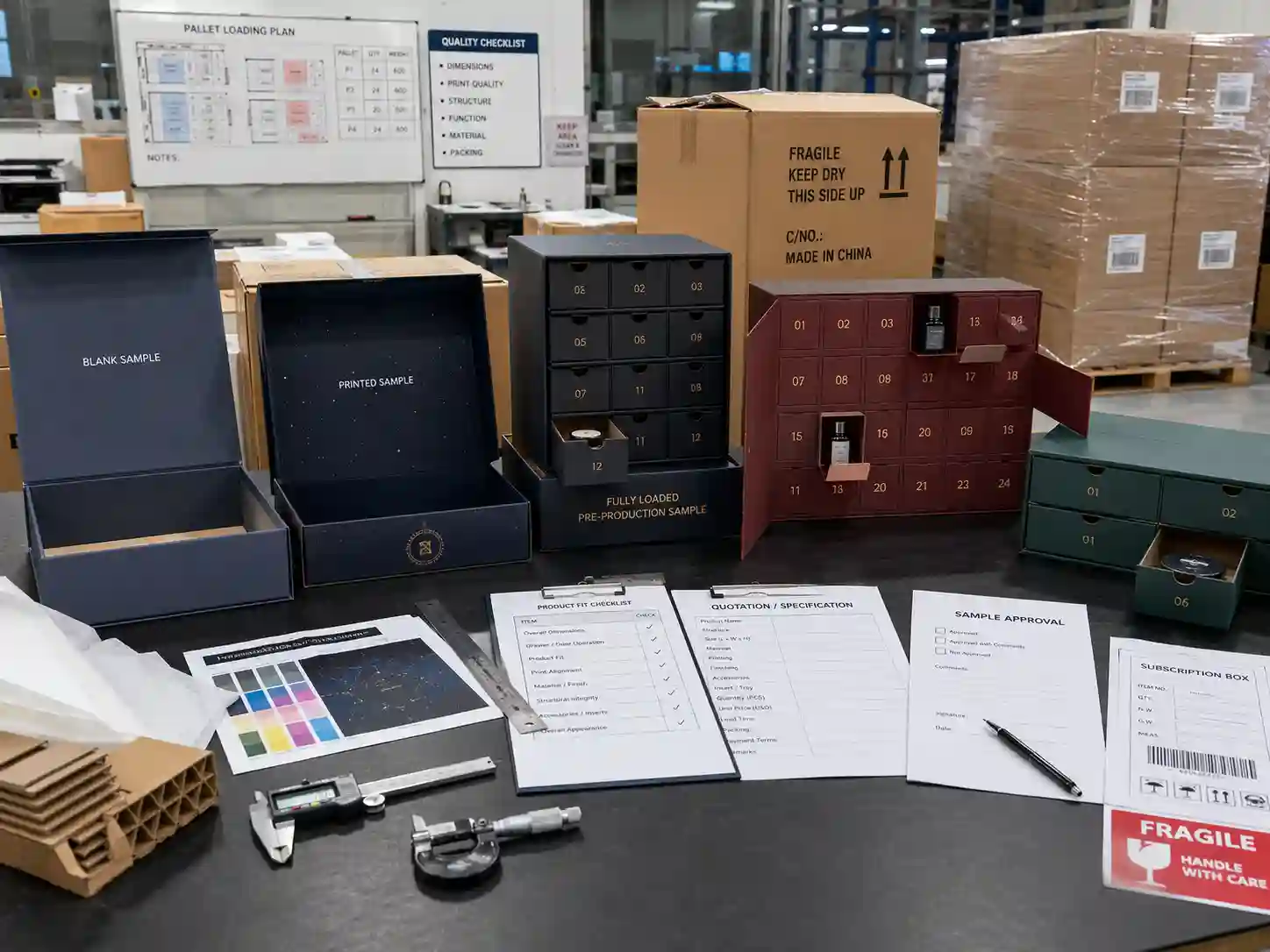
Most projects should use at least a blank sample and a printed sample. A pre-production sample is recommended when the box has many components, tight product tolerances, manual assembly steps, premium finishes, or a high loaded weight.
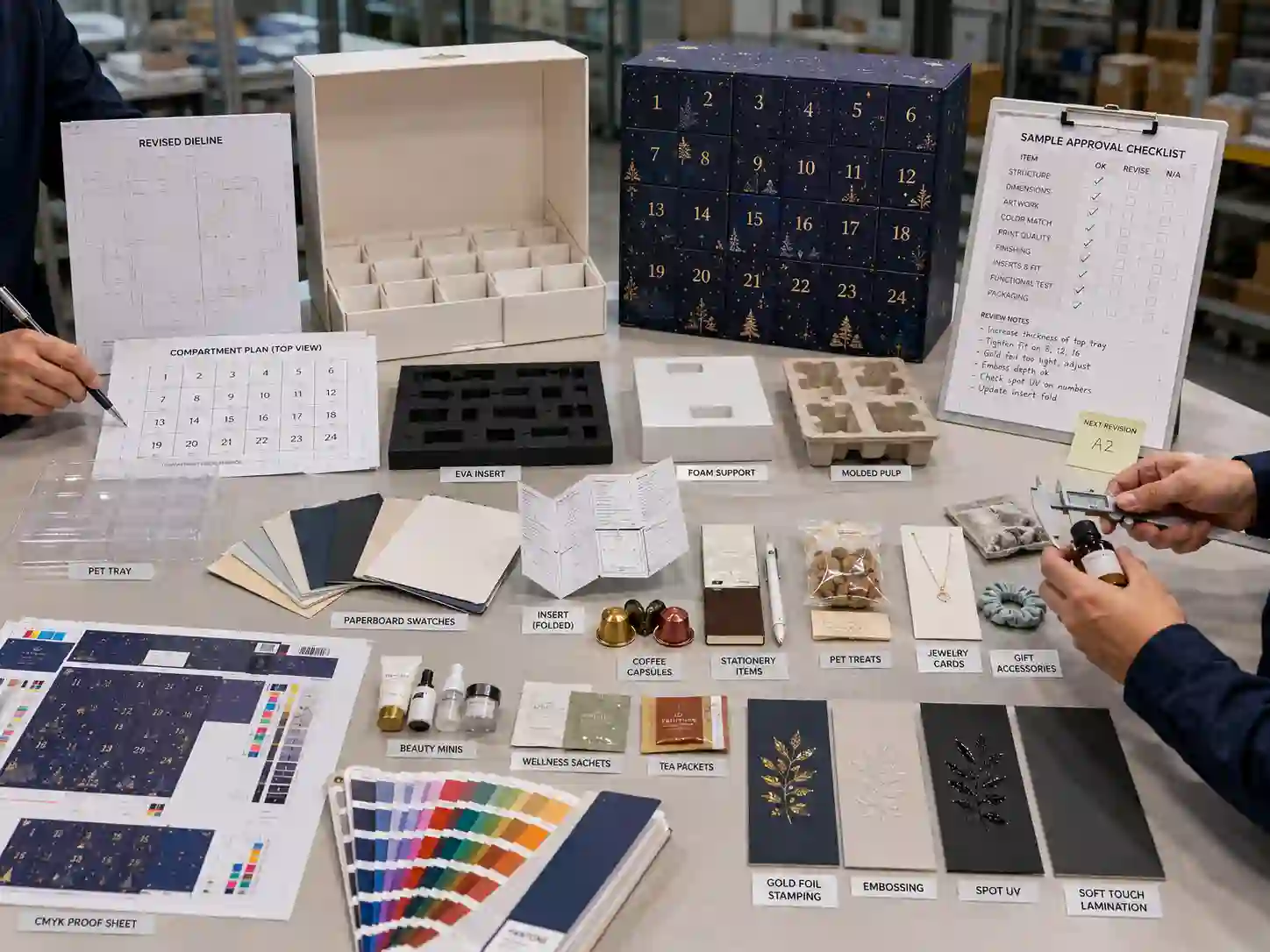
1. Blank structural sample
A blank sample is used to confirm size, structure, opening sequence, insert layout, product fit, and assembly method before spending time on final printing. It may be produced from production-grade or substitute material, so the supplier should identify any differences from the intended bulk specification.
During blank sample review, check:
- Whether every product enters and exits its compartment easily.
- Whether doors, drawers, ribbons, hinges, and magnets function as intended.
- Whether the box remains level when fully loaded.
- Whether heavy products need reinforced compartments or a different position.
- Whether the external dimensions are practical for shipping cartons, shelves, and fulfillment stations.
- Whether assembly and product loading can be completed without damaging printed surfaces.
2. Printed sample
A printed sample confirms artwork placement, CMYK reproduction, Pantone colors, lamination, foil stamping, embossing, spot UV, numbering, and overall appearance. It should also reveal whether graphics remain aligned across doors, drawers, wrapped edges, and adjoining panels.
A digital print sample may be appropriate for checking layout and general appearance, but it may not reproduce offset printing, metallic foil, or production lamination exactly. Ask the supplier to state which colors and finishes are simulated.
3. Fully loaded sample
A fully loaded sample tests the interaction between the box and the actual assortment. It can identify insert deformation, drawer friction, product movement, uneven weight distribution, or closure problems that are not visible in an empty prototype.
4. Pre-production sample
A pre-production sample should represent the approved production specification as closely as possible. It is particularly useful when the project includes custom tooling, multiple printed components, complex hand assembly, strict color requirements, or products supplied by several vendors.
Quotable specification: Sample approval should cover measurable construction details, not only visual appearance. Record the approved dimensions, materials, board thickness, insert layout, print references, finishes, accessories, packing method, and acceptable tolerances.
How should artwork and the dieline be checked before printing?
Artwork should be applied only to the latest approved dieline, with each door, drawer, fold, glue area, wrapped edge, and compartment number clearly identified. Final files should include bleed, vector text or outlined fonts, linked images, finishing layers, and color references.
- Confirm that the dieline revision number matches the approved structural sample.
- Check the reading direction of every numbered door and removable drawer.
- Keep essential text away from folds, perforations, wrapped corners, and thumb notches.
- Separate foil stamping, embossing, debossing, and spot UV into clearly named layers.
- Specify whether colors are CMYK, Pantone, or a combination.
- Review barcode size, quiet zones, and contrast before production. Buyers can reference official guidance from GS1 barcode standards.
- Approve a physical color reference when exact brand-color matching is important.
Matte lamination can create a restrained premium surface but may show rubbing or fingerprints depending on the film. Gloss lamination increases reflectivity and can make colors appear more saturated. Foil, embossing, and spot UV should be positioned with allowance for folds and registration tolerance.
What causes prototype revisions and how can buyers control them?
Most revisions come from changing products, incomplete measurements, unrealistic insert tolerances, artwork applied to an outdated dieline, or a structure selected before the distribution method is known. Revision control is easier when each sample round has a defined purpose.
| Observed problem | Likely cause | Recommended correction |
|---|---|---|
| Products rattle during handling | Cavity too large or insufficient top restraint | Reduce cavity clearance, add paper locks, revise tray geometry, or add a protective pad |
| Drawers are difficult to open | Insufficient clearance, board swelling, or misaligned wrapping | Adjust drawer tolerance and test with production materials after lamination |
| Doors tear at the perforation | Perforation pattern or paper grain is unsuitable | Revise cut-to-tie ratio, grain direction, door size, or opening notch |
| Loaded box bends or twists | Uneven weight distribution or insufficient internal support | Reposition heavy SKUs, add dividers, increase board strength, or reduce unsupported spans |
| Artwork does not align across panels | Dieline change, wrapping tolerance, or insufficient bleed | Update artwork on the approved dieline and define critical registration areas |
| Calendar is too expensive to ship | Oversized structure or inefficient export-carton utilization | Reduce unused cavity space, compare folding and rigid options, and calculate carton loading earlier |
Buyer tip: Consolidate comments into one marked-up review file for each sample round. Separate required corrections from optional design preferences and identify who has final approval authority.
How do MOQ and sampling choices affect cost and lead time?
MOQ depends on the structure, printing method, material procurement, tooling, finishing processes, and amount of manual assembly. A simple folding carton calendar may support a different quantity range from a large rigid drawer box with several insert materials.
Sampling cost may include structural engineering, dieline development, cutting, digital printing, offset setup, foil or embossing dies, molded tray tooling, hand assembly, and international courier charges. Some production finishes can be simulated for an early prototype, while others require production-like tooling.
Lead time should be divided into separate stages:
- Product data and design brief preparation.
- Dieline development and engineering review.
- Blank sample production and buyer evaluation.
- Artwork adaptation and printed sample production.
- Revision and final approval.
- Material procurement and pre-production checks.
- Mass production, assembly, QC, packing, and shipment.
For seasonal programs, the approval deadline is often more important than the factory completion date. Product changes late in sampling can affect the insert, box dimensions, artwork, export carton, pallet plan, and freight quotation simultaneously.
How should buyers evaluate a potential packaging supplier?
Compare suppliers by their ability to manage structural engineering, sample revisions, component consistency, production control, and export packing—not only by the first unit price. A technically complete quotation is usually more useful than a low estimate based on missing specifications.
Practical supplier decision guide
- Choose a rigid-box specialist when premium appearance, wrapped edges, drawers, magnets, and hand assembly are central to the project.
- Choose a folding-carton solution when flat packing, lower freight volume, automated cutting, and retail-scale quantities are priorities.
- Request insert engineering support when the assortment includes many sizes, fragile items, glass containers, or changing SKUs.
- Request packing support when products will be delivered to the packaging factory for final calendar assembly.
- Require documented sample approval when several teams, vendors, or countries are involved in the project.
Ask whether the supplier can explain material substitutions, production tolerances, color-control methods, inspection points, defect handling, and carton-loading calculations. Buyers may also review the capabilities of the Giftpackpro packaging factory and compare them with the technical needs of the project.
Which QC checks matter before mass production and shipment?
QC should verify the approved sample, production specification, functional performance, appearance, dimensions, product fit, assembly, and packing method. Complex calendars require checks at several production stages rather than only after final assembly.
Pre-production checks
- Confirm approved artwork, dieline version, materials, colors, finishes, insert files, and accessories.
- Compare incoming paperboard, greyboard, films, ribbons, magnets, and insert materials with approved references.
- Verify cutting dies, foil dies, embossing plates, and tray tooling before the full run.
- Produce a pre-production sample or first-off unit for buyer or internal approval when required.
In-process checks
- Measure cut components and assembled boxes at defined intervals.
- Check wrapping alignment, glue application, door perforations, drawer clearance, and magnet polarity.
- Compare printed color with the approved proof under controlled lighting.
- Confirm that compartment numbers, barcodes, warnings, and shipping-related information are correct.
Final inspection checks
- Inspect appearance, cleanliness, scratches, dents, glue marks, and damaged corners.
- Test door opening, drawer sliding, ribbon pulls, closures, and product removal.
- Check the fully loaded box for rattling, distortion, or product-to-product contact.
- Verify unit quantity, accessories, protective materials, carton labels, and shipping marks.
- Confirm export-carton dimensions, gross weight, net weight, pallet pattern, and stretch wrapping where applicable.
QC tip: A visually acceptable empty calendar can fail after loading. Functional inspection should include representative product weight and the actual packing orientation.
What export packing is appropriate for subscription advent calendar boxes?
Export packing should protect printed surfaces, corners, closures, inserts, and internal products throughout handling and transport. The correct method depends on whether the calendars ship empty, fully assembled, or fully loaded.
Common protection includes tissue sheets, paper pads, protective sleeves, corner protectors, inner cartons, reinforced export cartons, moisture-resistant liners where necessary, pallet sheets, strapping, and stretch wrap. Shipping marks and barcode label areas should be confirmed before carton printing.
For parcel distribution, consider testing the packed calendar inside its e-commerce mailer. For palletized transport, check carton compression and pallet overhang. Buyers can review distribution-testing concepts through the official International Safe Transit Association, then agree on a suitable test plan with their supplier or test laboratory.
What should be included in a quotation request?
A complete RFQ should describe the physical packaging, printing, order quantity, sample needs, product-loading responsibility, packing method, destination, and deadline. Providing only an inspiration image rarely produces a comparable quotation.
Quotation preparation checklist
- Requested structure and opening format.
- External box dimensions or complete product matrix.
- Number and size of compartments.
- Paperboard, greyboard, insert, and accessory preferences.
- Printing colors and required surface finishes.
- Order quantity and possible quantity breaks.
- Blank sample, printed sample, and pre-production sample requirements.
- Whether products will be packed into the calendar by the supplier.
- Unit packing, export-carton, pallet, and shipping-mark requirements.
- Delivery destination, trade term, and required arrival date.
- Inspection, testing, documentation, and compliance expectations.
Buyers can work with a custom advent calendar boxes manufacturer to convert this information into an engineered specification. Additional planning topics are available in the advent calendar box buying guides.
Which common buying mistakes should be avoided?
The most costly mistakes are usually caused by approving the appearance before confirming product fit, shipping efficiency, and production feasibility. Avoid treating the calendar as a graphic-design project only.
- Starting the dieline before all product dimensions are confirmed.
- Using prototype products that differ from the final production SKUs.
- Approving an empty sample without checking the loaded weight.
- Assuming a digital sample will match offset printing and special finishes exactly.
- Changing the product assortment after artwork approval.
- Ignoring fulfillment labor and loading sequence.
- Failing to define acceptable color, dimension, and assembly tolerances.
- Calculating freight only after the box size is finalized.
- Comparing quotations that use different materials, inserts, packing methods, or delivery terms.
- Skipping the pre-production check for a complex or high-value order.
Frequently asked questions about subscription advent calendar boxes
Can every subscription product assortment use the same compartment size?
No. A mixed assortment usually benefits from several compartment dimensions. Standardizing selected modules can simplify production, but each cavity must still control the assigned product without excessive movement.
Is a blank sample necessary before a printed sample?
It is strongly recommended for a new structure. The blank sample allows the buyer to correct size, opening, insert, and product-fit problems before artwork and premium finishes add cost.
What is the difference between a printed sample and a pre-production sample?
A printed sample demonstrates design and finishing, but it may use digital printing or simulated materials. A pre-production sample is intended to represent the approved mass-production specification more closely.
Can products be packed into the calendar at the packaging factory?
Potentially, but the buyer must confirm product delivery, inventory control, handling requirements, packing instructions, quality responsibilities, and any relevant regulatory conditions before quotation.
How early should a seasonal subscription calendar project begin?
Begin early enough to complete product measurement, structural development, at least one sample revision, artwork approval, mass production, inspection, and international shipping before the launch date. The required schedule varies with complexity and transport method.
How can buyers reduce packaging and freight cost?
Reduce unused compartment space, compare rigid and folding structures, simplify insert materials, limit unnecessary finishes, optimize export-carton loading, and request quantity-break quotations based on the same specification.
Prepare your sample and quotation request
Before asking Giftpackpro to develop subscription advent calendar boxes, prepare the product matrix, actual samples or verified dimensions, preferred structure, target quantity, artwork status, packing responsibility, destination, and launch deadline. This information allows the engineering team to recommend a suitable sample sequence and prepare a more accurate quotation.
Review available custom advent calendar box services, then request a custom quote with your product and packaging requirements. Early confirmation of the dieline, insert fit, sample approval criteria, QC plan, and export packing method helps reduce revisions before mass production.


