
Complex advent calendar structures often require drawers, doors, hinges, magnets, ribbons, and multiple panels, which can increase manual assembly time and inconsistency. To reduce hand assembly packaging requirements, engineers should simplify structural interactions, improve component positioning, validate assembly sequences, and confirm production feasibility before mass production. The goal is not to remove all manual work, but to design a structure that is easier, faster, and more repeatable to assemble.

How Can Structural Design Reduce Hand Assembly Packaging Requirements?
The most effective way to reduce assembly labor is to solve manual handling issues during the structural design stage. A well-developed advent calendar structure minimizes unnecessary folding, alignment, fixing, and adjustment steps during production.
Engineers usually review the relationship between drawers, doors, hinges, magnets, and panels before approving a structure. For example, a drawer system that slides smoothly with accurate tolerances requires fewer manual corrections than one that depends on workers adjusting parts during assembly.
| Structural Area | Assembly Challenge | Design Approach |
|---|---|---|
| Drawer system | Repeated adjustment during insertion | Optimize drawer clearance and guide structure |
| Door panels | Uneven alignment or difficult closing | Improve hinge positioning and panel support |
| Magnet closure | Manual repositioning of magnets | Define accurate magnet locations and fixing methods |
| Outer panels | Multiple folding and bonding steps | Simplify board structure and assembly sequence |
What Structural Changes Usually Reduce Manual Assembly Steps?
Reducing hand assembly normally comes from removing unnecessary operations rather than simply increasing automation. The structure should allow operators to complete predictable actions with fewer adjustments.
Can Drawer and Door Mechanisms Be Simplified?
Yes. Drawer and door mechanisms are often the largest contributors to assembly time. Designers can reduce labor by standardizing drawer positions, limiting separate reinforcement pieces, and ensuring doors close correctly without repeated alignment.
For hinged or magnetic doors, engineers should check:
- hinge placement accuracy;
- opening and closing movement;
- magnet attraction position;
- panel strength after repeated operation.
How Do Panel Designs Affect Assembly Efficiency?
Panel design directly affects how many steps are required before the box reaches its final form. Structures with fewer independent pieces generally require less manual handling, but the reduction must be balanced against strength and appearance requirements.
Project-dependent decisions include whether to use integrated panels, separate reinforcement layers, pre-glued sections, or flat-pack structures. The correct choice depends on product weight, display requirements, shipping conditions, and the expected assembly process.
How Should Engineers Validate Assembly Performance Before Production?
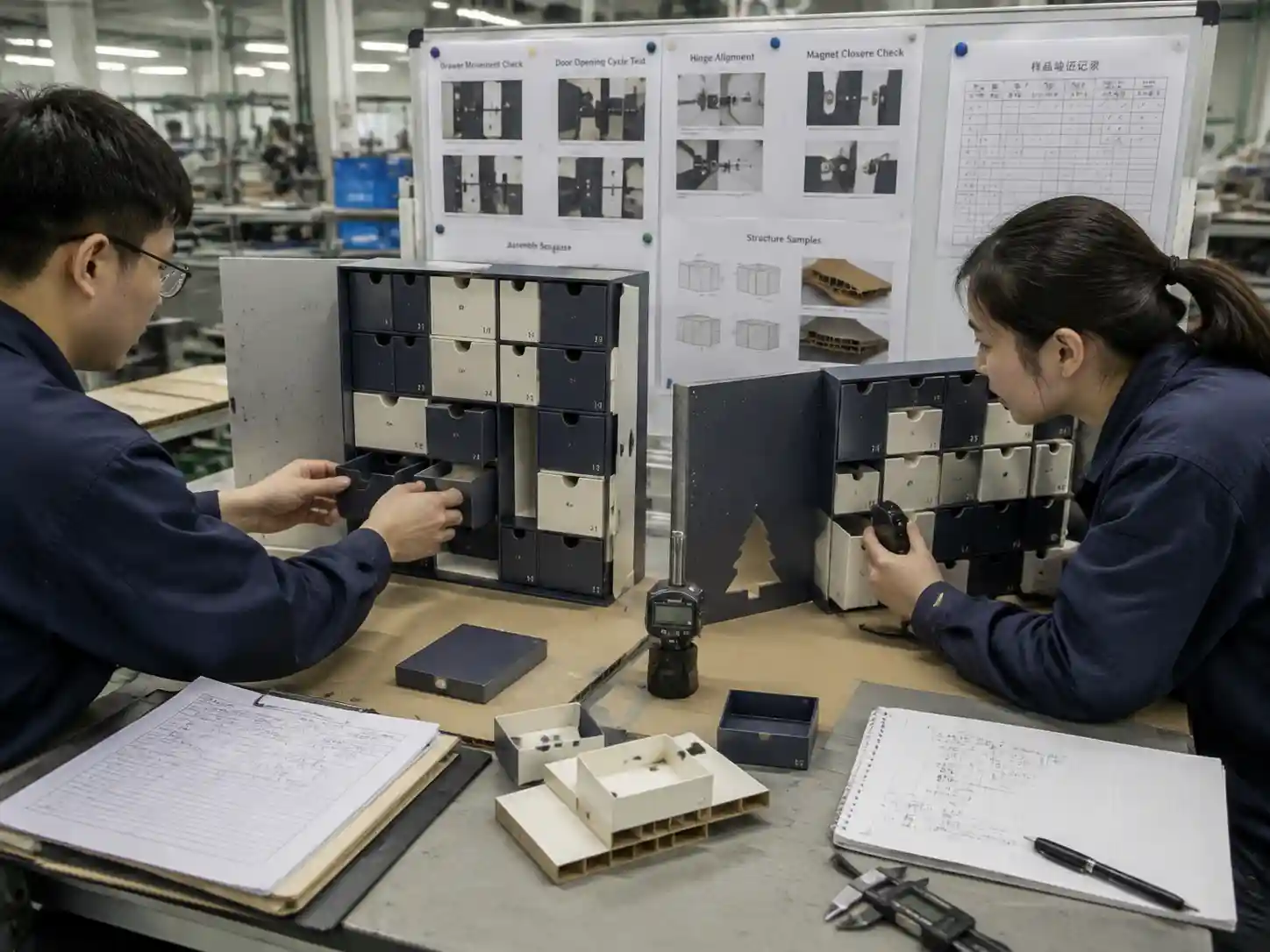
Assembly performance should be verified with physical samples, not only drawings. A structure that looks efficient in CAD may still create problems when workers handle real materials and components.
- Build prototype samples using production-intended materials.
- Record each assembly action from flat components to finished structure.
- Measure time-consuming steps and identify repeated adjustments.
- Check drawer movement, door alignment, hinge operation, and magnet positioning.
- Update drawings based on observed assembly issues.
Useful evidence includes assembly instructions, structural drawings, sample approval records, measurement sheets, and inspection notes. These documents help buyers and suppliers confirm why a design decision was made.
What Are Common Failure Modes When Reducing Manual Assembly?
Reducing assembly steps without sufficient engineering review can create quality problems. A faster assembly process must still maintain structural stability and consistent appearance.
- Over-simplified structure: fewer parts but insufficient strength during handling or display.
- Incorrect tolerance: drawers or doors become difficult to operate because clearances are too tight or loose.
- Weak fixing methods: magnets, ribbons, or decorative components require additional manual repair.
- Unclear assembly sequence: workers spend extra time identifying part positions.
- Material mismatch: board thickness or surface treatment changes affect folding and bonding performance.
Which Checks Confirm That a Structure Is Ready for Efficient Assembly?
A production-ready structure should pass practical checks covering movement, alignment, strength, and repeatability. The exact checks vary by project, but common verification areas include:
| Check | Purpose | Evidence |
|---|---|---|
| Assembly sequence review | Confirm operators can follow the process efficiently | Assembly notes and sample records |
| Drawer and door operation test | Verify smooth movement and correct positioning | Inspection checklist |
| Component placement check | Confirm magnets, hinges, and accessories are correctly located | Measurement records |
| Finished structure review | Confirm appearance and stability after assembly | Approved sample reference |

How Do Buyer Approvals Support Lower Assembly Risk?
Buyers can reduce production risk by approving structural details before manufacturing begins. Important approval points include final drawings, component positions, assembly sequence, and sample performance.
Verifiable approval records help separate confirmed requirements from project assumptions. For commercial packaging projects, this reduces late changes that may increase manual work during production.
Frequently Asked Questions
Does reducing assembly always mean fewer components?
No. A structure may use additional reinforcement components if they reduce adjustment work or improve consistency. The goal is efficient assembly, not simply fewer parts.
Can complex advent calendar structures be fully automated?
Not always. Decorative features, small components, and customized mechanisms may still require manual handling. Engineering focuses on reducing unnecessary manual operations.
When should assembly optimization be reviewed?
The best time is during structural development and sampling because changes are easier before production tooling and manufacturing processes are finalized.
How Can Giftpackpro Support Complex Advent Calendar Structure Development?
Reducing hand assembly requires coordination between structural design, sampling, production planning, and quality verification. Giftpackpro supports custom advent calendar projects through custom advent calendar box services, helping buyers evaluate structures, components, and assembly requirements before production.
For new projects, buyers can review custom advent calendar box products or contact the team through request a custom quote with structural requirements and product details.