
Complex advent calendar structures are often rejected during production when moving parts, alignment, stability, or assembly tolerances are not controlled. The highest-risk features usually include drawers that do not slide correctly, doors that do not align, weak hinge areas, unstable panels, and inconsistent magnet closures. These risks can be reduced through engineering drawings, prototype checks, dimensional measurements, and production approval records before bulk manufacturing.
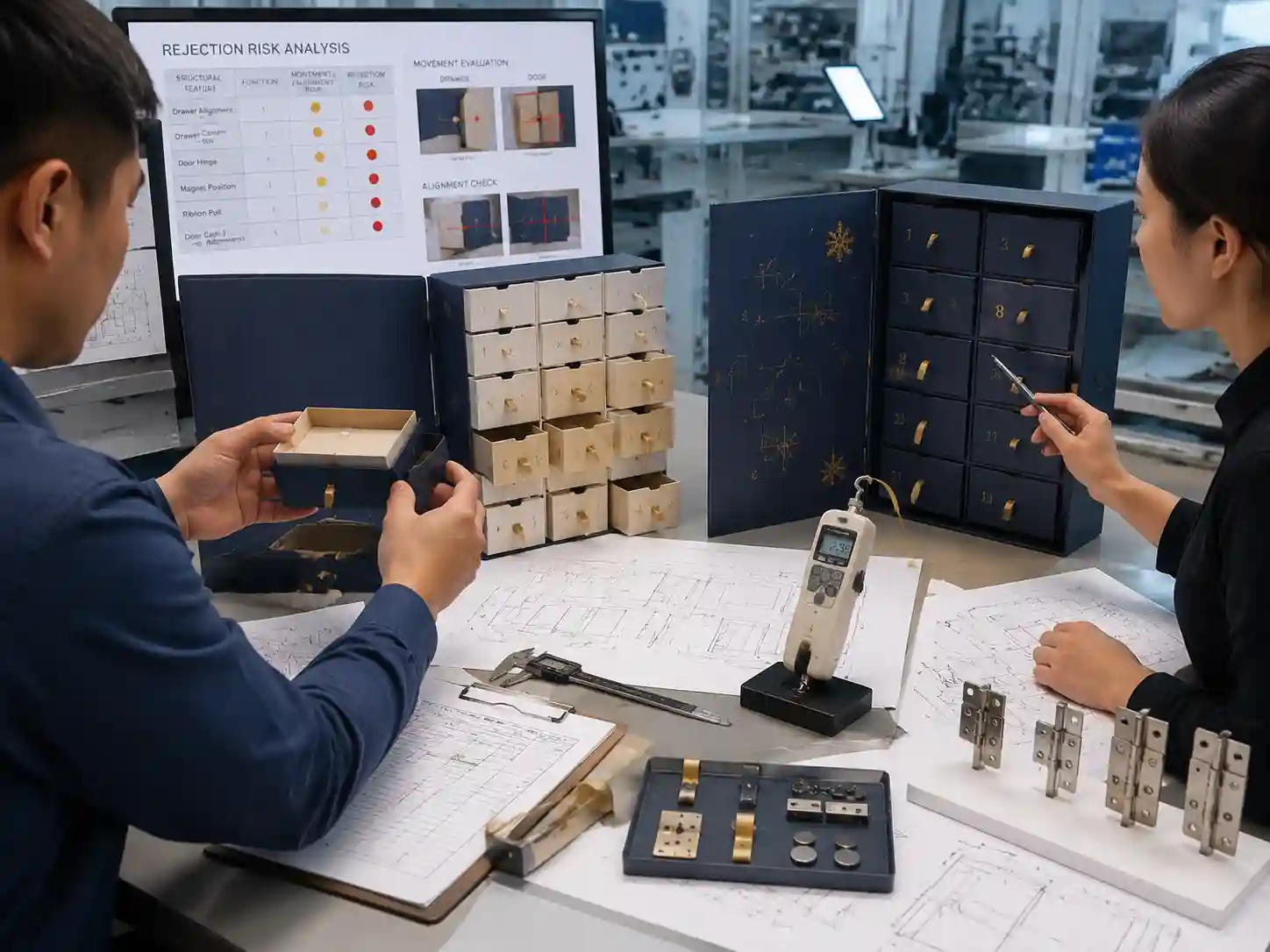
Which structural features create the highest advent calendar structural rejection risks?
The highest rejection risks usually come from functional structures that require repeated movement or precise positioning. Unlike simple rigid boxes, advent calendar boxes with drawers, doors, hinges, and magnetic closures depend on multiple components working together within limited tolerances.
The main risk areas include:
- Drawer systems: Incorrect clearance, uneven tracks, or weak inner supports can cause sticking, misalignment, or difficult opening.
- Door mechanisms: Poor positioning of door panels, cuts, or folding lines can create uneven gaps and inconsistent appearance.
- Hinge structures: Weak hinge points or incorrect folding directions can lead to tearing, cracking, or limited movement.
- Magnetic closures: Incorrect magnet positioning may cause weak closing force or excessive resistance.
- Large panels: Oversized surfaces can bend, warp, or lose stability without suitable reinforcement.
- Assembly interfaces: Multiple glued, folded, or inserted parts increase the chance of variation during production.
Why do drawers and moving parts create more production rejection?
Drawers and sliding components create higher rejection risk because small dimensional differences can directly affect function. A drawer may appear acceptable during sampling but fail during production if material thickness, folding accuracy, or assembly pressure changes.
Key checks include:
- Confirming drawer cavity dimensions against the approved structural drawing.
- Measuring clearance between the drawer body and surrounding walls.
- Checking smooth movement after repeated opening and closing cycles.
- Reviewing whether inner supports maintain the drawer shape during assembly.
Project-dependent factors such as board thickness, drawer size, product weight, and opening frequency determine the correct clearance range. Buyers should approve these details using physical samples and measurement records rather than relying only on visual inspection.
How do doors, hinges, and magnets affect rejection rates?
Door-based advent calendar structures often fail when alignment between the front panel, hinge area, and closing mechanism is not controlled. The risk increases when multiple small doors must maintain consistent spacing across a large surface.
| Structural feature | Common failure mode | Recommended verification |
|---|---|---|
| Door panels | Uneven gaps, poor alignment, difficult opening | Check cutting accuracy, folding position, and opening movement on samples |
| Hinges | Tearing, weak movement, incorrect folding angle | Inspect hinge construction and test repeated movement |
| Magnets | Weak closure or incorrect positioning | Verify magnet location, polarity, and closing performance |
| Panels | Bending or loss of rigidity | Measure flatness and review reinforcement structure |
Supplier drawings, prototype approval records, and inspection notes provide evidence that these details have been reviewed before production release.

How can engineers identify structural rejection risks before mass production?
The most effective approach is to review failure points during design validation instead of waiting for finished production units. A structured review should focus on movement, strength, alignment, and assembly repeatability.
What checks should be completed during prototype validation?
- Review the structural drawing and confirm all functional dimensions.
- Assemble prototypes using the intended production materials and methods.
- Test drawers, doors, hinges, and magnetic closures under normal operating conditions.
- Measure critical gaps, panel positions, and component alignment.
- Record approved changes before production documentation is released.
The exact validation method varies by project. A small decorative calendar and a large multi-compartment structure may require different reinforcement decisions, movement checks, and approval standards.
Which production issues should buyers include in a structural risk checklist?
A practical checklist helps purchasing teams, designers, and quality teams identify problems before shipment inspection.
- Are all moving parts operating smoothly after assembly?
- Do drawers maintain consistent clearance across samples?
- Are door gaps visually uniform?
- Are hinge areas reinforced enough for intended use?
- Are magnets positioned according to approved drawings?
- Do large panels remain flat after assembly?
- Are final production samples matched against approved prototypes?
These checks should be supported by physical samples, dimensional records, assembly instructions, and quality inspection documents. This evidence creates a clearer approval process between packaging designers, suppliers, and buyers.
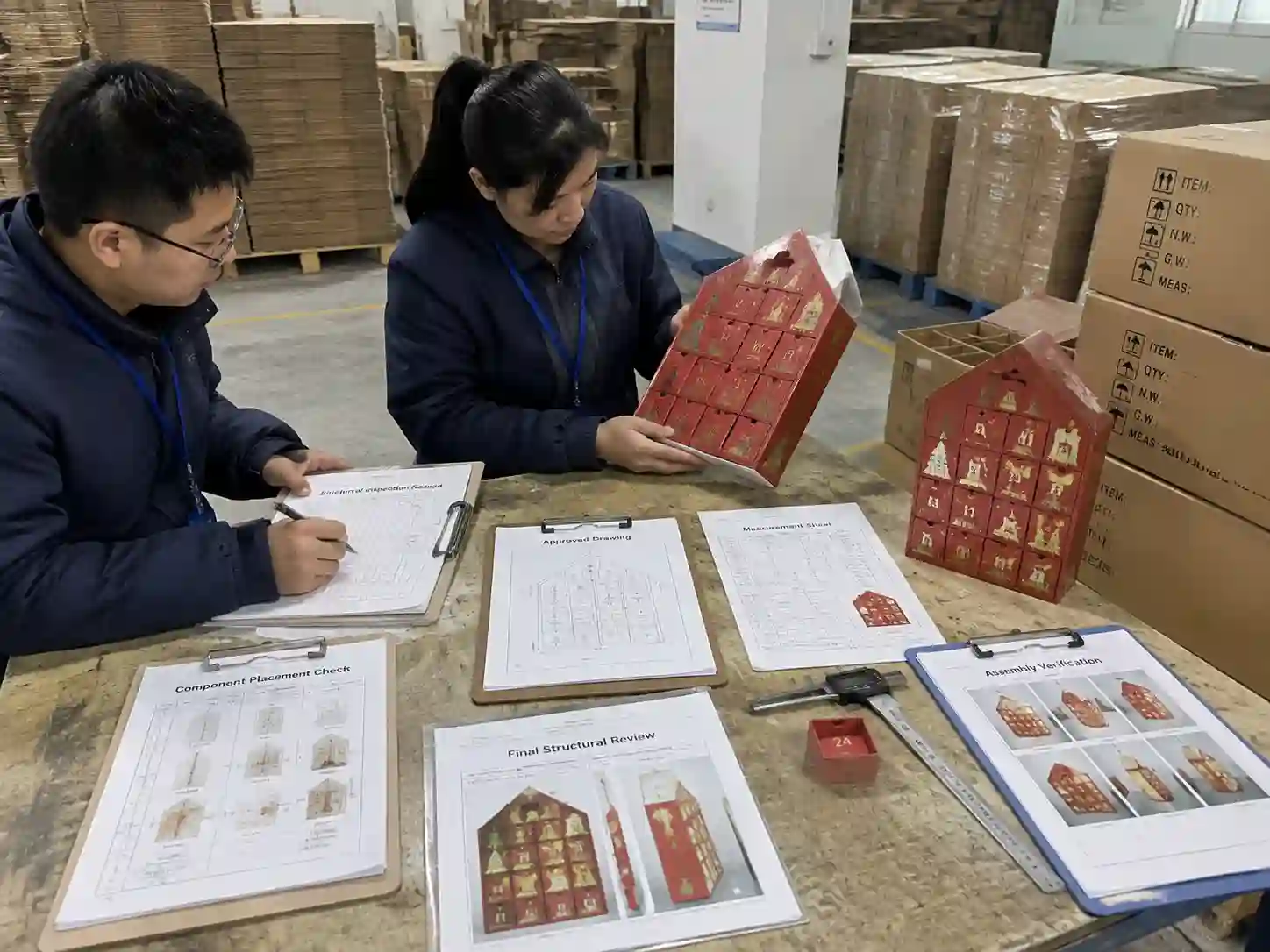
How should buyers separate confirmed risks from project-dependent decisions?
Some structural risks are common across many advent calendar projects, while others depend on the product size, design complexity, and intended usage.
| Type | Examples | How to confirm |
|---|---|---|
| Verifiable facts | Drawer movement, door alignment, magnet position, panel dimensions | Measure samples and compare with approved drawings |
| Project-dependent recommendations | Clearance allowance, reinforcement method, hinge design | Review with structural engineers and prototype testing |
| Buyer approvals | Final appearance, functional acceptance, production release | Approval records and signed sample confirmation |
FAQ: Which advent calendar structures are hardest to control in production?
Structures with multiple moving components, such as drawers combined with doors or magnetic closures, generally require more dimensional control because several parts must work together.
FAQ: Can structural problems be solved after bulk production starts?
Some minor adjustments may be possible, but major structural changes after production begins can affect materials, assembly methods, and consistency. Early prototype approval is usually the safer approach.
FAQ: What documents help verify structural quality?
Useful records include structural drawings, prototype approval notes, measurement sheets, assembly checks, and production inspection reports.
Giftpackpro supports custom structural development through custom advent calendar box services, including structure review, sample evaluation, and production coordination. For projects requiring detailed structural planning, buyers can also explore custom advent calendar box products or request a custom quote.