
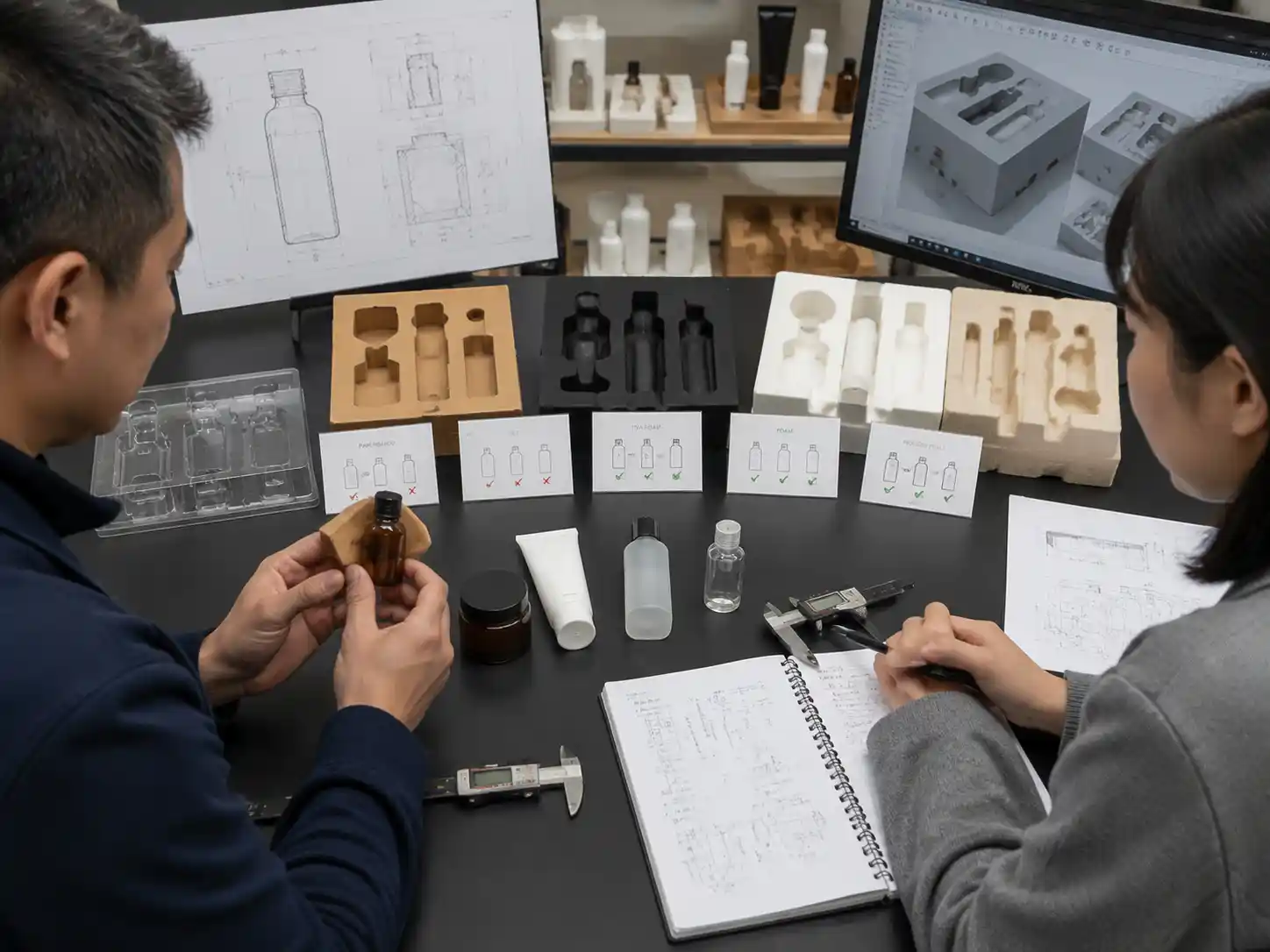
Mini bottles rotate inside paperboard inserts when the cavity design does not control the product shape, contact points, or movement direction during handling and transport. Preventing mini bottle paper insert rotation requires accurate product measurement, controlled cavity geometry, suitable retention features, and physical fit validation. The goal is to hold each bottle securely while still allowing easy removal and maintaining insert strength after loading.
Why does mini bottle paper insert rotation happen?
Mini bottles rotate when the insert provides insufficient lateral support around the bottle body, neck, or shoulder area. A cavity that is too loose allows the bottle to twist, while excessive restriction can make removal difficult or damage the insert.
The main causes usually include:
- Incorrect cavity diameter or shape based on incomplete product measurements.
- Round bottle profiles that lack anti-rotation contact points.
- Insufficient support around the bottle shoulder, cap, or base.
- Paperboard flexibility that increases movement after repeated handling.
- Incorrect product orientation inside multi-compartment layouts.
Verification should begin with product drawings, physical samples, and dimensional records rather than relying only on nominal bottle sizes.
How does cavity geometry prevent mini bottle rotation?
Cavity geometry prevents rotation by creating controlled contact between the insert and the bottle surface. Instead of only matching the bottle diameter, the cavity should manage the areas where movement is most likely to occur.
Which cavity features improve rotational control?
| Retention method | How it controls movement | Project considerations |
|---|---|---|
| Custom-shaped cavity walls | Creates multiple contact points around the bottle body. | Requires accurate bottle measurements and sample confirmation. |
| Shoulder or neck support | Limits tilting and twisting near the upper section. | Useful for bottles with narrow necks or heavier caps. |
| Folded paperboard locking features | Adds mechanical resistance without extra materials. | Must balance retention strength and removal access. |
| Soft contact materials such as EVA or foam | Improves grip and protects sensitive surfaces. | Material selection depends on product weight and finish requirements. |
For commercial packaging projects, the final cavity design should be confirmed through drawings and physical samples because bottle shapes, surface finishes, and weight distribution vary significantly.
How should insert designers measure mini bottles before creating cavities?
Accurate measurement is the first control step for reducing rotation. Designers should record the actual product dimensions that affect retention, not only the overall bottle height and diameter.
- Bottle body diameter at different heights.
- Neck diameter and shoulder transition shape.
- Cap or closure dimensions.
- Base shape and stability area.
- Product weight and center of gravity.
Measurement records, product samples, and approved drawings should be kept together so the insert design matches the production item. Any later bottle variation should be reviewed because small dimensional changes can affect cavity performance.
What fit tests confirm that mini bottles will not rotate?
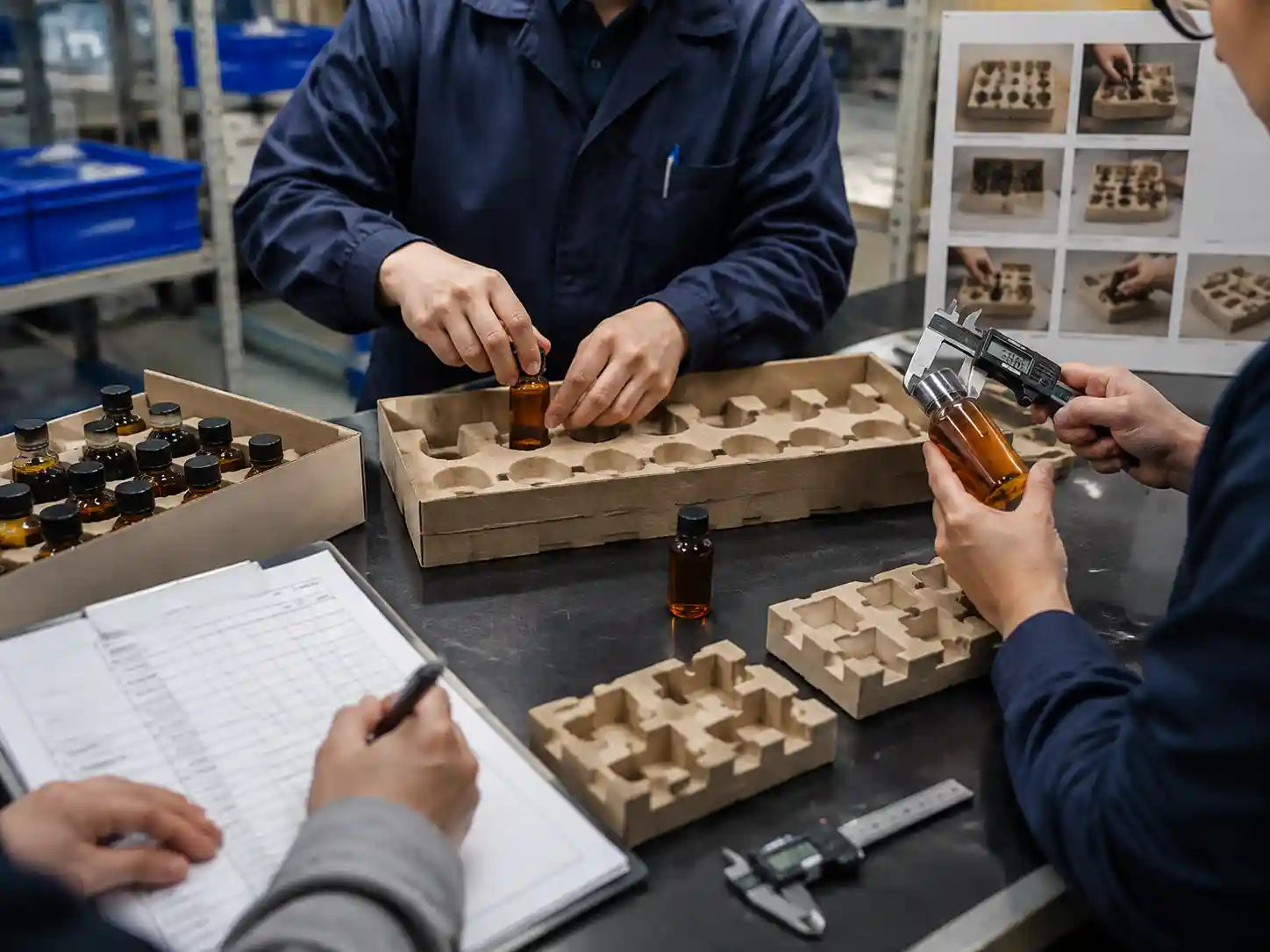
A fit test should verify both retention and usability. The bottle should remain aligned during handling while still allowing the intended removal method.
Recommended fit-test steps
- Place the actual bottle sample into the production-intent insert cavity.
- Check horizontal movement by gently applying side pressure.
- Check rotation by turning the bottle manually inside the cavity.
- Confirm that the bottle can be removed without tearing the insert.
- Inspect the cavity after repeated loading and removal cycles.
Evidence from these checks may include measurement sheets, prototype approval records, photos, and engineering comments. These records help confirm why a cavity design was accepted or revised.
How do you balance bottle retention with customer removal access?
The strongest retention design is not always the best packaging solution. A cavity that completely locks a bottle may create poor user access or increase assembly difficulty.
Good insert engineering balances:
- Enough contact points to prevent unwanted rotation.
- Clear finger access or removal space.
- Stable paperboard structure after loading.
- Consistent assembly performance during production.
For example, a heavier mini bottle may need stronger shoulder support, while a lightweight vial may only require controlled side-wall contact. The correct approach depends on bottle shape, weight, insert material, and packaging configuration.

What transit checks help verify rotation resistance?
Transit evaluation should confirm that the insert maintains product orientation after movement, vibration, and handling conditions expected during distribution.
| Check item | Purpose |
|---|---|
| Cavity inspection after loading | Confirms the bottle sits in the intended position. |
| Movement observation after handling | Identifies excessive rotation or shifting. |
| Insert deformation review | Checks whether paperboard strength is maintained. |
| Packaging approval record | Documents the accepted structure and revision level. |
Transit performance depends on the complete packaging system, including the outer box structure, product weight, insert material, and distribution environment. These factors should be reviewed during sampling and production approval.
What information should buyers approve before production?
Before production, buyers should approve the final insert drawing, product orientation, cavity dimensions, physical sample, and any agreed retention features.
Useful approval documents include:
- Final cavity layout drawing.
- Product measurement sheet.
- Prototype sample review notes.
- Inspection checklist for production verification.
These records create a clear reference for suppliers, sampling teams, and quality inspectors when confirming that mini bottles remain stable inside paperboard inserts.
FAQ: Can a standard round cavity prevent mini bottles from rotating?
A round cavity may reduce movement, but it does not always prevent rotation because the bottle and cavity share a circular profile. Additional contact features or shaped walls may be required depending on the bottle design.
FAQ: Are paperboard inserts suitable for preventing bottle movement?
Yes, properly engineered paperboard inserts can provide effective retention. Performance depends on board strength, cavity accuracy, folding structure, and product weight.
FAQ: Should buyers test real bottles instead of empty samples?
Yes. Real bottles provide accurate weight, surface friction, and balance conditions that affect rotation and retention performance.
Giftpackpro develops custom advent calendar box structures and insert solutions based on product dimensions, cavity requirements, and production validation. For projects requiring controlled bottle retention, review the available custom advent calendar box services or request a custom quote with product details and insert requirements.


