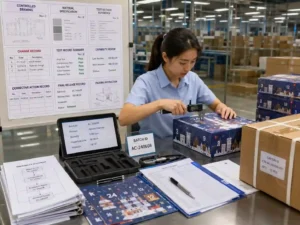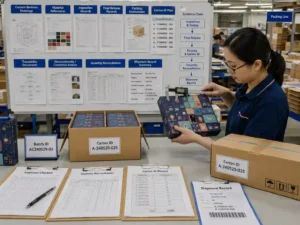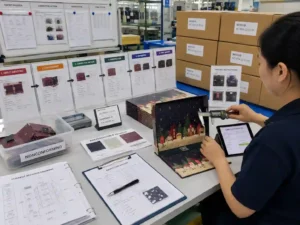
Quick answer: Mini bottle advent calendar boxes are custom paper packaging systems designed to hold small beverage bottles, sample bottles, drink vials, or similar heavy fragile items in numbered compartments. For B2B buyers, the key decisions are structure strength, insert protection, artwork accuracy, printing method, finishing durability, sample approval, MOQ planning, QC checks, and export packing. Because mini bottles add weight and glass-breakage risk, buyers should confirm bottle size, filled weight, insert material, board thickness, carton compression, pallet packing, and shipping marks before requesting a quotation or approving mass production.
What should buyers understand before choosing mini bottle advent calendar boxes?
Buyers should understand that mini bottle advent calendar boxes are not only decorative seasonal packaging; they are load-bearing retail display packs. The structure must support bottle weight, protect glass, keep each item in position, and present the brand artwork consistently across doors, drawers, sleeves, or folding panels.
For beverage brands, gift companies, retail buyers, and packaging distributors, the main risk is choosing a box style based only on appearance. A good calendar box for empty cosmetics or paper gifts may fail when loaded with glass mini bottles. Bottle diameter, height, shoulder shape, cap height, liquid weight, insert tolerance, and outer carton strength all affect the final packaging decision.
Giftpackpro works as a custom advent calendar boxes manufacturer for B2B seasonal packaging projects where structure, artwork, sampling, production, and export packing need to be planned together. When buyers compare custom advent calendar boxes, the best choice is usually the one that balances presentation, insert security, production efficiency, and shipping safety.
Which box structures work best for mini bottle advent calendar boxes?
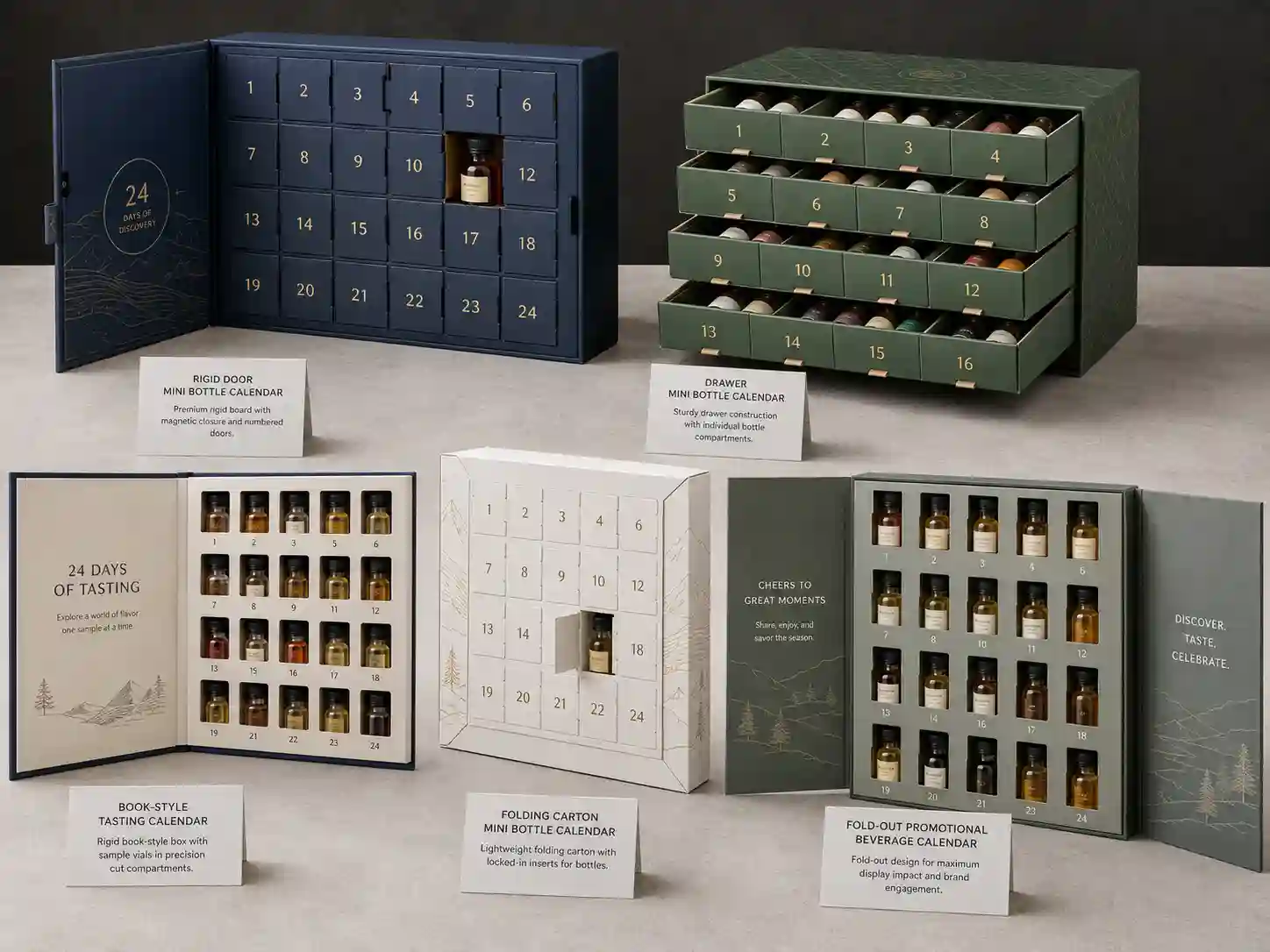
The best structure depends on bottle weight, bottle count, retail price point, and how the buyer wants consumers to open the calendar. Rigid door-opening boxes and drawer boxes are usually stronger for heavier mini bottles, while folding carton styles can work for lighter sample vials or lower-cost promotional campaigns.
| Structure option | Best for | Key advantage | Buyer caution |
|---|---|---|---|
| Rigid door-opening box | Premium mini bottle sets, glass bottles, retail gift displays | Strong greyboard structure, good shelf presence, clean numbered doors | Needs accurate door cutting and strong insert support behind each opening |
| Drawer box | Heavy bottles, repeat-use gift packaging, premium promotions | Good load support and smooth product access | Drawer sliding tolerance must be checked after loading real bottle weight |
| Book-style calendar box | Brand storytelling, tasting sets, limited seasonal launches | Large artwork area and premium opening experience | Spine strength and magnetic closure must be tested with filled samples |
| Folding carton calendar | Light sample bottles, plastic vials, lower MOQ campaigns | Lower material volume and easier flat packing | Not ideal for heavy glass unless reinforced with strong internal support |
| Fold-out display calendar | Promotional beverage sampling, retail counters, gift kits | High display visibility and flexible layout | Requires careful balance testing to avoid tipping when bottles are loaded |
Buyer tip: Do not approve a mini bottle calendar structure from a flat dieline alone. Ask the supplier to test a physical prototype with the real bottle size, cap height, filled weight, and proposed insert material.
How should inserts protect heavy or fragile mini bottles?
The insert must hold every bottle tightly enough to prevent movement but not so tightly that loading, removal, or door opening becomes difficult. For mini bottle advent calendar boxes, insert strength is often more important than the outer decoration because the insert carries the real product load.
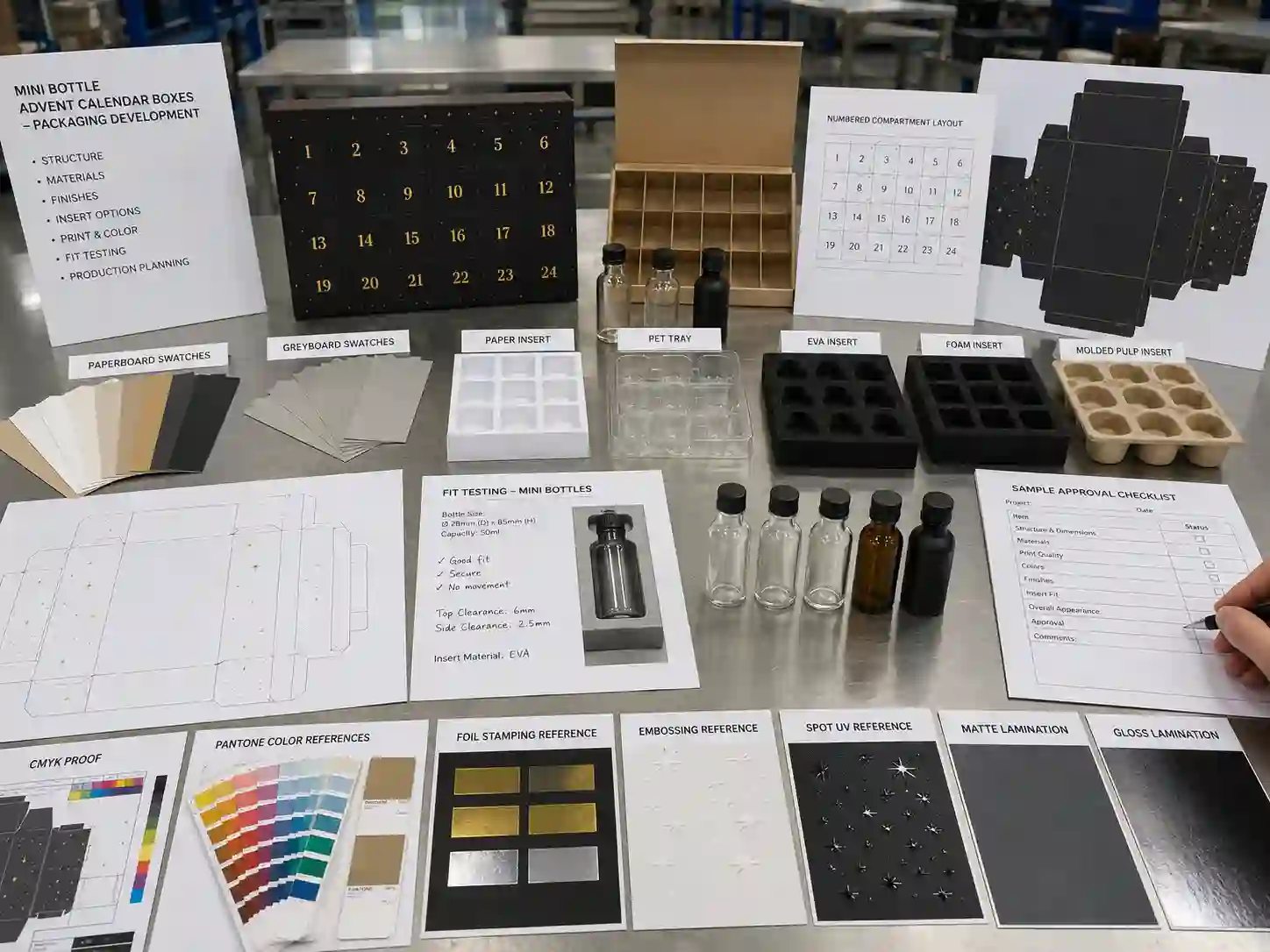
Common insert options include paper insert, PET tray, EVA insert, foam, and molded pulp. Each option has a different cost, appearance, tooling requirement, environmental profile, and fit tolerance. Buyers should choose based on bottle weight, fragility, expected shipping route, retail positioning, and packing method.
When should buyers use paper inserts?
Paper inserts are suitable for many B2B beverage calendars when the bottles are small, the layout is simple, and the outer box has enough strength. They can be printed or color-matched and are often easier to integrate with paperboard packaging.
However, paper inserts must be engineered carefully for glass bottles. Reinforced paperboard, folded support walls, double-layer platforms, or hidden cross supports may be needed to prevent sagging during storage and export shipping.
When are PET trays, EVA, foam, or molded pulp better?
PET trays are useful when buyers need precise cavities and consistent product placement. EVA and foam provide stronger cushioning for glass protection, while molded pulp may suit buyers who want a molded paper-based insert solution. The correct choice depends on whether the priority is premium appearance, shock absorption, recyclability, cost control, or fast assembly.
For filled mini bottles, the supplier should test vertical holding strength, side movement, drop impact, and compartment deformation. A bottle that fits well on a factory table may still move during sea freight, courier delivery, or pallet handling.
Factory tip: For heavy mini bottle sets, ask for insert testing with the bottles fully loaded, not empty. Filled weight changes compression, drawer sliding, opening force, carton stacking, and pallet stability.
How do printing choices affect the look and consistency of beverage calendar boxes?
Printing choices affect brand color, shelf impact, artwork detail, and production consistency. For mini bottle advent calendar boxes, buyers should confirm CMYK artwork, Pantone color requirements, proofing method, dieline position, numbering accuracy, and finishing effects before approving mass production.
CMYK printing is suitable for full-color graphics, gradients, lifestyle images, and seasonal artwork. Pantone printing is useful when brand colors must stay consistent across campaigns, retail channels, or related packaging items. Many buyers combine CMYK artwork with Pantone brand colors for better balance between visual richness and color control.
What artwork files should buyers prepare?
Buyers should prepare editable artwork files based on the supplier’s final dieline, not on a rough concept layout. Important details include bleed, safe area, cut lines, fold lines, glue areas, door numbers, barcode area, legal copy, recycling marks, product information, and shipping label zones.
Before sending artwork, check whether the calendar has separate surfaces such as front panel, back panel, side panels, drawer fronts, inner trays, door interiors, instruction cards, belly bands, or sleeves. Each surface may need its own print area and orientation check.
- Use the final confirmed dieline from the factory before completing artwork.
- Keep key text and logos away from cutting, creasing, and door perforation lines.
- Confirm door numbers match the actual compartment layout.
- Prepare CMYK values and Pantone references where brand color matters.
- Check barcode size, quiet zone, and label position before printing.
- Confirm whether metallic foil, embossing, or spot UV areas need separate artwork layers.
For barcode and product identification planning, buyers can refer to official GS1 barcode standards when preparing retail barcode requirements. The packaging factory should reserve enough flat, scannable space, but the buyer or brand owner should confirm barcode data and retailer rules.
Which finishing options make sense for mini bottle advent calendar boxes?
Finishing should support the brand position without weakening the package or creating production risk. Matte lamination, gloss lamination, foil stamping, embossing, debossing, and spot UV can all work well, but each effect must be checked against the box structure, artwork density, and handling requirements.
Premium beverage gift campaigns often use rigid box structures with matte lamination, metallic foil stamping, embossing, or spot UV on numbering areas. Promotional campaigns may use simpler CMYK printing with matte or gloss lamination to control cost and shorten lead time.
| Finishing option | Common use | Production note | Best buyer question |
|---|---|---|---|
| Matte lamination | Premium, soft-touch, elegant retail look | Can show scratches more easily on dark colors | Will the surface resist handling during assembly and packing? |
| Gloss lamination | Bright color, stronger shine, promotional display | Can increase reflection under retail lighting | Does the finish match our shelf display environment? |
| Foil stamping | Logo, date numbers, limited-edition details | Needs separate foil artwork and accurate registration | Is the foil area too close to folds, cuts, or door edges? |
| Embossing or debossing | Logo texture, premium tactile branding | Works better on stable board surfaces than narrow panels | Will pressure marks affect the inner structure or printed reverse side? |
| Spot UV | Highlight graphics, numbers, product themes | Requires accurate registration with printed artwork | Can the factory provide a proof showing the UV position clearly? |
Buyer tip: Do not add every premium finish to one design automatically. A clean rigid box with accurate color proofing and one controlled foil detail often looks more professional than a crowded surface with many competing effects.
How should buyers check color proofing before mass production?
Buyers should approve color only after reviewing a suitable proof under realistic lighting and comparing it with brand references. For mini bottle advent calendar boxes, color proofing is especially important because the box may be photographed for online listings, displayed in retail stores, and matched with bottle labels or caps.
A digital screen preview is not enough for final approval. Buyers should request a printed proof, wet proof, or pre-production sample depending on order value and color sensitivity. If Pantone colors are used, the buyer should confirm whether the factory will print spot color, simulate Pantone with CMYK, or combine both methods.
What should be checked on the printing proof?
The proof should be checked for color accuracy, text clarity, image sharpness, number position, foil area, lamination effect, and dieline alignment. Buyers should also review whether small text remains readable after lamination and whether dark color areas show dust, scratches, or fingerprints too easily.
- Compare CMYK printed areas with the approved digital artwork.
- Compare Pantone colors with physical Pantone references, not only a monitor.
- Check that door numbers are not cut off by perforation or creasing lines.
- Confirm foil stamping, embossing, and spot UV layers are correctly positioned.
- Review barcode and label areas on the final printed surface.
- Keep an approved proof or signed sample as the production control reference.
QC tip: The approved color proof should travel with the production file. During mass production, inspectors need a physical reference for print color, finish position, surface defects, and assembly alignment.
What MOQ and cost drivers should procurement teams expect?
MOQ and cost depend on structure complexity, board material, insert type, printing method, finishing, sample requirements, packing method, and production schedule. For mini bottle advent calendar boxes, cost is also affected by reinforcement needs because glass bottles and liquid weight require stronger materials and more careful assembly.
Rigid boxes, drawer boxes, EVA inserts, molded trays, foil stamping, embossing dies, and special finishes usually increase setup cost. Folding carton structures and paper inserts may reduce unit cost, but they must still pass strength and shipping tests for loaded bottles.
Which cost drivers matter most?
The biggest cost drivers are usually box structure, size, material thickness, insert tooling, printing complexity, finishing plates, hand assembly, export carton strength, and order quantity. A low unit price can become expensive if the insert fails, the cartons crush, or the buyer must rework artwork after proofing.
- Structure: Rigid box, drawer box, and book-style formats use more material and assembly labor than simple folding cartons.
- Insert: Paper insert is often simpler, while PET tray, EVA, foam, and molded pulp may require tooling or additional setup.
- Printing: CMYK is common, while Pantone spot color may add color control steps.
- Finishing: Foil stamping, embossing, spot UV, matte lamination, and gloss lamination add process cost and proofing requirements.
- Sampling: Blank sample, printed sample, and pre-production sample each serve a different approval purpose.
- Packing: Heavier loaded sets may need stronger export cartons, corner protectors, separators, and pallet planning.
What sample process should buyers request before production?
Buyers should request a sample process that verifies structure, insert fit, artwork, printing, finishing, and packing before mass production. For mini bottle advent calendar boxes, approving only a visual mockup is risky because real bottle weight can change the result.
A practical sample path can include a blank structural sample, a printed sample, and a pre-production sample. The blank sample checks size, layout, insert strength, and opening function. The printed sample checks color, finishing, artwork position, and surface effect. The pre-production sample confirms that mass production materials and processes match the approved standard.
Decision guide: Which sample should you request?
| Buyer situation | Recommended sample | Why it matters |
|---|---|---|
| New bottle size or new compartment layout | Blank structural prototype | Confirms bottle fit, insert support, opening function, and overall dimensions before print cost |
| Brand color or retail display is important | Printed sample or color proof | Checks CMYK, Pantone, lamination, foil stamping, embossing, and spot UV position |
| Large order or strict retailer approval | Pre-production sample | Locks material, print, finishing, assembly tolerance, and packing standard before mass production |
| Heavy glass bottles for export | Loaded sample with packing test | Checks insert movement, carton compression, bottle protection, and pallet packing assumptions |
Giftpackpro’s custom advent calendar box services can support buyers through structure planning, dieline review, sample development, artwork checking, and production preparation. For buyers comparing custom advent calendar box products, samples should be judged by loading performance as much as appearance.
How should buyers compare suppliers for mini bottle advent calendar projects?
Buyers should compare suppliers by factory experience, engineering support, proofing process, material options, insert testing, QC control, export packing knowledge, and communication accuracy. The lowest quotation is not always the safest choice when the product is heavy, fragile, seasonal, and deadline-sensitive.
A capable supplier should ask for bottle dimensions, filled weight, quantity per calendar, artwork requirements, insert preference, target retail channel, packing method, and shipping route. If a supplier quotes without asking about bottle weight or insert protection, the quotation may not reflect the real production risk.
Supplier comparison checklist
- Can the supplier provide a final dieline based on real bottle dimensions?
- Can they recommend rigid box, drawer box, door-opening box, folding carton, or fold-out structure based on weight?
- Can they test paper insert, PET tray, EVA insert, foam, or molded pulp options?
- Do they separate artwork proof, color proof, printed sample, and pre-production sample stages?
- Do they inspect printing, lamination, foil stamping, embossing, spot UV, assembly, and insert fit?
- Do they understand export carton strength, pallet loading, carton labels, and shipping marks?
- Can they provide practical feedback before mass production instead of only following a drawing?
Buyers can learn more about factory capability and project handling through the Giftpackpro packaging factory page, then use the advent calendar box buying guides to compare structure, materials, sampling, and export packing decisions across different seasonal packaging categories.
What QC checks matter most before shipment?
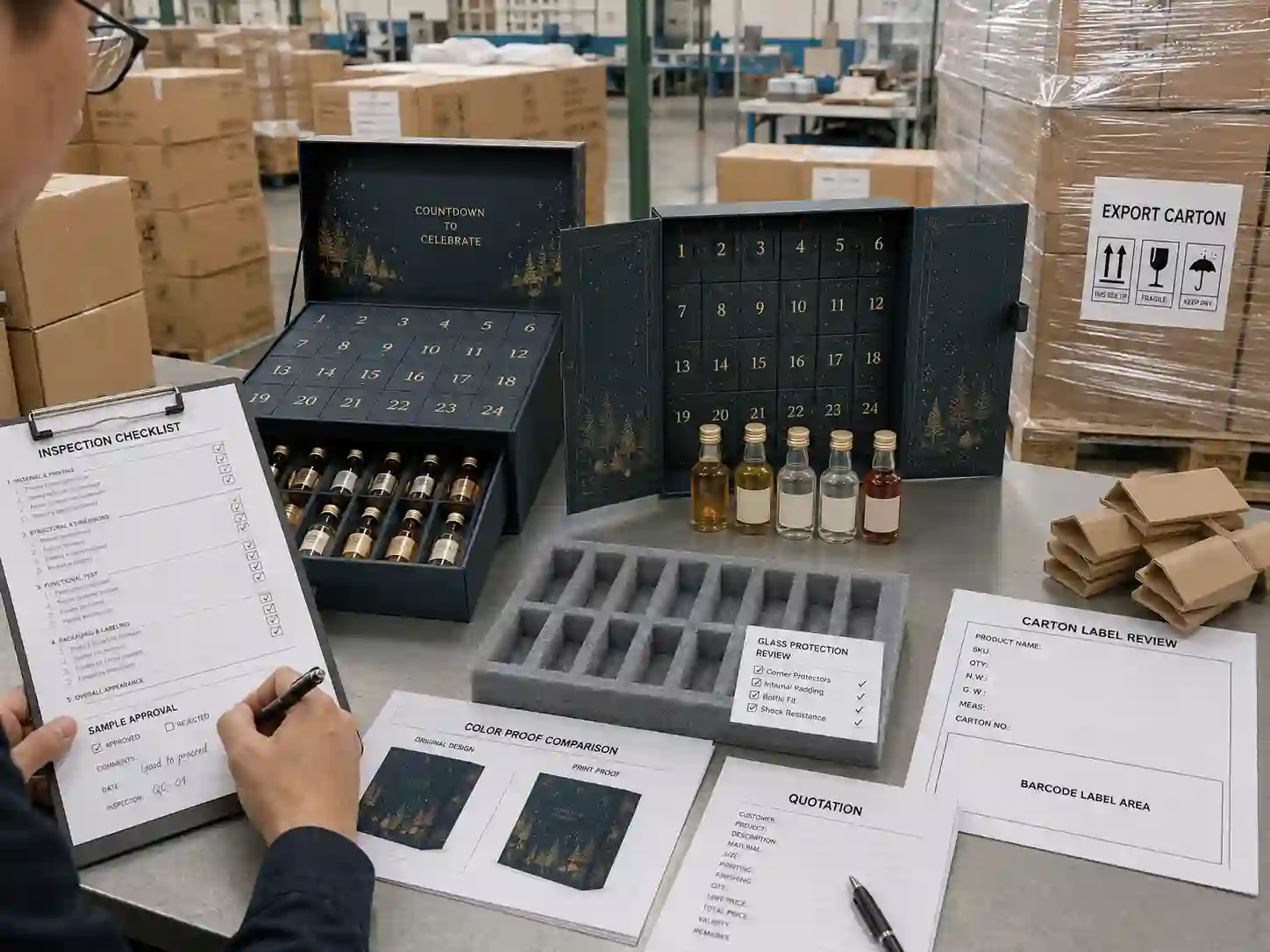
QC should confirm that the finished mini bottle calendar box matches the approved sample and can protect the loaded product during handling and export. For bottle packaging, inspection should cover appearance, structure, insert fit, opening function, print quality, finish alignment, carton strength, and shipping mark accuracy.
Mini bottle advent calendar boxes can fail in ways that are not visible from a front photo. Doors may tear, drawers may jam, inserts may sag, bottles may rattle, foil may misalign, or export cartons may deform under stacking pressure. A factory-side QC checklist should be built around the actual risk points of heavy fragile products.
Practical QC checklist for mini bottle advent calendar boxes
- Structure check: Confirm box dimensions, board thickness, folding accuracy, glue strength, drawer movement, and door-opening performance.
- Insert check: Load real bottles and test fit, removal, shaking, side movement, and bottom support.
- Printing check: Compare CMYK color, Pantone color, image clarity, text sharpness, and number position with the approved proof.
- Finishing check: Inspect matte lamination, gloss lamination, foil stamping, embossing, debossing, and spot UV for scratches, bubbles, misalignment, or peeling.
- Assembly check: Confirm panels align, doors open correctly, compartments match numbering, and bottles are easy to pack.
- Export carton check: Review carton size, carton compression, inner separators, corner protection, gross weight, shipping marks, and pallet stability.
- Documentation check: Keep approved sample records, inspection photos, carton labels, and final packing list aligned with the buyer’s purchase order.
For transport testing, buyers may review official guidance from the International Safe Transit Association when discussing package performance expectations with suppliers or logistics teams. The exact test method should be chosen according to product type, sales channel, and shipping route.
How should export packing be planned for heavy bottle calendars?
Export packing should be planned at the quotation stage, not after production. Heavy mini bottle advent calendar boxes need suitable master cartons, compression-resistant packing, corner protection, pallet planning, and clear shipping marks to reduce damage risk during international transport.
Buyers should confirm whether calendars will ship empty to a filling site or fully packed with bottles. Empty paper boxes mainly need protection against crushing, moisture, and surface scratches. Fully loaded bottle calendars require stronger carton strength, better internal separation, weight control, and careful pallet stacking.
What export packing details should be confirmed?
- Flat-packed or assembled packing method
- Pieces per export carton and total gross weight
- Carton material, flute type, and compression requirement
- Use of inner cartons, dividers, corner protectors, or protective bags
- Pallet size, stacking height, pallet wrap, and edge protection
- Shipping marks, carton labels, barcode label area, and retailer routing labels
- Moisture protection for long sea freight routes
Factory tip: If the final product will be filled by another factory, ask both the packaging supplier and filling partner to check loading sequence. A strong calendar can still be damaged if bottles are pushed into the insert at the wrong angle or packed before glue and lamination are fully stabilized.
What information should buyers prepare before requesting a quotation?
Buyers should prepare product dimensions, bottle weight, bottle count, target structure, insert preference, artwork requirements, finishing options, order quantity, sample needs, packing method, and delivery schedule before requesting a quotation. Complete information helps the supplier quote the real project instead of guessing.
For mini bottle advent calendar boxes, even small missing details can change price or feasibility. A 10 ml plastic vial, a 50 ml glass bottle, and a metal-capped beverage sampler may require different insert design, board thickness, door size, carton packing, and assembly process.
RFQ checklist for buyers
- Product type, bottle material, bottle height, diameter, cap size, and filled weight
- Number of bottles per calendar and compartment sequence
- Preferred structure: rigid box, drawer box, door-opening box, book-style box, folding carton, or fold-out display
- Insert preference: paper insert, PET tray, EVA insert, foam, molded pulp, or supplier recommendation
- Outer box size target or retail shelf size limit
- Artwork files, brand color references, CMYK or Pantone requirements, and dieline notes
- Finishing requirements such as matte lamination, gloss lamination, foil stamping, embossing, or spot UV
- MOQ target, forecast quantity, and order schedule
- Sample type required: blank sample, printed sample, or pre-production sample
- Export packing requirements, shipping marks, pallet requirements, and delivery destination
When buyers are ready to discuss a project, they can request a custom quote with bottle specifications, artwork goals, target quantity, and delivery timing. Clear information helps the factory recommend the right structure, insert, material, printing method, finishing process, and export packing plan.
What common mistakes should buyers avoid?
The most common mistakes are approving artwork before the final dieline, choosing weak inserts for heavy bottles, ignoring carton compression, and comparing quotations without checking what is included. These mistakes can create delays, extra cost, product damage, or retailer rejection.
- Approving design before engineering: A beautiful layout may not work if the bottle cavities, door lines, and insert support are not engineered first.
- Using empty bottles for fit testing: Empty bottles do not reflect filled weight, shipping stress, or insert sagging.
- Placing foil too close to folds: Foil stamping near creases, door cuts, or small panels can create registration problems.
- Skipping a printed sample: Digital artwork cannot fully predict lamination, spot UV, embossing depth, or Pantone matching.
- Ignoring assembly tolerance: Tight drawers, narrow cavities, and door perforations can change after mass production assembly.
- Choosing cartons by price only: Weak export cartons may crush under pallet stacking or long-distance shipping.
- Not defining shipping marks: Missing carton labels or unclear marks can delay warehouse receiving and retailer routing.
FAQ: Mini bottle advent calendar boxes for B2B buyers
Are mini bottle advent calendar boxes suitable for glass bottles?
Yes, they can be suitable for glass bottles if the structure, insert, carton packing, and QC checks are designed for filled bottle weight. Buyers should not use a generic lightweight calendar structure without load testing.
Should buyers choose a rigid box or folding carton?
A rigid box is usually better for premium glass bottle calendars and heavy gift sets. A folding carton may work for lighter plastic vials, small sample packs, or cost-sensitive promotions, but it still needs insert and compression testing.
Which insert is best for heavy mini bottles?
There is no single best insert for every project. Paper inserts can work when reinforced correctly, PET trays offer precise cavities, EVA and foam improve cushioning, and molded pulp can provide shaped paper-based protection. The final choice should be tested with real loaded bottles.
Can CMYK printing match brand colors exactly?
CMYK can produce strong full-color results, but exact brand color control may require Pantone references or spot color printing. Buyers should confirm proofing expectations before production and keep an approved color proof for QC comparison.
Is foil stamping suitable for numbered calendar doors?
Foil stamping can be suitable for numbers, logos, or premium details, but the foil area should not be too close to cuts, folds, or perforation lines. The supplier should check foil registration on a printed sample.
What is the most important QC check for bottle calendar packaging?
The most important QC check is loaded product testing. The finished sample should be tested with the real bottle size and filled weight to confirm insert support, opening function, carton packing, and shipping protection.
What should be included in a reliable quotation?
A reliable quotation should define structure, size, material, insert type, printing, finishing, MOQ, sample cost, sample lead time, mass production lead time, packing method, export carton details, and payment or delivery terms. If these details are missing, buyers may not be comparing suppliers fairly.
How can Giftpackpro support mini bottle advent calendar box projects?
Mini bottle advent calendar boxes require more than a seasonal graphic design. Buyers need a packaging plan that connects bottle dimensions, structure strength, insert protection, CMYK or Pantone printing, finishing effects, sample approval, mass production QC, and export packing.
Giftpackpro can help overseas brands, wholesalers, gift companies, e-commerce sellers, and purchasing teams develop buyer-focused custom packaging for seasonal mini bottle campaigns. To start efficiently, prepare bottle size, filled weight, bottle count, target structure, insert preference, artwork files, finishing ideas, MOQ target, delivery schedule, and export packing requirements before requesting a sample or quotation.
For B2B projects, the strongest packaging decision is not simply the most decorative design. It is the mini bottle advent calendar box structure that protects the product, supports the brand image, fits the purchasing budget, and can be produced, inspected, packed, and shipped reliably.