
Quick answer: Mini bottle advent calendar boxes should be designed around bottle weight, glass protection, compartment accuracy, retail display needs, and export shipping conditions. For seasonal campaigns, buyers should confirm the bottle size, filled weight, layout, opening style, insert material, artwork, MOQ, sample process, lead time, QC standard, and carton packing method before requesting a quotation. The best packaging solution is not only attractive; it must hold each mini bottle securely, protect glass during handling, support stacked cartons, and match the brand’s launch schedule.
For overseas brands, wholesalers, gift companies, retail buyers, and e-commerce sellers, mini bottle packaging is a practical way to build seasonal tasting sets, promotional kits, retail gift boxes, and limited-edition campaigns. Compared with lightweight items such as stickers or tea sachets, bottles create more pressure on the box structure, insert, and export carton. A good design must balance appearance, protection, cost, assembly speed, and delivery reliability.
Giftpackpro works as a custom advent calendar boxes manufacturer for B2B buyers who need paper-based seasonal packaging planned for bulk production. This guide explains the main design decisions before moving to sample, MOQ, mass production, QC, and quotation.
What should buyers decide before designing mini bottle advent calendar boxes?
Buyers should first define the bottle type, bottle dimensions, filled weight, campaign channel, opening experience, and target delivery schedule. These details decide the structure, insert strength, material thickness, artwork setup, and export packing method.
A mini bottle calendar may hold glass beverage samples, syrup bottles, perfume vials, cosmetic ampoules, coffee concentrates, tea shots, craft gift liquids, or promotional tasting products. Each item has different weight, fragility, leakage risk, and display requirements. A 24-piece glass bottle calendar needs stronger engineering than a 12-piece plastic sample set, even if the outside dimensions look similar.
Before asking for a quotation, buyers should prepare:
- Product category, such as beverage, perfume sample, cosmetic liquid, food gift, tea, coffee, candle accessory, toy add-on, jewelry gift, or mixed gift set.
- Bottle size, including height, diameter, cap width, and irregular shapes.
- Filled weight per bottle and total loaded weight of the full calendar.
- Number of compartments, such as 12, 24, 25, or custom campaign count.
- Preferred structure, such as rigid box, drawer box, door-opening box, folding carton, or fold-out display box.
- Sales channel, such as retail shelf, e-commerce, wholesale distribution, subscription campaign, or corporate gifting.
- Artwork requirements, including CMYK, Pantone color, foil stamping, embossing, spot UV, matte lamination, or gloss lamination.
- Target sample date, pre-production sample approval date, and mass production delivery window.
Buyer tip: For bottle packaging, always calculate the loaded box weight early. A design that looks fine as an empty prototype may fail when 12 to 25 filled bottles are installed.
Which structure is best for different mini bottle campaign applications?
The best structure depends on bottle weight, campaign value, retail display style, assembly method, and budget. Rigid boxes usually offer better protection and premium presentation, while folding cartons can be more cost-efficient for lighter products and larger campaigns.
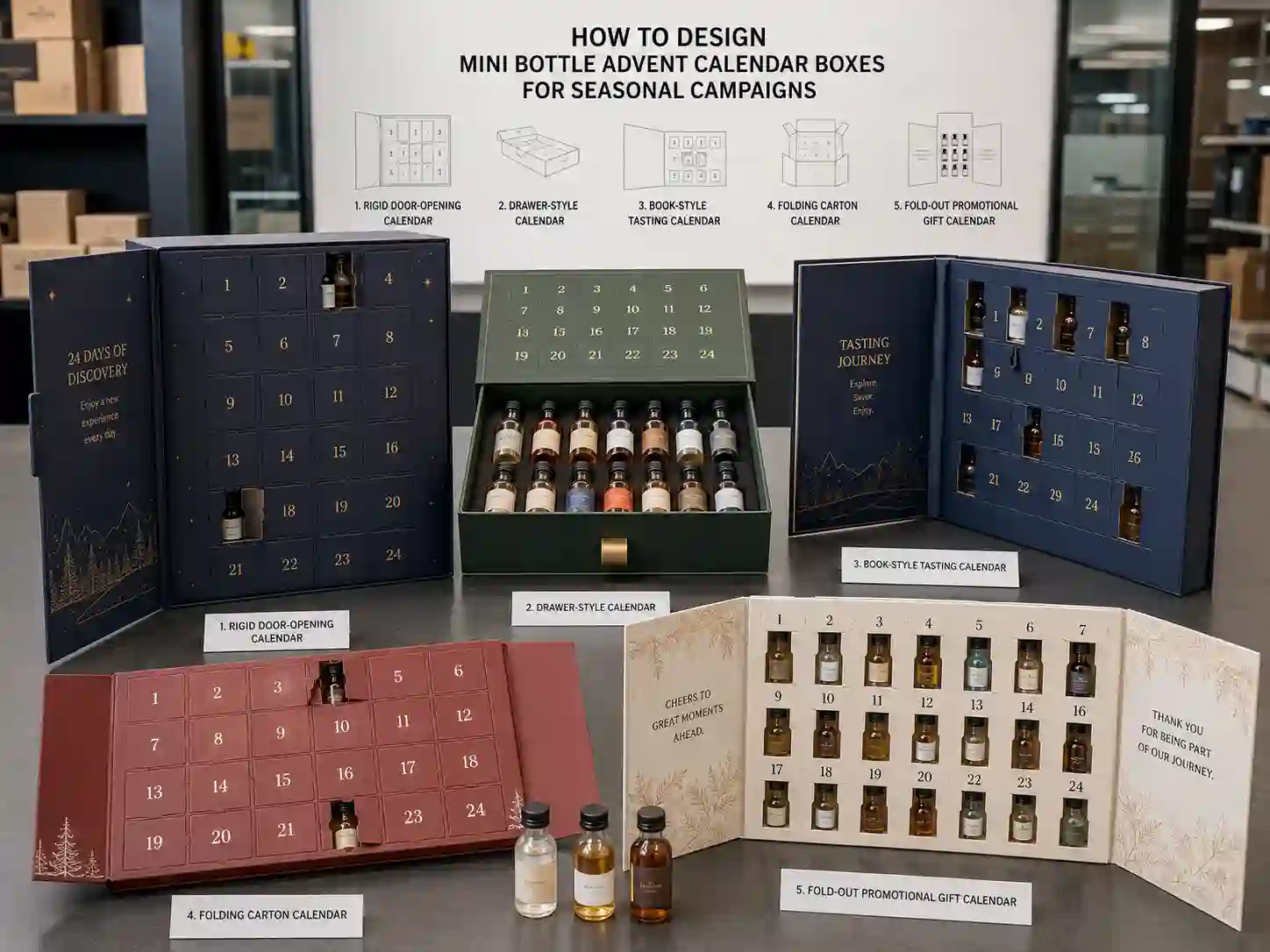
| Structure option | Best use case | Main advantage | Buyer watch point |
|---|---|---|---|
| Rigid door-opening box | Premium beverage samples, perfume vials, cosmetic ampoules, luxury tasting campaigns | Strong presentation, good shelf impact, suitable for heavier loaded sets | Needs accurate door cuts, reinforced greyboard, and insert fit testing |
| Drawer box | Gift sets, mini bottle discovery kits, e-commerce seasonal boxes | Smooth unboxing, strong internal support, good for staged reveal | Drawer friction must be tested after bottles are loaded |
| Book-style rigid box | Brand storytelling campaigns, tasting collections, retail gift display | Premium look with large printable surfaces | Hinge area and magnetic closure strength need checking |
| Folding carton calendar | Lighter plastic bottles, small sample vials, budget-sensitive campaigns | Lower material use and more compact packing | May need reinforced paperboard or inner tray for heavy glass bottles |
| Fold-out promotional calendar | Retail display, product education, limited promotional campaigns | Large display area for product information and numbered panels | Must control panel warping and compartment balance |
When should buyers choose a rigid box?
Choose a rigid box when the product is heavy, fragile, high-value, or intended for premium retail display. Greyboard thickness, wrapping paper quality, insert locking method, and outer carton strength all affect performance.
Rigid mini bottle advent calendar boxes are often suitable for glass bottles because they offer better compression resistance than simple folding cartons. They also support premium finishing such as foil stamping, embossing, spot UV, textured paper, matte lamination, and gloss lamination. However, buyers should expect higher material cost, longer assembly time, and more attention during sample approval.
When does a folding carton make sense?
A folding carton can work when bottles are small, lightweight, or supported by a strong inner tray. It is often chosen for larger promotional volumes where cost control and shipping efficiency are important.
For bottle calendars, folding cartons should not be selected only because they are cheaper. The factory should check paperboard grade, flute or reinforcement options, compartment stability, and how much pressure the filled bottles place on the front panels and opening doors.
How should inserts protect mini bottles during handling and shipping?
The insert must stop bottle movement, distribute weight, protect glass, and keep each numbered compartment aligned with the artwork. Insert selection is one of the most important decisions for mini bottle advent calendar boxes because it affects both presentation and breakage risk.
Common insert materials include paper insert, PET tray, EVA insert, foam, and molded pulp. Each option has a different balance of cost, appearance, sustainability preference, strength, and tolerance control.
| Insert type | Strength for bottles | Appearance | Typical buyer consideration |
|---|---|---|---|
| Paper insert | Medium to high when well engineered | Paper-based, brand-friendly, printable if needed | Good for many custom advent calendar boxes, but fold lines and locking tabs must be tested |
| PET tray | Good shape control for repeat bottle sizes | Clean and precise | Useful for tight fit, but material preference and recycling communication should be checked by market |
| EVA insert | High cushioning and premium feel | Clean, dense, and protective | Good for fragile or high-value bottles, but usually increases cost |
| Foam insert | High cushioning | Protective but less paper-focused | Useful for glass protection, but buyers should check target-market material requirements |
| Molded pulp insert | Good support when tooling and shape are correct | Natural paper-based look | Good for sustainability-positioned campaigns, but tooling and surface finish need review |
Factory tip: Insert testing should be done with real filled bottles, not only empty sample bottles. Filled weight changes how the tray bends, how the doors open, and how the export carton performs under stacking pressure.
How do bottle and beverage issues change the packaging design?
Bottle calendars need stronger structural planning than many dry gift categories because glass, liquid weight, caps, and possible leakage create additional risk. Buyers should check heavy product support, glass protection, insert strength, carton compression, and export packing before confirming mass production.
For beverage samples, coffee concentrates, syrup bottles, mini spirits alternatives, tea shots, or cosmetic liquids, the package should be designed around the real product profile. A bottle with a narrow neck and wider cap may need a stepped insert. A tall glass vial may need side support to prevent tilting. A heavy round bottle may need a deeper cavity, stronger backing board, or additional locking structure behind the numbered door.
Important bottle-specific checks include:
- Glass clearance: Keep enough space around glass to prevent direct impact while avoiding loose movement.
- Cap height tolerance: Check caps, droppers, spray pumps, or screw tops because they may be wider than the bottle body.
- Loaded drop risk: Review whether the bottle can fall forward when the door is opened.
- Insert compression: Test whether the tray bends under the total product weight.
- Carton stacking: Confirm that the master carton and inner packing can handle warehouse pressure.
- Leakage isolation: For liquid products, buyers should verify cap sealing with their product supplier before packaging production.
If food-contact or beverage-related packaging components are involved, buyers should discuss their market requirements with their compliance team. For U.S. food-contact questions, the official FDA food contact substances guidance can be a useful reference. For transport testing programs, buyers can review information from ISTA and confirm which test method is relevant for their distribution route.
How should artwork, dieline, and finishing be prepared?
Artwork should be prepared on the final approved dieline, with each door, drawer, compartment, glue area, bleed, crease, and cut line checked before printing. For seasonal bottle campaigns, artwork errors can delay sample approval and compress the production schedule.
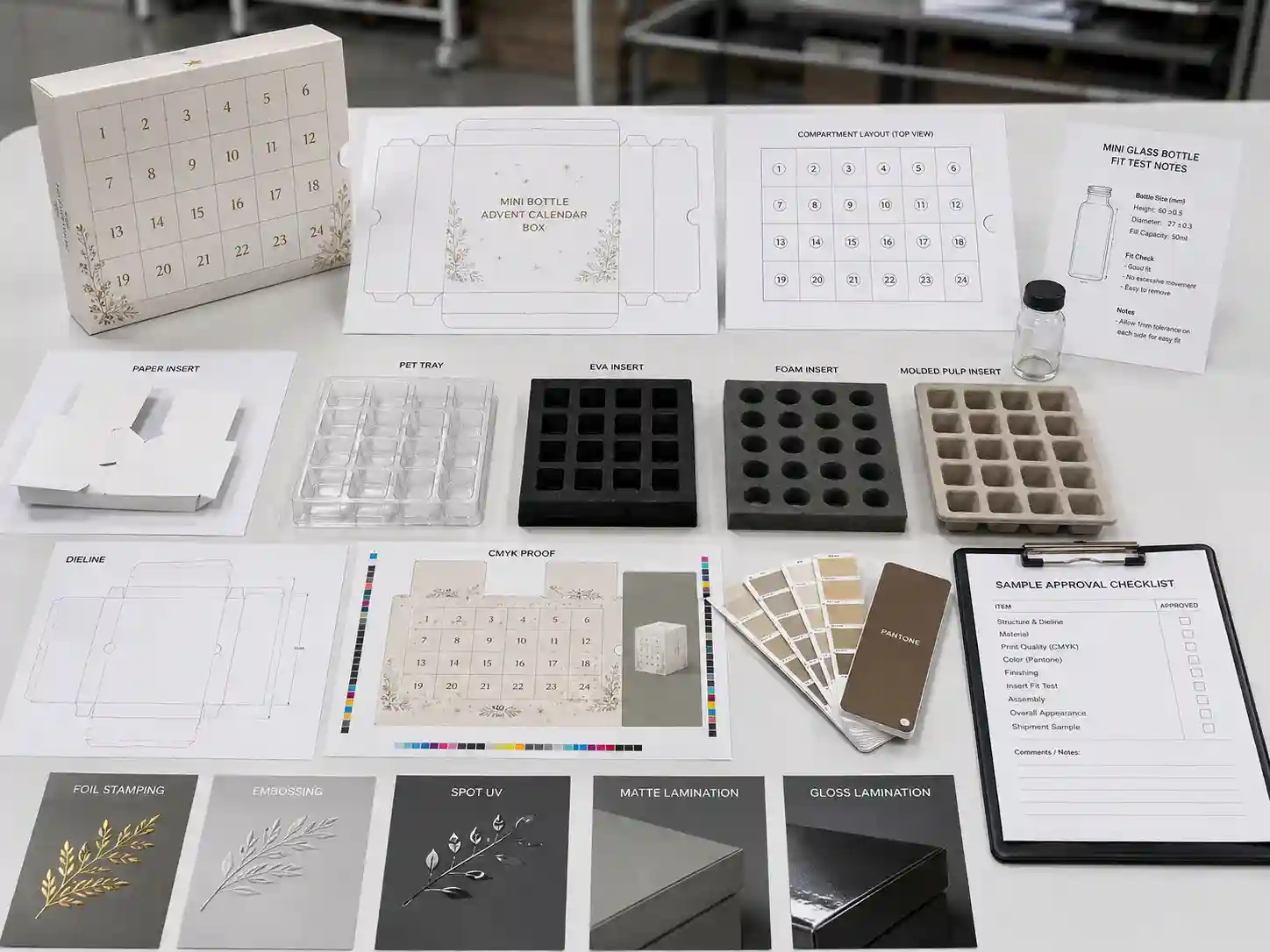
The dieline is not only a design template. It is a production control document. It shows where the paperboard folds, where doors open, where the insert sits, and how the bottle positions match the printed numbers. Buyers should not approve artwork until the structure and insert layout are confirmed.
Which printing and finishing options matter for B2B campaigns?
Printing and finishing should match the brand position, order quantity, product weight, and handling requirements. CMYK is suitable for full-color artwork, while Pantone colors help control important brand colors across production.
Common finishing choices include matte lamination, gloss lamination, foil stamping, embossing, debossing, spot UV, textured paper, and metallic paper. For retail display, foil stamping and embossing can make a premium calendar stand out. For e-commerce handling, lamination can help protect the printed surface from rubbing during packing and shipping.
Buyer tip: Do not approve foil stamping, embossing, or spot UV only from a screen image. These effects should be reviewed on a physical sample or proof because pressure, shine, registration, and surface texture can look different from digital mockups.
What artwork mistakes should buyers avoid?
The most common artwork mistakes are missing bleed, low-resolution images, incorrect color mode, unclear door numbers, artwork placed across cut lines, and late changes after sample approval. These issues can cause re-proofing, sample delays, or mass production risk.
- Keep important text away from cut lines, crease lines, and door openings.
- Confirm whether artwork should be supplied in CMYK or with specific Pantone references.
- Mark foil, embossing, spot UV, and varnish layers clearly in the artwork file.
- Check barcode area, warning labels, recycling marks, importer information, and shipping label space if required.
- Confirm whether each number matches the correct bottle position and opening direction.
What sampling process should buyers expect before mass production?
Buyers should expect a step-by-step sampling process: structure confirmation, blank sample, printed sample or prototype, insert fit test, artwork proof, pre-production sample, and final approval before mass production. Sampling reduces risk before the full order is produced.
For mini bottle advent calendar boxes, a blank sample is useful for checking size, opening style, insert fit, and loaded weight support. A printed sample helps confirm color, finishing, door alignment, surface treatment, and brand presentation. A pre-production sample should represent the approved mass production standard as closely as possible.
- Initial design discussion: Buyer shares bottle dimensions, layout, quantity, artwork direction, and sales channel.
- Dieline and structure proposal: Factory prepares a structure concept and layout for review.
- Blank sample: Buyer checks dimensions, compartment fit, opening function, and insert strength.
- Printed prototype: Buyer reviews CMYK, Pantone, lamination, foil stamping, embossing, spot UV, and overall appearance.
- Loaded fit test: Real bottles are installed to check movement, glass protection, and total weight support.
- Pre-production sample: Final sample is approved before mass production starts.
Giftpackpro provides custom advent calendar box services for buyers who need support with structure, dieline, sampling, inserts, and seasonal packaging production. Buyers can also review custom advent calendar box products to compare possible structures before developing a new project.
How should buyers compare MOQ, cost drivers, and lead time?
MOQ, cost, and lead time depend on structure complexity, box size, material thickness, insert type, printing method, finishing, assembly labor, packing method, and order volume. Buyers should compare quotations by specification, not only by unit price.
A low quotation may exclude important details such as stronger greyboard, reinforced paper insert, printed sample, finishing plates, export carton strength, pallet packing, or barcode label requirements. For bottle calendars, under-specified packaging can create higher downstream costs through breakage, delay, rework, or retail complaints.
What are the main cost drivers?
The main cost drivers are material thickness, rigid box assembly, insert complexity, number of doors or drawers, finishing effects, sample revisions, manual packing, and export carton requirements. Heavy bottle sets usually require stronger construction, which can increase both material and shipping cost.
- Structure: Rigid boxes generally cost more than folding cartons because they require greyboard, wrapping, and more assembly steps.
- Insert: EVA, foam, PET tray, molded pulp, and complex paper inserts have different tooling and labor requirements.
- Finishing: Foil stamping, embossing, spot UV, and special paper can require setup cost and longer proofing.
- Assembly: Multi-compartment calendars may need more manual work, especially for drawer or door-opening designs.
- Packing: Heavy glass bottle calendars may need stronger export cartons, corner protectors, dividers, or palletization.
Quotable B2B statement: The cheapest mini bottle calendar box is rarely the lowest-risk option; for glass products, insert strength and export carton compression can matter as much as the printed surface.
What decision guide helps buyers choose the right design route?
Buyers can choose the right design route by matching product weight, campaign positioning, sales channel, and schedule. The guide below helps purchasing teams narrow the packaging direction before requesting a sample or quotation.
| Buyer situation | Recommended direction | Reason |
|---|---|---|
| Premium glass bottle gift set for retail | Rigid door-opening or book-style box with reinforced insert | Supports higher presentation value and better loaded weight control |
| E-commerce mini bottle campaign | Drawer box or rigid box with strong export carton testing | Improves protection during parcel handling and repeated movement |
| Large promotional quantity with lightweight bottles | Folding carton with engineered paper insert or PET tray | Balances cost, packing efficiency, and sufficient product support |
| Mixed product advent calendar with bottles and dry gifts | Custom compartment layout with different cavity depths | Prevents heavy bottles from damaging lighter items |
| Sustainability-focused campaign | Paperboard structure, paper insert, or molded pulp insert | Supports a more paper-based material story, subject to buyer market verification |
| Short launch timeline | Use an existing structure direction with limited finishing complexity | Reduces sample revisions, tooling risk, and approval delays |
For more planning references, buyers can read other advent calendar box buying guides covering structure, inserts, sampling, quality control, and export packing.
How should buyers evaluate suppliers for seasonal bottle packaging?
Buyers should evaluate suppliers by their ability to handle structure engineering, insert testing, artwork proofing, sample control, QC inspection, export packing, communication, and realistic lead-time planning. A reliable supplier should ask practical questions before quoting.
When comparing suppliers, purchasing teams should check whether the factory understands bottle weight, glass protection, insert tolerance, door alignment, and carton compression. A supplier that only quotes from outside dimensions may miss important production risks.
Supplier comparison checklist
- Can the supplier suggest the right rigid box, drawer box, door-opening box, folding carton, or fold-out structure for the product weight?
- Can they test paper insert, PET tray, EVA insert, foam, or molded pulp options with actual bottles?
- Do they provide dieline checking before artwork is finalized?
- Can they support blank sample, printed sample, prototype, and pre-production sample approval?
- Do they explain MOQ, lead time, tooling cost, finishing cost, and packing cost clearly?
- Do they have QC checkpoints for printing, lamination, foil registration, door opening, insert fit, glue strength, and carton packing?
- Can they prepare export cartons, shipping marks, pallet instructions, and label areas according to buyer requirements?
- Do they communicate risks early instead of only accepting the buyer’s initial drawing?
Buyers can learn more about the Giftpackpro packaging factory when evaluating production capability, seasonal packaging experience, and custom project support.
What QC checks are important before shipment?
QC should confirm that the finished mini bottle advent calendar boxes match the approved sample in structure, color, insert fit, opening function, loaded support, carton packing, and labeling. For bottle calendars, QC must include both appearance and protective performance checks.
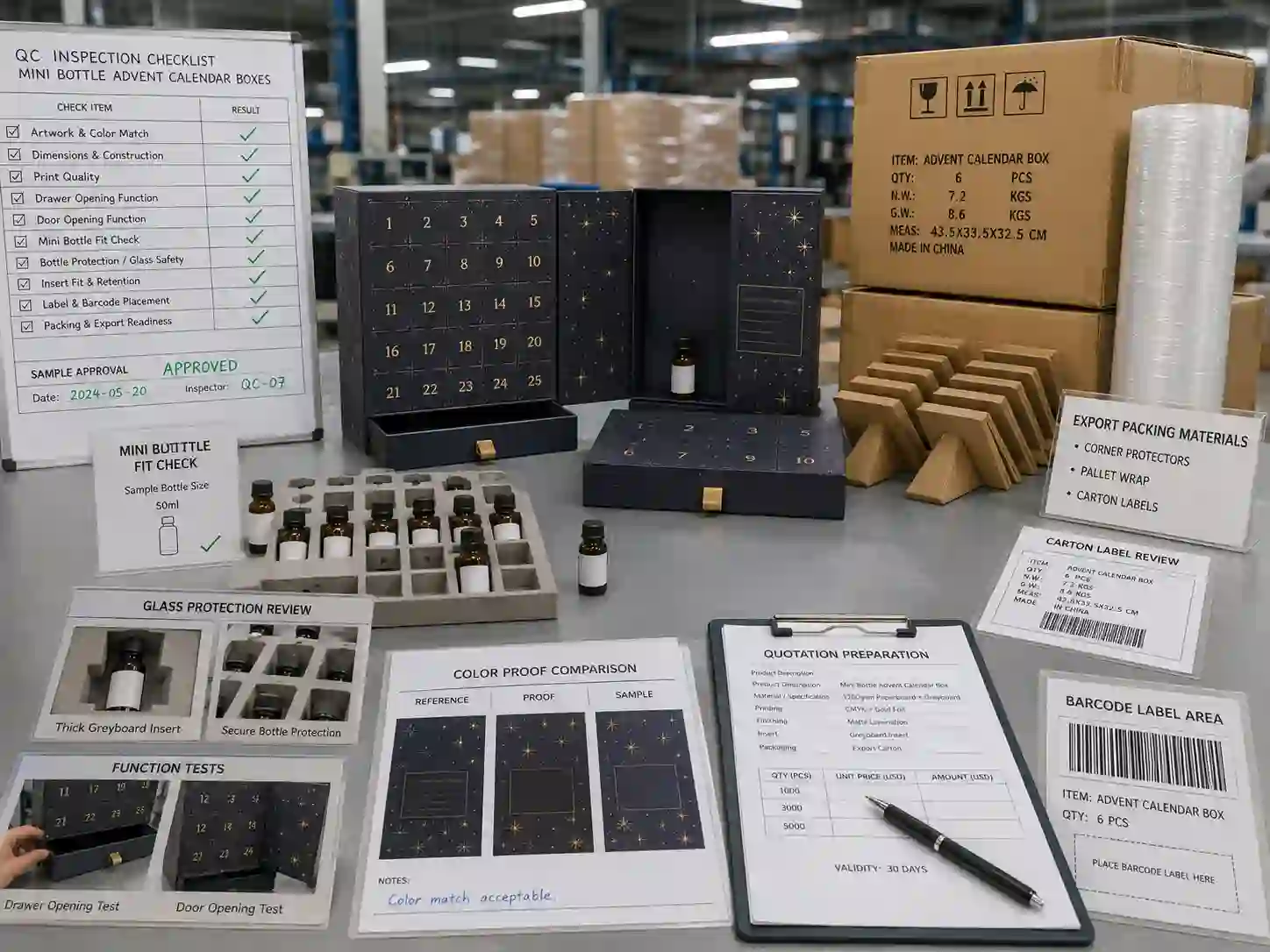
A practical QC plan should include incoming material checks, printing inspection, lamination review, finishing registration, die-cut accuracy, assembly tolerance, insert fit, door or drawer function, glue strength, carton packing, and final random inspection. For glass bottles, the buyer should also request loaded checks using the real bottle weight or approved equivalent.
QC checklist for mini bottle calendars
- Outer box dimensions match the approved dieline and sample.
- Doors, drawers, or panels open smoothly without tearing.
- Insert cavities hold bottles securely without excessive movement.
- Glass bottles do not hit each other or press directly against weak panels.
- Printed colors match approved CMYK proof or Pantone reference within agreed tolerance.
- Foil stamping, embossing, spot UV, matte lamination, or gloss lamination are correctly registered.
- Glue areas are clean and strong, especially around loaded compartments.
- Barcode area, carton label, and shipping marks are placed correctly if required.
- Export carton board strength is suitable for the loaded weight.
- Pallet packing, corner protectors, and stretch wrap follow the buyer’s shipping plan if used.
QC tip: Inspect one empty box and one fully loaded box. Empty packaging can hide problems such as tray bending, door stress, drawer friction, or carton compression caused by bottle weight.
How should export packing be planned for heavy mini bottle sets?
Export packing should be planned around total carton weight, stacking strength, glass protection, shipping marks, pallet handling, and destination warehouse requirements. Heavy bottle calendars need stronger master cartons than lightweight paper gift packaging.
Export carton planning should consider how many finished calendars are packed per carton, whether each calendar is flat packed or assembled, whether bottles are packed separately or already installed, and whether additional protection is needed. For assembled bottle calendars, the factory may need inner bags, corner protection, dividers, top-and-bottom pads, or stronger corrugated cartons.
Key export packing decisions include:
- Master carton size and gross weight limit.
- Carton compression strength for warehouse stacking.
- Individual box protection to prevent surface rubbing.
- Shipping marks, SKU labels, carton numbers, and barcode label areas.
- Pallet size, pallet height, corner protectors, and stretch wrapping if palletized.
- Drop, vibration, or transit testing requirements requested by the buyer or retailer.
Factory tip: Do not finalize carton quantity only by fitting the most units into one box. For mini bottle advent calendar boxes, carton weight and compression strength can be more important than maximum packing density.
What information should buyers prepare before requesting a quotation?
Buyers should prepare product details, structure preference, artwork requirements, order quantity, destination, packing method, and timeline before requesting a quotation. Clear RFQ information helps the factory quote faster and reduces misunderstandings.
Before contacting Giftpackpro, prepare the following quotation checklist:
- Project name and product category.
- Number of bottles and compartment layout.
- Bottle dimensions, filled weight, material, and cap style.
- Preferred box structure, such as rigid box, drawer box, door-opening box, folding carton, or custom concept.
- Material preference, such as paperboard, greyboard, specialty paper, molded pulp, PET tray, EVA, or foam.
- Printing files or design direction, including CMYK, Pantone, foil stamping, embossing, spot UV, matte lamination, or gloss lamination.
- Quantity range for MOQ review and price comparison.
- Sample type needed: blank sample, printed sample, prototype, or pre-production sample.
- Target delivery date and destination country or region.
- Export packing needs, including carton label, shipping marks, pallet, barcode area, or retailer packing rules.
When the project details are ready, buyers can request a custom quote from Giftpackpro. A clear RFQ helps the team recommend structure, insert, sample route, MOQ, lead time, and export packing options for custom seasonal packaging.
What common mistakes should buyers avoid?
Buyers should avoid choosing a structure before confirming bottle weight, approving artwork before dieline approval, ignoring insert testing, comparing quotations without specifications, and leaving export packing decisions until the end. These mistakes often create delays or quality problems during seasonal production.
- Mistake 1: Designing from appearance only. Bottle calendars must be engineered for weight, glass protection, and handling, not only shelf photos.
- Mistake 2: Using empty bottles for all sample tests. Filled products create different pressure and movement.
- Mistake 3: Treating inserts as decoration. Inserts are structural components that control product safety.
- Mistake 4: Approving artwork before structural confirmation. Door positions and compartment layout can change during sampling.
- Mistake 5: Ignoring carton compression. Heavy products can damage weak export cartons during stacking.
- Mistake 6: Comparing only unit price. A quotation should include structure, material, insert, finishing, sample, packing, and delivery assumptions.
FAQ: Mini bottle advent calendar boxes for B2B buyers
Are mini bottle advent calendar boxes suitable for glass bottles?
Yes, they can be suitable for glass bottles if the box structure, insert, and export carton are designed for the actual filled weight. Buyers should request loaded sample testing before approving mass production.
Which insert is best for mini bottle packaging?
There is no universal best insert. Paper inserts can work well for paper-based campaigns, PET trays offer precise cavities, EVA and foam provide cushioning, and molded pulp supports a natural material direction. The right choice depends on bottle size, weight, presentation, budget, and buyer market requirements.
Should buyers choose a drawer box or door-opening box?
A drawer box is useful for smooth unboxing and strong inner support, while a door-opening box works well for numbered daily reveal campaigns and retail display. For heavy bottles, both options should be tested with real loaded weight.
How early should buyers start a seasonal mini bottle calendar project?
Buyers should start as early as possible because structure design, insert testing, artwork preparation, printed sample approval, mass production, QC, and export shipping all require time. Projects with complex finishing or fragile glass bottles need more approval time than simple paper gift boxes.
What affects the MOQ for custom mini bottle calendars?
MOQ can be affected by material purchasing, printing setup, die-cut tooling, insert tooling, finishing plates, assembly labor, and carton packing method. Buyers should share quantity ranges so the factory can compare practical pricing levels.
Can one calendar hold mixed products such as mini bottles, chocolates, candles, jewelry, toys, tea, coffee, and gifts?
Yes, mixed product calendars are possible, but the compartment layout must separate heavy, fragile, and lightweight items. Mini bottles should be supported by stronger cavities so they do not damage chocolates, paper gifts, small toys, jewelry, tea sachets, coffee packs, or other items during shipping.
CTA: How to move from concept to sample with Giftpackpro
To design mini bottle advent calendar boxes for seasonal campaigns, prepare bottle dimensions, filled weight, compartment count, structure preference, artwork direction, quantity range, target launch date, destination, and export packing needs. Giftpackpro can then help review the dieline, insert, material, sample route, printing, finishing, MOQ, QC checkpoints, and quotation details.
For buyers planning custom advent calendar boxes with bottles, beverages, cosmetics, chocolate, candles, jewelry, toys, tea, coffee, or gift products, the safest development route is simple: confirm the product first, engineer the structure second, approve the sample third, and only then move to mass production.


