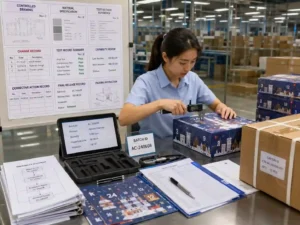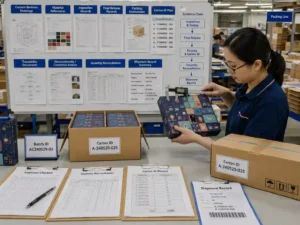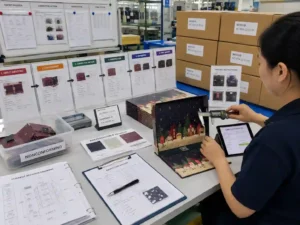
Quick answer: Beverage advent calendar boxes need stronger insert engineering than many other seasonal gift boxes because mini bottles, cans, vials, sachets, and concentrate packs add weight, pressure, and leakage risk. Buyers should compare the outer structure, insert material, compartment tolerance, bottle orientation, printing method, sample approval process, carton compression, and export packing plan before confirming mass production. For B2B projects, the best result usually comes from testing real filled products in a prototype, approving the dieline and artwork proof, then checking insert strength, door opening, drawer movement, glass protection, and master carton packing before shipment.
What should buyers understand before choosing beverage advent calendar boxes?
Buyers should understand the product weight, fragility, liquid packaging format, campaign channel, and delivery route before choosing beverage advent calendar boxes. A structure that looks attractive in photos may fail if the insert does not hold each bottle firmly during handling, warehousing, and export shipping.
Beverage sample calendars are different from chocolate, stationery, or lightweight beauty calendars. Mini glass bottles, cans, syrup samples, coffee concentrates, tea shots, drink mix sachets, and tasting vials all create different pressure points inside the box. The insert is not only a display component; it is also a load-bearing and protection system.
For overseas brands, wholesalers, retail buyers, and e-commerce sellers, the first buying decision should not be “Which box looks best?” The better question is: “Which structure can safely carry our real product weight while still supporting the campaign artwork, retail display, and shipping plan?”
A reliable custom advent calendar boxes manufacturer should ask about product dimensions, filled weight, bottle material, closure type, retail channel, packing method, and destination market before recommending a structure. These details affect paperboard thickness, greyboard strength, insert type, compartment layout, sample cost, MOQ, and lead time.
Which box structures work best for beverage sample calendars?
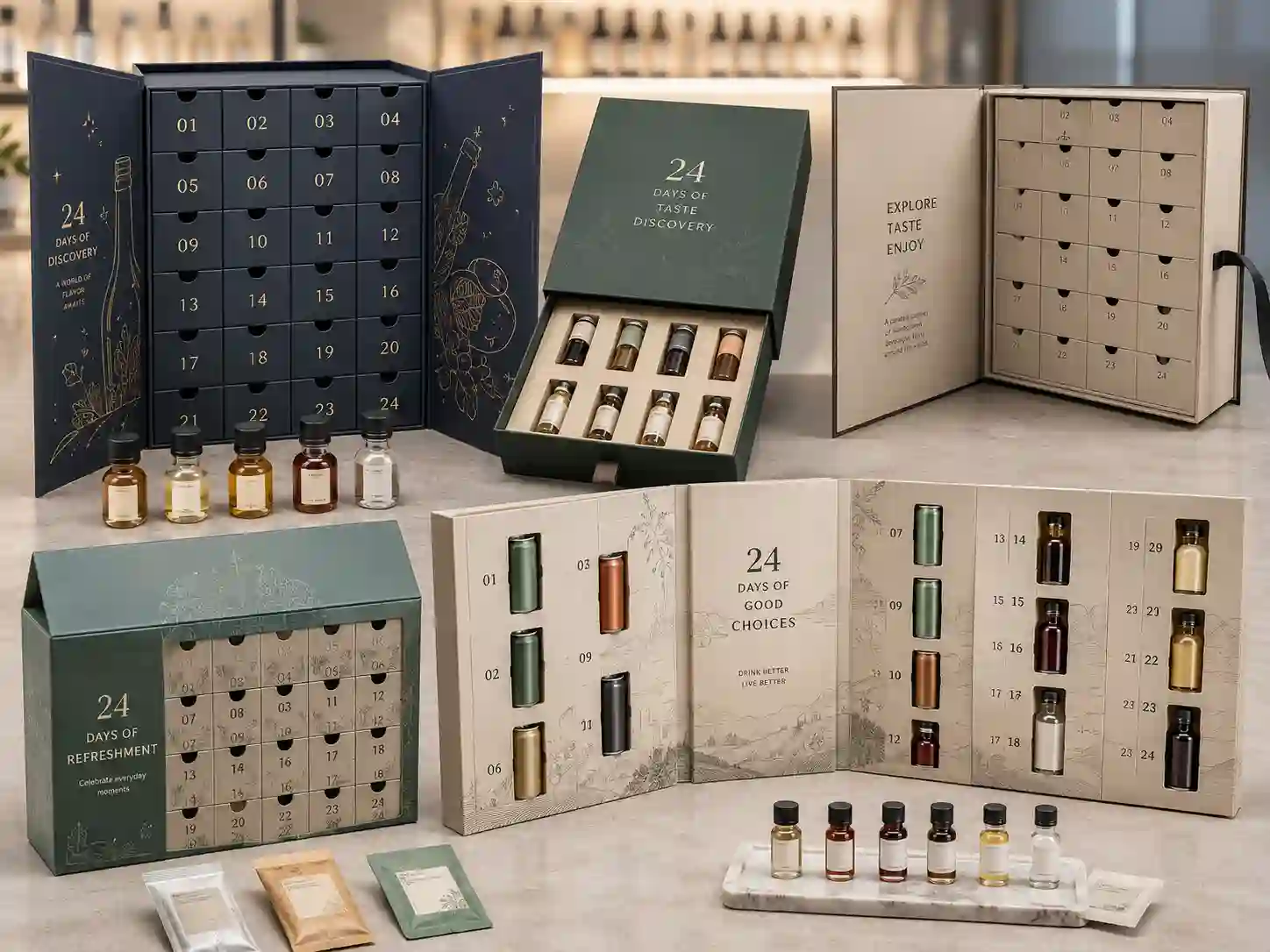
The best structure depends on the product weight, number of compartments, retail positioning, and whether the buyer needs shelf display, e-commerce protection, or premium gifting. For beverage advent calendar boxes, rigid boxes and reinforced drawer or door-opening structures are often safer for glass or heavy samples than thin folding cartons.
Common structures include rigid door-opening boxes, drawer boxes, book-style boxes, fold-out calendars, and folding carton calendars. Each can work, but only when the insert and outer box are designed as one system.
Rigid door-opening box: when is it the safest choice?
A rigid door-opening box is often suitable for premium beverage sample sets, especially when the products include glass bottles or multiple heavy units. Greyboard gives the calendar better shape retention, while numbered doors or panels create a strong retail presentation.
The buyer should check whether each door has enough clearance to open cleanly after printing, lamination, and assembly. If the door is too tight, consumers may tear the printed surface. If it is too loose, the product may move during transit.
Drawer box: when does it make sense for beverage samples?
A drawer box works well when the buyer wants smooth access, repeatable opening, and strong horizontal support. It can also help separate heavy samples into different levels instead of loading all weight onto one thin front panel.
For drawer beverage calendars, the factory should test drawer sliding after the real insert and sample products are loaded. Drawer friction changes after lamination, wrapping paper, foil stamping, and product weight are added.
Folding carton calendar: when is it acceptable?
A folding carton beverage calendar can be suitable for lightweight sachets, powder sticks, tea samples, or flat drink mix packs. It is usually not the first choice for heavy glass bottles unless the inner tray, carton board, and export packing are heavily reinforced.
Folding cartons may help control cost and shipping volume, but buyers should not select them only because they are cheaper. If the product weight is high, the risk of crushed corners, torn compartments, or poor shelf appearance may offset the initial saving.
Book-style or fold-out calendar: when is display more important?
Book-style and fold-out structures are useful when retail storytelling, product education, or multi-category tasting is important. They can show tasting notes, flavor groups, QR code areas, or campaign messages while keeping samples organized.
However, fold-out formats need careful balance testing. When several beverage samples sit on one side, the box may lean, sag, or open unevenly. The sample stage should include an open-display test, not only a closed-box appearance check.
How should buyers compare insert options for beverage advent calendar boxes?
Buyers should compare inserts by product weight, protection level, sustainability target, visual quality, tooling cost, and assembly efficiency. The insert is the part that decides whether the beverage samples stay aligned, protected, and easy to remove.
For beverage packaging, insert selection should be based on actual bottle dimensions and filled product weight, not estimated artwork drawings. Even small differences in bottle shoulder width, cap height, label thickness, or shrink sleeve thickness can affect compartment fit.
| Insert option | Best for | Buyer advantages | Risk to check |
|---|---|---|---|
| Paperboard insert | Sachets, slim cans, lightweight vials, paper-based campaigns | Good printability, recyclable appearance, lower tooling cost, easy to customize | May need reinforcement for heavy bottles or tall glass samples |
| PET tray | Uniform bottles, cans, molded cavities, high-volume retail projects | Accurate product positioning, clean display, efficient assembly | Tooling and sustainability requirements should be checked early |
| EVA insert | Premium glass bottles, fragile vials, luxury tasting sets | Strong cushioning, neat product fit, premium feel | Higher cost and material thickness may increase box size |
| Foam insert | Fragile glass, export-heavy routes, sample kits needing shock absorption | Good protection and flexible cavity cutting | May not match every sustainability or retail material requirement |
| Molded pulp insert | Eco-positioned beverage campaigns, cans, jars, heavier samples | Paper-based image, cushioning, strong molded support | Surface texture and tolerance should be approved with real products |
Buyer tip: Do not approve an insert only from a flat dieline. Ask for a blank sample or prototype using real products, because the correct insert must hold the beverage sample during shaking, turning, shelf display, and export packing.
Which insert design details prevent bottle movement and glass damage?
Insert strength, cavity tolerance, product orientation, support height, and removal clearance are the main details that prevent movement and glass damage. The goal is to hold the product securely without making it difficult for the end user to remove.
For mini glass bottles, the insert should support the base and restrict side movement. If only the neck is held, the bottle may swing inside the cavity. If only the base is held, the bottle may hit the front panel during transport. For heavier bottles, a deeper cavity or multi-layer insert may be required.
For cans, the key issue is surface scratching and dent prevention. The insert should stop metal-to-metal contact and avoid sharp paperboard edges around printed cans. For sachets and drink powder sticks, the issue is less about impact and more about clean organization, easy removal, and avoiding crushed corners.
For liquid samples, buyers should also check closure direction. Some beverage products should be packed upright to reduce leakage risk. If a calendar design requires bottles to lie flat, the buyer should confirm that caps, seals, and labels can tolerate that orientation during shipping and storage.
How tight should the compartment fit be?
The compartment should be tight enough to stop movement but not so tight that loading damages labels or removal frustrates the customer. A useful production target is consistent fit across all cavities, not only one perfect cavity in the sample.
During sampling, buyers should test several units from different positions in the calendar. Top-row, bottom-row, edge, and center compartments may behave differently because of folding, glue, paper tension, and weight distribution.
How much insert strength is needed for heavy products?
Heavy beverage samples need vertical support, side support, and outer box compression resistance. If the insert collapses under weight, the front design may still look fine at first, but the products can shift after stacking in cartons or pallets.
A factory-side check should include loaded box weight, drop-handling simulation, door or drawer function after loading, and master carton stacking. For large B2B orders, buyers should approve a pre-production sample before mass production so assembly tolerance and insert performance are confirmed at production speed.
How do printing and finishing choices affect beverage calendar structure?
Printing and finishing affect more than appearance; they also change folding tension, surface thickness, door opening, and assembly tolerance. Buyers should review artwork and structure together instead of approving design files separately from the box sample.
Common printing and finishing options include CMYK printing, Pantone color matching, foil stamping, embossing, spot UV, matte lamination, and gloss lamination. These can make custom advent calendar boxes more retail-ready, but they also add process steps, lead time, cost, and inspection points.
Matte lamination can create a premium soft look, but it may show scratches during handling if the calendar is heavy. Gloss lamination can make colors brighter, but it may create glare on retail shelves. Foil stamping and embossing can improve gift value, but they need enough flat surface area and stable registration.
Factory tip: For beverage advent calendar boxes with numbered doors, avoid placing small foil details too close to perforation lines, door cuts, or folding edges. Registration tolerance and cracking risk are higher around moving or cut areas.
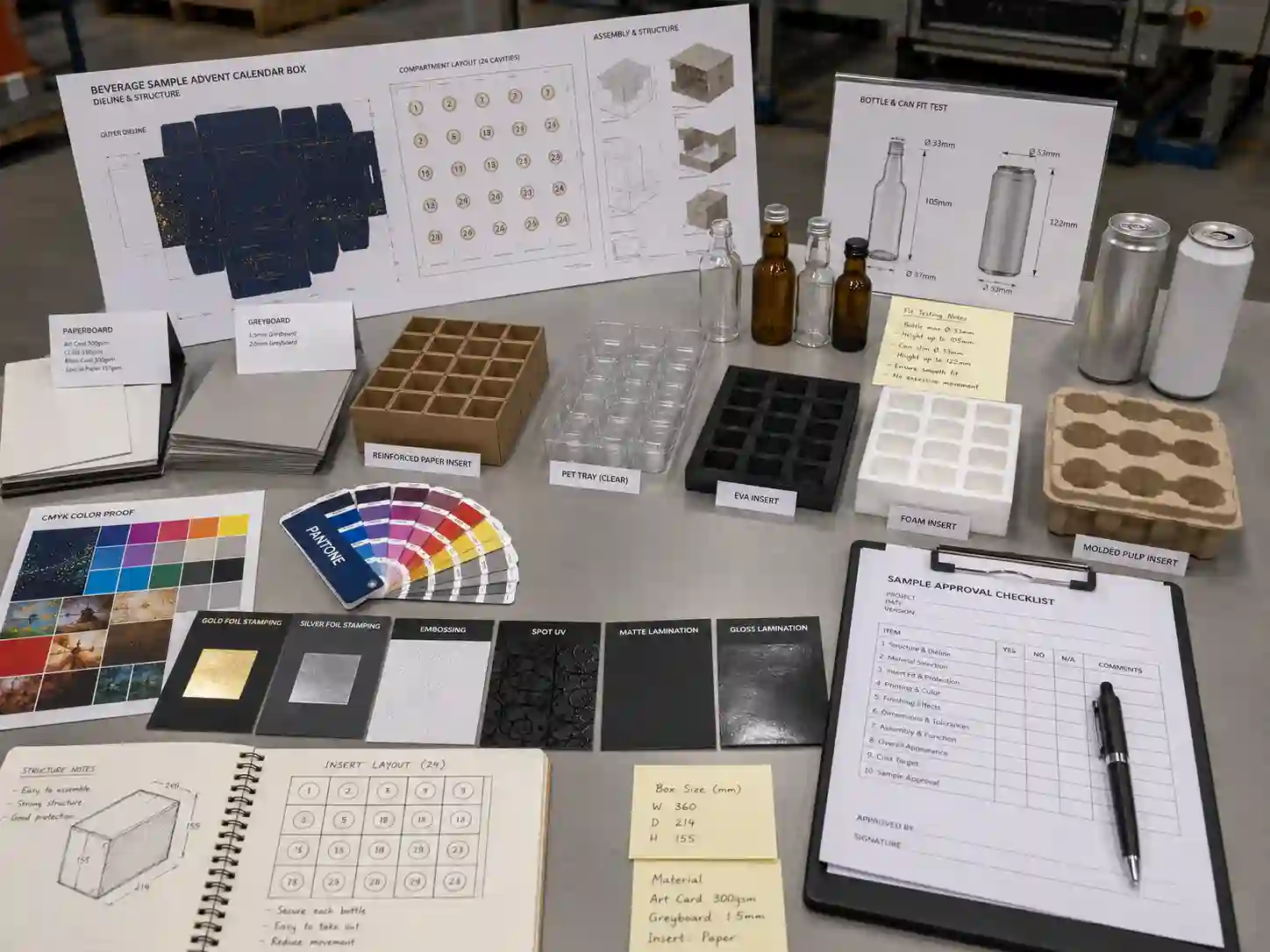
What should be checked on the dieline before artwork approval?
The dieline should be checked for product cavity size, door position, glue area, bleed, safety margin, barcode area, folding direction, and insert alignment. A beautiful artwork file can still create production problems if it ignores cutting and assembly limits.
Buyers should provide product dimensions in millimeters, including cap, label, sleeve, pump, crown cap, or shrink wrap. The factory should then match the outer structure and insert layout to real product measurements. If a product has multiple flavors or SKUs with slightly different sizes, the largest size should be tested first.
Important dieline checks include:
- Whether each bottle cavity matches the actual product diameter, height, and weight.
- Whether numbered doors open without hitting the bottle neck or cap.
- Whether drawer depth allows the insert to sit flat after loading.
- Whether barcode, QR code, recycling marks, and shipping label areas stay readable.
- Whether foil stamping, embossing, and spot UV areas avoid fold cracks and cut edges.
- Whether the calendar can be assembled efficiently during mass production.
If the buyer has sustainability or paper sourcing requirements, they can review official guidance from FSC chain of custody certification and ask suppliers to verify claims instead of assuming that all paperboard options carry the same documentation.
How should buyers choose materials for beverage sample calendars?
Buyers should choose materials based on load-bearing needs, brand positioning, destination market, and packing method. For beverage sample calendars, paperboard thickness and greyboard strength should be selected after calculating real product weight, not only based on a standard catalog.
Rigid boxes normally use greyboard wrapped with printed paper. They are suitable for premium beverage campaigns, glass protection, and strong shelf display. Folding cartons normally use paperboard and can be more efficient for lightweight packs. Inserts may use paperboard, PET, EVA, foam, molded pulp, or mixed materials depending on protection and cost requirements.
Material decisions also influence MOQ and lead time. Custom molded pulp, PET trays, or complex EVA inserts may require tooling. Special paper, metallic paper, textured paper, or unusual lamination may require longer purchasing time. If the buyer has a fixed seasonal launch date, these decisions should be made before artwork finalization.
What sampling process should buyers expect before mass production?
Buyers should expect a staged sampling process: dieline review, blank structure sample, printed sample, loaded product fit test, and pre-production sample approval. Skipping these steps can lead to insert failure, color deviation, weak assembly, or export damage.
For beverage advent calendar boxes, a blank sample is useful for checking size, structure, and insert fit before paying for full printing. A printed sample is useful for checking CMYK or Pantone color, finishing effects, numbering, surface quality, and shelf appearance. A pre-production sample confirms that the approved design can be repeated during mass production.
Giftpackpro can support buyers through custom advent calendar box services such as structure planning, dieline checking, material comparison, sample development, and production follow-up. Buyers can also review related custom advent calendar box products to compare common structures before starting a new RFQ.
What should buyers send for accurate sampling?
Buyers should send exact product dimensions, filled weight, photos, artwork requirements, expected quantity, destination country, packing preference, and campaign deadline. If possible, physical product samples should be sent to the factory for fit testing.
A beverage calendar sample made without real products is only a structural reference. It cannot fully confirm glass protection, bottle movement, insert pressure, leakage orientation, or carton compression performance.
Which MOQ, cost, and lead time factors matter most?
MOQ, cost, and lead time are mainly affected by structure complexity, material choice, insert type, printing process, finishing process, tooling, assembly labor, and packing method. Beverage calendars with heavy products usually cost more than lightweight calendars because they need stronger inserts and more careful export packing.
Buyers should compare quotations by specification, not only by unit price. A low quote may exclude insert tooling, sample revisions, stronger export cartons, pallet packing, special finishing, or pre-production testing. For purchasing teams, the most useful quotation is one that clearly lists material, size, insert type, printing, finishing, packing method, sample cost, MOQ, lead time, and payment terms.
Decision guide: which option should you choose?
- Choose rigid box plus EVA or foam insert when the calendar contains glass bottles, premium samples, or high-value gift sets.
- Choose rigid box plus molded pulp insert when the project needs stronger support with a paper-based sustainability message.
- Choose drawer box plus paperboard or PET tray when repeatable opening, organized display, and efficient assembly matter.
- Choose folding carton plus paper insert when the products are lightweight sachets, powder sticks, or flat beverage packs.
- Choose book-style or fold-out structure when the campaign needs tasting notes, product education, or multi-panel retail storytelling.
Buyer tip: When comparing suppliers, ask each factory to explain why they recommend a specific insert. A serious answer should mention product weight, cavity tolerance, assembly method, sample testing, carton packing, and cost trade-offs.
What QC checks are important for beverage advent calendar boxes?
QC should focus on structure strength, insert fit, printing accuracy, assembly consistency, product loading, door or drawer function, and export carton protection. Beverage projects need more load testing than lightweight paper gift packaging.
A practical inspection plan should include incoming material checks, color proof comparison, die-cut accuracy, glue strength, lamination quality, insert placement, compartment consistency, loaded box appearance, and final packing. For glass beverage samples, buyers should add fit testing, shake testing, corner protection review, and carton compression checks.
Practical QC checklist for buyers
- Confirm final box size, compartment size, and loaded product weight.
- Check that bottles, cans, vials, or sachets sit securely in every compartment.
- Test door opening, drawer sliding, and product removal after loading.
- Compare printed colors against approved CMYK proof or Pantone target.
- Check foil stamping, embossing, spot UV, matte lamination, or gloss lamination quality.
- Inspect glue areas, corners, wrapped edges, and visible surface defects.
- Check barcode area, QR code area, legal copy area, and shipping marks.
- Review export carton strength, inner protection, pallet pattern, and carton label accuracy.
- Confirm that the final packed carton matches the approved packing specification.
Transport testing should be discussed early for fragile or high-value beverage campaigns. Buyers can review official information from ISTA test procedures when they need a recognized approach for comparing packaging performance during distribution.
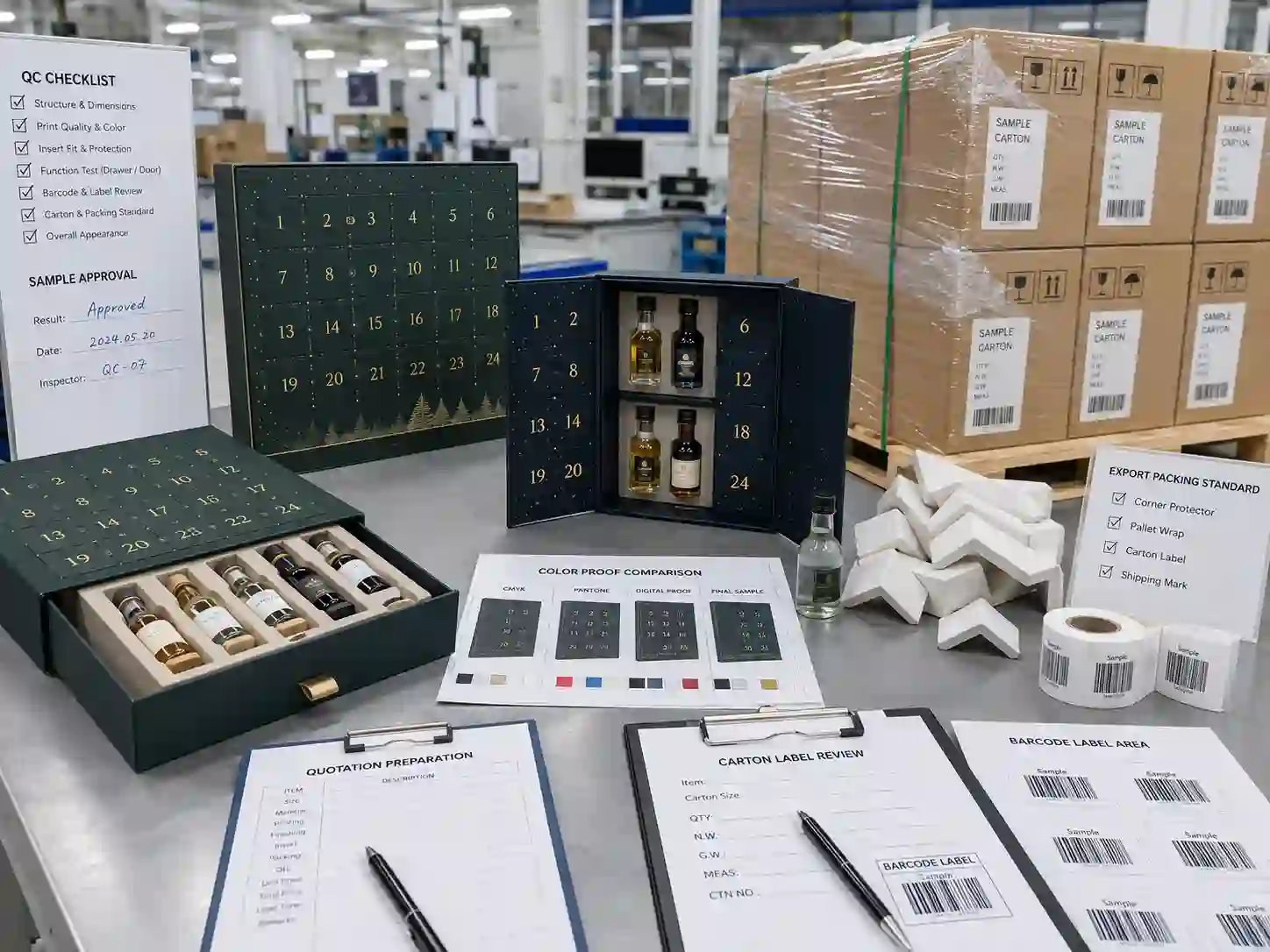
How should export packing be planned for beverage calendars?
Export packing should be planned around carton compression, bottle protection, moisture control, pallet stability, and shipping label accuracy. A strong inner calendar can still arrive damaged if the master carton and pallet plan are weak.
For assembled beverage advent calendar boxes, the master carton should reduce movement between units. Corner protectors, dividers, stronger corrugated cartons, pallet wrap, and clear shipping marks may be needed depending on product weight and shipping route. If the calendars ship flat, the buyer should confirm local assembly requirements and whether inserts can be assembled consistently after arrival.
Heavy calendars should not be packed only by maximum carton quantity. Sometimes fewer units per export carton reduce compression damage, improve manual handling, and protect retail surfaces. The buyer should ask for carton size, gross weight, net weight, units per carton, pallet quantity, and loading plan before shipment.
How should buyers compare beverage calendar suppliers?
Buyers should compare suppliers by engineering ability, sampling accuracy, communication clarity, QC process, export packing experience, and quotation transparency. A supplier that only offers a low price without insert testing may not be suitable for beverage sample projects.
Good supplier questions include:
- Have you produced custom advent calendar boxes for heavy or fragile products?
- Can you recommend insert options based on real bottle weight and dimensions?
- Can you make a blank sample before printed sampling?
- How do you check dieline accuracy and insert tolerance?
- What QC points do you inspect during mass production?
- How do you pack heavy calendars for export cartons and pallets?
- What information is included in your quotation?
Buyers who want to understand factory capability can review the Giftpackpro packaging factory background and compare it with their project needs, timeline, and product risk level.
What information should buyers prepare before requesting a quotation?
Buyers should prepare product specifications, box requirements, insert expectations, artwork needs, quantity, deadline, destination, and packing requirements before requesting a quotation. Complete RFQ information helps the factory recommend the correct structure and reduces back-and-forth delays.
Before contacting Giftpackpro, prepare the following:
- Product type: glass bottle, can, vial, sachet, concentrate pack, tea shot, powder stick, or mixed items.
- Product dimensions and filled weight for each SKU.
- Number of compartments and preferred layout.
- Preferred box style: rigid box, drawer box, door-opening box, folding carton, book-style, or fold-out calendar.
- Preferred insert: paper insert, PET tray, EVA insert, foam, molded pulp, or open to factory recommendation.
- Artwork status: finished AI/PDF files, rough design, or need dieline first.
- Printing and finishing: CMYK, Pantone, foil stamping, embossing, spot UV, matte lamination, gloss lamination, or special paper.
- Estimated order quantity, target MOQ, and launch date.
- Destination country, shipping method, carton label needs, and pallet requirements.
What common mistakes should beverage calendar buyers avoid?
The biggest mistake is approving the appearance without testing the loaded product fit. Beverage advent calendar boxes must be evaluated as a complete system: outer box, insert, product, artwork, assembly, carton, and pallet.
- Using estimated bottle dimensions: Always confirm real measurements, including caps, labels, and shrink sleeves.
- Ignoring filled weight: Empty sample bottles do not represent real shipping pressure.
- Choosing the cheapest insert: A weak insert may cause glass movement, crushed doors, or poor retail presentation.
- Approving artwork before dieline checking: Door cuts, folds, glue areas, and insert openings can affect visible design.
- Skipping the pre-production sample: Mass production may reveal tolerance issues that were not obvious in a handmade sample.
- Underestimating export packing: Heavy calendars need stronger cartons, stable pallets, and clear shipping marks.
FAQ: Beverage advent calendar boxes for B2B buyers
Are beverage advent calendar boxes suitable for glass bottles?
Yes, but glass bottles need stronger structure, accurate inserts, and export packing checks. A rigid box with EVA, foam, molded pulp, or reinforced paperboard insert is often safer than a lightweight carton for fragile glass samples.
Can one calendar hold different beverage sample sizes?
Yes, but mixed sizes require a custom insert layout. Buyers should send all product dimensions and weights so the factory can design different cavity sizes and test the most fragile or heaviest items first.
Is paperboard insert strong enough for beverage samples?
Paperboard can work for lightweight samples, sachets, powder sticks, and some small bottles when properly reinforced. For heavier glass bottles, buyers should compare paperboard with PET, EVA, foam, or molded pulp before confirming.
What is the difference between a sample and a pre-production sample?
A sample checks structure, size, printing, and presentation. A pre-production sample confirms the final materials, production process, insert fit, artwork, finishing, and packing method before mass production starts.
How early should buyers start a beverage calendar project?
Buyers should start early enough to allow structure development, insert testing, artwork proofing, sample revisions, mass production, QC, export packing, and international shipping. Complex inserts, special finishing, and seasonal deadlines require more planning time.
Can Giftpackpro help with structure and insert recommendations?
Yes. Giftpackpro can review product information, recommend suitable structures and inserts, prepare dieline guidance, support sampling, and provide quotation details based on the buyer’s quantity, artwork, timeline, and export packing needs.
Ready to develop beverage advent calendar boxes?
Beverage advent calendar boxes should be quoted only after the product weight, insert requirement, structure, printing, sampling plan, QC points, and export packing method are clear. Preparing these details helps buyers receive a more accurate quotation and reduces production risk.
To start a project with Giftpackpro, send your product dimensions, filled weight, compartment count, preferred structure, insert preference, artwork status, order quantity, destination, and target delivery date. You can explore more advent calendar box buying guides or request a custom quote with your RFQ details.