
Quick answer: Beverage advent calendar boxes for seasonal campaigns should be designed around product weight, glass protection, insert strength, opening experience, carton compression, and export packing from the first dieline stage. For beverage brands, the best structure is not only the most attractive display box; it is the box that keeps mini bottles, cans, sachets, concentrate packs, or drink vials stable through sampling, assembly, retail handling, e-commerce delivery, and international shipping. Buyers should confirm product dimensions, filled weight, compartment layout, insert material, artwork method, MOQ, sample process, QC points, and packing method before requesting a quotation.
What should buyers understand before designing beverage advent calendar boxes?
Buyers should understand that beverage packaging is heavier and more fragile than many other advent calendar categories. A design that works for candy, cosmetics, or stationery may fail when loaded with glass bottles, liquid samples, cans, or concentrate packs.
For seasonal campaigns, the box must perform in three different environments: brand presentation, mass production assembly, and logistics. A beautiful door-opening calendar is not enough if the insert bends, the drawers jam, the bottles move during transit, or the export carton collapses under pallet stacking.
Before starting artwork, procurement teams should define the product mix clearly: bottle size, can diameter, sachet thickness, vial height, filled product weight, whether the products are glass or plastic, and whether the final calendar will be sold through retail, e-commerce, subscription, wholesale gift programs, or promotional campaigns.
Giftpackpro positions beverage sample calendars as custom packaging projects, not standard stock boxes. If you need a supplier that can help review structure, inserts, artwork, samples, MOQ, mass production, and shipping preparation, start from a custom advent calendar boxes manufacturer with experience in seasonal paper gift packaging.
Which box structure is best for beverage sample seasonal campaigns?
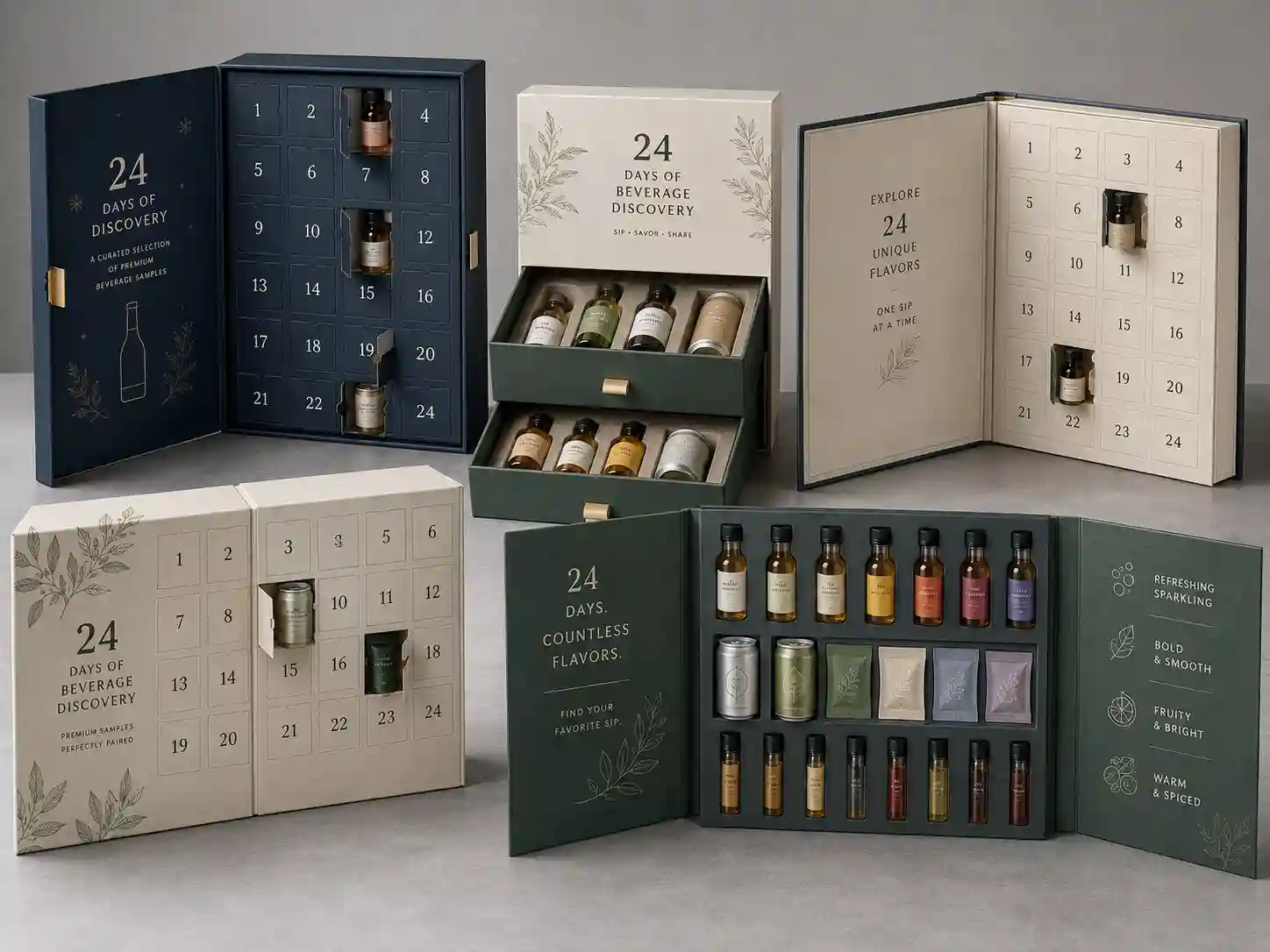
The best structure depends on product weight, display target, assembly method, and shipping risk. For beverage advent calendar boxes, rigid structures and reinforced inserts are usually safer for glass and heavy liquid products, while folding carton options may suit lighter sachets, powder sticks, or low-weight drink samples.
Common structures include door-opening boxes, drawer boxes, book-style rigid boxes, folding carton calendars, and fold-out presentation calendars. Each structure affects dieline complexity, production cost, assembly time, product loading, and buyer experience.
| Structure option | Best use case | Main advantage | Buyer risk to check |
|---|---|---|---|
| Rigid door-opening box | Mini glass bottles, premium beverage samples, retail gift sets | Strong display value and good front-facing campaign presentation | Door tear resistance, insert support, and total loaded weight |
| Drawer box | Heavier samples, structured tasting sets, controlled daily reveal | Good product separation and stronger loading control | Drawer friction, pull-tab durability, and alignment tolerance |
| Book-style rigid box | Premium sample kits, influencer mailers, wholesale gifting | High perceived value and large artwork area | Hinge strength, magnet strength, and bottle movement inside |
| Folding carton calendar | Lightweight sachets, powder sticks, tea concentrates, drink pouches | Lower material weight and easier flat packing | Compression strength and limited support for heavy glass items |
| Fold-out calendar | Campaign storytelling, sampling promotions, shelf display | Large visual surface and flexible layout | Panel stability and uneven product weight distribution |
Buyer tip: Do not select the structure only from a reference photo. Send the actual product weight and dimensions to the factory before confirming the box style. A 24-day calendar filled with liquid samples may require stronger greyboard, reinforced walls, or a different insert design than a visual concept suggests.
How should buyers plan size, layout, and compartment design?
Buyers should plan the size from the product outward, not from the outer box inward. Beverage packaging needs enough space for product tolerance, insert thickness, finger access, label clearance, and protection around glass or sealed liquid containers.
The layout should answer several practical questions: How many days or compartments are required? Are all products the same size? Will the calendar include bottles, cans, sachets, vials, or mixed beverage formats? Should products stand upright, lie horizontally, or sit at an angle for display?
For mini bottles, a vertical layout may show the cap and label well, but it increases the box depth and may raise shipping volume. A horizontal layout can reduce height but needs stronger side support to prevent rolling. For cans, diameter tolerance is critical because a tight cavity can damage printing or make loading slow. For sachets or concentrate packs, the insert must prevent sliding and keep the printed side visible when the door is opened.
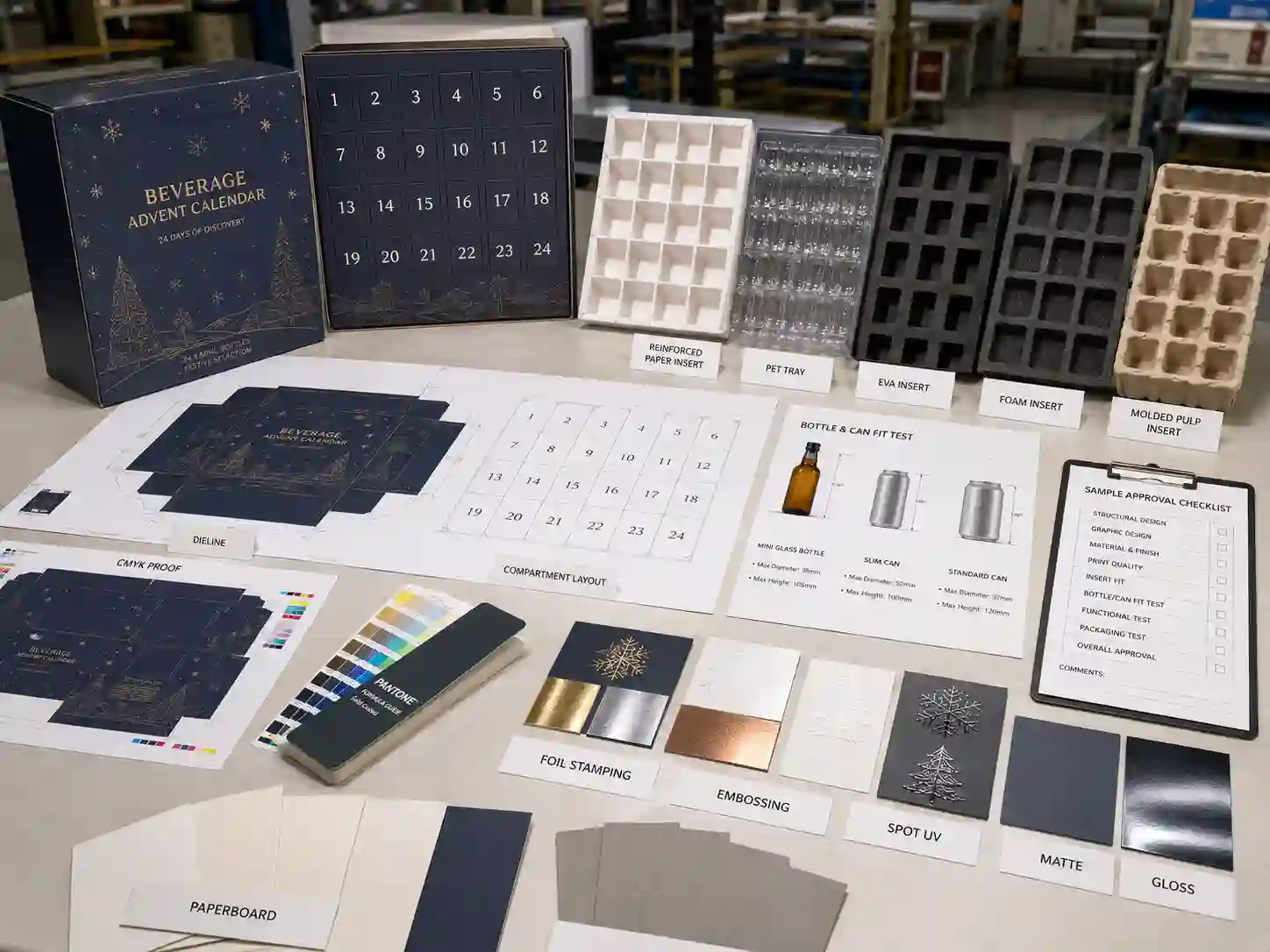
A professional dieline should include outer dimensions, inner cavity size, compartment positions, glue areas, folding lines, door cut lines, pull tabs, insert layers, and packing direction. Buyers should review the dieline before artwork begins because late structure changes can require complete artwork adjustment.
Which insert material works best for beverage advent calendar boxes?
The insert should be chosen according to product weight, fragility, sustainability target, visual requirement, and budget. Beverage items need stronger insert support than many lightweight gift products because liquid weight creates pressure during handling and shipping.
Paper inserts are common for paperboard-based calendars and can be cost-effective for lighter beverage samples. PET trays provide clean cavity shaping and better product visibility, but buyers should check recycling expectations in the destination market. EVA insert and foam insert options can improve cushioning for glass bottles, although they may not fit every sustainability policy. Molded pulp can be useful for protective positioning and a more paper-based material story, but tooling, surface texture, and cavity accuracy should be discussed early.
For heavy glass products, insert strength is not only about the top tray. The factory may need to reinforce the lower support, add internal walls, increase paperboard thickness, or change the way compartments share load. If the insert bends during sample testing, mass production will not improve the performance unless the structure is revised.
Decision guide: how to match insert type with beverage product format
- Mini glass bottles: Use a reinforced paper insert, EVA insert, foam, molded pulp, or combined structure depending on weight and drop risk.
- Aluminum cans: Check diameter tolerance, scuffing risk, and whether the can needs a visible label window.
- Sachets and powder sticks: A paper insert or folding carton compartment can work if the product does not slide behind the door.
- Drink vials: Check upright stability, cap clearance, and whether glass-to-glass contact is fully prevented.
- Mixed beverage samples: Use a custom compartment layout instead of forcing one standard cavity size for all products.
Factory tip: Ask for an insert test using real filled samples, not empty bottles. Empty containers can make the structure appear stronger than it will be during final loading, carton stacking, and export handling.
How do material choices affect strength, cost, and seasonal display?
Material choices affect the box’s load-bearing strength, print result, retail feel, shipping weight, and unit cost. For beverage advent calendar boxes, buyers should treat paperboard, greyboard, insert material, lamination, and carton packing as one connected system.
Rigid boxes commonly use greyboard wrapped with printed paper. Thicker greyboard can improve stiffness and premium feel, but it also increases weight, shipping volume, and cost. Folding carton calendars use paperboard and may be more efficient for lighter samples, but they need careful compression review if the calendar will be stacked in export cartons or displayed in retail.
Paperboard quality also affects die-cut doors, folding accuracy, and edge durability. Door-opening panels need enough tear control so buyers can open them cleanly without ripping the surrounding artwork. Drawer boxes need stable board thickness so the drawer slides smoothly after lamination, wrapping, and assembly.
If your campaign needs paper-based positioning, discuss FSC-related material options with your supplier and verify claims through official documentation. Buyers can review general responsible forest material information from FSC and then ask the packaging factory what documentation is available for the selected material.
What customization decisions should be made before artwork starts?
Buyers should finalize structure, dieline, insert layout, opening direction, and key finishing areas before completing artwork. Artwork created before structure approval often causes delays because door cuts, glue areas, drawer fronts, and fold lines may move during engineering review.
Common printing and finishing choices include CMYK printing, Pantone spot colors, foil stamping, embossing, spot UV, matte lamination, and gloss lamination. For beverage sample calendars, finish selection should support both shelf appeal and durability. Matte lamination can create a premium surface but may show scratches during handling. Gloss lamination can brighten colors but may not match every luxury or natural beverage brand style. Foil stamping and embossing can highlight a logo area, but buyers should avoid placing fine details near die-cut doors or folding edges.
Artwork files should include bleed, safe zones, barcode areas, shipping label considerations if needed, and clear compartment numbering. If a barcode is required for retail or e-commerce, plan the barcode zone early and check the official GS1 barcode standards for general barcode guidance before final retail approval.
How should sampling and prototype approval work?
Sampling should prove structure, insert fit, artwork position, and assembly method before mass production. For beverage packaging, buyers should not approve a sample based only on the outside appearance.
A practical sampling process may include a blank structural sample, a printed sample, and a pre-production sample. The blank sample checks size, compartment design, loading direction, and product fit. The printed sample checks color, artwork placement, lamination, foil stamping, embossing, spot UV, and opening experience. The pre-production sample confirms the final approved method before bulk production starts.
During sample review, load the actual beverage items into the box and simulate the real campaign format. If the final product will include 12 mini bottles, test all 12. If the final product will be e-commerce shipped, check whether the inner products move when the box is tilted, shaken lightly, or packed into the master carton.
Sample approval checklist for beverage calendars
- Confirm outer box size, inner cavity size, and total loaded weight.
- Check whether glass bottles, cans, or vials touch each other inside the insert.
- Open every door or drawer to confirm access, tear line, and user handling.
- Review CMYK or Pantone color under normal lighting and compare with the approved proof.
- Check foil stamping, embossing, spot UV, matte lamination, or gloss lamination registration.
- Confirm that the insert does not bend, lift, crack, or slide when products are loaded.
- Place the loaded sample inside the planned export carton to review packing direction.
- Record revisions in writing before approving the sample for mass production.
QC tip: A sample approval note should describe what is approved, what must be changed, and which tolerance is acceptable. Vague approvals such as “looks good” can create disputes when mass production begins.
What MOQ and cost drivers should buyers expect?
MOQ and cost depend on structure complexity, material, insert type, printing method, finishing, sample requirements, labor, packing method, and seasonal production timing. Buyers should compare quotations by specification, not only by unit price.
Rigid boxes, drawer boxes, EVA inserts, molded pulp tooling, special finishing, and complex hand assembly can increase cost. Folding carton calendars may reduce structure cost for lightweight products, but weak carton strength can create hidden costs if damage occurs during shipping. A cheaper insert can become expensive if it causes bottle movement, glass breakage, slow assembly, or customer returns.
Seasonal campaigns also depend on lead time. Buyers should allow time for structure discussion, dieline confirmation, artwork adjustment, sampling, sample revision, material purchasing, mass production, final inspection, export packing, and international shipping. Rushing the sample stage may save a few days at the beginning but create larger problems during bulk production.
Giftpackpro’s custom advent calendar box services can support buyers who need help comparing structures, inserts, printing options, and sampling steps before confirming a final specification.
How should buyers compare beverage calendar suppliers?
Buyers should compare suppliers by engineering ability, sample process, communication quality, QC control, export packing experience, and quotation transparency. A low price is not useful if the supplier cannot explain insert strength, bottle protection, dieline tolerance, or carton stacking.
When evaluating a supplier, ask whether they can review real product dimensions, create a custom dieline, recommend insert materials, provide blank and printed samples, check color proofing, manage assembly tolerance, and prepare export packing for international shipment. For beverage products, supplier reliability is especially important because liquid-filled items create higher breakage and compression risk.
Review previous custom packaging categories, factory capabilities, and communication process. You can browse custom advent calendar box products for structure ideas and review the Giftpackpro packaging factory page to understand factory-side support before preparing an RFQ.
Supplier comparison checklist
- Can the supplier explain structure differences instead of only quoting from a photo?
- Can they design around actual filled product weight?
- Do they check dieline, insert, artwork, printing proof, and final sample together?
- Can they provide a clear MOQ, sample cost, production lead time, and packing method?
- Do they understand export carton strength, pallet loading, shipping marks, and carton labels?
- Do they document sample approval and mass production QC checkpoints?
What QC and export packing checks matter most for beverage advent calendar boxes?
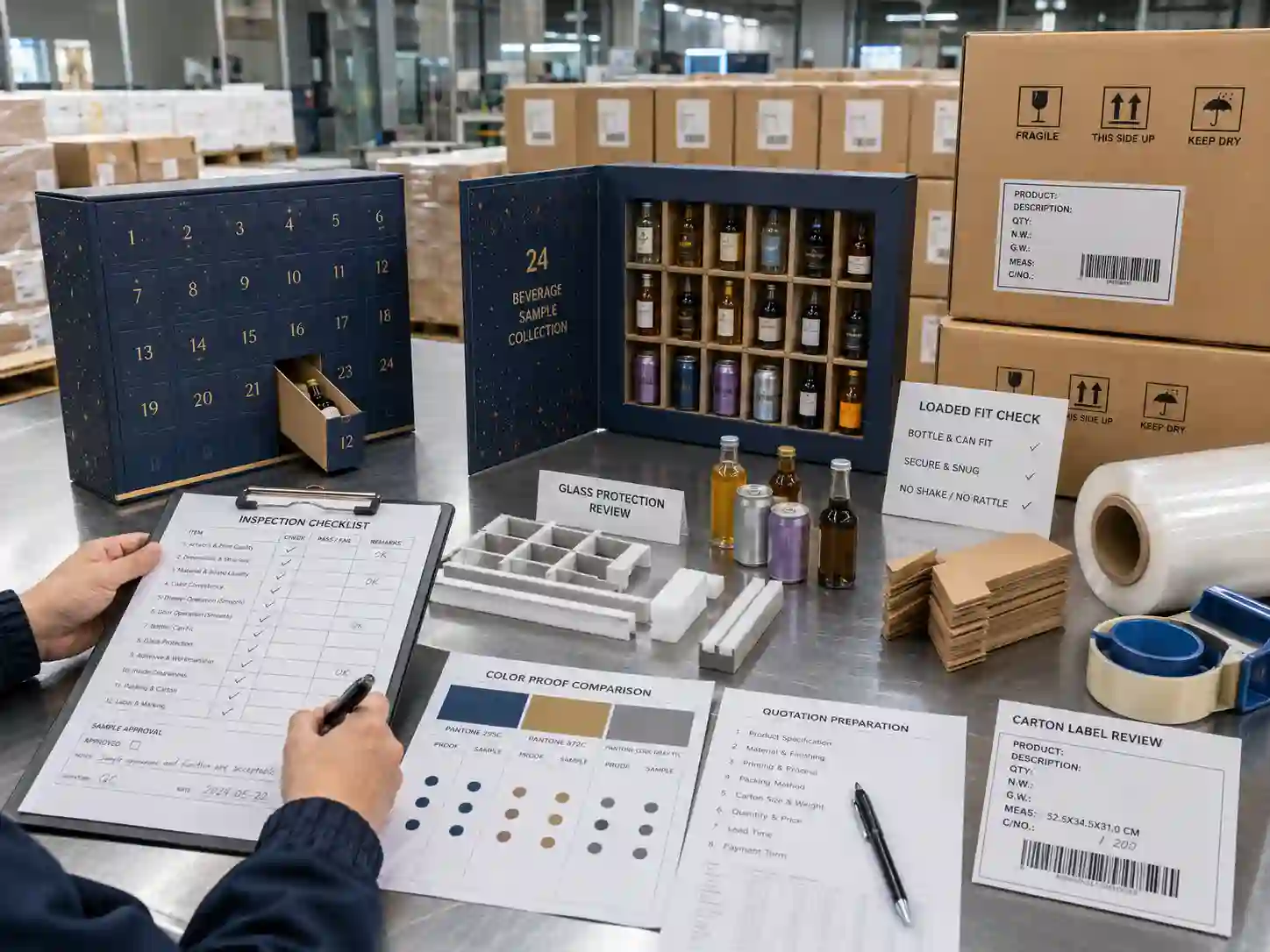
QC should focus on loaded-product performance, not only print appearance. Beverage sample calendars require checks for glass protection, insert strength, door or drawer function, carton compression, pallet stability, and shipping mark accuracy.
Final inspection should include material, dimensions, color, finishing, glue, wrapping, door cuts, drawer alignment, insert placement, and loaded product fit. For glass bottles or vials, the QC team should confirm that the insert prevents direct impact and movement. For cans, check scuffing and pressure points. For sachets, check whether products stay in position when the calendar is moved.
Export packing should match the final shipping channel. Retail shipments may require master cartons, carton labels, barcode areas, and pallet plans. E-commerce gift sets may need stronger outer protection because each unit may face parcel handling. Export cartons should be reviewed for compression strength, carton quantity, gross weight, dimensions, corner protection, pallet wrap, and shipping marks.
Buyers who need more background on planning and problem-solving can also review advent calendar box buying guides before confirming a seasonal campaign specification.
What information should buyers prepare before requesting a quotation?
Buyers should prepare product details, box style preference, quantity, destination, artwork requirements, insert expectations, sample needs, and timeline before asking for a quotation. The more complete the RFQ, the easier it is for the factory to recommend a realistic structure and price.
A strong RFQ for beverage advent calendar boxes should include the number of compartments, product dimensions, filled product weight, product material, bottle or can shape, preferred opening style, target outer size if any, printing method, finishing options, packing preference, estimated order quantity, delivery country, and required delivery date.
If you do not have a finished dieline, send reference photos and actual product measurements. If you already have artwork, explain whether it is flexible or fixed. If the product is glass, clearly mention glass protection expectations. If the final goods will be shipped by sea, air, or courier, mention this because packing decisions may differ.
Quotation preparation checklist
- Product list for each calendar day or compartment.
- Length, width, height, diameter, and filled weight for every beverage item.
- Preferred structure: rigid box, drawer box, door-opening box, folding carton, or fold-out calendar.
- Insert preference: paper insert, PET tray, EVA insert, foam, molded pulp, or factory recommendation.
- Artwork status: concept only, dieline-ready artwork, or final print file.
- Printing and finishing needs: CMYK, Pantone, foil stamping, embossing, spot UV, matte lamination, or gloss lamination.
- Estimated MOQ or target order quantity.
- Required sample type: blank prototype, printed sample, or pre-production sample.
- Destination country, shipping method, carton label needs, and shipping marks.
- Campaign launch date and latest acceptable delivery date.
To start a practical specification review, buyers can request a custom quote with product dimensions, target quantity, artwork status, and campaign timeline.
What common mistakes should buyers avoid?
The most common mistake is designing the calendar around appearance before checking product weight, insert strength, and export packing. For beverage campaigns, structural decisions must come before final artwork and promotional photography.
- Using empty bottles for testing: Empty containers do not represent real filled weight and can hide insert weakness.
- Choosing folding carton for heavy glass products without reinforcement: This may reduce unit cost but increase damage risk.
- Ignoring door and drawer tolerance: Lamination, wrapping, and assembly can change the opening feel.
- Placing important artwork across cut lines: Numbering, logos, and product messages can be damaged by door cuts or folds.
- Approving color without proof review: CMYK and Pantone expectations should be checked before mass production.
- Underestimating carton compression: Loaded beverage calendars can be heavy, especially in master cartons and pallets.
- Requesting a quotation with incomplete information: Missing product weight, insert preference, or destination can make quotations inaccurate.
FAQ: Beverage advent calendar boxes for seasonal campaign buyers
Are beverage advent calendar boxes suitable for glass bottles?
Yes, but glass bottles need stronger structural planning than lightweight products. Buyers should test real filled bottles, confirm insert strength, prevent glass-to-glass contact, and review export packing before approving mass production.
Is a rigid box always better than a folding carton?
No. A rigid box is often better for premium or heavy beverage samples, while a folding carton may be suitable for lightweight sachets, powder sticks, or small pouches. The right choice depends on product weight, display needs, budget, and shipping risk.
Which insert is best for mini beverage bottles?
There is no universal best insert. Reinforced paper inserts, PET trays, EVA inserts, foam, and molded pulp can all work depending on bottle weight, fragility, sustainability target, and budget. The final choice should be tested with real samples.
When should the dieline be confirmed?
The dieline should be confirmed after product dimensions, structure, insert layout, and opening method are reviewed. Artwork should begin only after the dieline is stable, because structure changes can move doors, folds, glue areas, and safe zones.
How can buyers reduce cost without weakening the calendar?
Buyers can reduce cost by simplifying structure, limiting special finishing, using common material specifications, optimizing carton size, and avoiding unnecessary oversized compartments. However, insert strength and export packing should not be reduced below what the loaded beverage products require.
What is the most important sample to approve?
The most important sample is the one that proves real product fit and final structure. A printed sample is useful for appearance, but beverage buyers should also check loaded weight, insert support, door or drawer function, and packing method.
How should buyers move from concept to production?
To design beverage advent calendar boxes for seasonal campaigns, start with the product list and weight, then confirm the structure, insert, dieline, material, artwork, sample, MOQ, QC plan, and export packing. A strong campaign box is the result of engineering and purchasing discipline, not only creative design.
Giftpackpro can help overseas brands, wholesalers, purchasing teams, and gift companies develop custom advent calendar boxes with practical structure review, sample preparation, production planning, and export packing support. Before requesting pricing, prepare product dimensions, filled weight, quantity, destination, artwork status, preferred box style, insert expectations, and launch timeline so the quotation can reflect the real project requirements.


