
Quick answer: To design tea advent calendar boxes for seasonal campaigns, buyers should confirm the tea format first, then choose a structure, insert, material, artwork process, sampling plan, MOQ, QC standard, and export-packing method around that product. Sachets, capsules, pouches, and small tea boxes each need different compartment sizes, moisture awareness, labeling space, and opening sequences. For B2B purchasing teams, the best result usually comes from sending a clear RFQ with product dimensions, quantity, artwork files, target market, packing preference, and launch schedule before sample development begins.
Tea advent calendar packaging is not only a decorative seasonal box. For brands, wholesalers, retail buyers, e-commerce sellers, and gift companies, it is a product-fit project, display project, logistics project, and cost-control project at the same time. A beautiful design can still fail if the sachet shifts, the capsule rattles, the door tears, the printed color is inconsistent, or the export carton is not planned for long-distance shipping.
Giftpackpro works as a custom advent calendar boxes manufacturer for B2B seasonal packaging projects, including paper-based advent calendars for tea, coffee, chocolate, cosmetics, candles, jewelry, toys, beverages, and gift sets. This guide focuses on how buyers can design tea advent calendar boxes with practical factory-side decisions before requesting a sample or quotation.
What should buyers understand before choosing tea advent calendar boxes?
Buyers should understand that tea advent calendar boxes must be designed around the tea product, not only around the visual theme. The format, weight, aroma sensitivity, moisture risk, labeling requirement, and retail channel all affect structure, insert, material, printing, packing, and quotation.
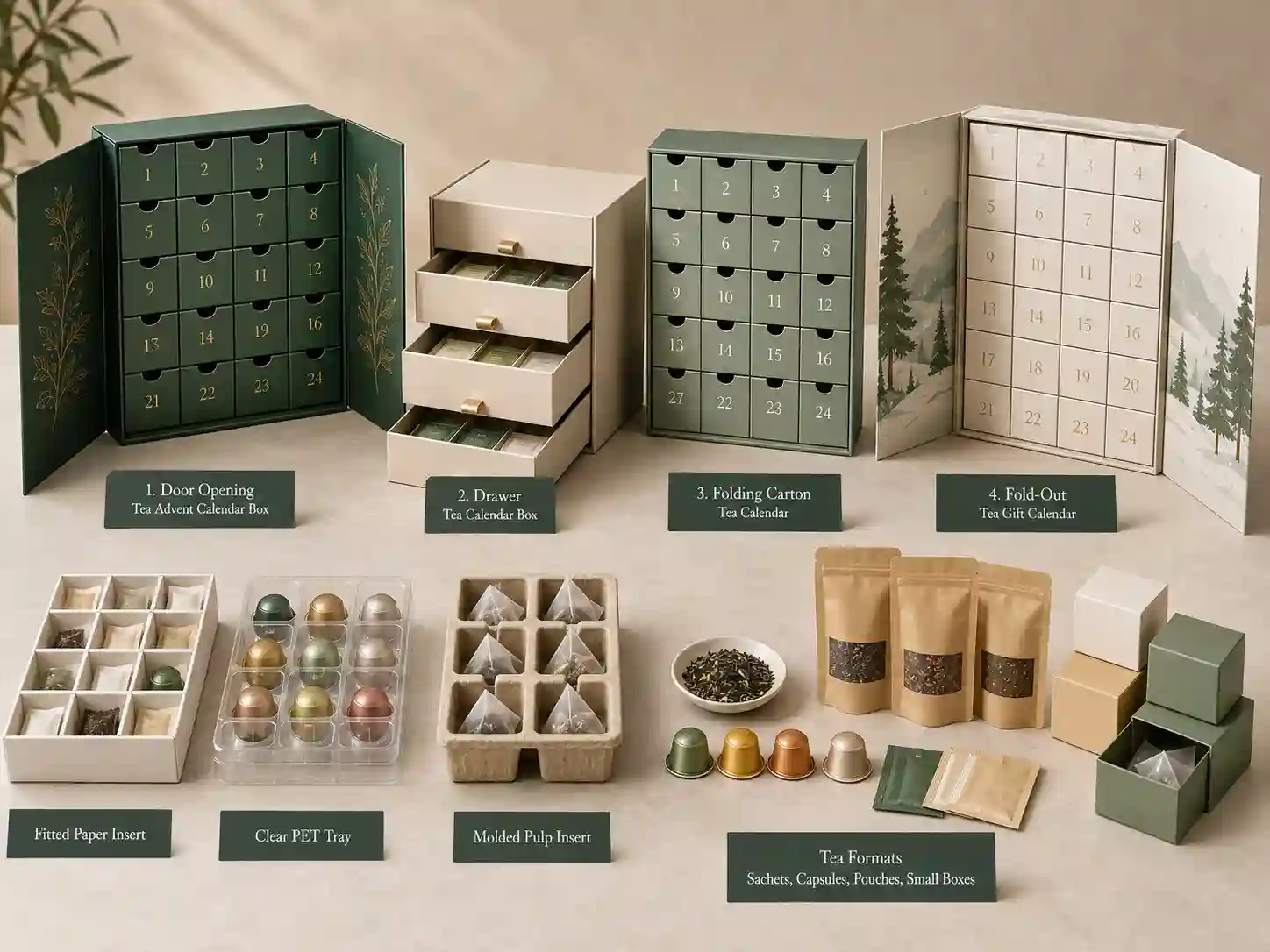
A tea sachet calendar may need slim paper compartments with smooth door-opening performance. A capsule calendar may need a PET tray, molded pulp insert, or paper insert with stronger cavities. A pouch calendar may require deeper compartments and more tolerance for flexible packaging. A small tea box calendar may need a rigid box or drawer box because the packed weight and display value are higher.
Buyer tip: Start with the packed tea item, not the box style. Send the supplier the actual sachet, capsule, pouch, or small box dimensions, including thickness, weight, and any outer wrapper material. The box structure can then be built around real fit data instead of assumptions.
Which tea product formats change the packaging design?
The tea format decides compartment depth, insert type, opening style, and packing method. A buyer choosing tea advent calendar boxes for flat sachets will usually make different decisions from a buyer packing capsules, pyramid bags, tins, or small retail boxes.
| Tea format | Key design concern | Suitable insert or structure | Buyer note |
|---|---|---|---|
| Flat tea sachets | Thin profile, sequence visibility, easy removal | Paper insert, door-opening box, folding carton calendar | Confirm sachet does not slide behind the door panel. |
| Tea capsules | Round shape, rattling risk, cavity accuracy | PET tray, molded pulp insert, EVA insert, rigid box | Test cavity tolerance before approving mass production. |
| Flexible tea pouches | Variable thickness and soft edges | Paperboard compartment, foam, molded pulp, drawer box | Allow enough finger space for removal. |
| Small tea boxes | Higher weight and larger compartment depth | Rigid box, drawer box, fold-out calendar | Check box balance when all compartments are filled. |
| Mixed tea gift set | Different item sizes and aroma separation | Custom insert with mixed cavities | Provide the full SKU list before dieline creation. |
For seasonal campaigns, many tea brands want a mixed-flavor sequence. This makes the compartment layout more important. The supplier should know whether day 1 to day 24 must follow a fixed flavor order, whether special items need larger spaces, and whether any product requires extra protection from movement or fragrance transfer.
Which structure is best for a tea advent calendar campaign?
The best structure depends on product weight, retail price level, display channel, assembly method, and campaign budget. Rigid boxes offer premium presentation, folding cartons support lighter and higher-volume programs, drawer boxes improve repeat opening, and door-opening boxes provide the classic numbered experience.
When should buyers choose a door-opening box?
A door-opening box is suitable when the buyer wants a numbered daily reveal and relatively flat tea items. It is commonly used for sachets, slim pouches, and lightweight tea gifts because the front panel can be printed with a campaign design while individual doors hide each compartment.
The dieline must consider tear lines, door hinge strength, finger access, and whether the sachet can be removed without bending. If the paperboard is too thin, the doors may deform. If it is too stiff, the doors may be difficult to open cleanly.
When should buyers choose a drawer box?
A drawer box is better when the campaign requires stronger compartments, thicker tea items, or a more reusable presentation. Each drawer can hold sachets, capsules, pouches, small tins, or mini tea boxes, but the cost and assembly labor are usually higher than a simple folding carton calendar.
Drawer calendars are often selected for premium gift programs, subscription-style launches, or retail displays where the box may stay visible for several weeks. Buyers should confirm drawer sliding tolerance, pull-tab strength, and whether drawers need printed numbers, labels, or inner dividers.
When should buyers choose a rigid box?
A rigid box is suitable for premium tea advent calendar boxes where structure, shelf impact, and perceived value are important. Greyboard wrapped with printed paper can support heavier contents and finishing options such as foil stamping, embossing, spot UV, matte lamination, or gloss lamination.
Rigid structures may include book-style opening, magnet closure, drawer layout, or fold-out panels. They usually require longer sampling and production planning than simple paperboard cartons because wrapping, corner finishing, insert placement, and assembly tolerance must be checked carefully.
When should buyers choose a folding carton calendar?
A folding carton calendar is practical for lightweight sachets, cost-sensitive promotions, and larger-volume retail programs. It can reduce unit cost and shipping volume, especially when flat-packed before final filling or assembly.
Buyers should confirm whether the supplier will ship the calendars flat, semi-assembled, or fully assembled. Flat packing can save freight space, but the buyer or co-packer must handle folding, filling, and final closure correctly.
How should inserts be designed for sachets, capsules, pouches, and small boxes?
Inserts should hold each tea item in the correct position while allowing easy removal and protecting the product during handling and transport. The insert choice affects cost, sustainability goals, appearance, assembly speed, and final user experience.
- Paper insert: Suitable for many sachet and pouch calendars. It is lightweight, printable, recyclable in many markets, and easy to customize with compartments.
- PET tray: Useful for capsules, small tins, or products needing precise cavities and clear shape control. Buyers should review local recycling and labeling expectations.
- EVA insert: Provides a premium grip and cushioning effect, often used for heavier or delicate gift items. It is normally less suitable when paper-based material goals are strict.
- Foam insert: Works for protection and cushioning, but buyers should consider appearance, sustainability positioning, and destination market expectations.
- Molded pulp insert: A paper-based option for shaped cavities, useful when buyers want a more natural material impression and stronger holding than a simple paperboard grid.
Factory tip: For tea capsules and small boxes, the insert tolerance should be tested with real filled products, not empty packaging shells. Weight changes how the insert behaves during drop handling, carton stacking, and pallet movement.
How should aroma and moisture awareness affect design?
Tea packaging projects should treat aroma and moisture as product-protection factors, even when the advent calendar box itself is secondary packaging. The buyer should confirm that the primary tea wrapper is properly sealed and that the calendar design does not create avoidable exposure, odor transfer, or compression risk.
Paperboard, greyboard, adhesives, inks, and finishing processes should be evaluated with the final wrapped tea product. Buyers selling into regulated markets should check food-contact and packaging requirements with their own compliance team, especially if any inner packaging or insert may touch food directly. For general guidance, buyers can review official resources such as the FDA food contact substances guidance and local destination-market rules.
Aroma-sensitive tea assortments may also need sequence planning. Strongly scented flavors should not be placed loosely near delicate flavors unless the primary packaging provides sufficient barrier protection. The supplier can help with compartment layout, but the brand owner should define product compatibility.
What artwork, printing, and finishing decisions matter most?
Artwork should be built from the final dieline and checked for door cuts, drawer fronts, numbering, barcode space, warning labels, recycling marks, and shipping-related requirements. Printing and finishing should be chosen for the campaign position, not only for decoration.
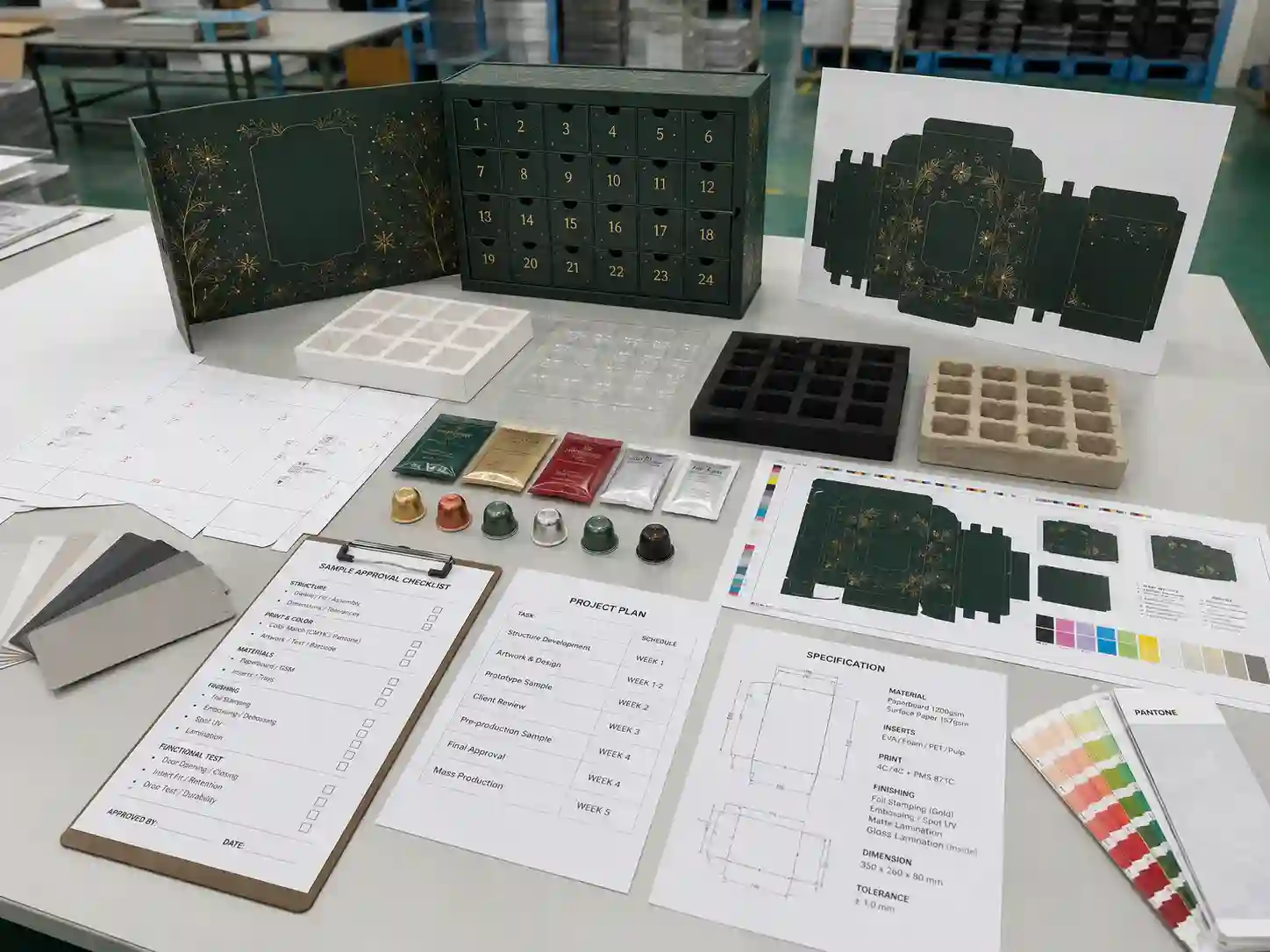
Common printing and finishing choices include CMYK printing for full-color seasonal graphics, Pantone matching for brand colors, matte lamination for a soft premium surface, gloss lamination for higher shine, foil stamping for metallic highlights, embossing for raised texture, and spot UV for contrast on selected artwork areas.
For tea advent calendar boxes, buyers should pay close attention to number placement. If numbered doors are too close to cutting or creasing lines, they may look misaligned after production. If the artwork crosses multiple doors, the supplier should check visual continuity after die-cutting and folding.
Buyer tip: Ask for an artwork proof and a white sample or digital prototype before final printing. For premium campaigns, approve a pre-production sample using the final paper, final printing, final insert, and final packed tea item whenever schedule allows.
What materials should buyers compare before sampling?
Buyers should compare material by structure, weight, finish, cost, assembly method, and export durability. A lower-cost paperboard may be suitable for sachets, while a thicker greyboard structure may be necessary for heavy tea gift sets or premium retail programs.
| Material choice | Best use | Advantage | Risk to check |
|---|---|---|---|
| Paperboard | Folding carton calendars, lightweight sachet boxes | Efficient for volume production and flat packing | May need reinforcement for heavier contents |
| Greyboard with wrapped paper | Rigid box and premium drawer calendars | Strong structure and premium presentation | Higher cost, longer production, more assembly checks |
| Black board or specialty board | Luxury tea gift campaigns | Distinctive appearance and better premium feel | Color consistency and edge appearance must be reviewed |
| Molded pulp | Paper-based shaped inserts | Good cavity support and natural material impression | Tooling, surface texture, and tolerance need approval |
| PET tray | Capsules, tins, shaped tea items | Precise cavities and stable item placement | Recycling communication and tray cracking risk |
Buyers with responsible sourcing goals can also review official information from the Forest Stewardship Council and ask suppliers what paper options are available for the project. Do not assume certification or recycled content unless it is documented and verified for the actual order.
How should buyers plan sampling and prototype approval?
Sampling should prove structure, product fit, artwork accuracy, opening performance, insert stability, and packing method before mass production. A sample is not only for appearance; it is the buyer’s chance to catch design and assembly problems while changes are still manageable.
- Dieline review: Confirm dimensions, creasing, cutting, door position, drawer layout, insert cavities, and labeling areas.
- White sample or structural prototype: Test product fit, compartment sequence, opening force, and assembly method without final printing.
- Artwork proof: Check CMYK, Pantone references, barcode area, numbering, warnings, recycling icons, and copy placement.
- Printed sample: Review color, lamination, foil stamping, embossing, spot UV, edge quality, and overall presentation.
- Pre-production sample: Approve the final version before mass production, especially for rigid box, drawer box, or mixed-insert calendars.
Factory tip: Sampling approval should be written, not only verbal. Keep the approved sample, artwork file, dieline version, insert drawing, and packing instruction as production references.
What MOQ and lead time factors affect tea advent calendar projects?
MOQ and lead time depend on structure, material, printing process, insert tooling, finishing, assembly complexity, and export packing. A simple folding carton calendar usually has a different MOQ and schedule from a rigid drawer calendar with molded pulp or PET tray inserts.
The biggest cost drivers are custom size, board thickness, insert complexity, number of compartments, printing area, finishing process, hand assembly, sample rounds, and carton packing method. If the calendar has 24 or 25 compartments with different cavity sizes, the supplier needs more time for dieline engineering and sample testing.
Lead time also depends on whether the buyer approves artwork and samples quickly. Seasonal campaigns have fixed retail windows, so late artwork confirmation can create production pressure. Buyers should build in time for design adjustment, sample shipment, internal review, mass production, final inspection, export carton packing, and international transportation.
How should buyers compare suppliers for tea advent calendar boxes?
Buyers should compare suppliers by engineering ability, sample quality, communication accuracy, export experience, QC process, and quotation clarity. The cheapest unit price may not be the best option if the supplier cannot control insert fit, door-opening tolerance, color proofing, or carton packing.
| Supplier comparison point | What to ask | Why it matters |
|---|---|---|
| Structure engineering | Can you make a dieline based on our tea sachet, capsule, pouch, or small box? | Product fit is the foundation of the calendar design. |
| Sample process | Can we review a white sample and printed sample before mass production? | Sampling reduces risk before bulk production. |
| Insert options | Can you compare paper insert, PET tray, EVA insert, foam, and molded pulp? | Different tea formats need different holding methods. |
| Printing control | How do you check CMYK, Pantone, lamination, foil, embossing, and spot UV? | Seasonal packaging depends heavily on visual consistency. |
| QC and packing | What inspection steps and export carton standards do you use? | Poor packing can damage calendars before retail launch. |
| Quotation detail | What is included in the price and what is optional? | Clear quotations prevent hidden cost changes. |
Buyers can review Giftpackpro packaging factory information, browse custom advent calendar box products, and compare related advent calendar box buying guides before preparing project details. For project planning support, the custom advent calendar box services page explains typical custom packaging steps.
What QC checks are important before export?
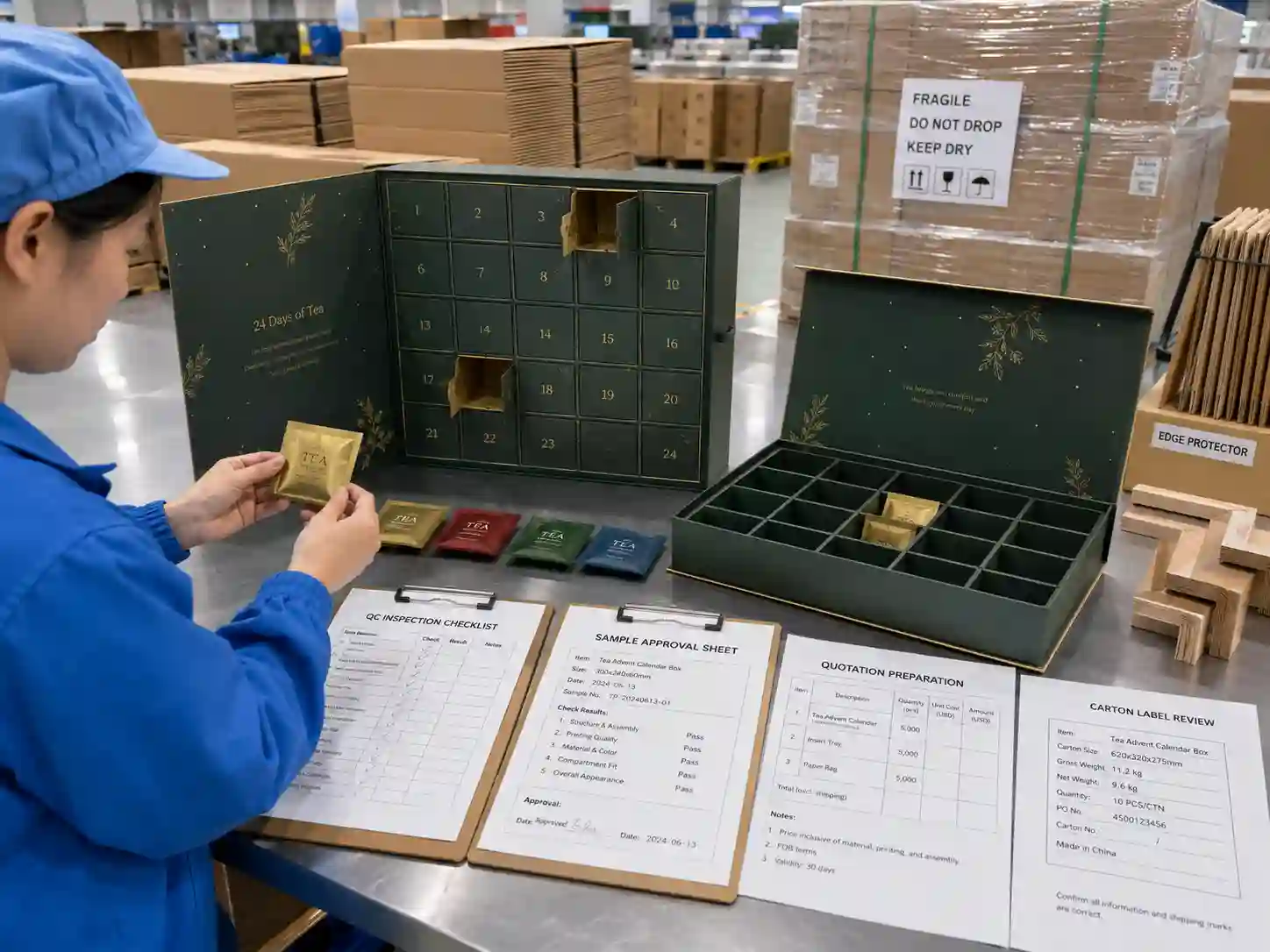
QC should check appearance, dimensions, structure, insert fit, opening performance, printing, finishing, assembly, carton packing, and shipping marks before export. Tea advent calendar boxes often contain many doors or compartments, so inspection must cover both the outside presentation and the internal product-holding function.
- Confirm final size, board thickness, and structure match the approved sample.
- Check door-opening strength, drawer sliding, fold-out alignment, and glue position.
- Test sachet, capsule, pouch, or small box fit in each relevant compartment.
- Review numbering sequence, printed labels, barcode space, and required market text.
- Inspect CMYK color, Pantone match, foil stamping, embossing, spot UV, matte lamination, or gloss lamination quality.
- Check insert placement, cavity shape, loose parts, paper dust, glue marks, and surface scratches.
- Review export carton strength, carton labels, shipping marks, carton quantity, and pallet plan.
QC tip: For calendars with a fixed flavor sequence, inspection should include sequence verification. A visually correct box can still be wrong if the tea flavors are packed behind the wrong numbered doors.
How should export packing be planned for seasonal campaigns?
Export packing should protect the calendar during carton handling, stacking, pallet movement, and international transport. Buyers should decide whether boxes ship flat, semi-assembled, fully assembled, or filled with products because each method changes carton size, labor, freight cost, and damage risk.
Flat packing can reduce freight volume for folding carton calendars, but it transfers more assembly work to the buyer or filling partner. Fully assembled packing is easier for receiving teams but increases carton volume and may need stronger corner protection, inner dividers, or pallet wrap. Rigid boxes and drawer boxes often need more careful carton arrangement to prevent crushed corners and scuffed surfaces.
Export cartons should include clear shipping marks, carton labels, item codes, quantity information, and handling instructions when needed. Pallet packing should consider carton strength, stacking height, moisture exposure, and warehouse handling. For high-value seasonal launches, buyers may request drop-test or transport-simulation guidance from their logistics team or refer to recognized packaging test organizations such as ISTA through official channels.
What information should buyers prepare before requesting a quotation?
Buyers should prepare product dimensions, quantity, structure preference, insert requirement, artwork status, destination market, packing method, and timeline before asking for a quotation. The more complete the RFQ, the more accurate the supplier’s pricing and sample recommendation will be.
Practical RFQ checklist for tea advent calendar boxes
- Target quantity and expected order schedule
- Tea format: sachet, capsule, pouch, tin, small box, or mixed products
- Exact product dimensions and weight for each item
- Number of compartments, such as 12, 24, 25, or custom sequence
- Preferred structure: rigid box, folding carton, drawer box, door-opening box, or fold-out calendar
- Preferred insert: paper insert, PET tray, EVA insert, foam, molded pulp, or open to recommendation
- Material preference: paperboard, greyboard, specialty paper, recycled paper, or certified paper request
- Artwork files, dieline status, CMYK or Pantone color needs
- Finishing requirements: matte lamination, gloss lamination, foil stamping, embossing, spot UV, or special texture
- Labeling space, barcode area, recycling marks, warning text, and market-language requirements
- Flat, semi-assembled, fully assembled, or filled packing preference
- Export carton requirement, pallet requirement, shipping marks, and destination country
- Sample deadline, mass production deadline, and retail launch date
When buyers are ready to move from concept to sample, they can request a custom quote with these details. A clear RFQ helps Giftpackpro recommend the right structure, insert, material, sample route, MOQ range, and export-packing plan for the project.
Decision guide: how do buyers choose the right design route?
Buyers should choose the design route by matching product value, tea format, retail channel, and logistics needs. The right solution is the one that protects the product, presents the campaign clearly, fits the budget, and can be produced reliably at the required quantity.
| Buyer situation | Recommended design route | Reason |
|---|---|---|
| Large-volume sachet promotion | Folding carton door-opening calendar with paper insert | Cost-efficient, lightweight, and suitable for flat tea sachets. |
| Premium loose-leaf or mixed tea gift set | Rigid box or drawer box with custom paperboard insert | Supports higher perceived value and stronger structure. |
| Tea capsule seasonal campaign | Rigid or folding carton structure with PET tray or molded pulp insert | Controls capsule movement and keeps cavities consistent. |
| E-commerce direct shipping | Stronger outer structure plus tested export carton packing | Reduces corner damage and surface scuffing during logistics. |
| Retail shelf display program | Printed front-panel calendar with clear numbering and barcode space | Improves shelf communication and store handling. |
| Eco-positioned tea campaign | Paperboard structure with paper insert or molded pulp insert | Supports paper-based messaging when verified with real material data. |
What common mistakes should buyers avoid?
Most tea advent calendar box problems come from starting artwork too early, skipping real product-fit testing, underestimating assembly tolerance, or leaving export packing until the end. These mistakes can create delays, extra sampling costs, and retail launch pressure.
- Designing from appearance only: A beautiful box may fail if the sachet bends, capsule rattles, or pouch cannot be removed easily.
- Using estimated product dimensions: Even small thickness differences can affect compartment fit and door closing.
- Ignoring aroma and moisture awareness: Secondary packaging should not compromise product protection or create odor-transfer concerns.
- Approving artwork before dieline confirmation: Door cuts, crease lines, and drawer fronts can change artwork placement.
- Skipping the pre-production sample: This is risky for premium rigid boxes, molded pulp inserts, complex finishing, or mixed-item calendars.
- Forgetting labeling space: Barcode, importer text, recycling marks, ingredients reference, and product identification may need planned space.
- Choosing flat packing without assembly planning: Freight savings can be lost if the buyer does not have a reliable filling and assembly process.
- Comparing quotations by unit price only: Tooling, sampling, insert cost, export cartons, palletization, and finishing can change the real landed cost.
FAQ: What do buyers ask before ordering tea advent calendar boxes?
Can one tea advent calendar box hold different tea formats?
Yes, but the insert must be designed for the actual product mix. A calendar that combines sachets, capsules, and small boxes may need mixed cavity sizes, reinforced compartments, and a clear packing sequence.
Is a rigid box always better than a folding carton?
No. A rigid box gives stronger structure and premium presentation, but a folding carton may be better for lightweight sachets, larger quantities, flat packing, and cost-sensitive retail campaigns.
Should buyers use a paper insert or PET tray?
Use a paper insert when the tea items are flat, lightweight, and suitable for paperboard compartments. Use a PET tray or molded pulp insert when the item shape needs more precise holding, such as capsules, small tins, or shaped gift items.
How early should buyers start sampling?
Buyers should start as early as possible before the seasonal launch window because dieline development, sample review, artwork proofing, printing, finishing, mass production, QC, export packing, and shipping all require time. The more complex the structure, the earlier the project should begin.
What affects the quotation most?
The main quotation factors are size, structure, quantity, material, insert type, number of compartments, printing area, finishing process, sample requirements, assembly labor, packing method, export carton specification, and delivery terms.
Can Giftpackpro help if the buyer only has a concept?
Yes. Buyers can provide the tea product details, campaign goal, target quantity, and reference structure. Giftpackpro can then suggest practical custom advent calendar box options and sample steps based on product fit, material, MOQ, and export requirements.
CTA: How to start a custom tea advent calendar box project
To start a tea advent calendar boxes project, prepare the tea product dimensions, quantity, compartment count, preferred structure, insert idea, artwork status, finishing request, destination market, packing method, and target delivery date. These details help the packaging factory recommend a practical design route instead of guessing from a general concept.
For B2B buyers planning seasonal retail, wholesale, gift, or e-commerce campaigns, Giftpackpro can support structure selection, dieline development, insert testing, sample approval, printing proof review, mass production, QC, export carton planning, and quotation preparation. Visit the custom advent calendar box services page, review more advent calendar box buying guides, or request a custom quote when your product details are ready.


