Quick answer: Tea advent calendar boxes are custom seasonal packaging solutions designed to hold tea sachets, capsules, pouches, mini tins, or small tea gift boxes in a numbered compartment layout. For B2B buyers, the best result depends on structure, insert fit, artwork control, printing method, finishing process, sample approval, MOQ, QC, and export packing. Brands should confirm product size, aroma and moisture protection needs, compartment sequence, labeling space, retail display requirements, and whether the boxes will ship flat or assembled before asking for a quotation.
For overseas brands, wholesalers, retail buyers, and gift companies, tea advent calendar packaging is not only a decorative box. It is a production project that combines paperboard engineering, insert tolerance, printed artwork, retail presentation, and export logistics. Giftpackpro supports buyers who need custom advent calendar boxes manufacturer support for seasonal paper gift packaging, from structure selection to sampling and bulk shipment planning.
What should buyers understand before choosing tea advent calendar boxes?
Buyers should first understand the tea format, compartment layout, box structure, artwork complexity, and shipment method. These decisions affect cost, MOQ, sampling time, production lead time, carton size, and the final consumer unboxing experience.
Tea products vary more than many buyers expect. A flat tea sachet may only need a slim paper insert, while a pyramid tea pouch, capsule, mini tin, or small paper tea box may need deeper compartments and stronger board support. If the product is scented or moisture-sensitive, the primary tea packaging must protect aroma and freshness; the advent calendar box usually provides presentation, organization, and retail display value, not the main food-contact barrier.
Buyer tip: Before discussing printing finishes, confirm the exact product dimensions and packing format. A beautiful artwork proof cannot solve a compartment that is too shallow for a tea pouch or too loose for a capsule.
Which box structures work best for tea advent calendar programs?
The right structure depends on the product weight, target price level, retail channel, opening experience, and packing method. Rigid boxes feel premium but cost more to produce and ship, while folding carton calendars are lighter and more efficient for larger retail runs.
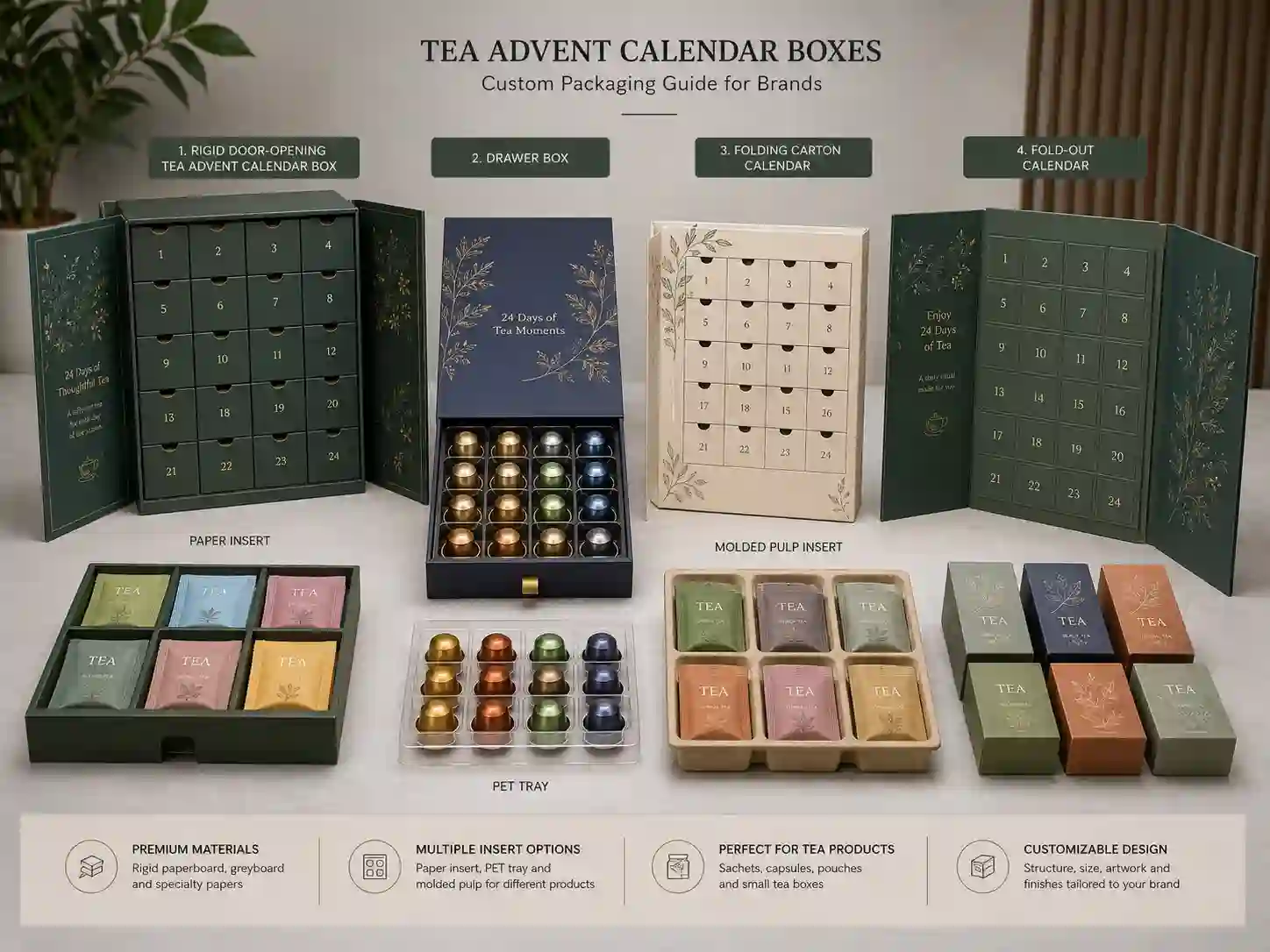
Common tea advent calendar boxes include door-opening boxes, drawer boxes, rigid book-style boxes, fold-out calendars, and folding carton structures. For gift retail and premium tea assortments, a rigid box with greyboard and wrapped printed paper creates a strong presentation. For supermarket, pharmacy, marketplace, or promotional programs, a folding carton or paperboard door-opening calendar may be more cost-effective.
| Structure option | Best for | Buyer advantages | Points to check before ordering |
|---|---|---|---|
| Door-opening box | Daily tea sachets, tea pouches, small packets | Classic numbered calendar layout, clear compartment sequence, strong shelf appeal | Door tear strength, perforation accuracy, compartment depth, artwork alignment |
| Drawer box | Premium tea samples, capsules, mini tins, small gift sets | Reusable feel, easy product access, strong perceived value | Drawer sliding tolerance, ribbon pull strength, insert stability, assembled shipping volume |
| Rigid book-style box | Luxury tea gifting and brand collaborations | Premium greyboard structure, large artwork area, suitable for foil stamping and embossing | Magnet placement, hinge strength, board thickness, export carton protection |
| Fold-out calendar | Retail storytelling, multiple tea flavors, larger visual display | Large presentation area, good for flavor sequence and campaign graphics | Panel folding tolerance, weight balance, outer sleeve strength |
| Folding carton calendar | Higher-volume seasonal retail programs | Lower unit cost, lighter shipping weight, efficient flat packing options | Paperboard grade, compression strength, die-cut accuracy, assembly labor |
A practical structure discussion should include board thickness, finished box size, opening direction, door numbering, retail display angle, and whether the calendar will stand upright or lie flat. Buyers can review more options through Giftpackpro’s custom advent calendar box products when comparing structure references.
How should inserts be designed for sachets, capsules, pouches, or small boxes?
Inserts should hold each tea item securely without crushing, shifting, or making removal difficult. The best insert depends on tea format, compartment count, product weight, sustainability target, and the level of protection required during transport.
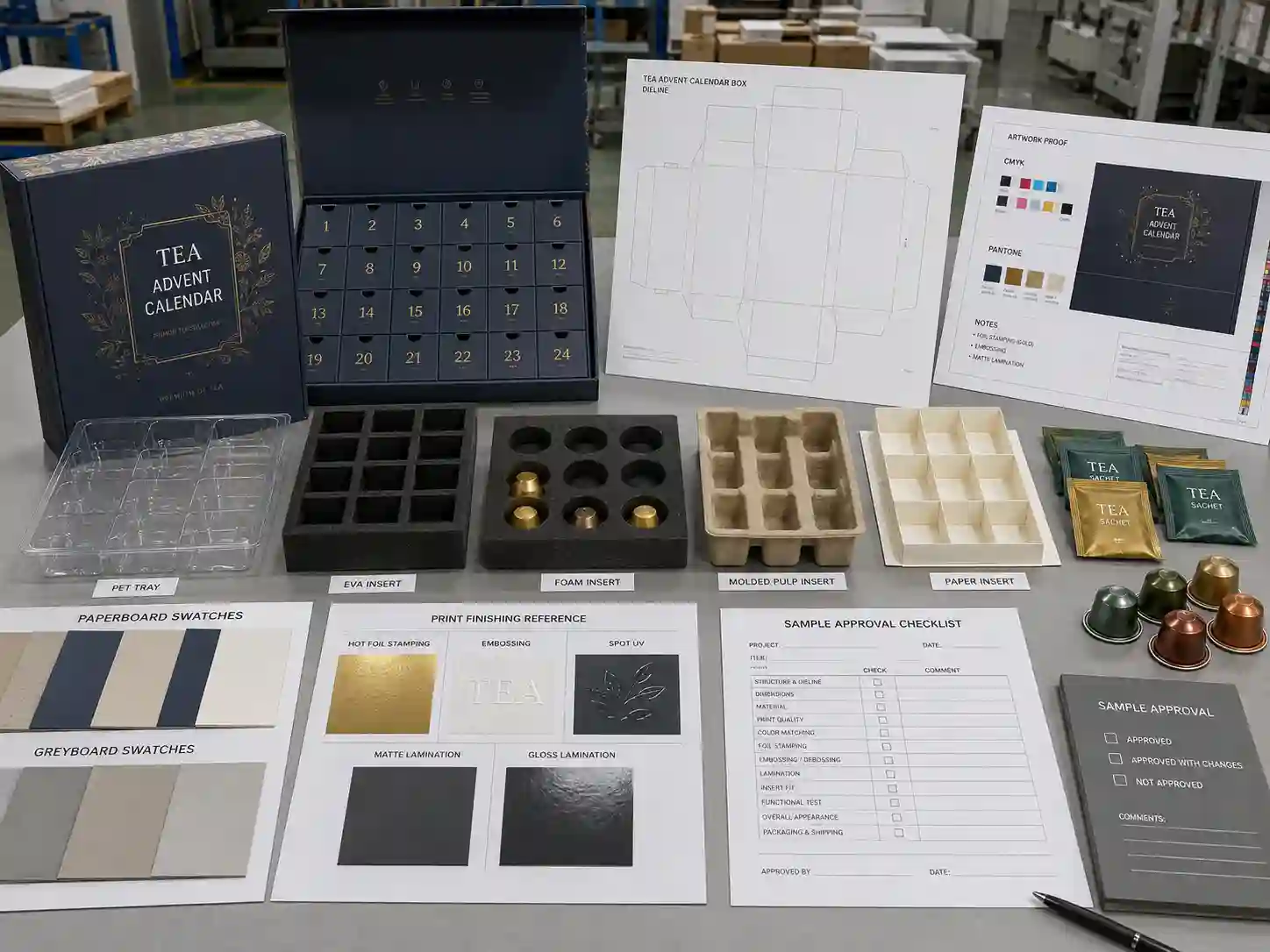
Tea sachets are usually thin and flexible, so they may fit in paperboard compartments or a folded paper insert. Capsules and mini tins need tighter cavity control and may require PET tray, EVA insert, foam, or molded pulp. Small tea boxes can often sit inside paperboard partitions if the carton board is strong enough and the compartment tolerance is tested during sampling.
Which insert material should buyers compare?
Buyers should compare insert materials by fit, appearance, cost, tooling, recyclability goals, and export durability. A low-cost insert is not always cheaper if it causes product movement, damaged doors, or slow packing on the production line.
- Paper insert: Suitable for sachets, flat pouches, lightweight small boxes, and buyers who want a paper-based structure.
- PET tray: Useful for capsules, mini tins, or shaped products where clear cavity control is needed.
- EVA insert: Often used for premium gift sets when a clean, firm presentation is required.
- Foam insert: Provides cushioning but should be checked against the buyer’s sustainability and market compliance preferences.
- Molded pulp insert: A paper-based molded option that can work for deeper cavities and a natural packaging look.
Factory tip: Send actual filled tea samples, not only empty sachets or CAD dimensions. Real products have seams, rounded corners, air volume, and thickness variation that affect compartment fit.
What printing decisions matter most for tea advent calendar boxes?
Printing decisions matter because tea advent calendar boxes usually carry flavor names, numbered doors, ingredient cues, barcode areas, and seasonal campaign graphics. Buyers should confirm CMYK artwork, Pantone color requirements, proofing method, surface finish, and dieline alignment before mass production.
For most custom advent calendar boxes, CMYK printing is used for full-color artwork, images, gradients, and campaign graphics. Pantone spot colors are useful when brand colors must remain consistent across packaging, labels, retail displays, and other printed materials. Buyers should avoid assuming that screen colors will match printed paper; color proofing is a physical production step, not a visual guess from a monitor.
When should buyers use CMYK, Pantone, or both?
CMYK is usually suitable for full artwork and cost-efficient production, while Pantone is useful for brand-critical colors or special solid tones. Many tea advent calendar boxes use CMYK for the main design and Pantone for key brand colors.
| Printing choice | Use when | Buyer benefit | Artwork check |
|---|---|---|---|
| CMYK printing | The design includes illustrations, images, gradients, or multi-color seasonal graphics | Flexible and suitable for most paperboard packaging designs | Check image resolution, color conversion, rich black settings, and overprint areas |
| Pantone color | The brand needs a specific logo color, background tone, or campaign color | Better color consistency for brand-critical elements | Confirm Pantone code, coated or uncoated paper effect, and proof approval |
| CMYK plus Pantone | The artwork needs full-color design plus controlled brand color | Balances visual flexibility and brand control | Confirm plate setup, cost impact, and color proof method |
Buyers preparing artwork should also check dieline layers, bleed, safe zone, door numbers, cut lines, crease lines, perforation lines, barcode placement, and flavor labeling space. For barcodes and retail identification, buyers can refer to official GS1 barcode standards and confirm local retail requirements with their sales channel.
Which finishing options make sense for tea advent calendar packaging?
Finishing options should support the brand position, not overload the box. Matte lamination, gloss lamination, foil stamping, embossing, debossing, and spot UV can improve shelf appeal when used with clear artwork priorities and realistic cost control.
Matte lamination gives a soft premium look and can reduce glare in product photography. Gloss lamination creates stronger shine and color impact. Foil stamping is often used on logos, numbers, borders, or festive accents. Embossing and debossing add tactile depth, especially on rigid box covers. Spot UV can highlight flavor names, door numbers, patterns, or selected design areas.
Buyer tip: Do not apply foil, embossing, and spot UV everywhere. Choose one or two focal areas, such as the logo, calendar numbers, or main pattern, so the box looks premium rather than visually crowded.
What should be checked before approving foil stamping, embossing, or spot UV?
Buyers should check registration tolerance, line thickness, surface compatibility, and sample appearance under real lighting. Fine foil details may fill in, small embossed text may lose clarity, and spot UV alignment may shift slightly during mass production.
- Confirm whether the finish is on coated paper, textured paper, specialty paper, or laminated surface.
- Keep foil artwork in a separate vector layer with clear naming.
- Use realistic minimum line thickness for foil and embossing.
- Check whether embossing affects nearby door perforations or crease lines.
- Review a physical sample or pre-production sample before approving bulk production.
How do materials affect print quality, structure, and cost?
Material selection affects the box strength, printed color, surface finish, weight, and export durability. Tea advent calendar buyers should compare greyboard, paperboard, specialty paper, coated paper, and insert materials together rather than treating them as separate decisions.
Rigid boxes often use greyboard wrapped with printed art paper, textured paper, or specialty paper. Folding carton calendars usually use paperboard that is printed, laminated, die-cut, creased, and assembled. If the product will be displayed upright, the box must resist bending and door distortion. If it will be shipped assembled, the export carton must protect corners, surfaces, and door panels.
For paper-based sourcing requirements, buyers may ask suppliers about FSC-related material options and verify claims through official channels such as the Forest Stewardship Council. Buyers should confirm documentation requirements before production rather than after shipment.
What artwork checks prevent expensive production mistakes?
The most important artwork checks are dieline accuracy, bleed, safe area, door number sequence, insert alignment, flavor labeling space, barcode readability, and finish layers. A small artwork mistake can affect every unit in mass production.
Tea advent calendar boxes often have many repeated small areas. Each door may need a number, flavor clue, illustration, or opening line. If the dieline shifts or the artwork is built on the wrong layer, door numbers can land too close to cut lines, flavor labels can be hidden, and foil areas can miss their intended position.
Practical artwork checklist for buyers
- Use the supplier’s final dieline, not an old template from a different structure.
- Keep cut, crease, perforation, glue, foil, embossing, and spot UV layers clearly separated.
- Confirm bleed on all outer edges and door openings.
- Place important text and numbers inside the safe zone.
- Check the compartment sequence against the actual packing plan.
- Reserve space for flavor labels, nutrition references, country marks, barcodes, or retail stickers if needed.
- Convert fonts to outlines or package font files according to supplier instructions.
- Check image resolution before proofing.
- Approve color proof under controlled lighting, not only from a phone photo.
Quotable B2B statement: For tea advent calendar boxes, artwork approval should happen only after the dieline, insert layout, product sequence, and finishing layers are confirmed together.
How should buyers plan samples and pre-production approval?
Buyers should use samples to confirm structure, insert fit, artwork position, opening performance, and export packing assumptions before mass production. A prototype can test size and structure, while a pre-production sample should reflect final materials, printing, finishing, and assembly details.
A white sample or blank prototype helps confirm the rigid box, drawer box, folding carton, or door-opening structure before full artwork investment. A digital printed sample may help with visual review, but it may not perfectly represent offset printing or final finishing. A pre-production sample is more important for final approval because it should show the actual material, printing process, lamination, foil stamping, embossing, spot UV, insert, and assembly method.
Buyers using Giftpackpro’s custom advent calendar box services can prepare product samples, artwork files, size requirements, and target shipment method before requesting sampling support.
What MOQ and lead time factors should buyers expect?
MOQ and lead time depend on box structure, material, printing method, finishing complexity, insert type, assembly labor, and seasonal production capacity. Buyers should discuss MOQ early because a rigid box with multiple finishes and custom inserts has a different production profile from a simpler folding carton calendar.
There is no universal MOQ that fits every tea advent calendar project. A basic paperboard structure may support a different minimum order quantity than a premium rigid box with drawer trays, foil stamping, and EVA inserts. Lead time can also change if the project needs tooling, special paper, molded pulp insert development, multiple color proofs, or revised samples.
Decision guide: how to choose the right production route
| Buyer priority | Recommended direction | Why it helps |
|---|---|---|
| Lower unit cost and lighter shipping | Folding carton or paperboard door-opening calendar | Efficient material use, possible flat packing, suitable for larger retail quantities |
| Premium gift presentation | Rigid box, book-style box, or drawer box | Stronger structure, better perceived value, more finishing options |
| Precise capsule or mini tin fit | PET tray, EVA insert, foam, or molded pulp insert | Improves cavity control and reduces product movement |
| Paper-based packaging preference | Paper insert or molded pulp insert | Supports a more paper-focused material strategy |
| Fast artwork approval | Limit special finishes and use clear dieline layers | Reduces proofing complexity and revision risk |
Factory tip: The fastest project is usually the one with complete product sizes, final artwork, confirmed insert requirements, and approved shipping method before sample making starts.
What QC checks are important before shipment?
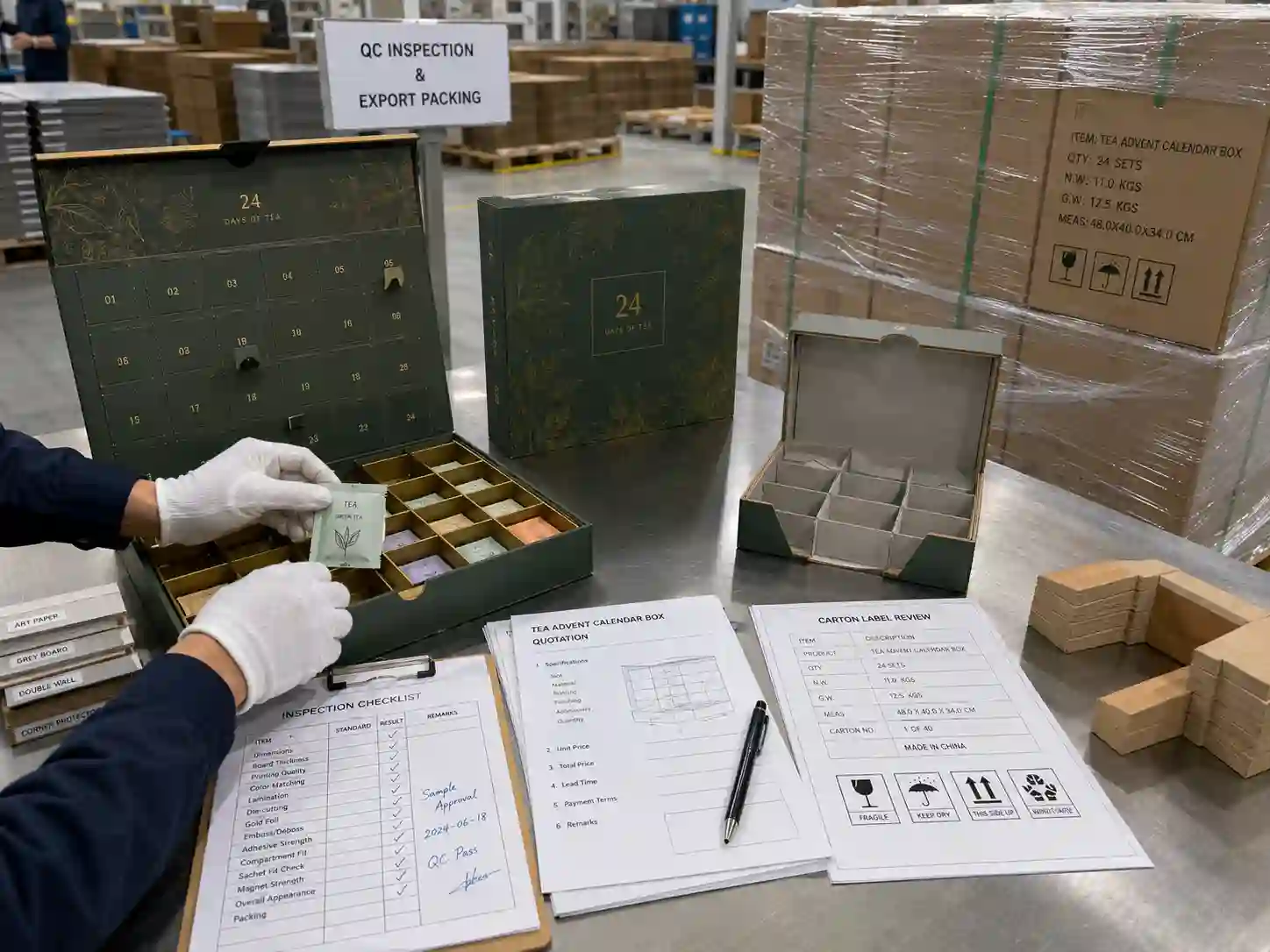
QC should confirm that the finished tea advent calendar boxes match the approved sample in structure, color, finish, insert fit, assembly, and export packing. Final inspection should check both appearance and function, not only printed surface quality.
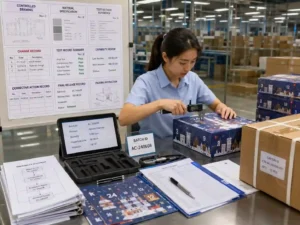
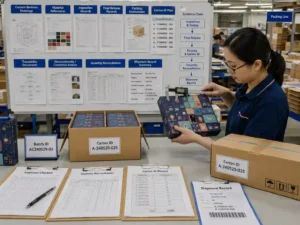
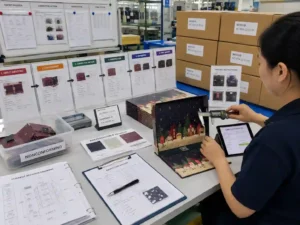
Important QC points include board thickness, box dimensions, door opening, drawer sliding, magnet position if used, glue strength, lamination quality, foil registration, embossing position, spot UV alignment, insert fit, compartment sequence, carton labels, and shipping marks. For tea products, the packaging team should also confirm that primary tea packs are clean, properly sealed, and not crushed during fitting.
QC checklist for tea advent calendar boxes
- Compare finished goods against the approved sample and signed specification.
- Measure outer box size, compartment size, and insert cavity tolerance.
- Check door numbers, flavor sequence, and opening direction.
- Inspect CMYK and Pantone color consistency against the approved proof.
- Check foil stamping, embossing, spot UV, matte lamination, or gloss lamination for defects.
- Test product insertion and removal using real sachets, capsules, pouches, or small boxes.
- Review glue points, creasing, folding, drawer movement, and door perforation strength.
- Confirm export carton quantity, carton label, shipping marks, and pallet packing plan.
QC tip: For a numbered tea calendar, random inspection should include sequence checking. A beautiful box can still fail if the wrong tea flavor is packed behind the wrong door.
How should export packing be planned for assembled or flat boxes?
Export packing should be chosen according to box structure, shipping distance, loading method, and warehouse handling. Assembled rigid boxes need more carton volume and corner protection, while flat-packed folding cartons may reduce freight volume but require assembly planning at the destination or packing facility.
For rigid tea advent calendar boxes, export cartons should protect surfaces, corners, doors, and decorative finishes. Corner protectors, inner dividers, polybags, tissue paper, or protective sleeves may be used depending on the finish. For pallet shipment, carton stacking strength and pallet wrap should be discussed before mass production. Shipping marks and carton labels should match the buyer’s warehouse, retailer, or logistics instructions.
Flat packing can reduce shipping volume for some paperboard designs, but it shifts assembly work to another stage. Buyers should calculate the full landed cost, including freight, labor, packing accuracy, and damage risk. For marketplace or retail distribution, carton drop resistance and barcode label placement may also need review.
How should buyers compare suppliers for custom tea advent calendar boxes?
Buyers should compare suppliers by engineering ability, sample quality, artwork checking, insert testing, printing control, QC process, communication, and export packing experience. The lowest unit price is not the best value if the supplier cannot manage dielines, color proofing, or seasonal delivery.
A qualified supplier should ask about tea format, product dimensions, compartment count, artwork files, printing requirements, finishing expectations, insert preference, MOQ, target delivery date, and shipping method. Buyers should be cautious if a supplier quotes only from a reference photo without confirming product fit, board thickness, insert material, and packing details.
- Ask whether the supplier can provide a dieline before artwork finalization.
- Check whether they understand paperboard, greyboard, rigid box, drawer box, and folding carton construction.
- Confirm sample stages: blank sample, printed sample, or pre-production sample.
- Review how they handle CMYK, Pantone, foil stamping, embossing, and spot UV proofing.
- Ask how they inspect insert fit and final assembly tolerance.
- Confirm export carton specifications, pallet plan, and shipping marks before production.
Buyers who want to evaluate factory background can review the Giftpackpro packaging factory page and compare it with project-specific sample, production, and QC discussions.
What information should buyers prepare before requesting a quotation?
Buyers should prepare product dimensions, tea format, box style, compartment quantity, material preference, artwork files, finishing requirements, insert preference, quantity, delivery country, and packing method. A detailed RFQ helps the supplier quote more accurately and reduces revision time.
For tea advent calendar boxes, the quotation should not be based on outer size alone. The supplier also needs the size and weight of each sachet, capsule, pouch, mini tin, or small tea box; the number of compartments; the desired opening sequence; and whether each compartment holds one item or multiple items. If the buyer needs retail label space, barcode areas, ingredient label zones, or multilingual packaging panels, these should be included before dieline confirmation.
RFQ preparation checklist
- Target box style: rigid box, folding carton, drawer box, door-opening box, or fold-out structure.
- Product details: tea sachet, capsule, pouch, mini tin, or small box dimensions and weight.
- Compartment count and sequence: 12-day, 24-day, 25-day, or custom layout.
- Insert preference: paper insert, PET tray, EVA insert, foam, molded pulp, or supplier recommendation.
- Material preference: paperboard, greyboard, specialty paper, or sustainability-related requirements.
- Printing: CMYK, Pantone, color proofing expectations, and artwork file format.
- Finishing: matte lamination, gloss lamination, foil stamping, embossing, debossing, or spot UV.
- MOQ and target order quantity.
- Sample requirement: blank prototype, printed sample, or pre-production sample.
- Export packing: flat or assembled packing, carton label, shipping marks, pallet requirement, and destination country.
Buyers can browse more advent calendar box buying guides or request a custom quote with product information, artwork files, quantity, and delivery requirements.
What common mistakes should buyers avoid?
Buyers should avoid choosing structure by appearance alone, approving artwork before dieline confirmation, ignoring insert tolerance, and requesting a quotation without product samples. These mistakes often create sample delays, cost changes, or quality issues during mass production.
- Mistake 1: Using only a reference photo. A reference photo cannot replace dimensions, material details, insert requirements, and production specifications.
- Mistake 2: Ignoring aroma and moisture needs. The primary tea pack should protect the tea; the calendar box should be designed around the sealed product.
- Mistake 3: Treating all inserts as interchangeable. Paper insert, PET tray, EVA insert, foam, and molded pulp have different costs, tolerances, and packing effects.
- Mistake 4: Adding too many finishes. Excessive foil stamping, embossing, and spot UV can increase cost and proofing complexity without improving brand clarity.
- Mistake 5: Forgetting export packing early. A box that looks good on the sample table still needs to survive carton packing, pallet handling, and international shipment.
FAQ: What do buyers ask about tea advent calendar boxes?
Can tea advent calendar boxes hold different tea formats in one set?
Yes, but mixed formats require careful insert planning. If sachets, capsules, pouches, and mini boxes are used together, the supplier should test each cavity size and confirm the packing sequence before mass production.
Are tea advent calendar boxes food-contact packaging?
In most projects, the calendar box holds individually wrapped tea products, so the sachet, pouch, capsule, or inner tea pack provides the primary product protection. Buyers should still verify material requirements, local regulations, and any food-contact expectations for their market.
Should buyers choose rigid boxes or folding cartons?
Rigid boxes are better for premium gifting and strong presentation, while folding cartons are often better for cost-sensitive, high-volume, or flat-packed retail programs. The right choice depends on product weight, price point, artwork, MOQ, and shipping plan.
How early should buyers start a seasonal tea calendar project?
Buyers should start early enough to allow structure selection, dieline confirmation, artwork checks, sampling, revisions, mass production, QC, export packing, and international shipping. Projects with custom inserts, special paper, foil stamping, embossing, or complex artwork need more planning time.
What is the most important sample to approve?
The pre-production sample is usually the most important because it should represent the final material, printing, finishing, insert, and assembly method. A blank prototype is useful for structure testing, but it does not replace final production approval.
Can Giftpackpro help with both structure and artwork checking?
Giftpackpro can support B2B buyers with structure discussion, dieline preparation, insert planning, sample review, printing and finishing coordination, and export packing communication. Buyers should provide product details and artwork requirements at the beginning of the project.
Conclusion: how to start a tea advent calendar boxes project
Tea advent calendar boxes should be developed as a structured packaging project, not only a seasonal design. Buyers should confirm the tea format, compartment layout, insert material, paperboard or greyboard structure, CMYK and Pantone printing needs, finishing effects, sample stage, MOQ, QC checklist, export carton, pallet plan, shipping marks, and quotation details before production.
To start a custom project with Giftpackpro, prepare your product size, quantity, preferred structure, artwork files, finishing ideas, insert preference, destination country, and packing method. Then contact the team through request a custom quote to discuss samples, quotation details, and production planning for tea advent calendar boxes.