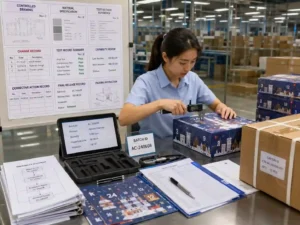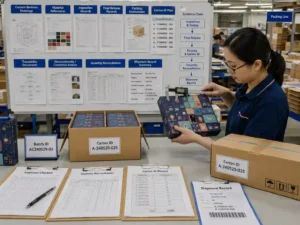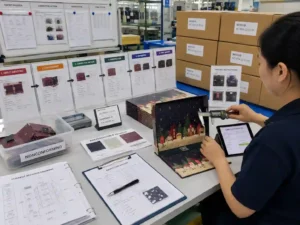
Quick answer: Designing chocolate advent calendar boxes for seasonal campaigns requires more than choosing a festive layout. B2B buyers should confirm the chocolate size, number of compartments, insert material, box structure, artwork method, sample approval process, mass production controls, export carton strength, and quotation details before placing an order. The best design keeps chocolates separated, protects the door-opening experience, supports retail labeling, reduces odor and moisture risks, and can be assembled consistently at scale. For overseas brands and purchasing teams, the safest workflow is to approve a blank sample first, then a printed pre-production sample, before bulk production and final QC.
What should buyers decide before designing chocolate advent calendar boxes?
Buyers should first define the product count, chocolate dimensions, target sales channel, retail display style, packing method, and delivery deadline. These decisions affect the structure, insert, material thickness, printing process, MOQ, lead time, and final quotation.
Chocolate is a sensitive gift product because it can be affected by pressure, temperature, odor, and moisture. The box is not only a decorative retail package; it must hold each chocolate in position, keep compartments separated, and maintain a clean opening experience from the first door to the last. For B2B seasonal campaigns, design decisions should be made around production repeatability, not only visual appeal.
A practical design brief for chocolate advent calendar boxes should include the number of days, wrapped or unwrapped chocolate size, approximate product weight, required insert type, packaging structure, artwork files, labeling area, outer carton requirements, destination market, and expected order quantity. Buyers can review related advent calendar box buying guides before preparing a detailed request.
Buyer tip: If the chocolate is already wrapped, share the finished wrapped dimensions instead of the bare chocolate dimensions. A small difference in wrapper edge thickness can change the insert cavity, door alignment, and compartment fit.
Which chocolate advent calendar box structure fits your seasonal campaign?
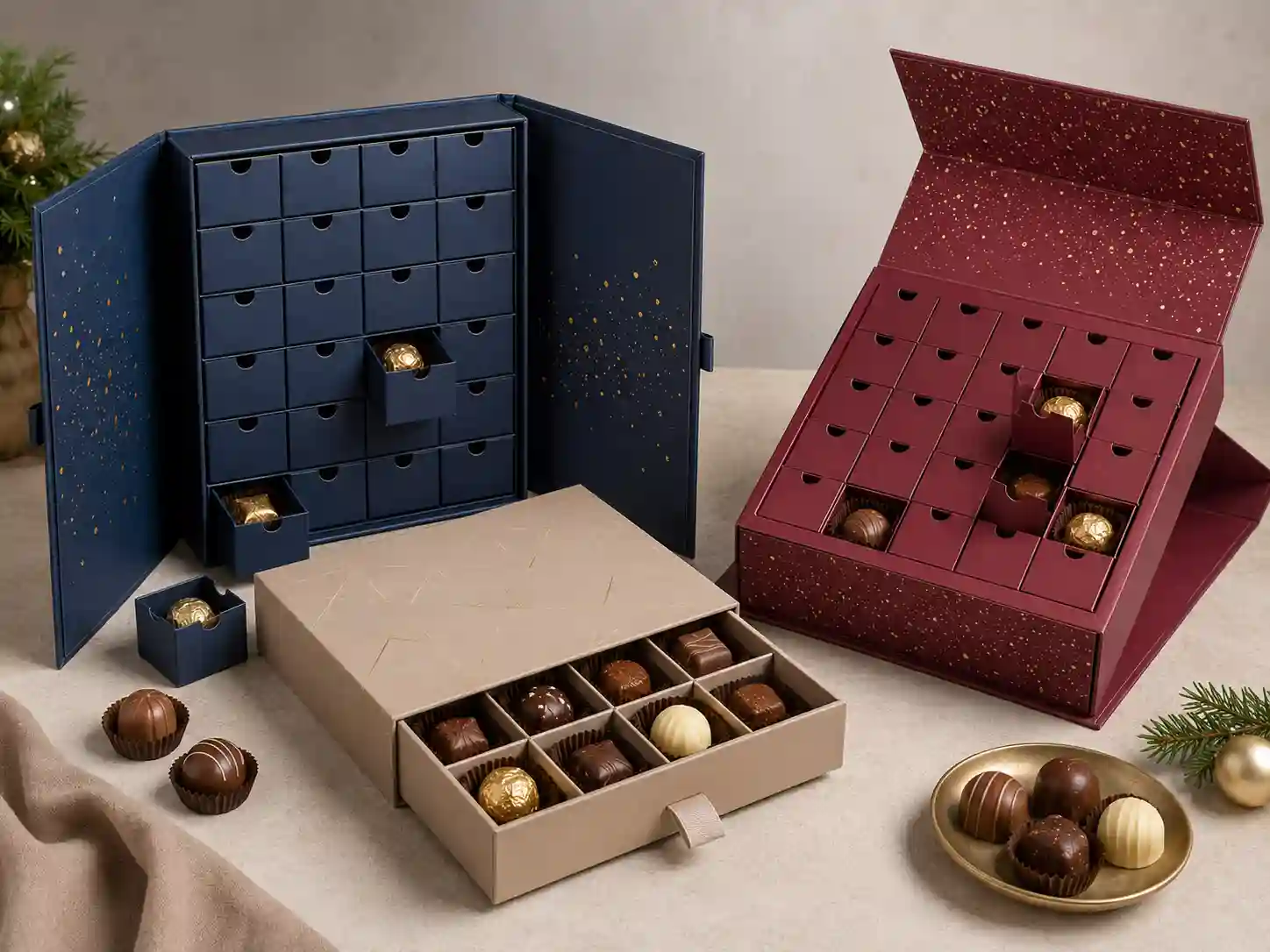
The right structure depends on retail positioning, product weight, budget, production quantity, and opening style. Rigid boxes provide premium presentation, folding cartons support cost-efficient campaigns, drawer boxes create a reusable gift feel, and door-opening boxes are the classic structure for daily reveal calendars.
| Box structure | Best for | Main advantages | Buyer considerations |
|---|---|---|---|
| Rigid door-opening box | Premium chocolate gift campaigns, retail shelves, luxury seasonal sets | Strong greyboard structure, high perceived value, good support for foil stamping, embossing, and matte lamination | Higher unit cost, longer production time, needs accurate insert and door alignment control |
| Folding carton calendar | High-volume promotional campaigns and lighter chocolate assortments | Lower material cost, efficient packing, easier shipping, suitable for CMYK printing | Less rigid than greyboard, needs careful paperboard selection and carton protection |
| Drawer box calendar | Gift sets, boutique chocolate assortments, mixed product formats | Premium opening experience, reusable feel, strong product separation when inserts are well designed | More assembly steps, drawer friction must be controlled, may increase labor cost |
| Book-style magnetic box | Brand storytelling, premium holiday collections, influencer or corporate gifting | Excellent presentation, wide artwork area, suitable for sleeve, ribbon, or magnetic closure | Magnet position, hinge durability, and export carton protection require extra checking |
For a seasonal retail campaign, buyers should compare box structures by product weight, shelf display, opening sequence, and shipping route. A rigid box may look premium, but it is not always necessary for every chocolate range. A folding carton can be more suitable when the campaign depends on large-volume distribution, tighter freight cost, and fast replenishment.
For brands that are still comparing structures, Giftpackpro can help evaluate options through custom advent calendar box services, including dieline discussion, sample development, insert selection, and production planning.
How should inserts be designed for chocolate separation and protection?
The insert should hold each chocolate securely without crushing the wrapper, transferring odor, or making the daily door difficult to open. Insert design is one of the most important quality points for chocolate advent calendar boxes because it controls product fit, separation, display position, and assembly speed.
Common insert options include paper insert, PET tray, EVA insert, foam, and molded pulp. For chocolate packaging, buyers should discuss whether the insert or inner tray may directly touch the chocolate or only contact the wrapper. If food contact is possible, buyers should request material information from the supplier and verify the requirements for the destination market. Official guidance such as the U.S. FDA page on food-contact substances can help buyers understand why material verification matters, but packaging suppliers should not make unsupported compliance claims without documentation.
Which insert material should buyers compare?
Paper inserts are suitable for many wrapped chocolate sets and support a recyclable paper-based packaging direction when properly specified. PET trays provide accurate cavity shapes and visibility but may require sustainability review by the buyer. EVA and foam provide cushioning for fragile or mixed gifts, but buyers should check odor, material appearance, and destination requirements. Molded pulp can support a natural paper-based look, although tolerance and surface smoothness should be tested with the real chocolate shape.
- Paper insert: Good for wrapped chocolates, lightweight seasonal sets, and paper-based packaging concepts.
- PET tray: Good for precise cavities, consistent positioning, and products with repeated shapes.
- EVA insert: Good for heavier mixed gifts, but odor and material feel should be reviewed.
- Foam insert: Good for cushioning, but may not fit every food gift positioning.
- Molded pulp: Good for natural presentation and compartment separation, but fit testing is essential.
Factory tip: Insert tolerance should be tested with actual production samples, not only CAD measurements. Chocolate wrappers can expand, fold, or trap air, which may cause tight cavities during assembly.
What material and printing choices affect appearance, cost, and durability?
Material and printing choices affect both retail appearance and factory repeatability. Buyers should choose paperboard, greyboard, lamination, color method, and finishing based on the box structure, order volume, handling requirements, and brand positioning.
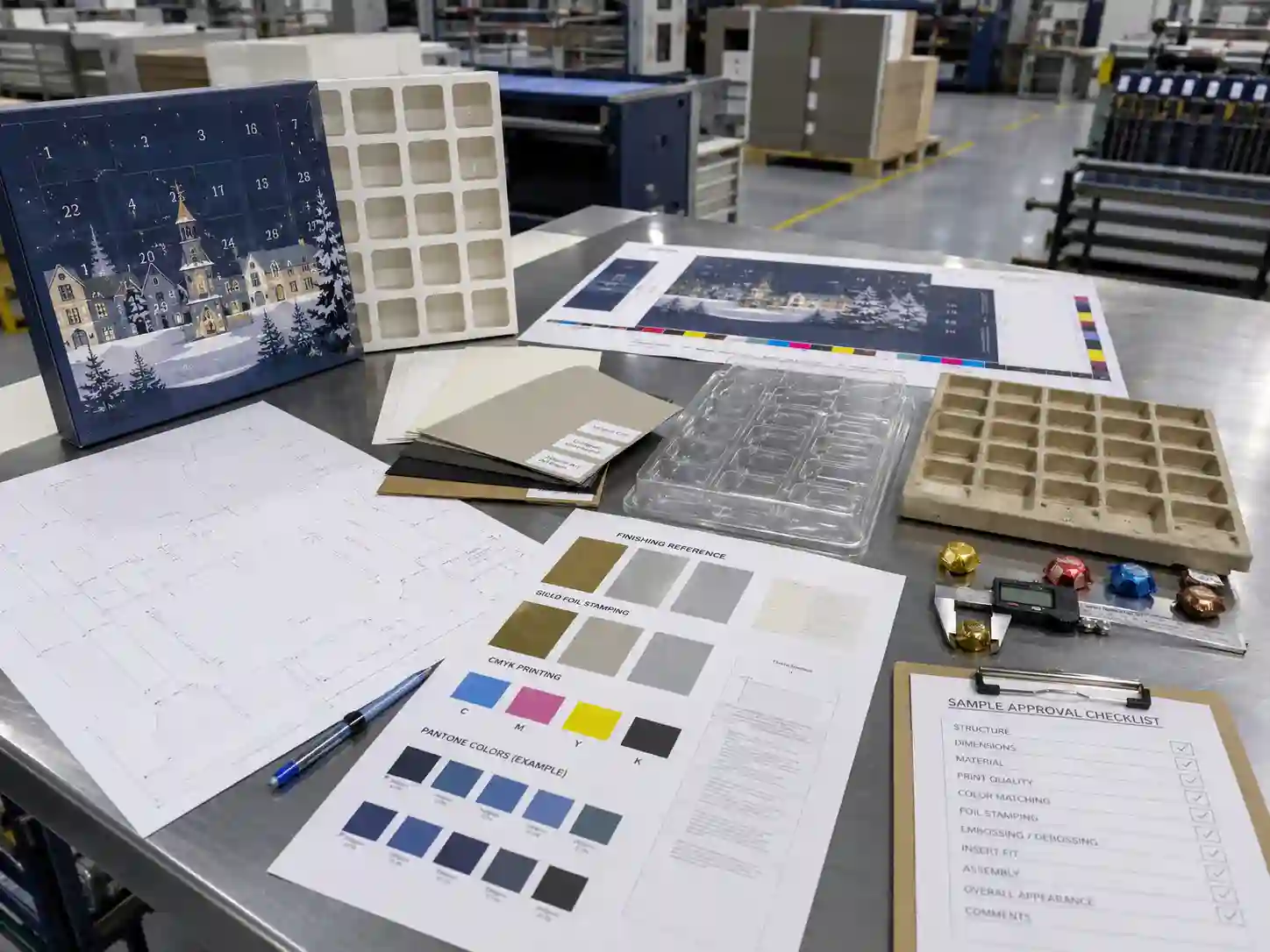
Rigid chocolate calendars often use greyboard wrapped with printed paper, while folding carton calendars use thicker paperboard or corrugated-supported formats depending on size and product weight. Matte lamination can create a refined look and reduce glare, while gloss lamination can make colors appear brighter. Foil stamping, embossing, and spot UV can improve shelf impact, but each finishing step adds setup requirements, cost, and inspection points.
For color control, buyers should provide artwork in the requested format and confirm whether key brand colors use CMYK or Pantone references. Pantone matching may be useful for brand-critical colors, while CMYK is often suitable for full-color seasonal artwork. The dieline should show cut lines, bleed, fold lines, glue areas, door positions, barcode area, warning or ingredient label space, and any retailer-required panel.
Quotable B2B statement: A chocolate advent calendar dieline is not only an artwork template; it is a production control document that connects printing, die-cutting, insert position, door opening, assembly, and final inspection.
How do sampling and pre-production approval reduce bulk order risk?
Sampling reduces risk by proving structure, insert fit, artwork placement, color direction, and assembly method before mass production. Buyers should approve a blank sample for structure first, then a printed sample or pre-production sample for color, finishing, and production details.
A blank sample is useful for checking size, structure, door opening, insert cavity, chocolate placement, and outer carton planning. A printed sample helps review artwork scale, CMYK color, Pantone reference, foil stamping, embossing, spot UV, matte lamination, gloss lamination, and barcode placement. A pre-production sample should represent the final materials and process as closely as possible before mass production begins.
For chocolate gift packaging, sampling should include a product fit test using the real chocolate or a dimensionally accurate dummy product. If the box has 24 or 25 compartments, buyers should check several cavities, not only one. Door opening force, tear line quality, internal clearance, and product movement after light shaking should all be reviewed.
What should be checked before sample approval?
- Confirm final box size, compartment count, and chocolate placement direction.
- Check whether each door opens cleanly without tearing nearby artwork.
- Test insert fit with actual wrapped chocolates or accurate dummy samples.
- Review color proof, artwork scale, barcode space, and required label area.
- Check finishing position for foil stamping, embossing, spot UV, or lamination.
- Confirm assembly method, glue strength, drawer friction, or magnetic closure if used.
- Review export carton size, carton quantity, and shipping marks before bulk production.
Buyer tip: Do not approve a sample based only on front-side appearance. For chocolate advent calendar boxes, the internal insert, door-opening function, and product separation are just as important as the printed cover.
What QC points matter most during mass production?
Mass production QC should focus on material consistency, printing accuracy, die-cutting precision, insert fit, assembly tolerance, door-opening function, carton strength, and final packing. These controls help prevent bulk problems that may not appear in a single sample.
During production, the factory should check incoming paperboard or greyboard, printing sheets, lamination quality, die-cut lines, glue application, folding accuracy, and insert placement. For chocolate calendars, cavity alignment is especially important because a small shift can block a door opening or make a compartment look empty even when the product is inside.
Inspection can include first-article review, in-process inspection, and final random inspection. Buyers should agree on acceptable tolerances before production, especially for color variation, door alignment, surface scratches, glue marks, warping, and carton packing quantity. If the product will be sold through retail or e-commerce channels, carton drop resistance and export packing strength should be discussed early.
Practical QC checklist for chocolate advent calendar boxes
- Printing: Check CMYK color, Pantone reference, registration, text clarity, barcode readability, and artwork position.
- Surface finishing: Check matte lamination, gloss lamination, foil stamping, embossing, spot UV, scratches, bubbles, and peeling.
- Structure: Check box squareness, panel alignment, door perforation, drawer movement, hinge strength, and magnetic closure if applicable.
- Insert: Check cavity size, product separation, tray position, glue or locking method, and chocolate movement after handling.
- Assembly: Check glue strength, folding accuracy, clean edges, compartment order, and packing speed consistency.
- Cleanliness: Check dust, paper scraps, odor, stains, and foreign matter before final packing.
- Export packing: Check carton strength, inner protection, shipping marks, pallet plan, and carton label accuracy.
QC tip: For calendar boxes with many doors, inspectors should open a controlled number of doors from different production batches. This helps catch die-cutting or perforation issues before cartons are sealed.
How should buyers manage odor, moisture, and food packaging concerns?
Buyers should treat odor, moisture, and food-contact questions as specification issues, not afterthoughts. Chocolate packaging should be reviewed for material smell, ink and adhesive suitability, moisture exposure during storage, and whether the chocolate is wrapped or directly exposed.
Most B2B chocolate advent calendar projects use individually wrapped chocolates, which helps reduce direct contact between the chocolate and the display insert. However, buyers should still confirm material type, printing method, adhesive application, ventilation during production, and storage conditions before shipment. Strong-smelling inks, adhesives, foam, or plastic trays can affect the perceived quality of a chocolate gift box even when no direct contact occurs.
For markets with specific packaging and recycling rules, buyers should verify requirements with their own compliance team, importer, or testing laboratory. Supplier statements should be supported by documentation when food contact, recycling marks, or retailer standards are required. Buyers can also review official packaging and waste information from the European Commission packaging waste page when planning EU-bound packaging.
What are the main cost and MOQ drivers?
The main cost drivers are structure type, box size, material thickness, insert material, printing coverage, finishing process, assembly complexity, order quantity, and export packing method. MOQ is affected by material sourcing, printing setup, die-cut tooling, insert tooling, and factory production scheduling.
Rigid boxes usually cost more than folding cartons because they require greyboard, printed wrapping paper, more hand assembly, and more packing volume. PET trays or molded pulp inserts may require tooling, while paper inserts can often be more flexible for lower-volume development. Foil stamping, embossing, and spot UV add setup and inspection requirements, especially when the artwork has tight registration.
Lead time depends on dieline confirmation, sample revision, material purchasing, printing schedule, production complexity, inspection, packing, and export logistics. Seasonal campaigns should leave time for sample approval and revisions because rushing directly into mass production increases the risk of wrong cavity size, weak door function, color mismatch, or carton damage.
How should buyers compare suppliers for seasonal chocolate packaging?
Buyers should compare suppliers by their ability to manage structure development, insert fit, artwork proofing, sample approval, mass production QC, export packing, and quotation transparency. The lowest unit price is not always the safest option if the supplier cannot control assembly tolerance or seasonal delivery timing.
A qualified supplier should ask about chocolate size, wrapped dimensions, box structure, insert material, artwork files, packing method, destination market, order quantity, and required delivery date. If a supplier quotes without asking for these details, the price may not include the correct insert, finishing, carton strength, or assembly requirements.
When reviewing a supplier, ask for examples of custom advent calendar boxes, sample process details, QC checkpoints, export carton planning, and communication workflow. Buyers can browse custom advent calendar box products to compare structure directions, or learn more about the Giftpackpro packaging factory when evaluating factory-side capabilities.
Decision guide: which option should your buying team choose?
Use the campaign goal to narrow the structure and insert before discussing decoration. This helps the quotation stay accurate and prevents artwork decisions from being made before the physical packaging is proven.
| Buyer situation | Recommended direction | Why it works |
|---|---|---|
| Premium retail chocolate launch | Rigid door-opening box with paper or PET insert | Strong shelf presence, good structure, and reliable compartment presentation |
| Large-volume promotional campaign | Folding carton calendar with paper insert | Cost-efficient, lighter to ship, and suitable for wider distribution |
| Mixed chocolates and small gifts | Drawer box or rigid box with customized insert | Better separation for different sizes and a more controlled reveal experience |
| Eco-positioned seasonal gift | Paperboard structure with paper insert or molded pulp trial | Supports paper-based presentation, but fit and surface quality must be sampled |
| E-commerce shipping focus | Durable structure with stronger export carton and inner protection | Helps reduce corner damage, crushing, and product movement during transit |
What export packing details should be confirmed before shipment?
Export packing should be confirmed before mass production because carton size, carton weight, pallet plan, and shipping marks affect freight cost and damage risk. Chocolate advent calendar boxes often have large surfaces and many edges, so corner protection and carton strength matter.
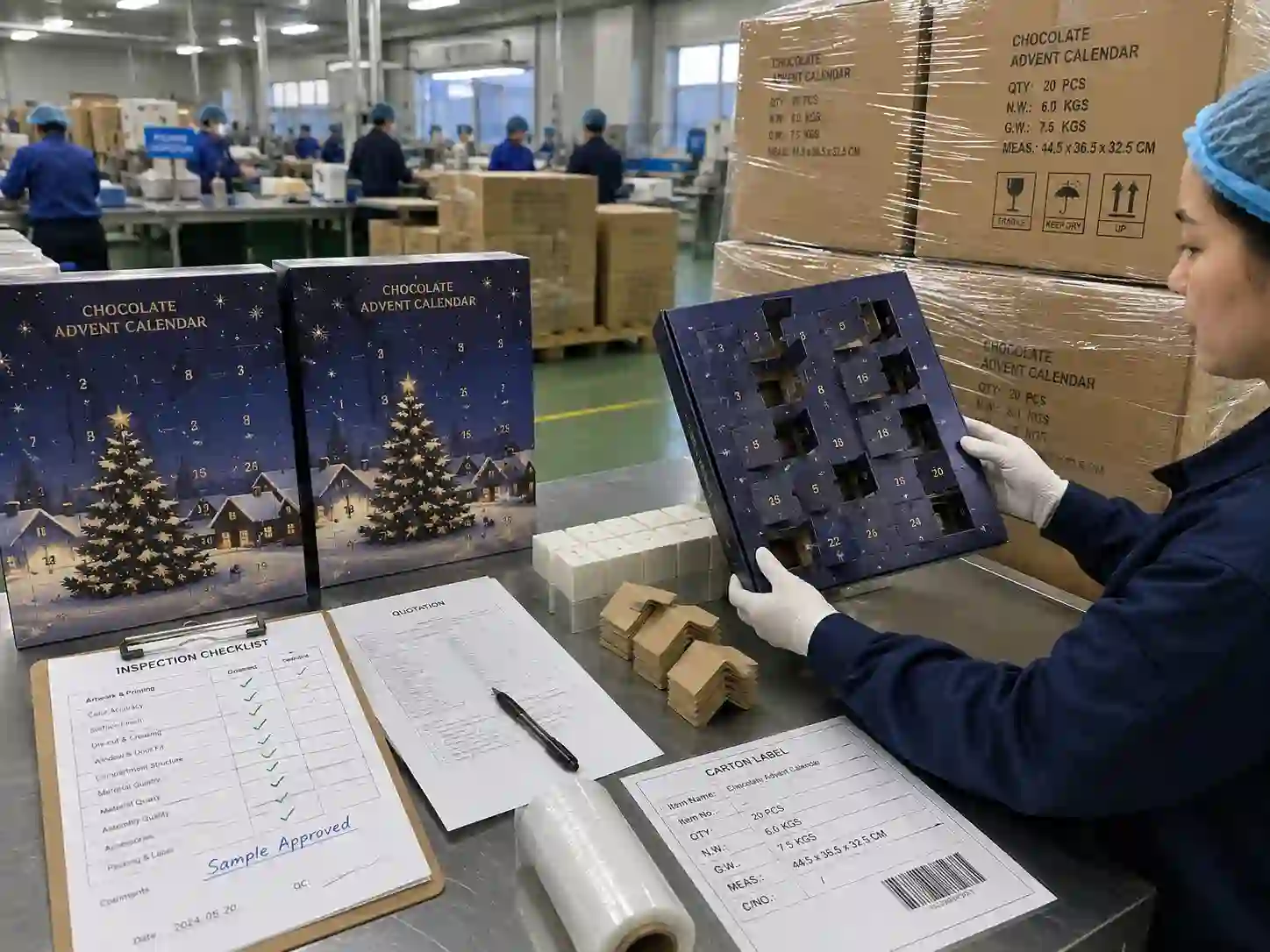
Buyers should confirm how many calendar boxes fit into each export carton, whether inner poly bags or tissue wrapping are needed, whether corner protectors are required, and how cartons will be palletized. For long-distance ocean or air shipment, packaging teams should discuss moisture exposure, carton compression, and warehouse handling. If the buyer requires transit testing, they can reference official information from organizations such as ISTA test procedures and confirm the exact test plan with a qualified lab or logistics partner.
Shipping marks should be generic and practical unless the buyer has specific retailer requirements. Carton labels may include item number, quantity, gross weight, net weight, carton size, destination, and handling marks. For Amazon, retail, or distributor orders, buyers should provide label instructions early to avoid repacking delays.
What information should buyers prepare before requesting a quotation?
Buyers should prepare product dimensions, box structure preference, artwork requirements, insert type, order quantity, destination, packing method, and target delivery date before asking for a quotation. Complete information helps the supplier quote the correct material, process, tooling, sample cost, MOQ, lead time, and export packing.
Before contacting Giftpackpro as a custom advent calendar boxes manufacturer, prepare the following RFQ details:
- Chocolate count, wrapped chocolate size, product weight, and whether products are identical or mixed.
- Preferred structure: rigid box, folding carton, drawer box, book-style box, or door-opening box.
- Insert preference: paper insert, PET tray, EVA insert, foam, molded pulp, or supplier recommendation.
- Artwork status: dieline needed, artwork ready, CMYK files, Pantone references, barcode area, and label space.
- Finishing requirements: matte lamination, gloss lamination, foil stamping, embossing, spot UV, or special texture.
- Quantity range, expected MOQ, sample requirement, target unit price range, and seasonal delivery deadline.
- Export needs: carton labels, shipping marks, pallet requirement, destination country, and logistics method.
Buyers who already have a design brief can request a custom quote with dimensions, quantity, artwork notes, and sample expectations. If the project is still at concept stage, Giftpackpro can help turn packaging ideas into sample-ready specifications through its custom development workflow.
What common mistakes should buyers avoid?
The most common mistakes are choosing decoration before confirming structure, using chocolate dimensions without wrapper allowance, skipping insert testing, approving artwork without checking door positions, and leaving export packing until the end. These mistakes can create production delays, higher cost, or packaging that looks good but does not function well.
- Ignoring wrapped size: The wrapper can make the product wider, thicker, or less uniform than expected.
- Using one cavity test only: Multi-door calendars need fit checks across different positions, not only the center.
- Overusing finishing effects: Foil stamping, embossing, and spot UV should support the design, not create registration risk everywhere.
- Leaving label space too late: Ingredient, barcode, recycling, warning, or retailer labels need planned artwork space.
- Skipping carton planning: A beautiful retail box can still fail if the export carton is weak or poorly packed.
- Approving unclear samples: Buyers should record sample approval notes, revision history, and final specifications in writing.
FAQ: Chocolate advent calendar boxes for B2B buyers
What is the best structure for chocolate advent calendar boxes?
The best structure depends on the campaign. Premium chocolate brands often choose rigid door-opening boxes, while high-volume seasonal promotions may use folding carton calendars. Drawer boxes are useful for mixed gifts or a reusable gift experience.
Should chocolate advent calendar boxes use paper inserts or plastic trays?
Paper inserts work well for many wrapped chocolates and paper-based packaging concepts. PET trays can provide more precise cavities for repeated shapes. Buyers should test both product fit and material suitability before approving mass production.
Can Giftpackpro make a sample before bulk production?
Yes. Sampling is important for checking box structure, dieline, insert fit, artwork position, printing color, finishing, and assembly tolerance. Buyers should approve a blank sample and, when needed, a printed pre-production sample before mass production.
What affects MOQ for custom advent calendar boxes?
MOQ is influenced by material purchasing, printing setup, die-cut tooling, insert tooling, production scheduling, and finishing methods. More customized structures or inserts may require higher setup commitment than standard paperboard designs.
How early should buyers start a seasonal chocolate packaging project?
Buyers should start early enough to allow concept development, dieline confirmation, sampling, revision, material sourcing, mass production, QC, export packing, and shipping. Seasonal campaigns become risky when sampling and production are compressed into the final weeks before launch.
What should be checked during final inspection?
Final inspection should check printing, color, finishing, door opening, insert fit, product separation, cleanliness, assembly quality, carton quantity, shipping marks, and export carton strength. For chocolate gifts, odor and product movement should also be reviewed.
CTA: Prepare your chocolate calendar project for sampling and quotation
To design chocolate advent calendar boxes efficiently, prepare the wrapped chocolate size, product count, preferred structure, insert direction, artwork files, finishing requirements, quantity range, delivery schedule, and export packing needs before requesting pricing. Clear specifications help Giftpackpro recommend the right structure, create a practical dieline, prepare samples, control mass production quality, and quote with fewer assumptions.
For new seasonal campaigns, start with structure and insert decisions before final artwork. For repeat programs, share the previous sample, revision notes, and QC issues so the new production can be improved. Giftpackpro can support overseas brands, wholesalers, retail buyers, and gift companies with custom advent calendar development from concept to export-ready packaging.