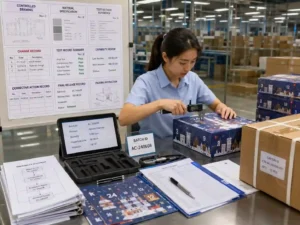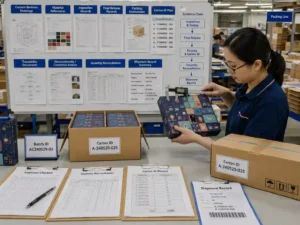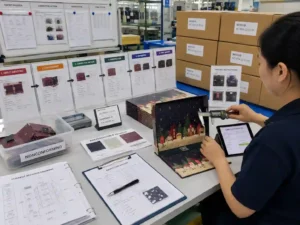
Quick answer: Chocolate advent calendar boxes should be designed around three connected decisions: the box structure, the insert system, and the export packing method. For B2B buyers, the best result usually comes from confirming chocolate dimensions first, testing insert fit with real wrapped products, approving a pre-production sample, and defining carton and pallet requirements before mass production. A rigid door-opening box may improve shelf impact, while a folding carton or drawer box may reduce shipping volume. Export packing matters because weak cartons, poor palletizing, unclear shipping marks, and loose inner packing can damage finished seasonal packaging before it reaches the retailer.
This guide is written for overseas brands, wholesalers, retail buyers, Amazon and e-commerce sellers, gift companies, packaging distributors, and purchasing teams comparing chocolate advent calendar boxes for seasonal campaigns. It focuses on structure, inserts, printing, QC, and export packing decisions that affect cost, lead time, supplier comparison, and damage reduction.
Giftpackpro works as a custom advent calendar boxes manufacturer for B2B buyers who need practical structure advice, sampling support, bulk production control, and export-ready packing. Buyers can also review advent calendar box buying guides when preparing early-stage project requirements.
What should buyers confirm before choosing chocolate advent calendar boxes?
Buyers should confirm the chocolate size, wrapped product weight, number of calendar doors or compartments, retail display method, shipping route, and final packing style before choosing a structure. These details affect the dieline, insert tolerance, paperboard strength, printing layout, carton size, and pallet loading efficiency.
Chocolate packaging is not only a visual retail box. It is also a product separation system, a printed promotional surface, and a shipping unit that must survive handling before the sales season. If the buyer only compares unit price without checking fit, carton strength, and assembly method, the final cost can increase through repacking, damage claims, delayed delivery, or last-minute redesign.
Before requesting a quotation, prepare the chocolate dimensions with wrapping included, not only the bare chocolate size. Wrapped pralines, mini bars, truffles, and molded chocolates often have small size variations. A few millimeters can affect whether the door closes cleanly, whether the insert holds each piece, and whether the calendar remains flat after packing.
Buyer tip: For chocolate advent calendars, send the supplier real product samples or accurate dummy samples during development. A dieline based only on estimated product size can create loose inserts, tight doors, crushed chocolate corners, or visible bulging after assembly.
Which box structure is best for chocolate advent calendar boxes?
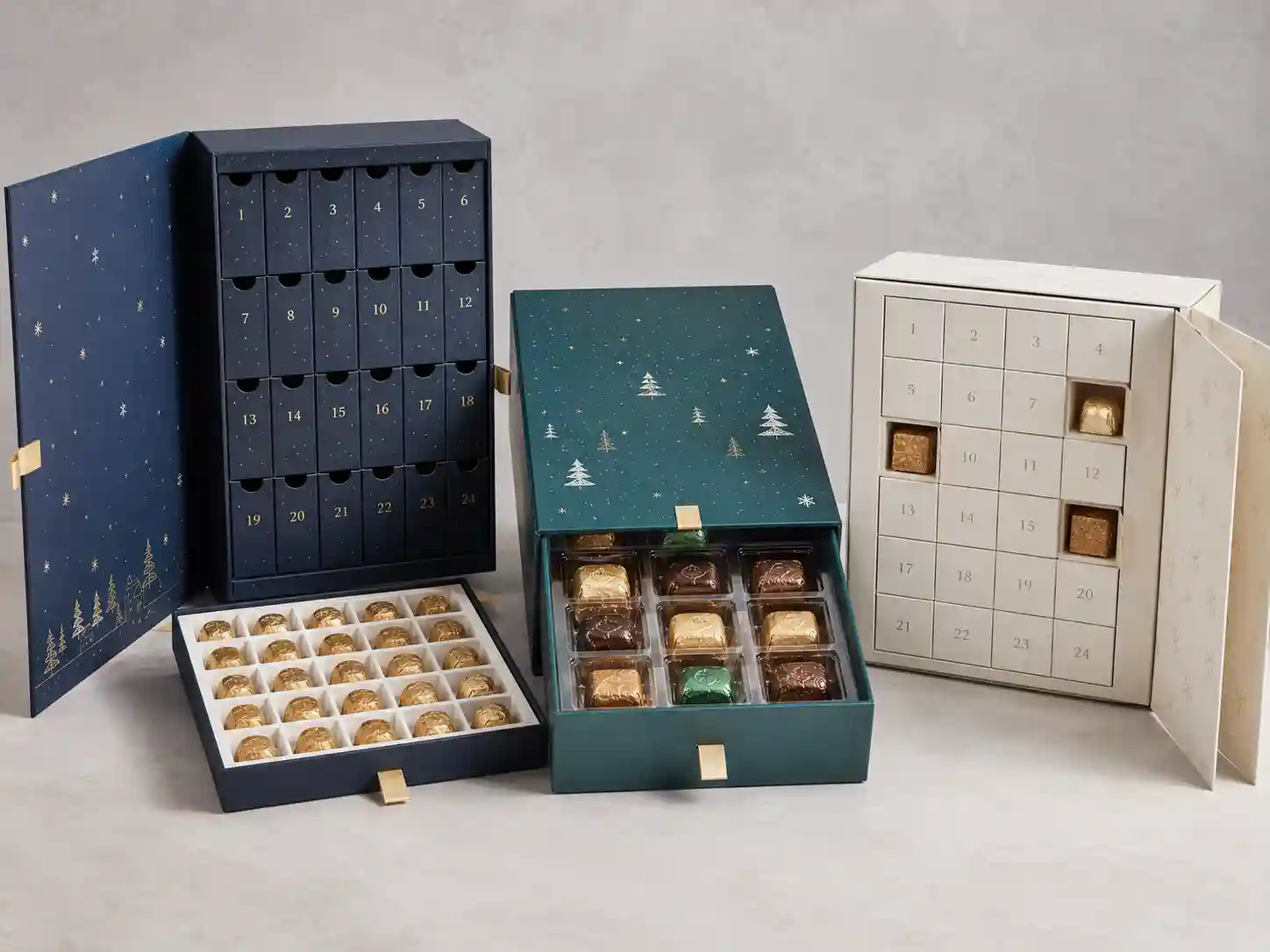
The best structure depends on the buyer’s retail position, budget, assembly method, and shipping plan. Rigid boxes usually give stronger premium presentation, folding cartons support larger volume and lower freight cost, drawer boxes create a reusable gift format, and door-opening boxes are common for numbered seasonal campaigns.
For chocolate advent calendar boxes, structure must be reviewed together with insert type and export packing. A premium rigid box may look impressive, but it usually occupies more carton space if shipped fully assembled. A folding carton can be efficient for flat packing, but it needs accurate creasing, locking, and insert support to avoid deformation. A drawer box creates a strong gift experience but may require extra tolerance control so the drawer slides smoothly after printing, lamination, and assembly.
| Structure option | Best use case | Main advantages | Buyer checks before approval |
|---|---|---|---|
| Rigid door-opening box | Premium chocolate calendar gifts, retail promotions, brand gift sets | Strong shelf impact, good perceived value, suitable for foil stamping and embossing | Door tearing strength, greyboard thickness, insert alignment, carton protection if shipped assembled |
| Folding carton calendar | Higher-volume retail programs and cost-sensitive campaigns | Lower material weight, can reduce freight volume when flat packed, efficient for mass production | Creasing quality, locking structure, paperboard stiffness, assembly labor, door perforation test |
| Drawer box | Gift sets, mixed chocolates, reusable presentation packaging | Smooth unboxing, strong product separation, premium feel | Drawer sliding tolerance, insert height, sleeve strength, carton orientation during shipping |
| Book-style magnetic box | Luxury chocolate gift sets and VIP seasonal campaigns | Premium opening experience, strong branding surface, suitable for rigid construction | Magnet placement, food odor awareness, board warping risk, export carton compression |
| Window or display style | Retail shelves where product visibility is useful | Shows product concept quickly, useful for gift display | Window film material, scuff protection, product privacy, labeling space, carton abrasion risk |
Quotable B2B statement: A chocolate advent calendar structure should be approved only after the buyer has checked product fit, opening performance, insert holding strength, and export carton protection, not just the printed appearance.
How should inserts be selected for product separation and damage reduction?
Inserts should keep every chocolate separated, stable, and easy to remove without crushing the product or damaging the calendar door. The insert choice affects food-contact discussion, odor awareness, assembly speed, carton compression resistance, and the final quotation.
Common insert options include paper insert, PET tray, EVA insert, foam, and molded pulp. Each option has a different balance of appearance, tolerance, cost, sustainability positioning, and protection. Buyers should avoid selecting inserts only by appearance because chocolate products can shift, mark the printed surface, absorb odor, or become difficult to remove if the cavity is too tight.
When is a paper insert suitable?
A paper insert is suitable when the chocolate is individually wrapped and the buyer wants a paper-based packaging system with moderate support. It is often used for lightweight mini bars, small wrapped chocolates, and simple compartment layouts.
Paper inserts can be die-cut, folded, and locked into the box. They are helpful for flat packing when the buyer wants to reduce shipping volume, but they require assembly control. If the insert is too thin, it may collapse during handling. If the locking points are weak, chocolates can move during carton vibration.
When is a PET tray suitable?
A PET tray is suitable when precise cavity shape, product visibility, and stronger product holding are required. It is commonly used for wrapped pralines, shaped chocolates, or mixed chocolate sizes that need more accurate separation.
For B2B buyers, PET trays should be checked for cavity depth, edge smoothness, product removal, and odor. If the chocolate is unwrapped or the tray may directly touch food, buyers should discuss food-contact material requirements with their own compliance team and request supplier documentation for verification. For general U.S. reference, buyers can review the FDA food-contact materials guidance at FDA Food Contact Substances.
When are EVA, foam, or molded pulp inserts used?
EVA and foam inserts are generally used when cushioning and premium presentation are more important than paper-only construction. Molded pulp can be considered when buyers want a formed insert with a paper-based sustainability message, but mold cost, texture, color variation, and fit tolerance should be checked early.
For chocolate gift packaging, buyers should be careful with insert odor, dust, moisture sensitivity, and direct contact. Many chocolate advent calendar projects use individually wrapped chocolate to separate food from decorative packaging materials. If a buyer has direct food-contact needs, that requirement should be stated before quotation, not after sampling.
Factory tip: Insert fit should be tested with the final wrapped chocolate, not with empty cavities or approximate samples. A good insert holds the product during transport but still allows consumers or store staff to remove each item without tearing the door or lifting the whole tray.
What printing and finishing choices affect seasonal chocolate packaging?
Printing and finishing should match the retail position while leaving enough space for labels, barcodes, warnings, recycling marks, and shipping-related stickers. CMYK, Pantone, foil stamping, embossing, spot UV, matte lamination, and gloss lamination all affect cost, lead time, and pre-production approval.
For chocolate advent calendar boxes, artwork usually includes numbered doors, product names, seasonal graphics, nutrition or ingredient label space, and retail barcode placement. Buyers should avoid placing critical text across creases, perforations, tear lines, magnetic closures, drawer edges, or glue areas. Small copy near door cuts can shift during production because die-cutting has normal tolerance.
CMYK printing is suitable for full-color artwork. Pantone colors are useful when brand color consistency matters. Foil stamping can highlight numbers, titles, or decorative elements, but foil areas should be tested near door cuts because cracking or misalignment can become visible. Embossing and debossing can create premium texture, but they may change board flatness if overused. Spot UV can add contrast, while matte lamination and gloss lamination protect the printed surface and change the visual feel.
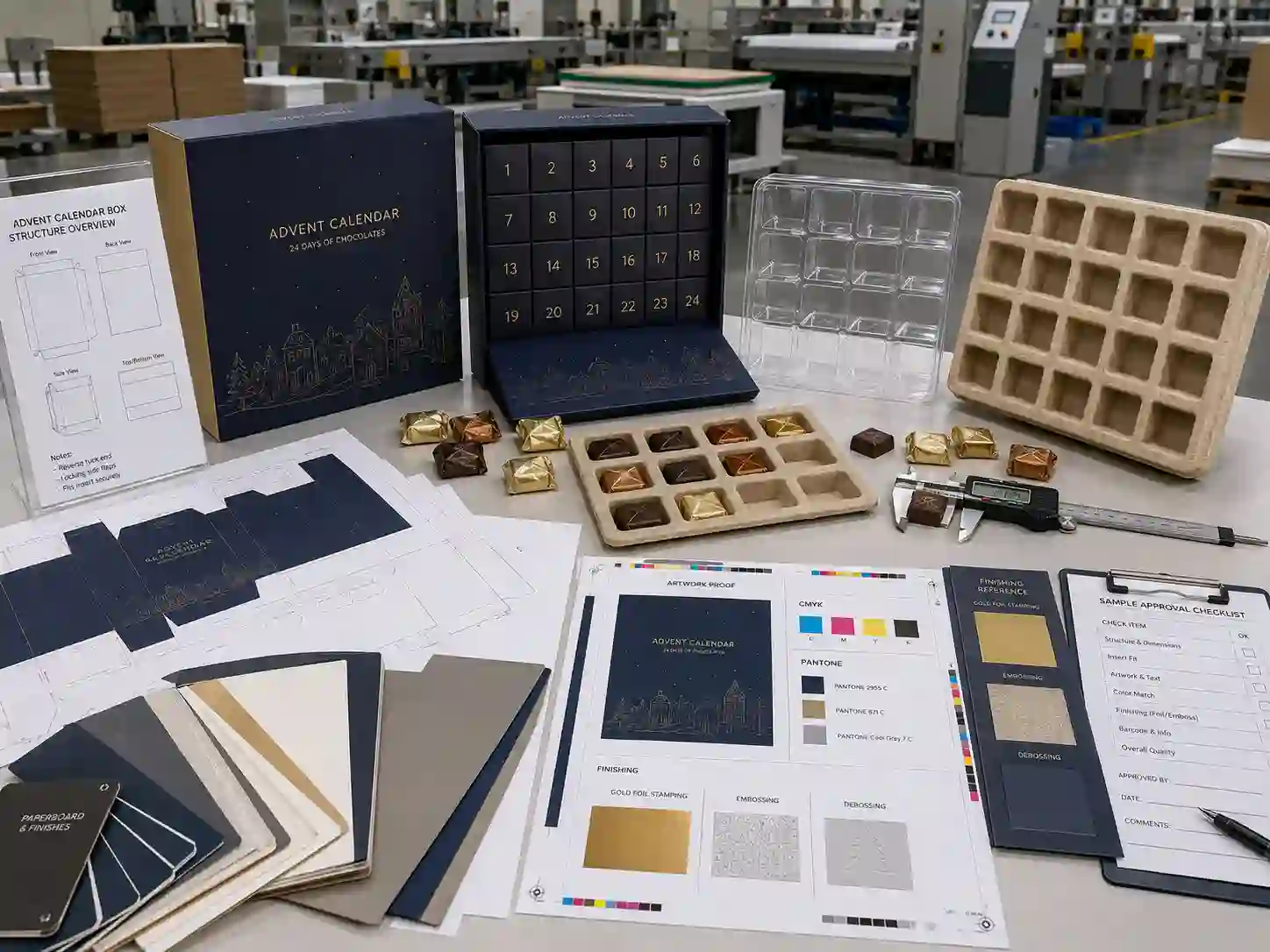
QC tip: A printing proof should be checked under normal lighting and production lighting. Buyers should approve color, text size, barcode readability, door numbering sequence, dieline alignment, and finishing position before mass production starts.
How do sampling and pre-production checks reduce risk?
Sampling reduces risk by testing the structure, insert, artwork, finishing, and packing method before mass production. For B2B chocolate advent calendar projects, buyers should use blank samples for structure, printed samples for visual review, and a pre-production sample for final approval before bulk production.
A blank sample helps confirm size, opening style, insert fit, product separation, assembly sequence, and carton concept. A printed sample helps review CMYK or Pantone color, foil stamping, embossing, spot UV, lamination, barcode area, and door numbering. The pre-production sample should represent the final material, final dieline, final insert, final artwork, final finishing, and final packing method as closely as possible.
If a buyer changes the chocolate size after sample approval, the supplier may need to update the dieline, insert tooling, carton size, and quotation. If artwork changes after the printing proof, mass production can be delayed. A clear sample approval record protects both the buyer and factory because it defines what should be inspected during QC.
Practical sample approval checklist
- Confirm outer box size, number of doors, opening direction, and display orientation.
- Check each chocolate cavity with the final wrapped product or accurate dummy product.
- Review paperboard, greyboard, paper insert, PET tray, EVA insert, foam, or molded pulp sample quality.
- Check door perforation, drawer sliding, magnetic closure, glue position, and assembly tolerance.
- Approve CMYK or Pantone color, foil stamping, embossing, spot UV, matte lamination, or gloss lamination.
- Confirm barcode area, label space, nutrition panel space, recycling marks, and any retailer-required information.
- Review odor, dust, scuffing, moisture sensitivity, and carton packing method.
- Sign off the pre-production sample before mass production.
Quotable B2B statement: A pre-production sample is the buyer’s control standard for mass production; it should include the final structure, insert, material, printing, finishing, and packing method whenever possible.
How do MOQ, cost, and lead time change by structure and packing method?
MOQ, cost, and lead time change based on structure complexity, insert tooling, printing process, finishing, assembly labor, carton volume, and export packing method. A cheaper box unit price can become more expensive after freight, pallet space, repacking, and damage risk are included.
Rigid boxes usually require more board, more hand assembly, and more carton volume. Folding cartons can be more efficient for mass production and flat packing, but they need accurate creasing and assembly instructions. PET trays may require tooling and material planning. Molded pulp inserts may require mold development. Foil stamping, embossing, spot UV, and special lamination add setup steps and may extend sample and production schedules.
Buyers should ask suppliers to separate the quotation into tooling, sample fee, unit price, insert cost, finishing cost, packing cost, carton details, and estimated carton volume. This makes supplier comparison more accurate. A quotation that only lists one unit price may hide important cost drivers.
Should chocolate advent calendar boxes be flat packed or assembled packed?
Flat packing saves freight volume and can reduce storage pressure, while assembled packing reduces buyer-side labor and helps confirm final appearance before shipment. The right choice depends on labor cost, packing line capability, retail deadline, box structure, and damage tolerance.
Flat packing is common for folding carton designs and some paper insert structures. It can reduce carton volume, but the buyer must have clear assembly instructions and enough labor at destination. Assembled packing is common for rigid boxes, drawer boxes, and premium gift sets. It protects the finished shape but increases export carton size and may require stronger corner protection and pallet planning.
| Packing method | Best for | Advantages | Risks to control |
|---|---|---|---|
| Flat packed | Folding carton calendars, paper inserts, high-volume shipments | Lower shipping volume, easier warehouse storage, often better freight efficiency | Assembly errors, missing parts, insert deformation, buyer-side labor cost |
| Semi-assembled | Projects needing lower freight volume with some factory assembly | Balances factory control and shipping efficiency | Clear instructions needed, parts must be packed in order, carton labeling must be precise |
| Fully assembled | Rigid boxes, drawer boxes, premium retail-ready programs | Factory checks final appearance, faster buyer-side use, lower assembly burden | Higher carton volume, greater compression risk, more pallet space required |
Decision guide: Choose flat packing when freight efficiency and buyer-side assembly capacity are priorities. Choose assembled packing when presentation consistency, tight retail timing, and factory-controlled finishing are more important. Choose semi-assembled packing when the buyer wants to reduce volume but still avoid complex assembly at destination.
What export carton and pallet details reduce shipping damage?
Export cartons should protect the finished calendars from compression, abrasion, moisture exposure, and handling impact. Palletizing should keep cartons stable, labeled, and suitable for warehouse movement without crushing the bottom layers.
For chocolate advent calendar boxes, export packing should be defined before mass production because carton size affects how boxes are packed, how many units fit per carton, how pallets are loaded, and how shipping marks are printed. A master carton should not be too heavy for normal handling. Inner protection may include polybagging, tissue, paper wrapping, dividers, corner protectors, or additional pads depending on the box finish.
Matte lamination can show scuffs more easily than some gloss surfaces, while foil stamping and spot UV areas may need surface protection to avoid rubbing during long-distance shipment. Rigid boxes and drawer boxes may need carton orientation control. Folding carton calendars may need pressure control so panels do not bend.
Palletizing should consider carton stacking strength, container loading, route length, warehouse handling, and buyer requirements. Stretch wrap, corner boards, pallet labels, and clear shipping marks help reduce confusion and damage. For projects with strict distribution testing needs, buyers can review official packaging test resources from ISTA and discuss whether a specific test protocol is required by their retailer or logistics provider.
What should be included in shipping marks?
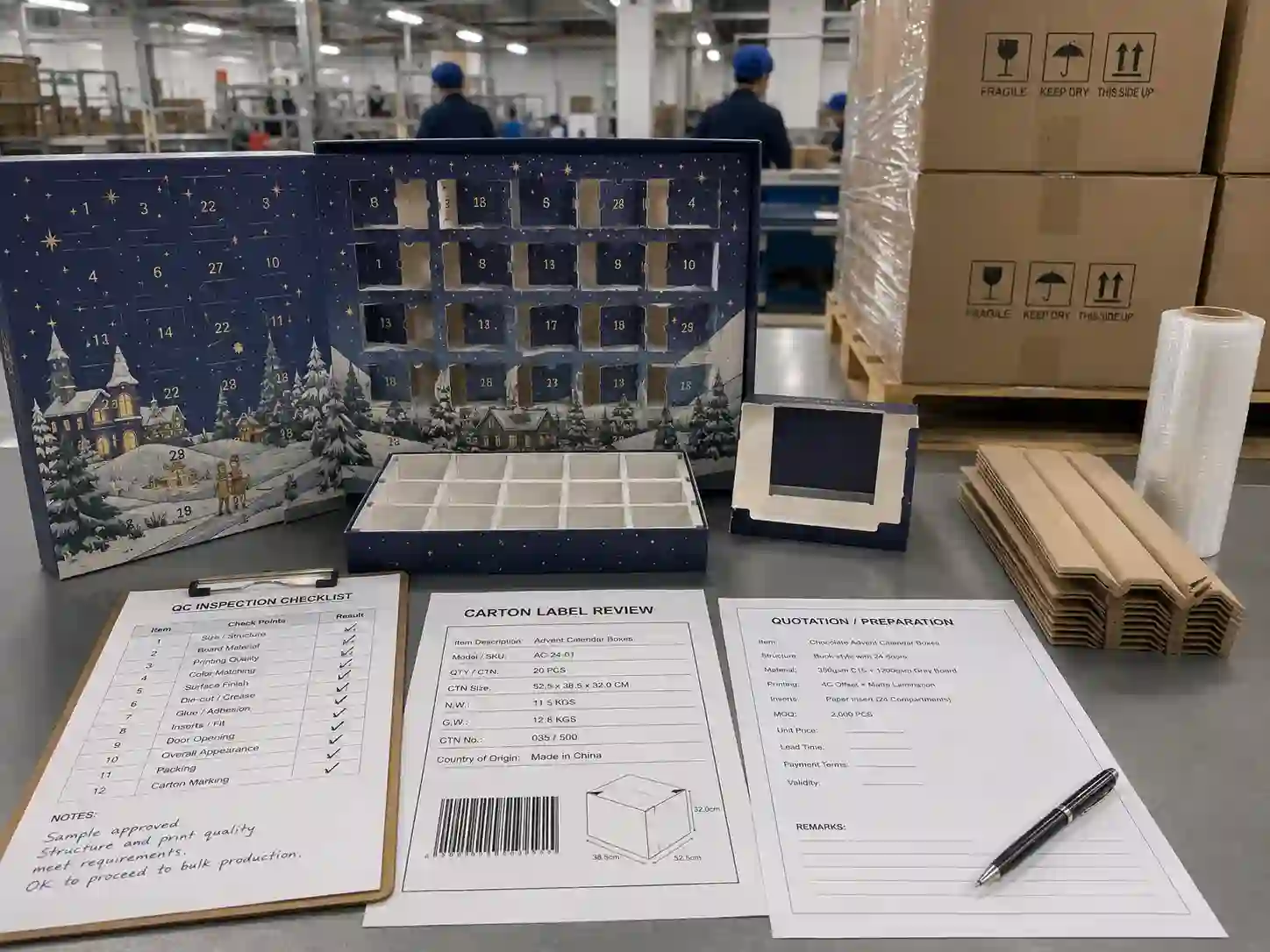
Shipping marks should identify the project clearly without exposing unnecessary commercial details. They usually include item name or code, PO number, carton number, quantity, gross weight, net weight, carton size, destination, handling symbols, and country of origin where required by the buyer’s logistics process.
For e-commerce and retail buyers, carton labels may also need SKU, barcode, FBA or warehouse routing information, mixed-carton notes, or pallet number. These requirements should be shared before carton printing. If they are added after packing, relabeling can delay shipment.
How should buyers inspect chocolate advent calendar boxes before shipment?
Buyers should inspect appearance, dimensions, insert fit, door function, print quality, finishing, assembly strength, carton packing, and shipping marks before shipment. Final QC should compare production goods against the approved pre-production sample and agreed inspection checklist.
For structure, check box size, flatness, door opening, drawer sliding, magnet placement, glue strength, board warping, and corner quality. For inserts, check cavity size, product holding, product separation, odor, dust, and installation position. For printing, check color consistency, registration, text clarity, barcode space, numbering sequence, foil stamping, embossing, spot UV, and lamination quality.
For export packing, check the master carton strength, units per carton, inner protection, carton label, shipping marks, pallet wrap, corner protectors, and carton stacking. Buyers should also confirm whether samples from mass production are retained for reference in case of later claims.
QC tip: A final inspection should open actual export cartons, not only review loose samples on a table. Many shipping problems are caused by carton packing pressure, rubbing, wrong orientation, missing labels, or weak master cartons.
How should buyers compare suppliers for custom chocolate advent calendar projects?
Buyers should compare suppliers by their ability to control structure engineering, insert testing, printing proofing, sampling, QC, export packing, and communication, not only by unit price. A reliable supplier should ask practical questions before quoting and should explain trade-offs clearly.
A strong supplier will request product dimensions, target structure, quantity, artwork status, finishing requirements, delivery deadline, packing method, shipping destination, and compliance expectations. If a supplier quotes without asking these details, the buyer may later face price changes or technical limitations.
When comparing suppliers, ask for photos or videos of similar box structures, not competing brand details. Request material options, sample timeline, mass production timeline, MOQ range, carton packing proposal, and inspection process. Buyers can review Giftpackpro’s custom advent calendar box services to understand common development steps from structure planning to production support, and explore custom advent calendar box products for structure references.
What information should be prepared before requesting a quotation?
Buyers should prepare product size, box style, quantity, artwork requirements, insert preference, material preference, finishing, packing method, destination, deadline, and inspection needs before requesting a quotation. Clear RFQ details help the factory calculate a realistic price and avoid assumptions.
A complete RFQ for chocolate advent calendar boxes should include:
- Calendar format: 12-day, 24-day, 25-day, or custom compartment count.
- Chocolate type: mini bar, wrapped praline, truffle, molded piece, mixed sizes, or gift set combination.
- Product dimensions and weight with final wrapping included.
- Preferred structure: rigid box, folding carton, drawer box, door-opening box, book-style box, or custom structure.
- Insert option: paper insert, PET tray, EVA insert, foam, molded pulp, or supplier recommendation.
- Material preference: paperboard, greyboard thickness target, specialty paper, or sustainability requirement to verify.
- Artwork status: dieline needed, artwork ready, CMYK or Pantone color, label space, barcode area, and door numbering.
- Finishing: foil stamping, embossing, debossing, spot UV, matte lamination, gloss lamination, or no special finishing.
- Sample needs: blank prototype, printed sample, pre-production sample, or production sample retention.
- Quantity and expected reorder plan, because MOQ and tooling decisions may change by volume.
- Packing requirement: flat packed, semi-assembled, fully assembled, units per export carton, pallet required or not.
- Shipping details: destination country, warehouse requirements, carton labels, shipping marks, and deadline.
Buyers who are ready to discuss a project can contact the Giftpackpro packaging factory team and request a custom quote with the above details. For early-stage projects, it is acceptable to ask the factory to recommend a structure based on product size, budget, retail channel, and shipping plan.
What common mistakes should buyers avoid?
The most common mistakes are choosing a structure before confirming product size, approving artwork before checking the dieline, ignoring insert tolerance, underestimating export carton strength, and comparing quotations without packing details. These mistakes can create cost increases and shipment delays.
- Using bare chocolate dimensions: Always measure the final wrapped product because wrapping changes fit.
- Placing artwork across functional cuts: Avoid important text or foil details across door perforations, creases, glue areas, or drawer edges.
- Ignoring odor and moisture awareness: Review material smell, storage condition, and product separation, especially for food gift packaging.
- Skipping the pre-production sample: The final sample is the control standard for QC and mass production.
- Choosing the lowest unit price only: Include tooling, insert, assembly, carton, pallet, freight volume, and damage risk in the comparison.
- Adding shipping marks too late: Confirm carton labels, SKU marks, PO numbers, and warehouse routing before carton printing.
- Not testing assembled packing: Check how finished boxes sit inside export cartons during compression and vibration.
FAQ: What do buyers ask about chocolate advent calendar boxes?
Can chocolate advent calendar boxes be made with food-contact materials?
They can be designed with food-contact requirements in mind, but buyers should state the requirement clearly before quotation and verify documentation for the target market. Many projects use individually wrapped chocolates so the decorative paper box and insert are not the direct food-contact layer.
What is the best insert for wrapped chocolates?
Paper inserts are suitable for many lightweight wrapped chocolates, while PET trays offer more precise cavities for shaped or mixed-size products. EVA, foam, and molded pulp may be used for special gift formats, but odor, dust, fit, and contact requirements should be reviewed.
Is a rigid box better than a folding carton?
A rigid box is usually better for premium presentation, while a folding carton is often better for freight efficiency and larger volume programs. The best choice depends on retail position, MOQ, budget, assembly plan, and export packing method.
How early should buyers start sampling?
Buyers should start sampling early enough to allow structure changes, insert revisions, artwork proofing, and pre-production approval before mass production. Seasonal chocolate packaging has a fixed retail window, so late changes can create shipping pressure.
What affects the quotation most?
The main cost drivers are box structure, size, material thickness, insert type, printing colors, finishing, tooling, assembly labor, order quantity, export carton packing, and pallet requirements. A clear RFQ helps the supplier quote accurately.
Can the boxes be shipped flat packed?
Some folding carton and paper insert designs can be shipped flat packed. Rigid boxes, drawer boxes, and premium assembled calendars are often shipped fully or semi-assembled. The factory should confirm the packing method during sampling.
What should be checked during final QC?
Final QC should check dimensions, door opening, insert fit, print quality, finishing, glue strength, product separation, carton packing, shipping marks, and pallet condition. The inspection should compare goods against the approved sample.
How can buyers start a chocolate advent calendar box project with Giftpackpro?
To start a project for chocolate advent calendar boxes, prepare the product dimensions, target structure, insert preference, artwork status, quantity, finishing requirements, packing method, destination, and delivery deadline. Giftpackpro can then help review structure feasibility, sample planning, production details, QC points, and export packing options.
For buyers still comparing options, review more advent calendar box buying guides or explore custom advent calendar box services. When your product size, quantity, and timeline are ready, request a custom quote so the quotation can include structure, insert, printing, sample, mass production, export carton, pallet, and shipping mark details.