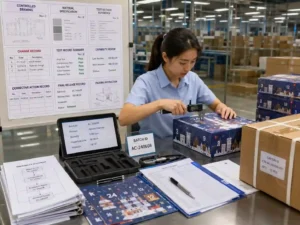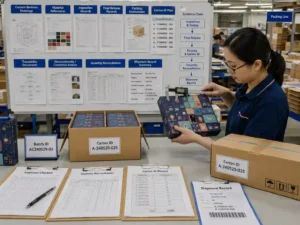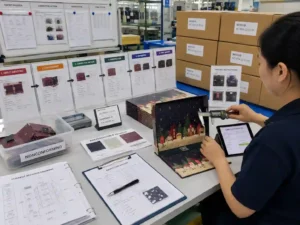
Quick answer: Candy advent calendar boxes are custom paper packaging systems designed to separate small candies, support seasonal retail display, protect contents during export, and present branded artwork across multiple numbered doors, drawers, or compartments. For B2B buyers, the right solution depends on candy size, wrapping type, box structure, insert material, printing method, MOQ, sample approval, QC standard, and carton packing method. When sourcing from China, compare factories by dieline accuracy, insert testing, communication speed, quotation detail, production lead time, payment terms, inspection process, and export-packing reliability—not only by unit price.
For brands, wholesalers, gift companies, retail buyers, packaging distributors, and e-commerce sellers, candy advent calendar packaging is not simply a printed gift box. It is a multi-part packaging project that combines product layout, paper engineering, artwork control, hand assembly, food/gift packaging awareness, and international shipping protection. A low quotation can become expensive if compartments are too loose, doors tear during opening, candy odors transfer into paper, labels have no usable space, or cartons arrive crushed after sea freight.
This guide explains how to compare custom candy advent calendar boxes from a China sourcing perspective, including structure, inserts, artwork, sampling, MOQ, quality control, export packing, and RFQ preparation. Buyers can also review related advent calendar box buying guides or contact Giftpackpro as a custom advent calendar boxes manufacturer for project-specific structure advice.
What should buyers understand before sourcing candy advent calendar boxes from China?
Buyers should understand that candy advent calendar boxes require early coordination between candy dimensions, insert fit, artwork layout, retail labeling, sample approval, and export packing. A reliable supplier should help convert the buyer’s product list into a working dieline, not only print a box after artwork is supplied.
Before comparing China factories, prepare the candy assortment, approximate product weight, wrapped candy dimensions, target quantity, destination market, retail channel, and preferred structure. Candy packaging often involves many small items, so minor dimensional mistakes can multiply across 12, 24, 25, or 31 compartments. If one cavity is wrong, the whole calendar may fail assembly.
Buyer tip: Send the factory physical candy samples or accurate wrapped-size measurements before confirming the insert. A candy measured before wrapping may not match the final packed size, especially if twist wrap, flow wrap, pouch wrap, or mini carton packaging adds width or height.
Food and gift packaging also requires odor and moisture awareness. Paperboard, greyboard, glue, lamination, ink, insert material, and carton storage conditions can affect the buyer’s quality perception. Packaging suppliers should not make unsupported food-contact compliance claims, but they should discuss material options, separation design, inner wrapping assumptions, and documents the buyer may need to verify for the target market. For official guidance on food-contact packaging expectations in the United States, buyers can review the FDA food-contact substances guidance.
Which candy advent calendar box structure fits your product and retail channel?
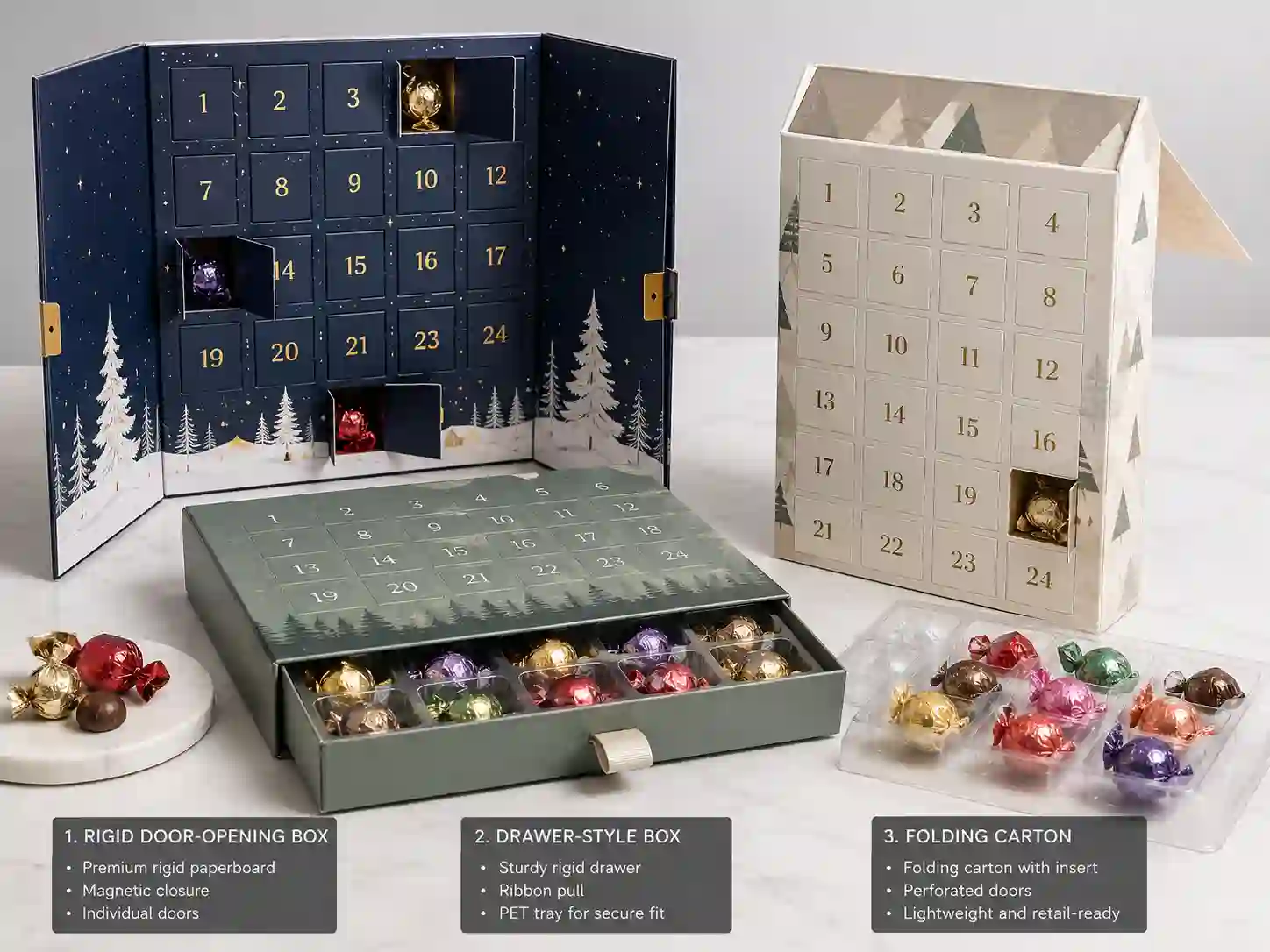
The best structure depends on candy weight, retail price point, shelf display needs, assembly budget, and shipping method. Rigid boxes usually look more premium, folding cartons can reduce cost and freight volume, drawer boxes improve the unboxing experience, and door-opening boxes are common for classic candy calendar layouts.
| Structure option | Best for | Key advantage | Buyer risk to check |
|---|---|---|---|
| Door-opening box | Traditional candy countdown calendars with numbered doors | Strong seasonal display and easy daily access | Door perforation, tear strength, and insert alignment must be tested |
| Rigid box with compartments | Premium candy gifts, retail gifting, wholesale brand programs | Better structure strength and higher perceived value | Higher unit cost, larger carton volume, and more hand assembly |
| Drawer box | Luxury candy assortments, reusable gift sets, mixed product sizes | Good presentation and flexible compartment planning | Drawer friction, pull-tab strength, and transit movement need checking |
| Folding carton calendar | Cost-sensitive campaigns, e-commerce bundles, lighter candies | Can be shipped flatter and assembled efficiently | May need reinforcement if the candy weight is high |
| Book-style magnetic box | Premium seasonal candy gifts and influencer seeding kits | Strong visual impact and good inner layout control | Magnet placement, board thickness, and export carton protection affect cost |
For lightweight wrapped candy, paperboard folding carton structures may be practical if the buyer wants lower MOQ and easier freight planning. For heavier assortments, a greyboard rigid box may reduce bending and improve shelf presence. For mixed candies, a drawer box or multi-layer structure may be more flexible than a single flat tray.
Quotable B2B statement: The box structure should be chosen after the candy layout is confirmed, because compartment count, candy height, and insert depth usually control the final box thickness more than the artwork concept does.
Which insert material should buyers choose for candy separation?
The insert should hold each candy in position, reduce product mixing, support door alignment, and match the buyer’s sustainability, cost, and presentation goals. Common options include paper insert, PET tray, EVA insert, foam, and molded pulp.
A paper insert is often suitable for individually wrapped candies because it is printable, recyclable in many local systems depending on coatings and contamination, and visually consistent with paper gift packaging. A PET tray can provide clearer cavity definition for irregular shapes, but buyers should check thickness, transparency, recycled-content requirements, and local packaging rules. EVA and foam can offer cushioning, but they may not fit every food-adjacent project or sustainability objective. Molded pulp may support a more natural look, but tooling, surface texture, and cavity precision should be reviewed carefully.
| Insert type | Use case | Strength | Questions for the supplier |
|---|---|---|---|
| Paper insert | Wrapped hard candy, gummies, mini sweets, chocolate-style pieces | Good paper-based appearance and flexible layout | Can it hold the candy after shaking and carton drop handling? |
| PET tray | More precise cavities or mixed candy shapes | Clean cavity definition and product visibility if required | What thickness, color, and material documentation can be provided? |
| Molded pulp | Eco-positioned gift packaging and natural-texture projects | Protective and paper-based feel | Does the cavity tolerance match small candy sizes? |
| EVA or foam | Special gift sets or fragile mixed items | Good cushioning and neat presentation | Is it appropriate for the buyer’s candy wrapping and target market? |
Factory tip: For candy advent calendar boxes, insert testing should include shake testing, door-opening testing, upside-down handling, and assembly-line loading checks. A beautiful prototype is not enough if operators cannot load the candy quickly during bulk packing.
How do printing and finishing choices affect candy calendar cost and quality?
Printing and finishing choices affect unit cost, sample lead time, color consistency, scuff resistance, retail appearance, and production risk. CMYK printing is common for full-color artwork, Pantone colors help control brand tones, and finishes such as matte lamination, gloss lamination, foil stamping, embossing, and spot UV should be used where they support the retail positioning.
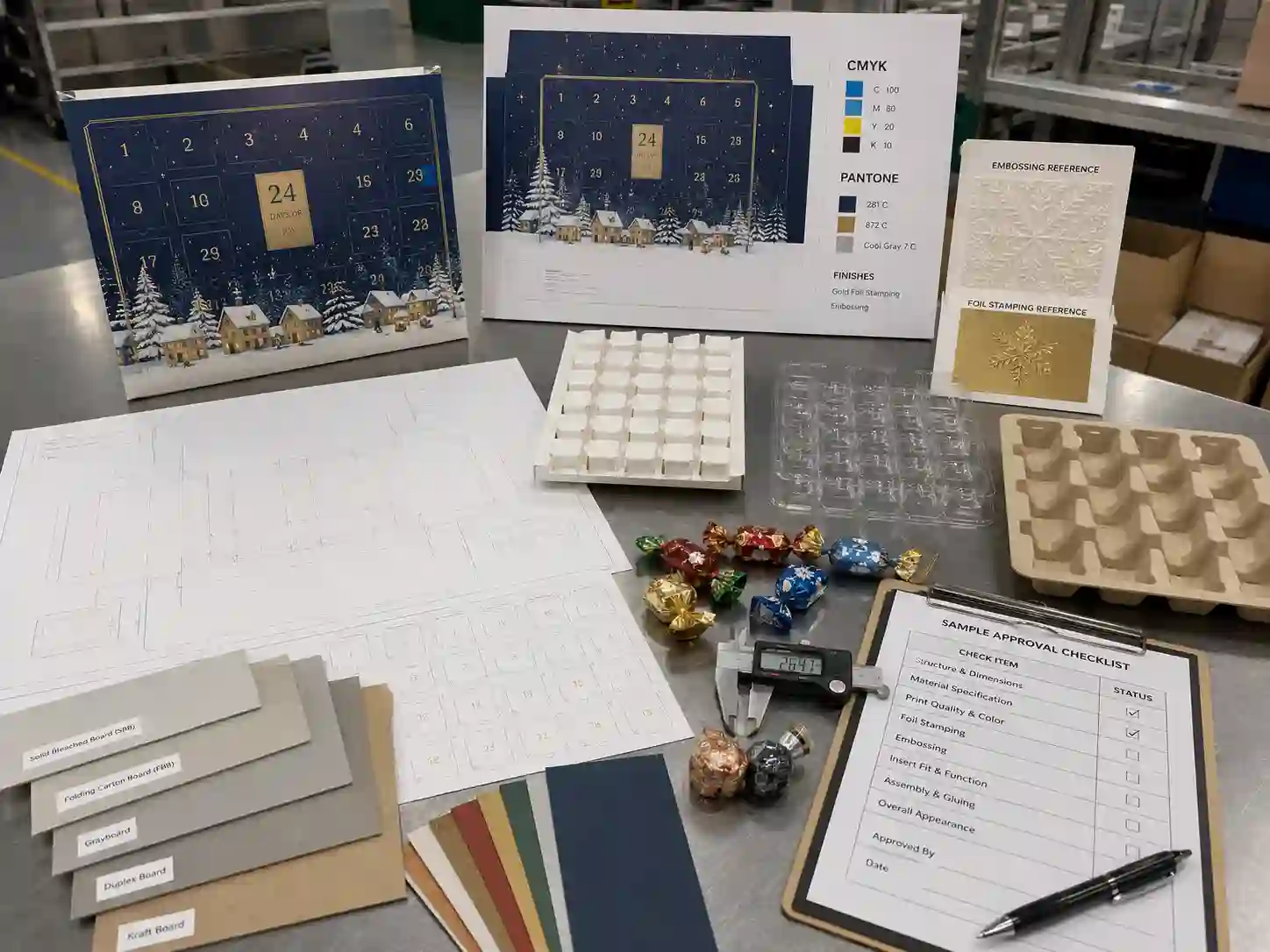
For candy calendars, the artwork usually includes numbered doors, seasonal graphics, product claims, ingredients or label panels, barcode areas, recycling symbols, warning text where applicable, and shipping or retailer information. The factory should check whether the buyer’s artwork matches the dieline, whether door numbers are correctly positioned, and whether important text is outside glue areas, fold lines, thumb holes, perforations, or cutting edges.
Matte lamination gives a softer premium look but can show scratches on dark artwork if not handled carefully. Gloss lamination creates a brighter surface and may resist some scuffing, but it can look less premium for certain gift campaigns. Foil stamping and embossing create strong shelf impact but require tooling and accurate registration. Spot UV can highlight logos, candy illustrations, or door numbers, but alignment should be checked on printed samples.
QC tip: Always review a printed sample or pre-production sample under practical lighting, not only on a screen. CMYK artwork, Pantone matching, lamination, foil, embossing depth, and spot UV registration can look different after real paper, ink, and finishing are applied.
How should importers compare China factories and quotations?
Importers should compare factories by quotation transparency, engineering support, sample accuracy, communication quality, lead time control, payment terms, QC process, and export-packing experience. The cheapest unit price is not the best value if the quote excludes insert tooling, sample revisions, carton protection, finishing cost, or realistic shipping volume.
When evaluating suppliers, ask whether the factory has experience with custom advent calendar boxes, not only general paper boxes. Multi-compartment seasonal packaging requires stronger coordination between design, printing, die cutting, gluing, assembly, insert fitting, inspection, and packing. Buyers can review custom advent calendar box products to understand structure possibilities before finalizing an RFQ.
| Comparison point | What strong suppliers provide | Warning sign |
|---|---|---|
| Quotation detail | Material, size, structure, insert, printing, finishing, MOQ, packing, sample fee, tooling, and lead time | One-line price without specifications |
| Dieline support | Box and insert dieline based on product dimensions and artwork requirements | Supplier asks only for artwork before checking candy size |
| Sampling process | Blank sample, printed sample, or pre-production sample depending on project stage | No clear revision process or approval record |
| Communication | Confirms details in writing and raises risks early | Answers “yes” to every request without technical feedback |
| QC and packing | Inspection checklist, carton protection, shipping marks, and packing method confirmation | Only discusses box appearance, not export damage risk |
Buyer tip: Ask each supplier to quote the same specification. If one factory quotes a rigid greyboard box with PET tray and another quotes a folding carton with paper insert, the unit prices are not comparable.
What MOQ and lead time should buyers discuss before placing an order?
MOQ and lead time depend on structure, material availability, printing, finishing, insert tooling, hand assembly, order quantity, and the factory’s seasonal production schedule. Buyers should not assume one universal MOQ or delivery time for all candy advent calendar boxes.
A simple folding carton calendar may support a lower starting quantity than a complex rigid box with multiple drawers, foil stamping, embossing, and custom molded inserts. A PET tray or molded pulp insert may require tooling and additional sample time. Premium finishing may require separate process scheduling. During seasonal peaks, production capacity for custom advent calendar boxes can become tight, so buyers should confirm deadlines before final artwork approval.
A practical lead time discussion should separate these stages:
- Structure consultation and initial dieline planning
- Blank sample or structural prototype
- Artwork adjustment and printing proof
- Printed sample or pre-production sample
- Material purchasing and mass production
- Final inspection, export packing, and booking shipment
Quotable B2B statement: In custom candy advent calendar production, lead time risk usually comes from late artwork, unconfirmed inserts, special finishing, and unclear approval responsibility—not only from printing time.
What sampling process reduces production mistakes?
A controlled sampling process reduces the risk of wrong size, weak doors, poor insert fit, color deviation, and slow assembly during mass production. Buyers should approve structure first, then artwork and finishing, then the final pre-production sample before bulk manufacturing.
For early sourcing, a blank sample can confirm overall dimensions, compartment layout, opening method, and insert fit before spending money on full printing. A printed sample helps evaluate color, lamination, foil stamping, embossing, spot UV, barcode position, door numbering, and label space. A pre-production sample should represent the approved mass production standard and should be kept by both buyer and factory for inspection reference.
Practical sample approval checklist
- Confirm outer box size, calendar thickness, and display orientation.
- Check candy fit in every compartment using final wrapped candy dimensions.
- Open sample doors or drawers repeatedly to test tearing, friction, and user access.
- Review dieline accuracy, fold lines, glue areas, and artwork safe zones.
- Check CMYK and Pantone color expectations under normal lighting.
- Confirm foil stamping, embossing, spot UV, matte lamination, or gloss lamination quality.
- Check label space, barcode area, ingredient panel position, and retailer-required markings.
- Record approved materials, insert type, board thickness, carton packing, and shipping marks.
Buyers should also keep a signed or clearly confirmed sample approval record. The approval record should include photos, version numbers, final dimensions, material descriptions, and any accepted tolerance. This protects both buyer and factory if questions appear during mass production.
How should buyers manage food/gift packaging risks for candy calendars?
Buyers should manage candy calendar packaging as a food-adjacent gift packaging project, especially when candies are individually wrapped but placed inside printed paper structures. Key risks include odor, moisture, product separation, label space, material documentation, storage conditions, and retailer-specific requirements.
Most packaging factories do not control the candy formula, inner candy wrapper, or importing compliance requirements. Therefore, buyers should verify food-contact requirements, ingredient labeling, allergen statements, recycling claims, barcode rules, and destination-market packaging regulations with their own compliance team or qualified advisor. Packaging suppliers can support by providing material descriptions, structure details, and supplier documents when available, but buyers should avoid assuming that a paper box is automatically compliant for direct food contact.
For barcode and retail identification planning, buyers can refer to official GS1 barcode standards. Barcode placement should be included on the artwork before the printed sample, not added after mass production.
Common packaging mistakes to avoid
- Using unwrapped candy directly against printed paper without proper material review.
- Ignoring odor transfer from glue, ink, lamination, foam, or storage cartons.
- Choosing a shallow insert that lets candy move behind numbered doors.
- Designing artwork without label space, barcode space, or retailer information panels.
- Approving digital color only and skipping printed sample review.
- Changing candy size after insert tooling or dieline approval.
- Comparing quotations without matching structure, board thickness, insert, and packing method.
- Forgetting export carton strength, palletization, and shipping marks until the order is finished.
What QC points matter most during mass production?
QC for candy advent calendar boxes should focus on structure accuracy, insert fit, printing consistency, finishing quality, assembly strength, door or drawer function, cleanliness, odor, and export packing. Inspection should compare production goods against the approved pre-production sample and written specifications.
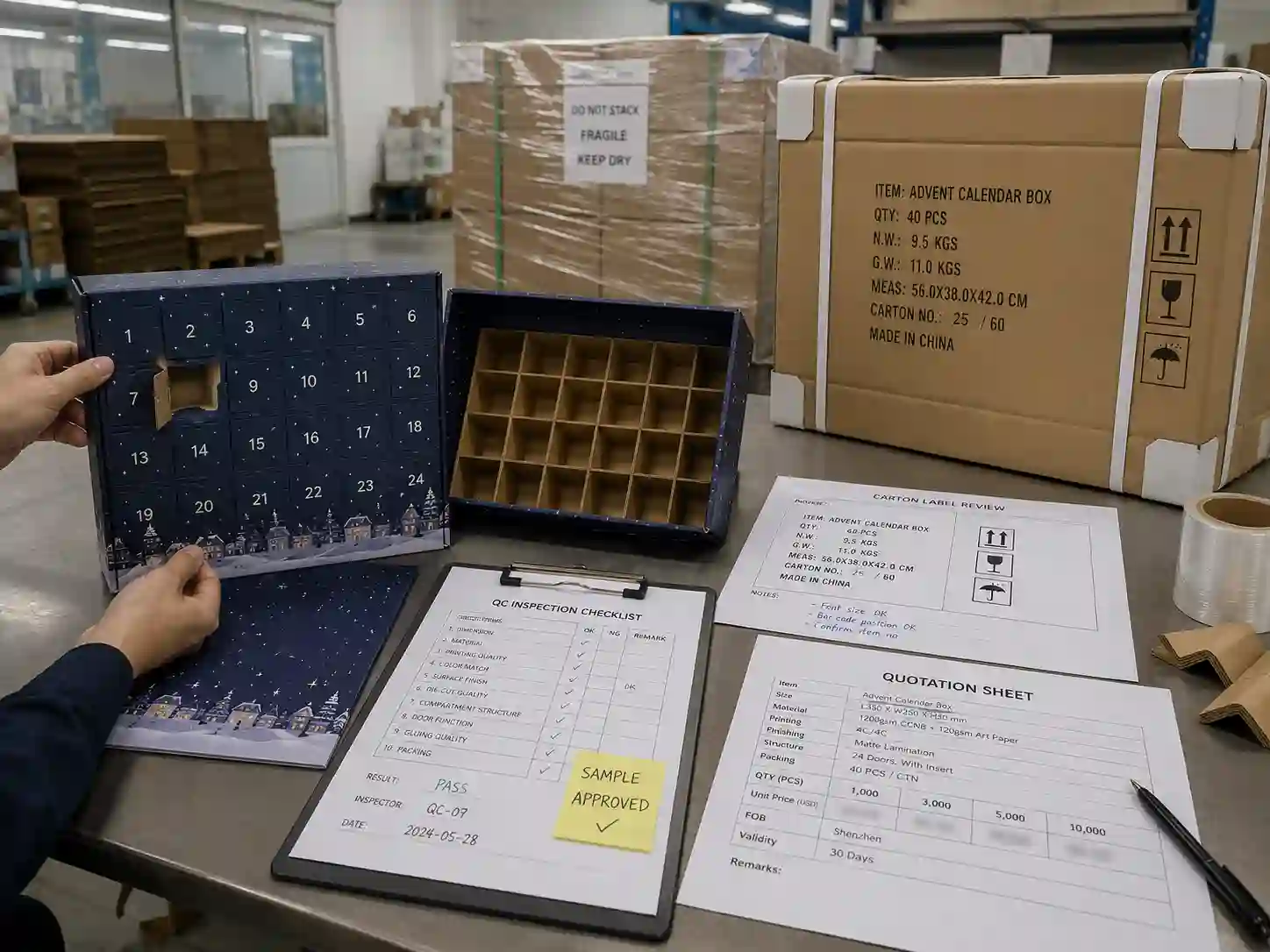
A useful QC checklist includes incoming material inspection, printing proof check, die-cutting accuracy, folding and gluing strength, insert assembly, compartment count, door-number sequence, surface defects, color consistency, lamination bubbles, foil or spot UV registration, carton quantity, and shipping mark accuracy. For rigid boxes, inspectors should also check board warping, corner wrapping, magnet or ribbon placement if used, and lid alignment. For folding cartons, inspectors should check creasing, locking tabs, glue strength, and flat-packing condition.
QC tip: For multi-compartment calendars, inspect both appearance and function. A calendar that looks good on the front can still fail if the insert shifts, doors open into the wrong cavity, or drawers are too tight for repeated use.
Buyers can ask the supplier whether final inspection is based on a written AQL plan, internal factory standard, or buyer-specific checklist. If the buyer requires third-party inspection, the factory should support inspection scheduling, carton access, and sample selection from finished goods.
How should export packing protect candy advent calendar boxes?
Export packing should prevent crushing, corner damage, moisture exposure, surface scuffing, carton mislabeling, and pallet instability during international shipping. The packing method should be confirmed before mass production because carton size and loading quantity affect quotation and logistics cost.
Candy advent calendar boxes may be shipped fully assembled, semi-assembled, or flat packed depending on structure. Fully assembled rigid boxes improve presentation control but increase carton volume. Flat-packed folding cartons can reduce freight volume but may shift assembly responsibility to the buyer or co-packer. Semi-assembled packing may balance shipping efficiency and factory control, but it requires clear assembly instructions.
Export-packing checklist for buyers
- Confirm whether boxes are shipped flat, semi-assembled, or fully assembled.
- Check master carton size, gross weight, net weight, and quantity per carton.
- Ask whether inner polybags, paper interleaving, corner protectors, or dividers are needed.
- Confirm shipping marks, carton labels, SKU numbers, and destination information.
- Review pallet size, pallet height, stretch wrap, corner boards, and loading method if palletized.
- Check whether carton strength is suitable for sea freight, air freight, or courier handling.
- Confirm whether the factory can support retailer carton-label requirements.
For buyers with strict transport testing requirements, packaging validation may include drop, vibration, compression, or handling tests. The supplier can advise on carton protection, but the buyer should confirm required testing standards with the retailer, logistics provider, or third-party lab.
Decision guide: which packaging route should you choose?
Choose the packaging route by matching brand positioning, candy type, budget, retail channel, and shipping plan. The best decision is the one that protects the product, supports the buyer’s sales channel, and can be produced consistently at the target quantity.
| Buyer situation | Recommended route | Why it fits |
|---|---|---|
| Premium retail candy gift with higher shelf price | Rigid door-opening box or book-style box with paper/PET insert | Stronger presentation, better structure, and more premium unboxing |
| Cost-sensitive e-commerce or wholesale campaign | Folding carton calendar with paper insert | Lower material use and easier freight planning for light candies |
| Mixed candy sizes or small gift add-ons | Drawer box or multi-level rigid box | More flexible compartment planning and improved product separation |
| Eco-positioned paper gift packaging | Paperboard structure with paper insert or molded pulp insert | Better paper-based story, but cavity tolerance must be tested |
| Retailer program with strict labels and barcodes | Printed sample approval before mass production | Reduces risk of missing label space, barcode issues, or artwork errors |
If the buyer is still comparing options, Giftpackpro’s custom advent calendar box services can help review structure, insert, printing, and export-packing options before a final specification is locked.
What information should buyers prepare before requesting a quotation?
Buyers should prepare product dimensions, quantity, structure preference, insert requirement, artwork status, finishing options, packing method, destination country, and target delivery date before requesting a quotation. The more complete the RFQ, the more accurate the supplier comparison will be.
Quotation preparation checklist
- Calendar format: 12-day, 24-day, 25-day, 31-day, or custom compartment count.
- Candy details: wrapped size, weight, shape, assortment plan, and whether samples can be sent.
- Structure preference: rigid box, folding carton, drawer box, door-opening box, or open to factory suggestion.
- Insert preference: paper insert, PET tray, molded pulp, EVA, foam, or supplier recommendation.
- Material expectation: paperboard, greyboard thickness, specialty paper, or sustainability requirements.
- Printing: CMYK, Pantone, inside/outside printing, and artwork file status.
- Finishing: matte lamination, gloss lamination, foil stamping, embossing, spot UV, ribbon, magnet, or window if required.
- Sample needs: blank sample, printed sample, prototype, or pre-production sample.
- MOQ and order quantity: target quantity plus possible reorder plan.
- Export packing: flat packed, semi-assembled, fully assembled, carton quantity, pallet needs, and shipping marks.
- Commercial terms: destination port or warehouse, preferred Incoterms, payment schedule, and required delivery date.
Buyers can introduce their project to the Giftpackpro packaging factory with these details so the sales and engineering team can respond with a practical structure recommendation instead of a generic price range.
FAQ: What do buyers often ask about candy advent calendar boxes?
Can candy advent calendar boxes be customized for different candy sizes?
Yes. The outer box and insert can be customized around wrapped candy dimensions, but buyers should confirm final candy size before approving the dieline. Changing candy size after sample approval may require a new insert and revised structure.
Are rigid boxes better than folding cartons?
Rigid boxes are usually better for premium positioning and heavier assortments, while folding cartons can be better for budget control, lighter candy, and shipping efficiency. The right choice depends on candy weight, retail price point, MOQ, and export-packing method.
Which insert is best for individually wrapped candy?
Paper inserts are common for individually wrapped candy because they align well with paper gift packaging and can be customized by compartment. PET trays, molded pulp, EVA, or foam may be selected when cavity precision, cushioning, or presentation needs are different.
What is the difference between a sample and a pre-production sample?
A sample may be used to test structure, size, printing, or finishing during development. A pre-production sample should represent the final approved standard before mass production and should be used as the reference for QC inspection.
Why do quotations for the same candy calendar vary so much?
Prices vary because suppliers may quote different board thicknesses, box structures, insert materials, printing methods, finishing options, assembly levels, carton packing, sample fees, tooling fees, and quality requirements. Buyers should compare itemized specifications, not only unit price.
Can the factory guarantee food-contact compliance?
A packaging factory can provide material information and supplier documents where available, but buyers should verify food-contact and labeling requirements for their destination market. This is especially important if candy is not fully wrapped or if packaging may directly contact food.
How early should buyers start a seasonal candy calendar project?
Buyers should start as early as possible because structure development, insert testing, artwork approval, sampling, material purchasing, production scheduling, QC, and international shipping all require time. Starting late often limits structure options and increases production risk.
How can Giftpackpro support a candy advent calendar box project?
Giftpackpro supports B2B buyers with custom structure planning, insert matching, dieline preparation, printing and finishing review, sample development, mass production, QC coordination, and export packing for candy advent calendar boxes. The goal is to help buyers compare practical options, avoid specification gaps, and move from concept to production with fewer surprises.
Before you request a custom quote, prepare your candy sizes, compartment count, target quantity, preferred structure, insert idea, artwork status, destination market, packing method, and delivery deadline. If you are still unsure, share your product list and target retail channel first; Giftpackpro can suggest suitable custom advent calendar boxes, from folding carton calendars to rigid box gift packaging, based on manufacturing feasibility and sourcing priorities.