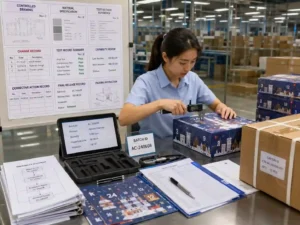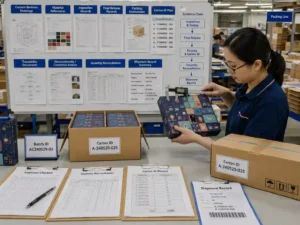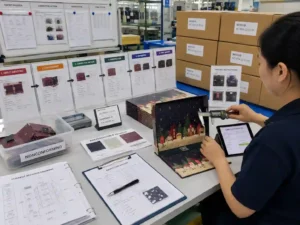
Quick answer: To design candy advent calendar boxes for seasonal campaigns, B2B buyers should start with the sales channel, candy size, filling method, shelf display needs, shipping route, and launch timeline. The right box is not only a festive outer package; it must separate candy pieces, protect wrapped products from pressure and odor transfer, leave space for labels and barcodes, support retail or e-commerce handling, and pass sample approval before mass production. For overseas brands, the best results come from comparing structures, inserts, materials, artwork, MOQ, lead time, QC standards, export cartons, and quotation details before choosing a supplier.
What should buyers decide before designing candy advent calendar boxes?
Buyers should decide the campaign channel, product count, candy dimensions, target price, and delivery deadline before choosing the box structure. These decisions control almost every packaging detail, from insert material and door size to carton strength and final quotation.
A retail buyer may need strong shelf presence, clear labeling space, and consistent display dimensions. An Amazon or e-commerce seller may prioritize gift-set protection, outer carton durability, barcode placement, and lower damage rates. A wholesaler may need a flexible design that can be adapted for several customers with different artwork but the same structure.
For seasonal launches, timing is especially important. Candy advent calendar boxes usually require dieline confirmation, blank sample review, artwork proofing, printed sample approval, mass production, assembly, inspection, export packing, and shipping. Missing one approval step can delay the launch window more than changing the box price by a small percentage.
Buyer tip: Treat the packaging brief as a campaign document, not only a box specification. Include sales channel, gift positioning, target shelf price, candy type, warehouse route, and launch date when contacting a custom advent calendar boxes manufacturer.
Which candy advent calendar box structure fits your seasonal campaign?
The best structure depends on how the buyer wants the calendar to be displayed, opened, filled, packed, and shipped. Rigid boxes feel premium but cost more and take more space, while folding carton calendars are lighter and better for larger retail volumes.
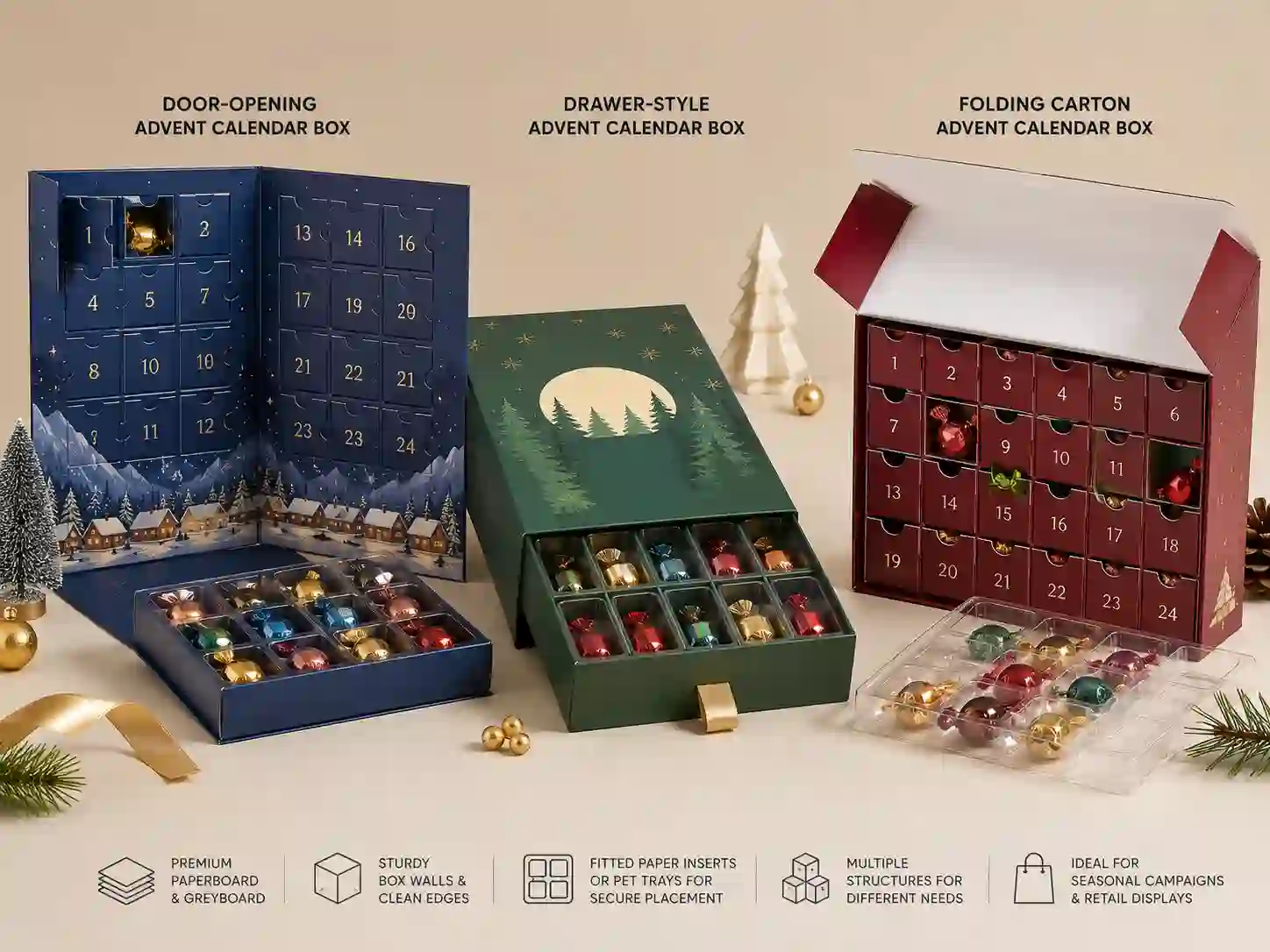
Common B2B structures include door-opening boxes, drawer boxes, book-style rigid boxes, sleeve boxes, folding carton calendars, and hybrid structures with inner trays. Each structure affects tooling, labor, material usage, packing efficiency, and product protection.
| Structure option | Best campaign use | Main advantages | Buyer watchpoints |
|---|---|---|---|
| Door-opening box | Classic retail advent calendar with daily candy access | Clear 12-day or 24-day experience, strong front-panel artwork, good shelf impact | Door cuts must align with insert cavities; weak doors may tear during opening |
| Rigid box | Premium candy gift set, brand campaign, influencer or VIP gifting | Strong greyboard structure, premium hand feel, suitable for foil stamping and embossing | Higher unit cost, larger carton volume, longer production and assembly time |
| Drawer box | Reusable gift format or mixed candy assortment | Good unboxing experience, easier access to trays, strong perceived value | Drawer tolerance must be tested so it slides smoothly after printing and lamination |
| Folding carton calendar | Large-volume retail campaign with controlled cost | Lower material weight, efficient flat packing, suitable for supermarket and promotional runs | Needs careful board selection and compression checks for shipping |
| Sleeve and tray box | E-commerce gift set, subscription box, or limited seasonal bundle | Simple structure, clean branding, easier packing for wrapped candy | May need extra inner protection if the gift set ships directly to consumers |
Quotable B2B statement: A candy advent calendar structure should be selected after the candy layout is confirmed, because door size, insert depth, board thickness, and carton volume all depend on the product cavity plan.
How should inserts be designed for candy separation and protection?
Inserts should keep each candy piece separated, stable, and easy to remove without crushing the product or damaging the calendar door. For candy packaging, insert design is not only about appearance; it also supports hygiene perception, filling efficiency, and transport safety.
Most candy calendars use individually wrapped candy, and the insert must match the wrapped size rather than the bare candy size. Buyers should measure the largest wrapped piece, including twisted ends, sealing seams, irregular shapes, and possible seasonal variations. A cavity that looks perfect for one sample may be too tight for mass-produced candy if wrapper tolerance is ignored.
Which insert material should buyers compare?
Paper inserts are often suitable for paper-based seasonal gift packaging, while PET trays offer clearer cavity definition for small candy pieces. Molded pulp can support a more natural look, but buyers should test surface texture, cavity precision, and product fit before approval.
- Paper insert: Good for lightweight wrapped candy, paper-based positioning, and easier printing or color matching.
- PET tray: Useful for precise cavities, glossy presentation, and consistent shape control.
- Molded pulp insert: Suitable for natural-style campaigns, but cavity tolerance and surface finish should be reviewed carefully.
- EVA or foam insert: More common for fragile gift items than standard candy; use only when the candy gift set needs higher cushioning or mixed-product support.
Factory tip: Send actual candy samples before approving the insert. Photos and dimensions help, but real wrapped samples reveal thickness, wrapper friction, odor, cavity fit, and filling speed more accurately.
What materials and food-packaging issues matter for candy gift sets?
Buyers should choose paperboard, greyboard, liner paper, coating, adhesive, and insert materials based on structure, sales channel, and product contact situation. When candy is involved, the packaging brief should clearly state whether candy is individually wrapped and whether any material may touch the food directly.
Many candy advent calendar boxes are designed for wrapped candy, meaning the box and insert usually act as secondary packaging. Even so, buyers should discuss odor awareness, moisture sensitivity, ink coverage, lamination smell, glue application, and storage conditions. Heavy ink coverage, strong lamination odor, or unsuitable adhesives can create problems for candy gift sets even when the candy itself is wrapped.
Food-contact claims should be handled carefully. A packaging supplier can provide material information, but buyers should verify the required compliance path for their market, product type, and intended use. For U.S. regulatory context, buyers can review official FDA information about packaging and food contact substances.
QC tip: Do not approve a candy calendar sample only by checking the front artwork. Open the doors, smell the inside, test candy removal, check insert dust or debris, and review whether the inner materials are suitable for the product’s packaging relationship.
How should artwork, labeling, and retail display be planned?
Artwork should be planned around the dieline, door cuts, fold lines, barcode areas, warning labels, nutrition or product information panels, and retail display orientation. A beautiful design can fail in production if key text crosses a crease, door perforation, or glue area.
Before artwork begins, buyers should request a confirmed dieline from the factory. The dieline should show cut lines, crease lines, bleed, safe zones, door openings, glue positions, window areas if any, and insert alignment marks. For seasonal campaigns, leave practical space for SKU labels, importer details, product count, recycling marks, barcode, and any market-specific information required by the buyer’s sales channel.
Printing options for custom advent calendar boxes may include CMYK printing, Pantone spot color, matte lamination, gloss lamination, foil stamping, embossing, debossing, spot UV, and textured paper. These options affect both presentation and cost. Premium finishing is useful for gift campaigns, but too many processes can increase sampling time, reject risk, and unit cost.
For retail and e-commerce identification, buyers should also check barcode requirements with their sales channel. GS1 provides official guidance on barcode standards, and many retailers have their own placement and scannability rules.
Buyer tip: Keep barcode and mandatory label areas away from foil stamping, high-gloss effects, heavy texture, and curved or folded surfaces. A premium finish should not make warehouse scanning harder.
How do retail, e-commerce, and promotional channels change the design?
Retail packaging should attract attention on shelf, while e-commerce packaging must survive parcel handling and still look giftable when opened. Promotional packaging often needs faster lead time, clear cost control, and flexible artwork adaptation across campaign versions.
Retail shelf campaigns
For retail shelf placement, confirm the standing direction, front-panel size, shelf depth, hanging or display requirements, and how many units fit in a master carton. The front artwork should explain the candy count and gift concept quickly without relying on consumer storytelling. Buyers should also consider whether the calendar needs a display-ready carton or standard export carton.
E-commerce and gift-set campaigns
For e-commerce, the calendar may travel through parcel networks instead of palletized retail distribution. This increases the importance of corner protection, inner stability, compression resistance, and outer carton selection. A rigid box may look premium, but it still needs a shipping plan that prevents dented corners and crushed doors.
Promotional and wholesale campaigns
For promotional runs, buyers may need several artwork versions using the same structure and insert. This can reduce tooling changes and simplify production planning. Wholesalers should ask whether the factory can keep one approved dieline and adjust printing files for different customer campaigns.
What sampling process should buyers expect before mass production?
Buyers should expect at least a dieline review, blank sample, printed sample or digital proof, and pre-production sample before mass production. The goal is to approve structure, fit, artwork, finishing, and packing method before committing to bulk production.
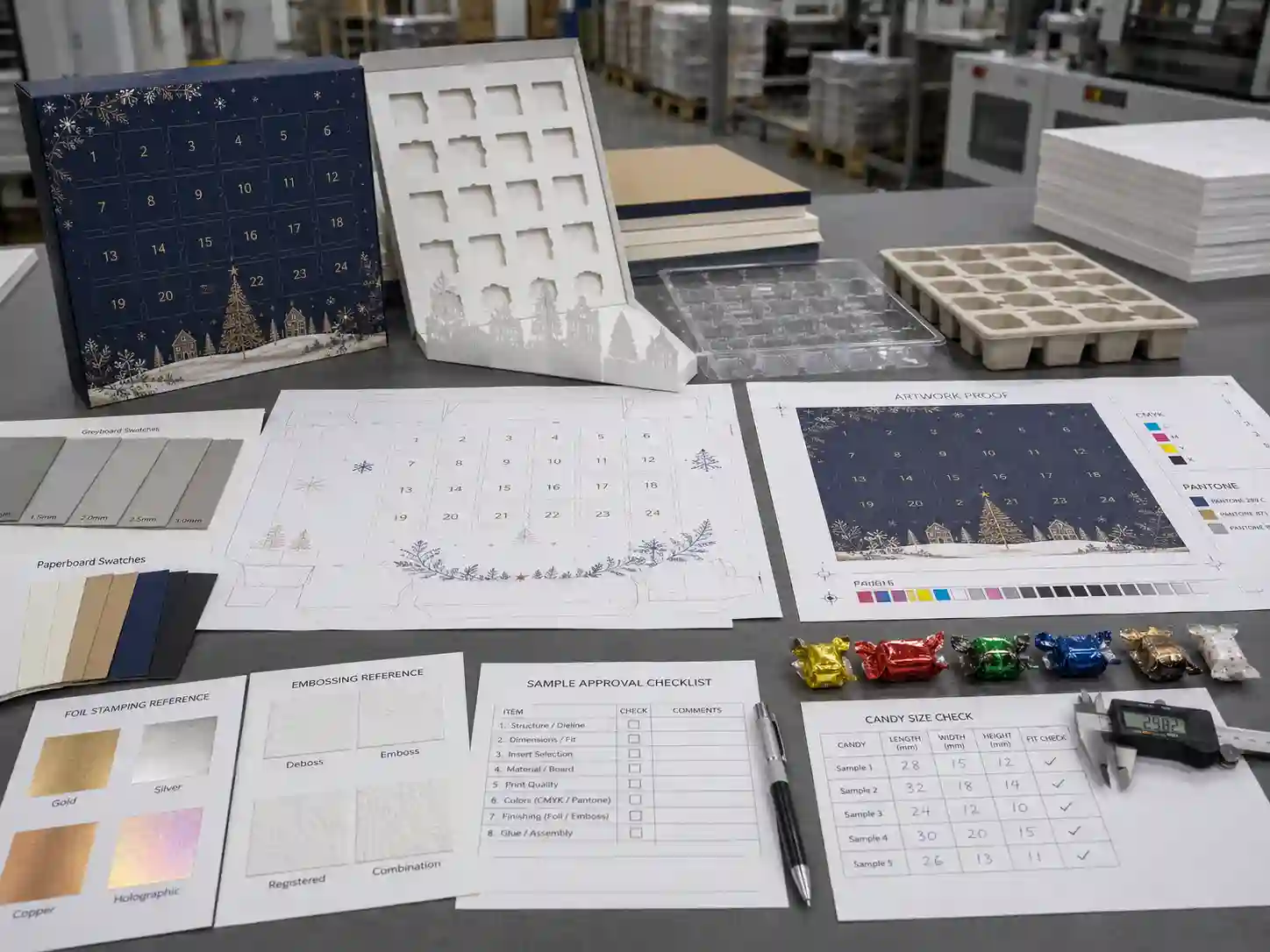
- Dieline confirmation: Check size, door layout, insert position, bleed, safe zones, and barcode space.
- Blank sample: Review structure, board thickness, opening experience, insert fit, and assembly tolerance without final printing.
- Artwork proof: Confirm CMYK values, Pantone references, text position, product information, and finishing areas.
- Printed sample: Check color, lamination, foil stamping, embossing, spot UV, door cutting, and overall presentation.
- Pre-production sample: Approve the final reference sample for mass production and QC comparison.
Quotable B2B statement: The pre-production sample should become the factory and buyer’s shared reference for color, structure, insert fit, door opening, finishing, and packing standard.
How do MOQ, cost, and lead time affect design choices?
MOQ, cost, and lead time are affected by structure complexity, material thickness, printing process, finishing, insert type, assembly labor, and export packing method. A lower unit price is not always better if it increases damage risk, delays sampling, or weakens retail presentation.
Rigid box structures usually require more board, wrapping paper, manual assembly, and carton volume. Folding carton structures can be more efficient for larger quantities but need careful board selection. PET trays may require tooling, while paper inserts may be easier to adjust. Special finishing such as foil stamping, embossing, and spot UV can improve gift value but should be confirmed early because they affect proofing and production scheduling.
Buyers should ask for quotations based on realistic quantity breaks. For example, request pricing at 1,000, 3,000, 5,000, and 10,000 units if those quantities match the campaign. Also ask whether sample cost, tooling cost, insert mold cost, carton packing, and palletization are included or quoted separately.
How should buyers compare candy advent calendar box suppliers?
Buyers should compare suppliers by structure knowledge, sample accuracy, communication speed, insert testing, printing control, QC process, export packing experience, and quotation clarity. The cheapest quotation may not be the safest choice for a time-sensitive seasonal campaign.
A reliable supplier should ask practical questions about candy size, wrapped dimensions, product count, sales channel, artwork status, target launch date, packing method, and shipping destination. If a supplier quotes immediately without asking about structure, insert, material, and export packing, the price may be incomplete.
| Supplier comparison point | What buyers should ask | Why it matters |
|---|---|---|
| Structure experience | Have you produced door-opening, drawer, rigid, or folding carton advent calendars before? | Advent calendars need accurate door cutting, insert alignment, and assembly control. |
| Insert testing | Can you test with actual wrapped candy samples? | Product separation and cavity fit affect filling speed and customer experience. |
| Artwork control | Can you review dieline, bleed, safe zones, CMYK, Pantone, and finishing layers? | Artwork mistakes are costly after plates, molds, or bulk printing begin. |
| Sampling process | Will you provide blank sample, printed sample, and pre-production sample options? | Sample approval reduces risk before mass production. |
| QC and packing | What inspection points and export carton standards will be used? | Seasonal goods must arrive on time and in sellable condition. |
| Quotation clarity | Does the quote include material, insert, finishing, packing, sample, tooling, and lead time? | Incomplete quotations make supplier comparison unreliable. |
Giftpackpro provides custom advent calendar box services for buyers who need help comparing structures, inserts, materials, sampling, and production planning for seasonal campaigns. Buyers can also review custom advent calendar box products to understand common formats before preparing a formal RFQ.
What QC checks are important before export?
QC should confirm that the approved sample standard is followed in mass production. For candy advent calendar boxes, inspection should cover structure, door opening, insert fit, printing, finishing, assembly, cleanliness, carton packing, and shipping marks.
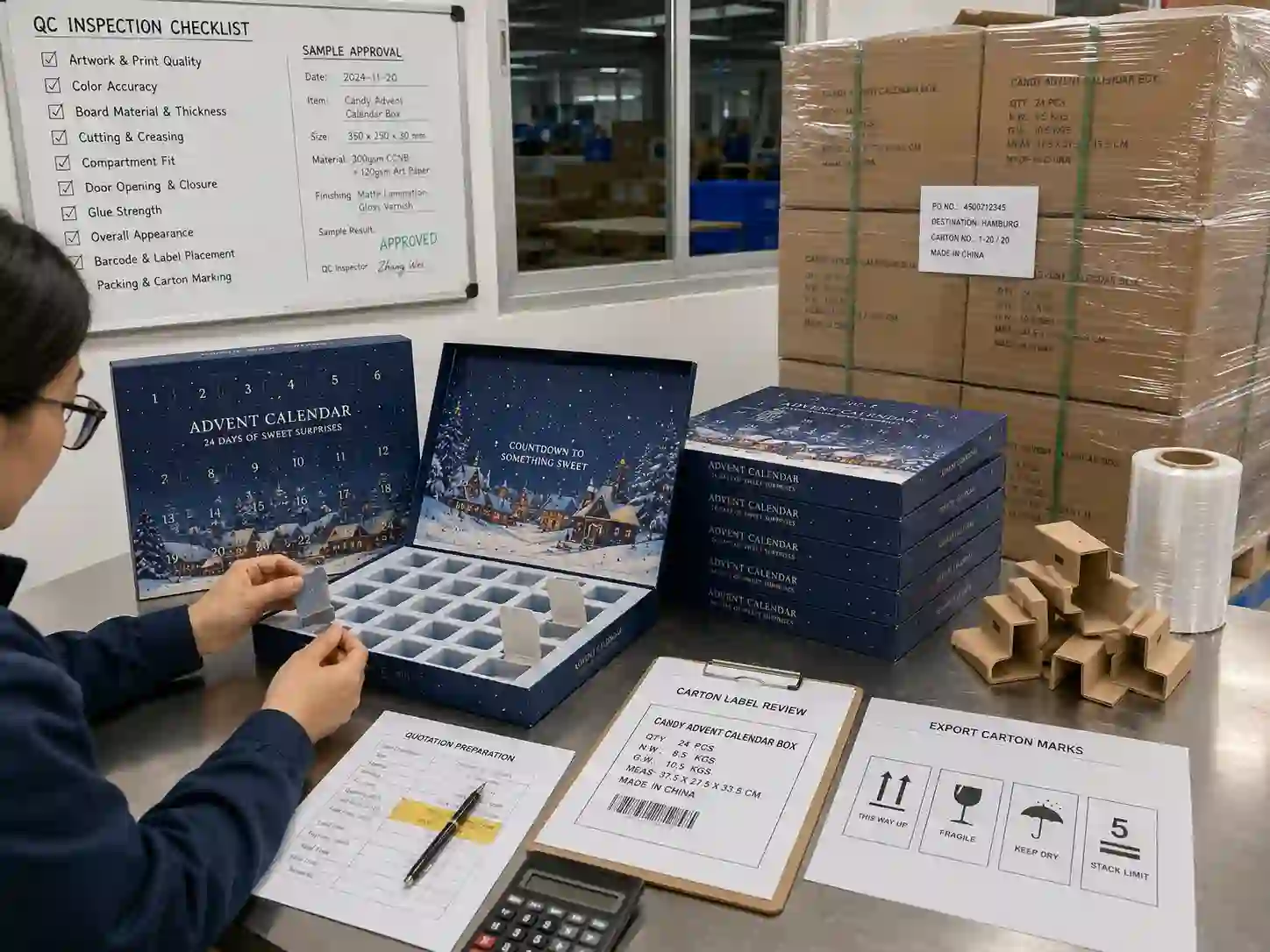
Final inspection should not only count units. Inspectors should open sample doors, check whether cavities align with numbers, confirm that the insert remains fixed, review color consistency, test drawer movement if applicable, and inspect corners for crushing or glue marks. For retail campaigns, front-panel appearance matters because small defects can affect shelf presentation.
Practical QC checklist for candy advent calendar boxes
- Confirm outer size, inner cavity layout, and product count against the approved dieline.
- Check door numbering, perforation, opening force, and door alignment.
- Test actual wrapped candy fit in multiple cavities, including the smallest and deepest positions.
- Review paperboard or greyboard thickness, warping, edge quality, and corner strength.
- Check CMYK color, Pantone matching, foil stamping, embossing, spot UV, and lamination quality.
- Inspect glue areas, folding lines, drawer movement, sleeve fit, and assembly tolerance.
- Check odor, dust, loose paper fibers, and visible contamination risk.
- Confirm barcode area, label panel, shipping marks, and carton label information.
- Review export carton strength, inner packing, corner protectors, pallet plan, and moisture awareness.
- Compare final goods with the signed pre-production sample before shipment approval.
How should export packing be planned for seasonal launches?
Export packing should protect the calendar during factory handling, container loading, warehouse storage, and final distribution. The packing method should be discussed during quotation, not after mass production is finished.
Buyers should confirm whether calendars ship flat, semi-assembled, or fully assembled. Flat packing can save volume for some folding carton designs, but many candy advent calendar boxes require assembled packing to protect structure and maintain presentation. Rigid boxes and filled gift sets usually need stronger master cartons, corner protection, and careful palletization.
For international shipments, carton labels and shipping marks should be clear and consistent. Include item number, quantity, gross weight, net weight, carton size, destination, and handling marks if required by the buyer. Pallet wrapping should protect against dust and moisture during logistics, while not crushing the cartons.
Factory tip: A good export packing plan balances carton strength, carton weight, pallet efficiency, and unpacking convenience. Overpacking increases freight cost, but underpacking can create retail returns and launch delays.
What information should buyers prepare before requesting a quotation?
Buyers should prepare product dimensions, quantity, structure preference, material expectations, artwork status, insert requirements, destination, sales channel, and launch deadline before requesting a quotation. A complete RFQ helps the factory quote faster and reduces later price changes.
Before contacting Giftpackpro or another supplier, prepare the following information:
- Target quantity and possible quantity breaks for MOQ comparison.
- Number of candy pieces, such as 12-day, 24-day, or custom layout.
- Actual wrapped candy size, weight, shape, and sample availability.
- Preferred structure: rigid box, folding carton, drawer box, door-opening box, or custom structure.
- Insert preference: paper insert, PET tray, molded pulp, EVA, foam, or open to factory recommendation.
- Material preference, including paperboard, greyboard thickness, liner paper, and surface finish.
- Artwork status, dieline needs, CMYK or Pantone requirements, and finishing effects.
- Retail, e-commerce, wholesale, or promotional campaign channel.
- Labeling space, barcode location, importer information, and market-specific packaging notes.
- Sample requirements: blank sample, printed sample, prototype, or pre-production sample.
- Export packing requirements, carton limits, pallet needs, and shipping marks.
- Delivery deadline, shipping destination, and preferred trade terms if known.
Decision guide: Which design path should you choose?
Buyers should choose the design path that matches campaign value, sales channel, and operational risk. A premium retail launch, a cost-sensitive promotion, and an e-commerce gift set should not use the same design logic.
| Buyer situation | Recommended design direction | Reason |
|---|---|---|
| Premium seasonal gift campaign | Rigid box, drawer box, or book-style door-opening box with paper or PET insert | Supports higher perceived value, stronger shelf impact, and premium finishing. |
| Large retail promotion | Folding carton door-opening calendar with cost-controlled paper insert | Better for higher quantities, lighter weight, and efficient carton packing. |
| E-commerce gift set | Strong rigid or sleeve structure with tested inner protection and export carton plan | Reduces damage risk during parcel handling and warehouse movement. |
| Wholesale multi-customer program | One approved structure with flexible artwork versions | Reduces tooling changes and simplifies supplier management. |
| Short lead-time campaign | Use an existing proven structure with limited finishing changes | Minimizes sampling risk and speeds up production approval. |
What common mistakes should buyers avoid?
The most common mistakes are approving artwork before structure testing, ignoring wrapped candy size, underestimating export packing, and comparing incomplete quotations. These mistakes can create delays, damage, or unexpected cost increases.
- Choosing structure before product layout: The candy count and cavity plan should guide the structure, not the other way around.
- Measuring bare candy only: Wrapped candy may need more space because of seams, twists, or irregular packaging.
- Ignoring odor and moisture awareness: Candy gift packaging should be reviewed for material smell, lamination odor, storage condition, and inner cleanliness.
- Placing key text on cuts or folds: Door cuts, creases, glue areas, and perforations can damage important artwork or labels.
- Skipping blank sample approval: A printed sample is more useful after the structure has already been tested.
- Using too many premium finishes: Foil stamping, embossing, spot UV, and special paper can improve value, but each process adds cost and approval risk.
- Comparing price without packing details: A lower unit price may exclude insert tooling, sample cost, carton protection, palletization, or shipping marks.
- Leaving supplier selection too late: Seasonal packaging needs time for prototyping, revision, mass production, QC, and export logistics.
FAQ: Candy advent calendar boxes for B2B seasonal campaigns
What is the best structure for candy advent calendar boxes?
The best structure depends on the campaign channel and budget. Door-opening folding carton calendars work well for large retail promotions, while rigid box or drawer formats are better for premium gift campaigns and higher perceived value.
Should candy advent calendar boxes use paper inserts or PET trays?
Paper inserts are suitable for many wrapped candy calendars and paper-based packaging goals. PET trays are useful when the buyer needs more precise cavities, clearer product positioning, or stronger shape control. Actual wrapped candy samples should be tested before final approval.
Can the box material touch candy directly?
This depends on the material, market, and intended use. Many candy calendars use individually wrapped candy, so the box is secondary packaging. If any component may contact food directly, buyers should verify the appropriate food-contact requirements for their target market instead of relying on a general claim.
How early should buyers start a seasonal candy calendar project?
Buyers should start early enough to allow dieline development, blank sampling, artwork proofing, printed sample approval, mass production, QC, export packing, and shipping. The more custom the structure, insert, and finishing, the more time should be reserved for revisions.
What affects the quotation most?
The main cost drivers are structure type, box size, board thickness, insert material, printing coverage, finishing processes, order quantity, assembly labor, sample needs, export packing, and carton volume. Buyers should request itemized quotations to compare suppliers accurately.
What should be checked in a pre-production sample?
Check the final structure, candy fit, door opening, insert alignment, artwork position, color, finishing quality, barcode and label area, carton packing method, and overall appearance. The approved pre-production sample should guide mass production QC.
CTA: Prepare your RFQ for Giftpackpro
To develop candy advent calendar boxes for retail, e-commerce, wholesale, or promotional seasonal campaigns, prepare your candy dimensions, quantity, structure idea, insert preference, artwork status, launch deadline, and export packing requirements. Giftpackpro can help review the dieline, sample plan, material options, production details, and quotation scope before mass production.
Buyers can learn more about the Giftpackpro packaging factory, explore more advent calendar box buying guides, or request a custom quote with project details for sample and quotation discussion.
Final buyer takeaway: Candy advent calendar boxes should be designed around the campaign channel, candy protection, insert fit, artwork accuracy, QC standard, export packing, and launch timeline. A strong seasonal package is not only attractive; it is practical to produce, inspect, pack, ship, and sell.