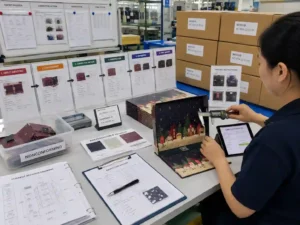
Quick answer: A reliable drawer advent calendar box function check should confirm that every drawer opens smoothly, stays aligned, supports the loaded product, and closes without rubbing, tilting, or becoming trapped. Buyers should test both empty and fully loaded samples, repeat the opening cycle, inspect drawer clearance, check insert retention, and compare the sample against the approved dieline and product dimensions. Drawer performance depends on greyboard thickness, wrapping paper, internal tolerances, insert design, assembly accuracy, surface finishing, and product weight. These decisions also affect MOQ, labor cost, sampling time, production efficiency, export packing, and the accuracy of the supplier’s quotation.
What should buyers understand before choosing a drawer advent calendar box?
A drawer-style advent calendar is usually selected when a brand needs a premium presentation, reusable structure, strong product separation, or controlled access to multiple gifts. However, it normally uses more board, paper, insert material, hand assembly, and packing volume than a basic door-opening paperboard calendar.
Before selecting this format, buyers should confirm whether the retail value and product mix justify the additional material and labor. A rigid multi-drawer box can suit cosmetics, jewelry, stationery, tea, mini candles, accessories, and premium gift sets, but each drawer must be engineered around its product rather than copied from a standard template.
Buyers comparing formats can review examples from a custom advent calendar boxes manufacturer and inspect different custom advent calendar box products before fixing the structure.
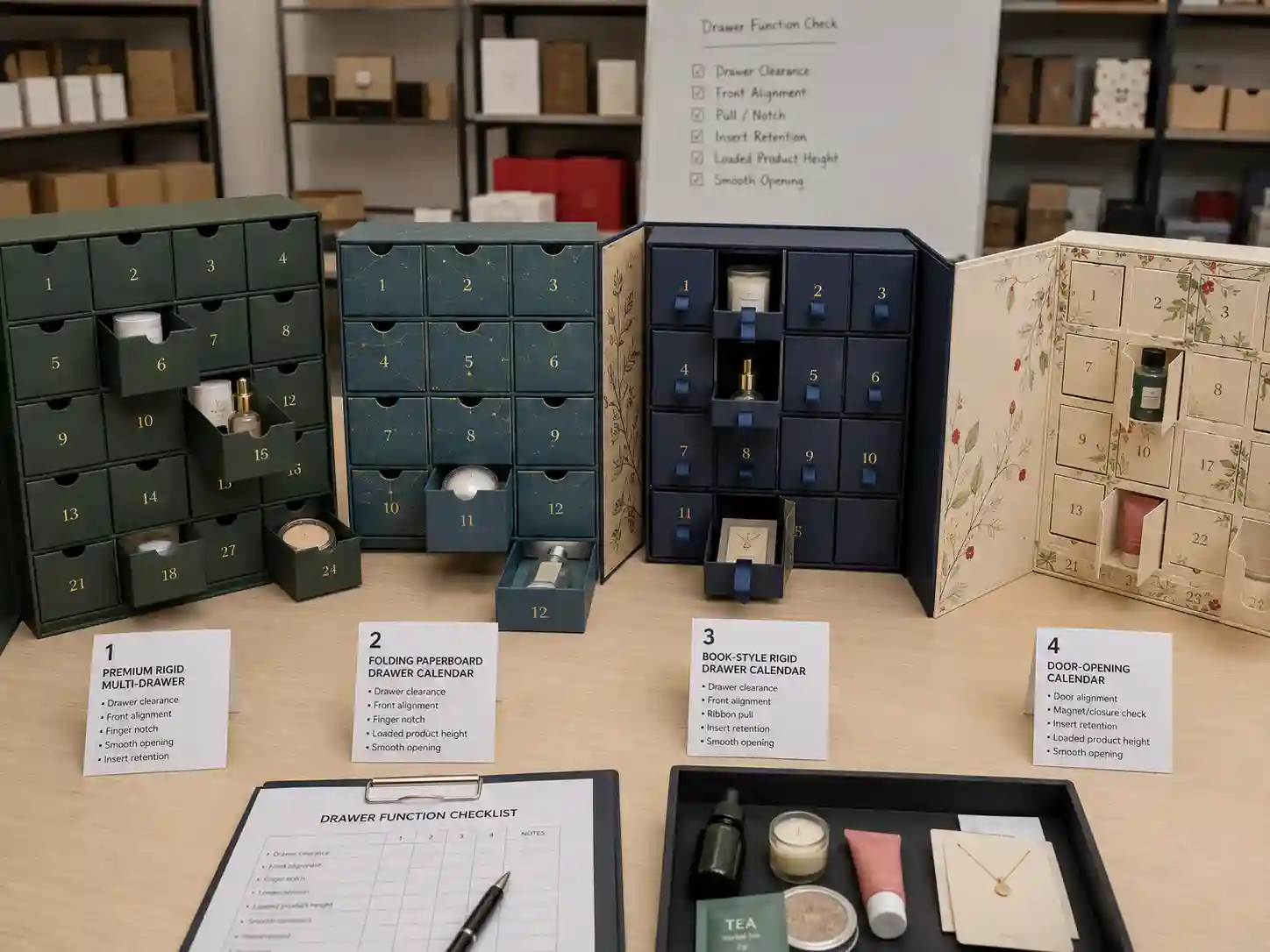
How does a drawer box compare with other advent calendar structures?
| Structure | Function and buyer benefit | Main cost drivers | Key functional risk |
|---|---|---|---|
| Rigid multi-drawer box | Premium appearance, strong walls, separate reusable drawers | Greyboard, wrapping paper, drawer assembly, inserts, larger export volume | Drawers may rub, skew, sag, or become too tight after wrapping |
| Folding drawer box | Lower shipping volume and potentially faster packing | Paperboard grade, die-cutting, gluing, locking construction | Insufficient stiffness under heavier products |
| Door-opening paperboard box | Efficient material use and lower assembly complexity | Printed paperboard, partitions or tray, perforation design | Doors may tear, open early, or provide poor product access |
| Book-style rigid calendar with drawers | Premium reveal with an outer cover and internal drawer system | Magnets, hinges, rigid board, multiple wrapped components | Cover pressure or misalignment can interfere with drawer movement |
Buyer tip: Do not compare quotations by finished size alone. Ask each supplier to state the structure, board thickness, number of separately assembled drawers, insert type, printing, finishing, packing method, and carton quantity. Two boxes with similar external dimensions can require very different labor and material inputs.
How should a drawer advent calendar box function check be performed?
The buyer should test every drawer in the prototype and pre-production sample under realistic loading conditions. A visual inspection alone cannot confirm whether the structure will work after products, inserts, finishing layers, and export handling are added.
- Check the box on a flat surface. Confirm that the outer frame does not rock, twist, or lean. A distorted cabinet can create different drawer clearances on the left and right sides.
- Open every drawer while empty. Pull each drawer straight out using the intended finger notch, ribbon, metal pull, or paper tab. Record any scraping, sudden resistance, side movement, or uneven pull force.
- Load the actual products or accurate weight dummies. Product weight can cause the drawer bottom or insert to bend, changing the way the drawer slides.
- Repeat the opening and closing cycle. Test each drawer several times rather than accepting one successful opening. Repeated movement can expose loose wrapping edges, weak pull tabs, insert movement, and progressive rubbing.
- Check partial and full extension. The drawer should remain controlled when partly open and should not unexpectedly fall out unless removable drawers are an intentional feature.
- Inspect the closed position. Drawer fronts should sit at a consistent depth and maintain even gaps. One recessed or projecting drawer can indicate an assembly or dimensional problem.
- Tilt the loaded calendar carefully. Confirm that products remain in their cavities and that drawers do not slide open during normal handling.
- Test after protective packing is applied. Tissue, sleeves, shrink wrap, belly bands, and tight-fitting outer cartons can place pressure on the box and change drawer movement.
QC tip: Test the first drawer, the last drawer, corner drawers, center drawers, and any drawer carrying the heaviest product. These positions experience different frame pressure and reveal different assembly problems.
What functional defects should buyers record?
- Drawer requires excessive force to open or close.
- Drawer front rubs against the frame or neighboring drawer.
- Drawer moves diagonally instead of straight.
- Drawer bottom bends under product weight.
- Insert rises, rotates, or catches against the cabinet opening.
- Ribbon pull detaches, stretches, or becomes trapped.
- Finger notch is too small for practical access.
- Product protrudes above the drawer wall and hits the frame.
- Wrapping paper lifts at an edge and interferes with movement.
- Drawer slides open when the loaded calendar is slightly tilted.
- Drawer gaps or front positions are visibly inconsistent.
- Foil, embossing, or lamination cracks near the drawer edge.
Defects should be photographed, labeled by drawer number, and linked to a measurable dimension or observable function. Comments such as “drawer feels wrong” are difficult for a factory to correct. Comments such as “drawer 8 rubs against the right frame after the 500 g product dummy is loaded” are actionable.
Which dimensions and tolerances control smooth drawer movement?
Drawer function is controlled by the relationship between the drawer’s outside dimensions and the cabinet opening, not by either component alone. Buyers should ask the supplier to define the planned clearance and confirm it in the assembled sample.
The required allowance depends on the board, paper, wrapping method, finishing, humidity exposure, and box size. A rigid drawer made from greyboard becomes larger after both sides are wrapped. Matte lamination, gloss lamination, specialty paper, foil stamping, embossing, and spot UV can also change surface friction or create localized thickness.
Important measurements include:
- Internal width, height, and depth of each cabinet opening.
- External width, height, and depth of the finished drawer.
- Thickness of the drawer front and side walls.
- Clearance above, below, and beside the loaded drawer.
- Insert height relative to the drawer wall.
- Maximum product height after caps, seals, sleeves, or protective bags are added.
- Distance available for fingers to grip the notch or pull tab.
- Closed-position depth of each drawer front.
Factory tip: Dieline dimensions should not be treated as finished dimensions without accounting for board thickness, paper buildup, folding direction, adhesive, and hand-assembly variation. The approved sample should become the physical reference for mass production.
How do the insert and product affect drawer performance?
The insert must secure the product without making the drawer too heavy, too tall, or difficult to access. Buyers should evaluate the insert and drawer as one system rather than approving them separately.
A paper insert is lightweight and can be printed, but narrow supports may collapse around heavy or irregular products. A clear PET tray provides accurate cavities and product visibility, but the flange and tray height must not catch the cabinet opening. EVA insert and foam can hold fragile products securely, although their thickness, density, odor requirements, and appearance should be specified. Molded pulp may support sustainability objectives, but its surface variation and wall thickness need to be tested against drawer clearance.

Which insert option is appropriate?
| Insert type | Suitable applications | Drawer-function consideration | Quotation detail to provide |
|---|---|---|---|
| Folded paper insert | Tea sachets, stationery, lightweight cosmetics, small gifts | Support tabs must not bow outward or catch the drawer opening | Paper grade, printing, cavity size, loading direction |
| PET tray | Cosmetics, accessories, mini containers | Tray flange and formed height must remain below the drawer edge | Material thickness, color, cavity drawing, recycled-content requirement if applicable |
| EVA or foam | Jewelry, glass containers, fragile or high-value items | Insert must not expand beyond the drawer walls or create excessive weight | Density, thickness, color, surface treatment, product dimensions |
| Molded pulp | Selected gift products and sustainability-led projects | Dimensional variation must be allowed for in the drawer opening | Pulp type, color, cavity depth, surface expectation, tooling quantity |
For product-fit testing, provide the factory with final production items whenever possible. A nominal product dimension may exclude a cap, wrapper seam, label overlap, hanging tag, protective sleeve, or manufacturing variation. These details can make a loaded drawer jam even when the original cavity drawing appears correct.
How should artwork and finishing be checked around moving drawers?
Artwork approval should include alignment across the entire assembled calendar, especially when numbers, patterns, illustrations, foil, or spot UV continue from the cabinet to the drawer fronts. A correct flat proof does not guarantee correct alignment after cutting, wrapping, and hand assembly.
Buyers should check:
- Number sequence and drawer position against the approved artwork.
- Consistent margins around every drawer front.
- CMYK or Pantone color consistency between separately printed sheets.
- Foil stamping position near edges, notches, pulls, and folding areas.
- Embossing or debossing that could distort a drawer front.
- Spot UV buildup that may increase friction near sliding surfaces.
- Matte or gloss lamination adhesion at frequently handled edges.
- Grain direction and paper cracking at folds or wrapped corners.
For responsible fiber sourcing requirements, buyers can ask suppliers to provide verifiable documentation and review information from the official Forest Stewardship Council. Certification claims should be checked against the exact material, supplier, and project scope rather than assumed from a general factory statement.
Which sample stages are necessary before mass production?
For a custom drawer structure, buyers should normally review a structural prototype and a finished pre-production sample. A white sample can confirm size and mechanism, while a printed finished sample confirms the combined effects of material, wrapping, finishing, insert, product loading, and assembly.
What should each sample stage prove?
- Dieline or digital drawing: overall dimensions, drawer count, product allocation, opening direction, insert layout, and artwork zones.
- White prototype: physical size, drawer clearance, product fit, finger access, board strength, and packing volume.
- Printed sample: CMYK or Pantone color, lamination, foil stamping, embossing, spot UV, paper wrapping, and visual alignment.
- Pre-production sample: final materials, final inserts, final accessories, loading sequence, approved workmanship, and export-packing method.
- Mass-production reference: signed or clearly documented approval sample retained by both buyer and factory.
Use custom advent calendar box services to discuss structural development, sample requirements, material selection, printing, finishing, and production planning before approving a complex calendar.
Buyer tip: Approve the sample with actual products loaded and identify each drawer by number. A signed sample with missing products cannot fully establish the accepted drawer function.
How do drawer design choices affect MOQ and price?
The largest cost drivers are usually material consumption, number of separate components, hand-assembly time, insert tooling, printing setup, finishing passes, packing volume, and order quantity. Drawer calendars often involve more production steps than folding-carton or door-opening structures.
| Cost factor | Why it changes the quotation | Possible cost-control approach |
|---|---|---|
| Number of drawers | Every drawer requires cutting, wrapping or folding, gluing, inspection, and assembly | Use fewer drawer sizes, repeat dimensions, or group several products where the retail concept allows |
| Rigid greyboard construction | Uses thicker board, wrapping paper, and more manual labor | Compare rigid and folding drawer versions during development |
| Multiple insert materials | Adds tooling, purchasing, sorting, and loading complexity | Standardize insert material or cavity families |
| Complex finishing | Foil, embossing, spot UV, and specialty papers require separate processes and setup | Prioritize finishing on the main visual areas instead of every internal surface |
| Many drawer sizes | Increases tooling, setup, sorting, and assembly-error risk | Use a modular grid with repeated drawer dimensions |
| Large finished volume | Raises export-carton, warehouse, pallet, and freight costs | Request a packing-volume comparison before final structure approval |
MOQ is not determined by one universal industry number. It can be influenced by paper purchasing quantities, printing sheet efficiency, tooling setup, finishing processes, insert production, assembly capacity, and the factory’s production schedule. Buyers should request pricing at realistic quantity levels rather than asking only for the lowest possible MOQ.
A useful quotation comparison may include 1,000, 3,000, and 5,000 units, or other quantities suited to the campaign. Ask whether sample charges, tooling, printing plates, insert molds, packing materials, and delivery terms are included or listed separately.
How should buyers compare drawer-box suppliers?
Compare suppliers by engineering clarity, sample accuracy, QC planning, and quotation completeness—not only by the lowest unit price. A supplier should be able to explain how drawer clearance, insert height, product weight, finishing, assembly, and packing will be controlled.
Practical supplier decision guide
- Choose an experienced structural partner when product sizes vary, drawers carry different weights, or a premium rigid construction is required.
- Choose a folding construction specialist when shipping volume and assembly efficiency are the primary cost concerns.
- Request a physical sample before comparing final prices when suppliers have interpreted the structure differently.
- Favor a detailed quotation that lists material, inserts, finishing, accessories, packing, MOQ, sample lead time, production lead time, and trade terms.
- Confirm QC documentation when the project includes many numbered drawers, several products, or strict retail launch dates.
- Review factory communication by checking whether technical questions receive measurable answers rather than general assurances.
Buyers can learn more about the production background of the Giftpackpro packaging factory and use the company’s advent calendar box buying guides to prepare internal specifications.
What QC checks should be completed during mass production?
Mass-production QC should verify materials and components before final assembly, then test completed loaded or weight-simulated units. Waiting until finished boxes are packed makes drawer defects more expensive to correct.
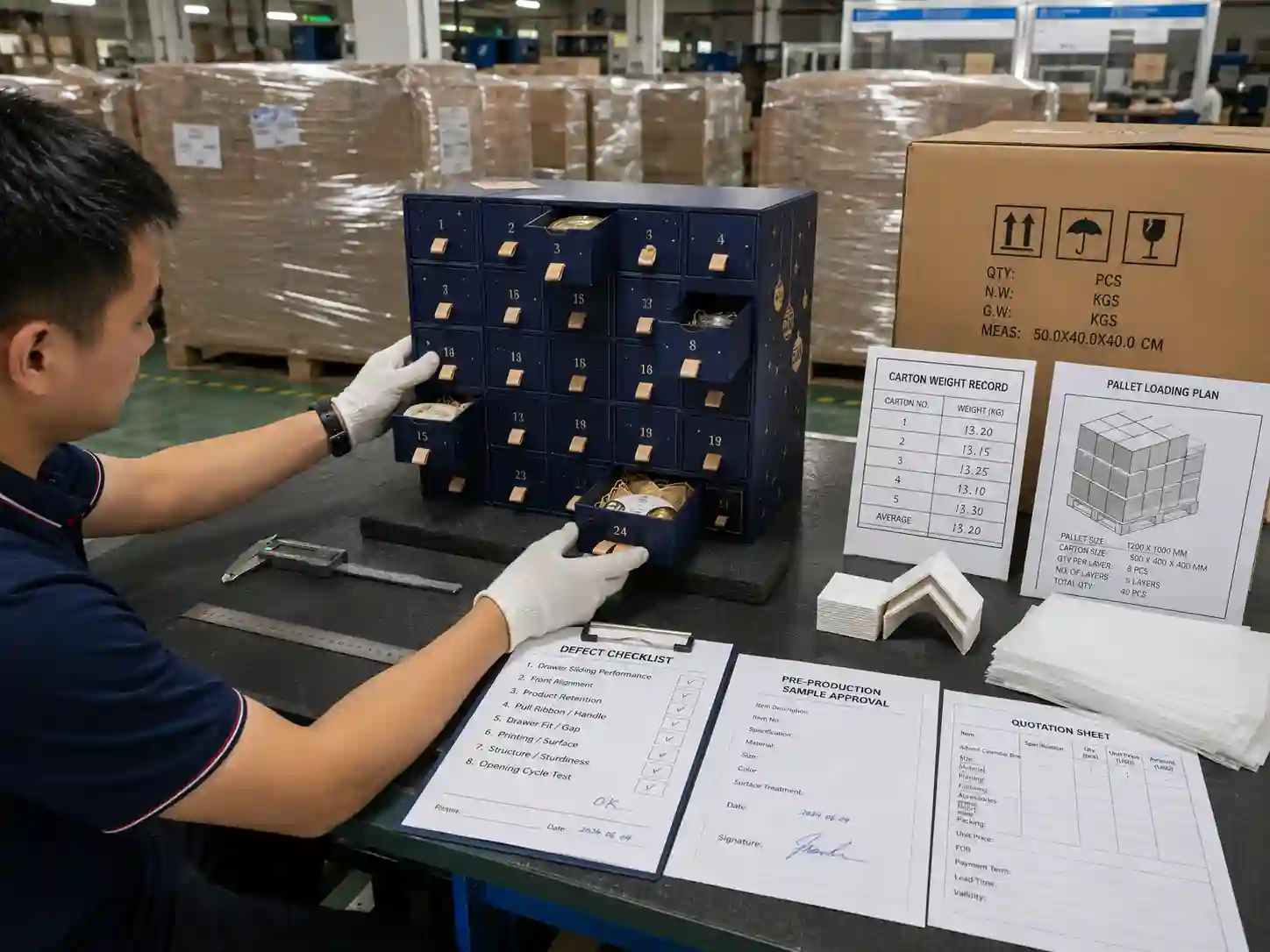
Drawer-function QC checklist
- Confirm greyboard or paperboard grade and thickness against the approved specification.
- Check cabinet and drawer dimensions at the start of production.
- Inspect wrapped components for lifted paper, excessive glue, exposed board, and distorted corners.
- Verify drawer numbers and artwork orientation before assembly.
- Test empty drawer movement on samples from different production periods.
- Test selected drawers with actual products or approved weight dummies.
- Confirm inserts sit flat and remain below the permitted height.
- Check pull ribbons, tabs, notches, and other opening features.
- Compare drawer-front alignment and gap consistency with the approved sample.
- Inspect foil, embossing, spot UV, and lamination near moving edges.
- Perform loaded tilt and handling checks.
- Verify final quantity, barcode area, shipping marks, carton weight, and carton dimensions.
- Retain inspection records and representative production samples.
Buyers may also ask whether the proposed shipping test is appropriate for the product and distribution route. The official International Safe Transit Association provides information about packaged-product testing, although the exact test plan should be selected according to shipment method, product fragility, and retailer requirements.
How should drawer advent calendar boxes be packed for export?
Export packing should prevent pressure, abrasion, moisture exposure, movement, and corner damage without compressing the drawer cabinet. The inner protection and export carton must be tested with the finished, loaded box dimensions.
Depending on the structure, packing may include tissue, protective paper pads, polybags where permitted, sleeves, corner protectors, partitions, reinforced export cartons, pallet stretch wrap, and clear shipping marks. Heavy rigid calendars may need lower carton quantities to keep carton weight manageable.
Ask the supplier to provide:
- Finished unit dimensions and net weight.
- Individual packing method.
- Units per export carton.
- Export-carton dimensions, gross weight, and net weight.
- Carton board specification or reinforcement method.
- Estimated total carton quantity and cubic volume.
- Pallet configuration when pallets are required.
- Shipping-mark, barcode, and destination-label requirements.
QC tip: Recheck drawer movement after the calendar has been placed in its retail sleeve, individual protection, and export carton. Excessive packing pressure can turn an approved drawer into a tight drawer.
What information should be prepared before requesting a quotation?
A complete RFQ allows suppliers to calculate materials, labor, tooling, packing, and production time more accurately. Missing product data usually leads to assumptions, provisional pricing, or later cost revisions.
Quotation preparation checklist
- Required order quantity and alternative quantity levels.
- Target delivery date and destination country or port.
- Finished box dimensions or product list for size development.
- Number of drawers and preferred arrangement.
- Dimensions, weight, material, and fragility of every product.
- Preferred rigid box, folding carton, drawer box, or book-style structure.
- Paperboard or greyboard expectations.
- Paper insert, PET tray, EVA insert, foam, or molded pulp preference.
- CMYK or Pantone printing requirements.
- Matte lamination, gloss lamination, foil stamping, embossing, or spot UV requirements.
- Artwork status and available dieline files.
- Sample type required and sample approval deadline.
- Individual packing, export-carton, pallet, barcode, and shipping-mark requirements.
- Required quotation currency, delivery term, and destination.
Send final products or precise product drawings before the prototype stage when possible. Buyers ready to start development can request a custom quote with the product list, quantity, target structure, artwork requirements, delivery schedule, and packing instructions.
Which common mistakes cause drawer-function problems?
- Approving an empty sample: The loaded drawer may sag, rub, or become difficult to remove.
- Using approximate product sizes: Caps, wrappers, labels, and production variation can exceed the planned cavity.
- Ignoring finishing thickness: Lamination, spot UV, specialty paper, and wrapped edges may reduce clearance.
- Making every drawer a different size: This increases tooling, sorting, labor, and assembly-error risk.
- Checking only one drawer: Corner, center, upper, and lower drawers can perform differently.
- Failing to number defects: The factory cannot efficiently correct a problem without a drawer location and measurable description.
- Changing products after sample approval: A small change in product weight or height may invalidate the tested insert and drawer clearance.
- Comparing incomplete quotations: A low unit price may exclude tooling, inserts, special finishing, individual packing, or reinforced export cartons.
- Skipping packed-box testing: Sleeves, wrapping, carton pressure, and pallet stacking can affect drawer movement.
Frequently asked questions about drawer advent calendar box checks
Should every drawer be tested during sample approval?
Yes. Every drawer should be opened, closed, visually inspected, and checked with its intended product or a representative weight. Special attention should be given to the heaviest drawers and drawers positioned near cabinet corners.
Is a white prototype enough for bulk production approval?
A white prototype is useful for confirming structure, size, and basic product fit, but it does not show the effect of printed paper, lamination, foil, embossing, wrapping, final inserts, and assembly. A finished pre-production sample is safer for final approval.
Why can a printed drawer feel tighter than the white sample?
Printed and laminated paper, adhesive buildup, wrapped corners, finishing layers, and hand-assembly variation can increase the finished drawer dimensions or surface friction. The final clearance should therefore be confirmed with production-equivalent materials.
Does a heavier product always require thicker greyboard?
Not automatically. The complete structure should be assessed, including drawer span, bottom construction, insert support, cabinet design, and product distribution. Increasing board thickness can improve strength but may also increase weight, cost, and required clearance.
How can buyers reduce the cost of a multi-drawer calendar?
Use repeated drawer sizes, simplify finishing, standardize inserts, reduce unnecessary internal printing, compare rigid and folding structures, optimize carton quantity, and request quotations at several production volumes. Cost reduction should not remove the clearance or strength needed for reliable function.
What should be included in a drawer-function approval record?
The record should identify the sample version, material specification, product-loading condition, drawer numbers tested, observed defects, approved corrections, photos, dimensions, artwork version, insert version, packing method, and approval date.
Prepare the drawer specification before approving cost and production
A successful drawer advent calendar box function check connects structural engineering with product fit, material selection, artwork, finishing, assembly tolerance, QC, export packing, and quotation planning. Test every drawer empty and loaded, document measurable defects, and approve a production-equivalent sample before mass production.
For an efficient sample or quotation review, prepare the product dimensions and weights, drawer arrangement, insert preference, printing and finishing requirements, order quantity, delivery schedule, and export-packing instructions. Giftpackpro can then evaluate the structure, identify practical cost drivers, and propose a sample and production plan based on the actual campaign requirements.