
Quick answer: A reliable door-opening advent calendar box check should confirm that every door opens cleanly, stays attached where intended, gives sufficient finger access, and does not damage nearby printing, inserts, or products. Buyers should test blank samples, printed samples, and the final pre-production sample under realistic loading conditions. Important checks include perforation strength, hinge position, score depth, door clearance, insert alignment, product retention, opening sequence, surface-finishing durability, and repeated-use performance. The approved sample should then become the measurable reference for mass-production QC, export packing, and supplier acceptance.
Door-opening performance is not only a visual detail. It directly affects product access, packaging appearance, assembly efficiency, customer complaints, and the consistency of a seasonal retail campaign. A door that is too difficult to open may tear the printed face panel, while a door that opens too easily can expose or release the product during packing, transport, or shelf handling.
What should buyers understand before choosing a door-opening advent calendar box?
Buyers should first understand that the door, compartment, insert, and product must be engineered as one system. A door layout cannot be approved only from an artwork PDF because finished performance depends on board thickness, cutting tolerances, perforation design, insert position, product weight, lamination, and assembly accuracy.
A typical door-opening box uses a printed paperboard face panel with die-cut or perforated doors positioned over individual product compartments. The outer structure may be a folding carton, a rigid box wrapped with printed paper, or a hybrid structure combining a greyboard frame with a paperboard door panel.
Before selecting the format, buyers should define:
- The number, size, weight, and orientation of all products.
- Whether each door is torn open once or opened and reclosed.
- Whether the product sits in a paper insert, PET tray, EVA insert, foam, or molded pulp insert.
- Whether the calendar will be displayed upright, laid flat, hung, or shipped inside an e-commerce carton.
- Whether the door panel uses matte lamination, gloss lamination, foil stamping, embossing, spot UV, or uncoated paper.
- Whether compartments must be opened in a numbered sequence.
Buyer tip: Send the supplier physical products or accurate product dimensions and weights before the dieline is finalized. Product drawings without caps, pumps, cables, pouches, or protective bags may produce incorrect compartment dimensions.
Which box structure gives the best door-opening performance?
The best structure depends on product weight, retail positioning, budget, packing method, and the required opening experience. Folding-carton calendars are cost-efficient and lightweight, while rigid door-opening boxes offer greater structural stability for premium or heavier product sets.
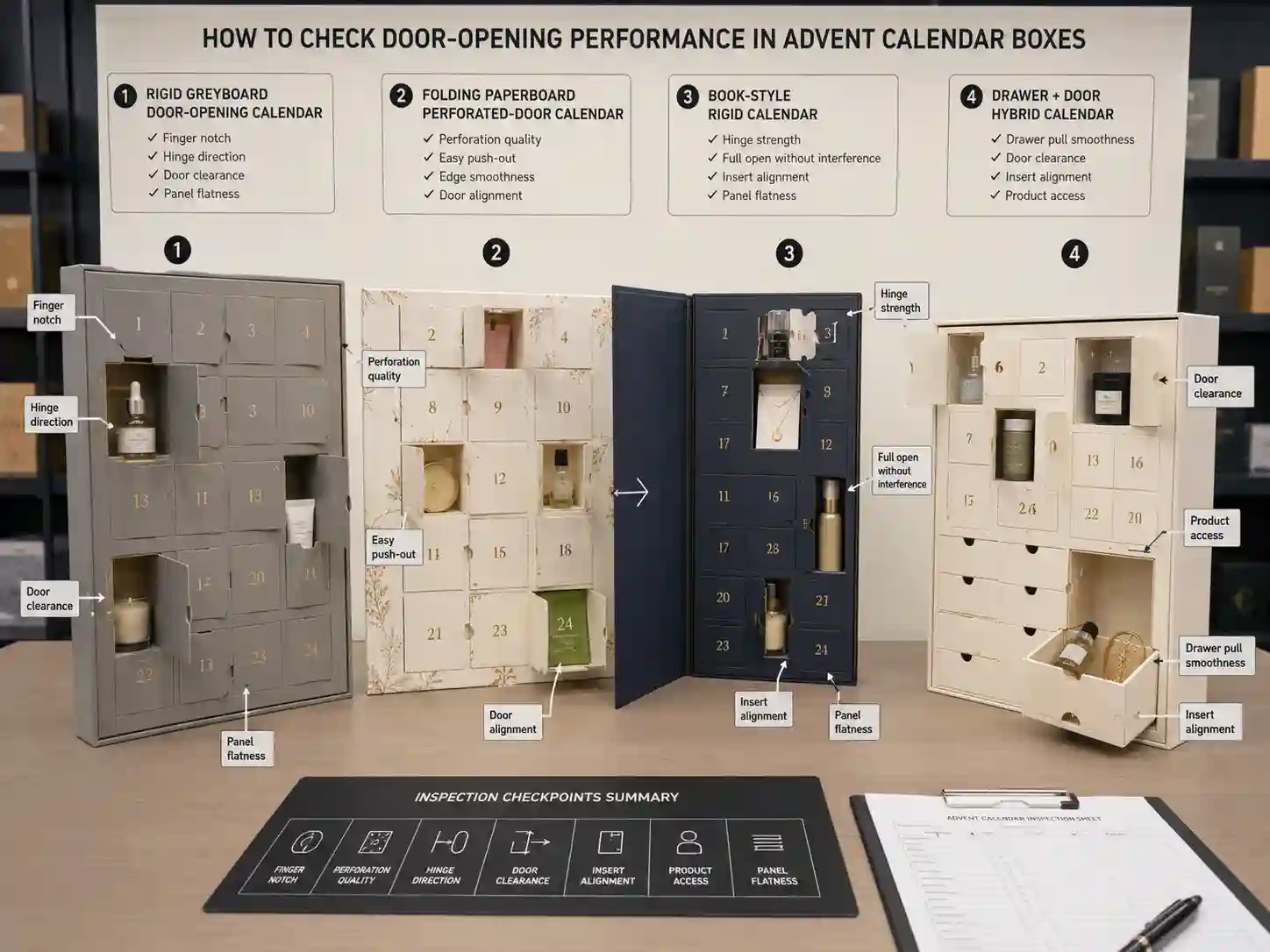
| Structure option | Door-opening characteristics | Best suited to | Main buyer risk |
|---|---|---|---|
| Folding paperboard calendar | Doors are usually cut and perforated directly into the printed outer panel. | Lightweight products, higher-volume programs, retail and promotional campaigns. | Panel bowing, weak perforations, or product pressure pushing doors outward. |
| Rigid box with paperboard door panel | A stable greyboard frame supports a separate printed door sheet and internal insert. | Cosmetics, jewelry, candles, tea, stationery, and premium gift assortments. | Misalignment between the door sheet, frame openings, and insert cavities. |
| Book-style door-opening box | An outer cover protects the numbered door panel and can improve presentation. | Premium launches, influencer kits, corporate gifts, and e-commerce programs. | Cover magnet strength, hinge resistance, and extra material or assembly cost. |
| Drawer and door hybrid | Some products are accessed through doors while larger items use drawers. | Mixed product sizes or campaigns requiring varied unboxing actions. | Complex assembly, higher tolerance requirements, and longer sample development. |
For lightweight sachets or small accessories, paperboard structures may provide adequate support. For glass bottles, candles, beverage samples, or multiple heavy products, a rigid frame is usually more stable because it limits panel distortion and supports the insert during transport.
A buyer comparing custom advent calendar box products should not evaluate structure by appearance alone. Request a fully loaded prototype and test it in the intended display direction. A box that performs correctly when flat may develop opening or product-retention problems when stood vertically.
How should a door-opening advent calendar box check be performed?
A practical door-opening advent calendar box check should evaluate opening force, tear direction, hinge strength, access space, door position, compartment alignment, and damage after opening. Every door size should be tested because small and large doors often behave differently on the same panel.
1. Check whether each door starts opening easily
The buyer should be able to locate the intended opening edge and lift or tear the door without using a tool. Finger notches, thumb cuts, semicircular cutouts, or short starter cuts can improve access, but they must not expose the product prematurely.
If the starter point is too small, users may press the panel inward and damage the insert. If it is too large, the door may appear open before use or reveal too much of the product compartment.
2. Inspect the perforation and cut pattern
The perforation must hold the door closed during assembly, packing, export transport, and shelf handling, but release predictably when opened. This balance is affected by the ratio of cut sections to uncut bridges, paperboard thickness, fiber direction, lamination, and door shape.
Inspect for:
- Incomplete die cutting or blocked perforations.
- Excessive uncut bridges that cause rough tearing.
- Weak bridges that break during packing.
- Perforation dust or loose paper fibers.
- Tears running beyond the intended door outline.
- Cracking of ink, foil, or lamination along the opening edge.
Factory tip: A long rectangular door may require a different perforation pattern from a small square door. Applying one perforation specification to every door can create inconsistent opening force.
3. Confirm that the hinge remains controlled
For a tear-open door, one edge normally remains connected as a hinge. The hinge should allow enough movement to access the product without separating accidentally or pulling the surrounding panel away from the box.
For reusable doors, the score line must fold cleanly without whitening, cracking, or excessive rebound. Paper grain direction can influence hinge quality, especially when the door is narrow or repeatedly opened.
4. Measure clearance around every door
A door must move without rubbing against adjacent doors, decorative frames, foil areas, ribbons, or the outer rigid-box border. Dimensional variation from die cutting, mounting, and hand assembly should be considered in the sample, rather than relying only on the nominal dieline.
Pay particular attention to doors located near corners, folds, book-style hinges, magnetic closures, or wrapped greyboard edges. These positions often have less usable clearance than doors near the center of the panel.
5. Test access with the actual product loaded
Opening the door is only the first step; the product must also be removable without tearing the compartment or forcing the user to dismantle the insert. The cavity should provide finger access around the product while retaining it during shipping.
For bottles, test access around the cap or shoulder. For sachets, confirm that the pouch does not slide behind the insert. For jewelry cards or stationery, add a finger notch or ribbon where necessary. Fragile glass products may require a close-fitting PET tray, EVA insert, foam support, or molded pulp cavity.
How do inserts affect door alignment and product access?
The insert determines whether products remain centered behind each door. Even a well-cut door panel will perform poorly if the insert shifts, bows, or places the product too close to the opening surface.
Common insert choices include:
- Folded paper insert: Cost-effective, recyclable in many markets, and suitable for lightweight products, but it needs adequate locking tabs and support walls.
- Clear PET tray: Provides accurate cavities and product visibility during packing, but buyers should confirm material specifications and recycling requirements for the destination market.
- EVA or foam insert: Offers strong retention and a premium appearance but can increase cost, thickness, and material-compliance considerations.
- Molded pulp insert: Offers molded support and a fiber-based presentation, although tooling, surface texture, and cavity tolerance must be reviewed.
The insert should be locked into the outer structure or fixed using an approved assembly method. Loose inserts can move during vibration, causing products to press against doors or become inaccessible after transport.
QC tip: Test the loaded box upright, flat, upside down, and after gentle shaking. Then reopen selected doors to confirm that products have not migrated between compartments.
What should be checked on blank, printed, and pre-production samples?
Each sample stage answers a different purchasing question. A blank sample confirms engineering, a printed sample confirms graphics and finishing, and the pre-production sample confirms the final combination of structure, materials, printing, inserts, and assembly.
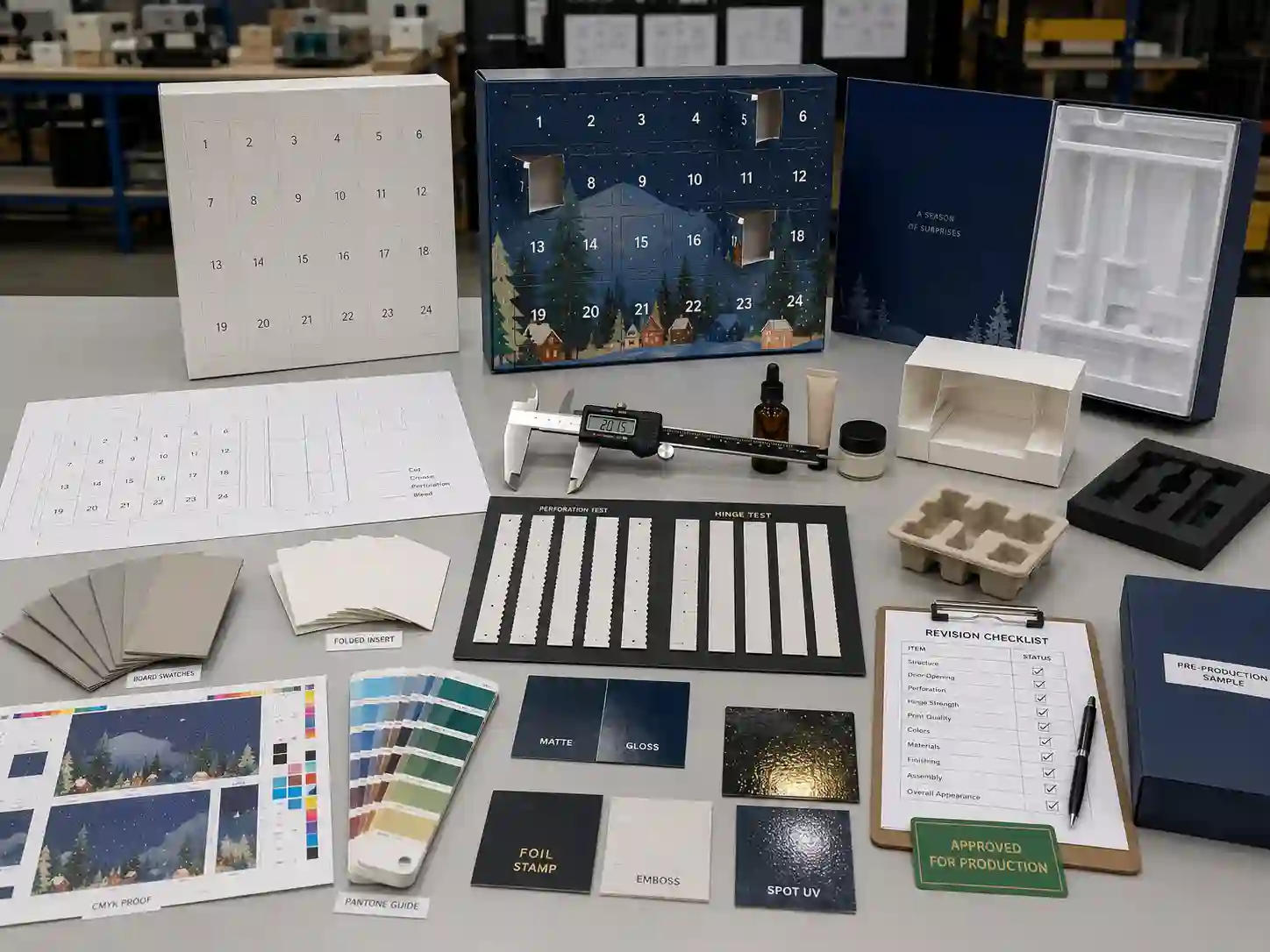
| Sample stage | Main purpose | Door-opening checks | Approval decision |
|---|---|---|---|
| Blank structural sample | Validate dimensions, dieline, compartments, insert fit, and assembly method. | Opening position, perforation concept, hinge direction, finger access, product removal. | Approve or revise structure before expensive printing and finishing. |
| Printed sample or prototype | Review CMYK or Pantone color, artwork position, numbering, lamination, and finishing. | Ink cracking, foil crossing perforations, registration around doors, visual alignment after opening. | Approve artwork and finishing appearance, subject to final materials. |
| Pre-production sample | Represent the intended mass-production specification as closely as possible. | Fully loaded function, repeated opening, assembly tolerances, closure security, packing compatibility. | Sign and retain as the control reference for mass production and QC. |
The blank sample should be tested with real products even if its paper color and finish are not final. Structural changes made after artwork approval can move door positions, numbers, decorative borders, and foil-stamping areas.
On the printed sample, inspect whether the dieline and artwork registration keep numbers, text, and graphics centered on each door. Foil stamping, embossing, and spot UV should not unintentionally bridge a perforation unless testing confirms that the finish will tear cleanly.
The pre-production sample should use the confirmed paperboard, greyboard thickness, insert, printing method, lamination, adhesive, accessories, and assembly process. Both buyer and supplier should keep an approved reference sample or clearly documented approval record.
How should artwork and finishing be designed around the doors?
Artwork should make the opening edge intuitive while allowing realistic printing and die-cutting tolerances. Fine borders, small numbers, and critical text should not be placed too close to perforations or score lines.
Buyers should review the production dieline at full size and confirm:
- Door numbers match the product-loading plan.
- Critical graphics stay inside the supplier’s recommended safe area.
- Bleed extends correctly across all cut edges.
- Barcodes and legal text are not placed on tear-away areas.
- Foil stamping and embossing do not weaken narrow door bridges.
- Matte or gloss lamination does not make perforations difficult to release.
- The artwork orientation remains correct after folding and assembly.
CMYK printing may be suitable for photographic graphics, while Pantone references can help control important brand colors. Buyers should still approve a physical or contract proof because monitor colors do not reliably predict paper, ink, lamination, or foil appearance.
For responsibly sourced paper requirements, buyers can ask suppliers to provide applicable documentation and verify current chain-of-custody claims through the official Forest Stewardship Council resources rather than relying only on an unverified logo in a quotation.
What practical checklist should buyers use during sample approval?
Approve the sample only after structure, appearance, product fit, and handling have been reviewed together. The checklist should record pass, fail, required revision, responsible party, and the version date.
- Confirm finished box dimensions and door positions against the approved dieline.
- Load every product into its assigned numbered compartment.
- Check whether doors remain flat before opening.
- Open every door using normal finger pressure.
- Record doors that are too tight, too loose, or difficult to start.
- Inspect perforation edges for uncontrolled tearing or fiber damage.
- Confirm hinges stay attached and fold in the intended direction.
- Check that adjacent doors and printed areas remain undamaged.
- Remove each product and assess finger access.
- Test the box upright, flat, and after simulated handling.
- Review print registration, numbering, CMYK or Pantone color, lamination, foil, embossing, and spot UV.
- Confirm insert locking, adhesive locations, ribbons, magnets, and accessories.
- Check the inner pack, export carton, corner protection, and shipping marks.
- Photograph approved details and clearly mark all revisions.
- Sign or digitally approve the final pre-production sample specification.
How do MOQ, cost, and lead time change with the door design?
Door count alone does not determine cost. The main cost drivers are box structure, finished size, material thickness, insert type, die-cut complexity, printing coverage, finishing processes, hand assembly, product loading, protective packing, and the quantity ordered.
A folding-carton format may have a lower unit cost at suitable production quantities, while a rigid door-opening box requires greyboard cutting, paper wrapping, mounting, insert assembly, and more manual QC. Irregular door shapes, many door sizes, windows, ribbons, magnets, or mixed inserts can increase tooling and labor.
MOQ should be discussed together with the final specification. Suppliers may have different practical minimums for offset printing, rigid-box assembly, molded inserts, foil stamping, or custom export cartons. Buyers should ask whether the quoted MOQ applies to one design, one size, one artwork version, and one shipping destination.
Lead time should separate structural development, blank sampling, printed sampling, revision rounds, material procurement, mass production, product loading, inspection, and export preparation. Delayed product data or artwork revisions can affect the schedule more than the physical sampling process itself.
How should buyers compare door-opening box suppliers?
Compare suppliers by the quality of their engineering questions and sample-control process, not only by the lowest quotation. A capable supplier should identify risks involving product weight, insert movement, perforation strength, finishing across doors, assembly tolerances, and export handling.
Use this supplier decision guide
- Choose a supplier with structural sampling support when product sizes vary or the layout contains many door dimensions.
- Choose a supplier with insert-development experience when products are fragile, heavy, irregular, or packed vertically.
- Choose a supplier with documented approval control when several artwork versions, languages, or product-loading plans are involved.
- Choose a supplier with export-packing experience when boxes have delicate corners, foil surfaces, book-style covers, or large display dimensions.
- Request inspection evidence when consistent opening performance is a critical acceptance requirement.
Ask whether the supplier manufactures the complete box, outsources specific processes, or coordinates multiple factories. Outsourcing is not automatically a problem, but responsibility for tolerances, color control, assembly, and final inspection must be clear.
Buyers can review the capabilities of the Giftpackpro packaging factory and discuss relevant custom advent calendar box services before deciding which sampling sequence is appropriate.
What QC checks are required before mass production ships?
Mass-production QC should compare finished boxes with the approved pre-production sample and measurable specifications. Inspectors should not judge door performance only by appearance while boxes remain unopened.
A practical inspection plan may include:
- Finished dimensions and box squareness.
- Door location and numbering accuracy.
- Perforation completeness and opening-force consistency.
- Hinge attachment and tear-path control.
- Insert alignment and cavity dimensions.
- Product loading and removal.
- Print registration and color consistency.
- Lamination, foil, embossing, spot UV, and edge-wrapping defects.
- Adhesive marks, loose panels, exposed greyboard, or damaged corners.
- Inner packing, export-carton strength, carton quantity, and shipping marks.
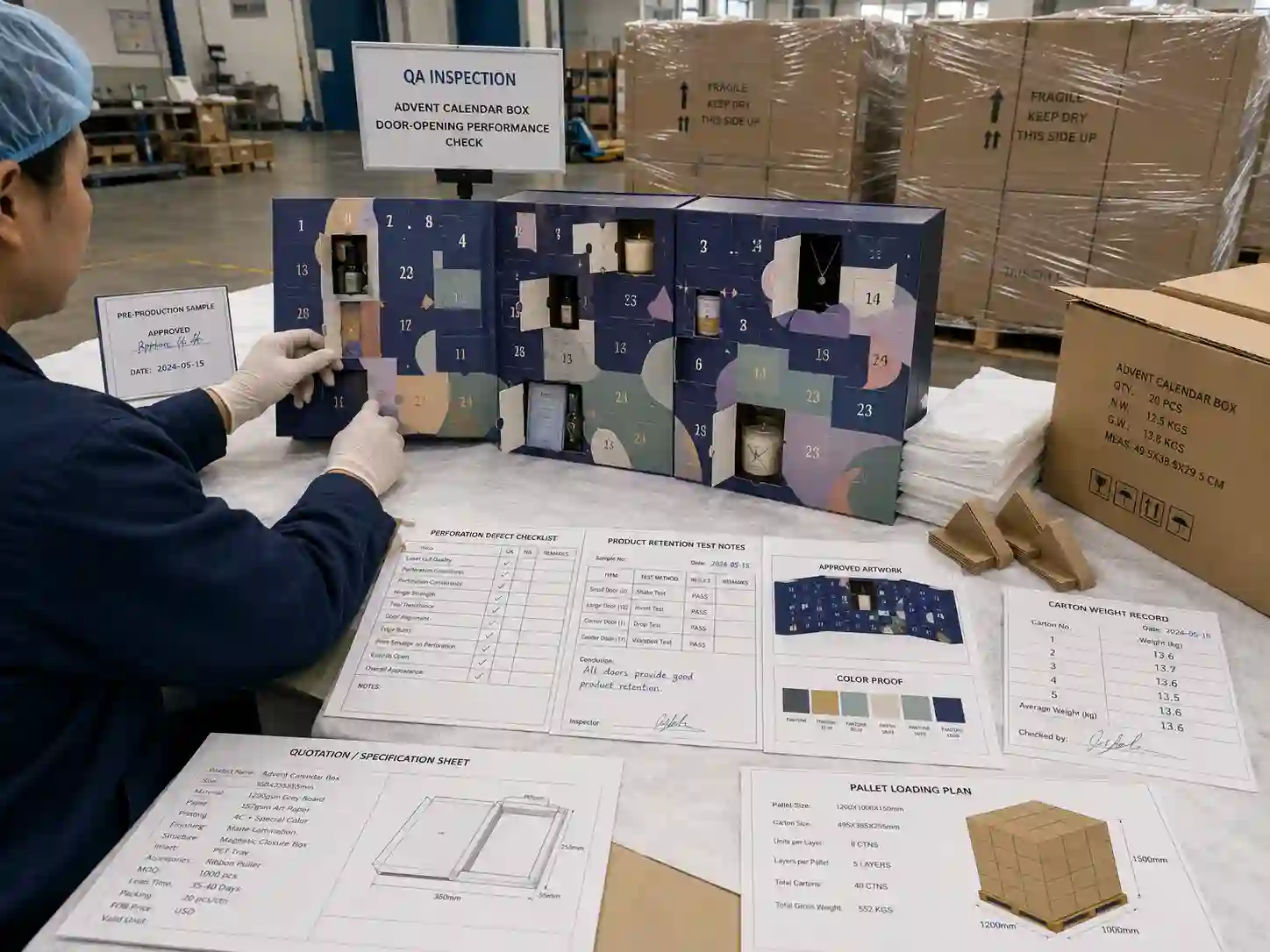
Opening a door is destructive for tear-open designs, so the sampling plan should specify how many finished units and which door positions are tested. Include small, large, edge, corner, and center doors rather than testing only one convenient compartment.
Buyers arranging transport testing can discuss an appropriate distribution-test method with their logistics and packaging teams and refer to official information from the International Safe Transit Association. The selected test level should reflect the packed product, shipping route, palletization, and sales channel.
How should export packing protect door-opening calendars?
Export packing should prevent compression, abrasion, moisture exposure, corner impact, and movement inside the master carton. Doors can become loose or visibly outlined if products press against the face panel during transport.
Depending on the box structure, packing may require tissue sheets, paper pads, protective sleeves, polybags where appropriate, corner protectors, partitions, reinforced export cartons, and pallet stretch wrapping. Foil, gloss lamination, and dark printed surfaces may need interleaving to reduce rubbing marks.
The export-carton specification should state carton dimensions, gross and net weight, units per carton, stacking direction, pallet pattern, and shipping marks. Buyers should also confirm whether cartons will be shipped loose-loaded or palletized because compression and handling conditions differ.
QC tip: Pack a small trial quantity exactly as intended for export, then reopen the cartons and perform the door-opening check again. This can reveal panel pressure, insert movement, surface rubbing, and corner damage that are not visible during an unpacked sample review.
What information should be included in a quotation request?
A complete RFQ helps suppliers quote comparable structures and reduces later cost changes. Avoid requesting only a price for “24-door advent calendar boxes” without product, size, material, insert, printing, packing, and quantity details.
Prepare the following information:
- Required box style and reference photos or sketches.
- Quantity, target delivery date, and destination country.
- Product list with dimensions, weights, orientation, and fragile areas.
- Number, approximate size, and opening direction of doors.
- Preferred paperboard, greyboard, or sustainability requirements.
- Insert preference: paper, PET tray, EVA, foam, molded pulp, or supplier recommendation.
- Artwork status and printing requirements.
- Required finishing, including lamination, foil stamping, embossing, or spot UV.
- Need for a blank sample, printed prototype, or pre-production sample.
- Product-loading, assembly, barcoding, or labeling requirements.
- Inner packing, export carton, pallet, and shipping-mark instructions.
- Inspection, testing, and documentation expectations.
Ask the supplier to separate tooling, sample, unit, insert, finishing, product-loading, export-packing, and freight-related costs where practical. This makes revisions easier to evaluate and helps purchasing teams compare quotations on the same basis.
Which common mistakes should buyers avoid?
The most common mistake is approving artwork before the product layout and door structure are stable. This creates avoidable revisions when doors, cavities, or opening directions change.
Other frequent problems include:
- Testing an empty box instead of a fully loaded sample.
- Using estimated product dimensions without packaging caps or bags.
- Ignoring how lamination or foil affects perforation release.
- Approving only the easiest door and not testing every door size.
- Placing products too close to the door panel.
- Failing to define whether doors are tear-open or reusable.
- Accepting a visual prototype that does not use production-equivalent materials.
- Not recording revisions by dieline and artwork version number.
- Leaving export packing and pallet requirements until production is complete.
- Comparing supplier prices based on different insert, material, or packing specifications.
Frequently asked questions about door-opening advent calendar boxes
How tight should a perforated door be?
It should remain securely closed during assembly, packing, transport, and handling, but open with normal finger pressure along the intended tear path. There is no universal opening-force value for every material and door size, so the approved physical sample should establish the buyer’s acceptance reference.
Should every door use the same perforation pattern?
Not necessarily. Large, narrow, curved, corner, and small doors may require different cut-to-bridge arrangements. The supplier should test representative door sizes during blank sampling.
Can foil stamping or spot UV cross a door perforation?
It is possible, but the finish may crack, bridge, or change the opening force. A printed physical sample should be tested before approval, particularly when foil or thick UV coating crosses a tear line.
Is a paper insert suitable for a vertical door-opening box?
It can be suitable for lightweight products when cavities, locking tabs, and support walls are correctly designed. Heavier or slippery products may require a formed tray or additional retention features.
What is the most important sample to approve?
The final pre-production sample is the main production reference because it should combine the approved structure, material, insert, artwork, printing, finishing, accessories, and assembly method. Blank and printed samples remain important development steps before that approval.
How many boxes should be opened during final inspection?
The inspection quantity should reflect order size, buyer requirements, defect risk, and the destructive nature of the test. The plan should cover different carton positions and representative small, large, edge, center, and corner doors.
Prepare your sample and quotation request
A successful door-opening advent calendar box check starts before production, with accurate products, a controlled dieline, a realistic insert, and clearly documented sample approval. Before contacting Giftpackpro, prepare your quantity, product dimensions and weights, door layout, artwork status, preferred materials, insert requirements, finishing, delivery destination, and target date.
Buyers can review more advent calendar box buying guides, work with a custom advent calendar boxes manufacturer, or request a custom quote for a blank sample, printed prototype, pre-production sample, or mass-production project.


