Quick answer: A useful packaging failure engineering case study should show what failed, the requirement that was not met, how the failure was identified, the evidence used to investigate it, the confirmed or most defensible cause, the corrective action, and the result of verification after the change. The strongest case studies preserve traceability between drawings, samples, material specifications, measurements, inspection records, packing evidence, and approval decisions instead of presenting an unexplained before-and-after success story.
What makes a packaging failure useful as an engineering case study?
A packaging failure becomes useful when another buyer or engineer can follow the evidence from the original requirement through failure, investigation, correction, and verification. The objective is not to prove that problems never occur; it is to demonstrate how a supplier identifies and controls them.
For a multi-component advent calendar, for example, a problem might involve compartment fit, door clearance, structural alignment, board deformation, product movement, adhesive condition, or packing protection. A credible case study identifies the affected configuration precisely rather than describing it simply as a “packaging problem.”
The record should normally identify the relevant sample, drawing revision, material specification, product reference, inspection or test stage, and production or packing status. This prevents evidence from different revisions or projects from being combined accidentally.
What evidence should be captured before investigating the failure?
Capture the original condition before changing the sample or process. Measurements, photographs, inspection records, test conditions, sample identities, drawings, and material specifications establish what actually failed and provide the baseline for later comparison.
| Evidence | What it should establish | Buyer verification point |
|---|---|---|
| Requirement or drawing | The intended dimension, material, function, orientation, or acceptance condition | Confirm revision and approval status |
| Sample or batch identity | Which physical units produced the failure | Match IDs across photos, records, and test documents |
| Measurements | The actual condition rather than a visual impression | Check feature measured, units, method, and recorded result |
| Dated photographs | Visible condition at the relevant inspection or test stage | Confirm photos can be linked to the identified sample or batch |
| Material records | The specified and, where documented, actual material associated with the failure | Compare specification references and applicable records |
| Inspection or test record | How and when the failure was detected | Check method, acceptance criterion, result, and disposition |
| Packing records | The configuration used if packing or transport exposure is relevant | Verify quantity, orientation, protection, carton identity, and revision |
Not every case needs every document. The evidence set depends on the failure mechanism. A dimensional fit problem may require detailed measurements and drawing references, while a packing-related problem may require carton specifications, loading configuration, packing photographs, and handling or test records.
How should the original failure be defined?
Define the failure against a specific requirement wherever possible. “The insert did not work” is weak documentation; “the identified product could not be seated without interference in the approved sample configuration” gives engineers a condition that can be investigated and retested.
A useful failure statement separates three things: the requirement, the observed condition, and the consequence. It should avoid declaring a root cause before investigation has established one.
What should you avoid in the failure statement?
Avoid unsupported conclusions such as “the board was too weak” when the available evidence only shows deformation. Board grade, thickness, grain direction, geometry, loading, humidity exposure, assembly, or another factor may require investigation before a cause can be assigned.
This distinction improves case-study credibility because it separates a verifiable fact—such as a measured dimension or recorded deformation—from an engineering interpretation that still needs evidence.
How do you investigate the root cause without turning the case study into guesswork?
Compare the failed condition against controlled references and test plausible causes systematically. Drawings, approved samples, material specifications, actual measurements, production records, and packing records should narrow the investigation.
A practical investigation may include:
- Confirm the affected sample, batch, or packing configuration.
- Confirm which drawing and material specification applied.
- Measure the failed feature and relevant surrounding features.
- Compare results with approved requirements or reference samples.
- Review whether materials, assembly, printing, converting, packing, or handling differed from the intended condition.
- Identify candidate causes and record the evidence supporting or rejecting each one.
- Define the cause only to the level supported by the available evidence.
For complex failures, several contributing factors may exist. A case study is more credible when it acknowledges this than when it forces every problem into a single convenient explanation.
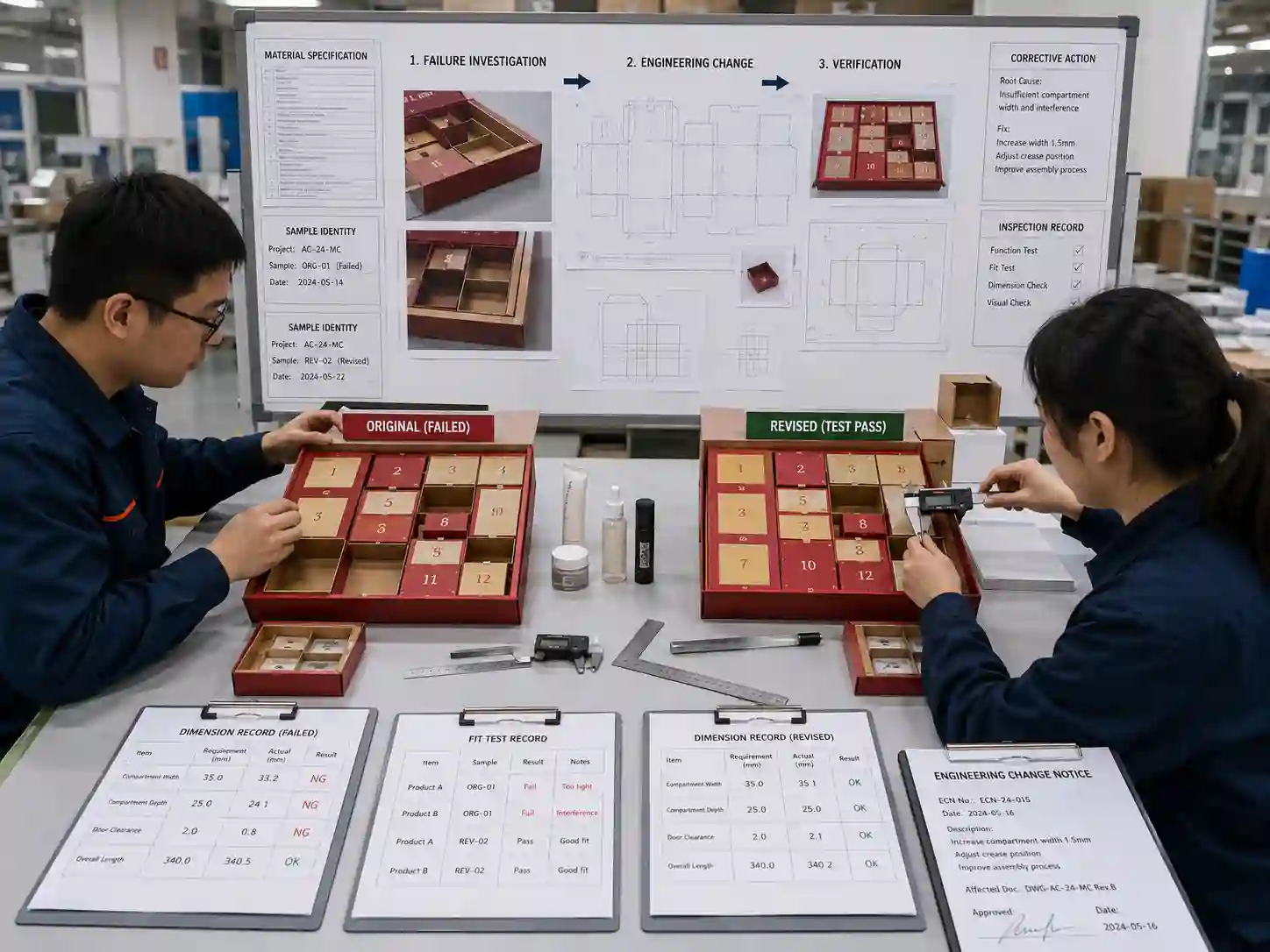
How should corrective action be documented?
The corrective action should connect directly to the investigated cause and be represented by a controlled change. Revised drawings, specifications, packing instructions, tooling information, process controls, or inspection requirements should identify exactly what changed.
For example, if an identified compartment interferes with a product, the engineering record might show the original geometry, actual measurements, revised geometry, new drawing revision, revised sample identity, and subsequent fit verification. If the issue originated in packing, the equivalent evidence might document changes to orientation, protective components, carton configuration, or packing instructions.
Keep project-dependent recommendations separate from confirmed corrective actions. An engineer may recommend increasing clearance, adding support, or changing a material, but it does not become an approved project change until the appropriate review and approval process accepts it.
How do you prove that the correction actually worked?
Repeat the relevant inspection or test on an identified revised sample or configuration. Verification should use comparable requirements and conditions so the result demonstrates whether the corrective action addressed the original failure.
A useful verification checklist is:
- Is the revised sample or batch clearly identified?
- Is the new drawing, specification, or instruction revision recorded?
- Was the originally failed characteristic checked again?
- Are actual measurements or observations recorded rather than only “PASS”?
- Are the test or inspection conditions documented where they affect interpretation?
- Can revised photographs be linked to the reinspection record?
- Were related characteristics checked for unintended effects where appropriate?
- Is the disposition or approval status clear?
A successful revised sample does not automatically prove that every future production unit will behave identically. The case study should state what was actually verified—for example, a particular revised sample, trial, inspection, or production batch—without expanding that result into an unsupported guarantee.
What does strong versus weak failure documentation look like?
Strong documentation creates a traceable engineering sequence. Weak documentation relies on photographs, general explanations, and success claims that cannot be tied to controlled project records.
| Weak documentation | Stronger engineering evidence |
|---|---|
| Photo captioned “insert problem” | Photo linked to sample ID, drawing revision, affected feature, and inspection record |
| “Size was incorrect” | Specified dimension and actual measured condition recorded with the measurement reference |
| “Material upgraded” | Original and revised material specifications identified by controlled references |
| “Factory fixed the problem” | Corrective action linked to a revised drawing, specification, process, or packing instruction |
| Unidentified before-and-after photos | Original and revised samples have traceable identities and dates |
| “Retest passed” | Reinspection or test record identifies method, requirement, revised sample, and recorded result |
How should a packaging failure engineering case study separate facts, recommendations, and approvals?
Label these categories clearly because they serve different purposes. Measurements and controlled records can establish facts; engineering proposals depend on project conditions; commercial or technical acceptance belongs to the authorized buyer or other designated approver.
Verifiable facts can include drawing revisions, measured dimensions, identified materials, inspection results, sample identities, dated photographs, and recorded packing configurations.
Project-dependent recommendations can include changing clearance, structure, material, protection, assembly sequence, inspection frequency, or another engineering control. Their suitability depends on the product, packaging design, manufacturing process, handling conditions, and acceptance criteria.
Buyer approvals should remain identifiable as approvals. A supplier can present engineering evidence and recommend a solution, but changes affecting agreed specifications, appearance, function, materials, or packing may require buyer authorization according to the project’s approval process.
How can buyers use failure case studies to evaluate supplier capability?
Use the case study to examine the supplier’s control process rather than simply judging whether the final sample looks good. The most useful evidence shows whether the supplier can preserve traceability, investigate discrepancies, control revisions, implement corrective action, and demonstrate verification.
Ask to see enough of the evidence chain to answer practical questions: Was the failed unit identifiable? Was there a controlled requirement? Were actual conditions measured? Was the root-cause conclusion supported? Did the correction create a new controlled revision? Was the changed configuration inspected again?
Where commercially sensitive information must be removed, anonymized records can still be useful if document relationships, revision references, sample identities, measurements, dates, and verification status remain understandable.
Buyers evaluating broader supplier controls can also review the Giftpackpro packaging factory, explore custom advent calendar box services, or use the advent calendar box buying guides for related procurement topics.
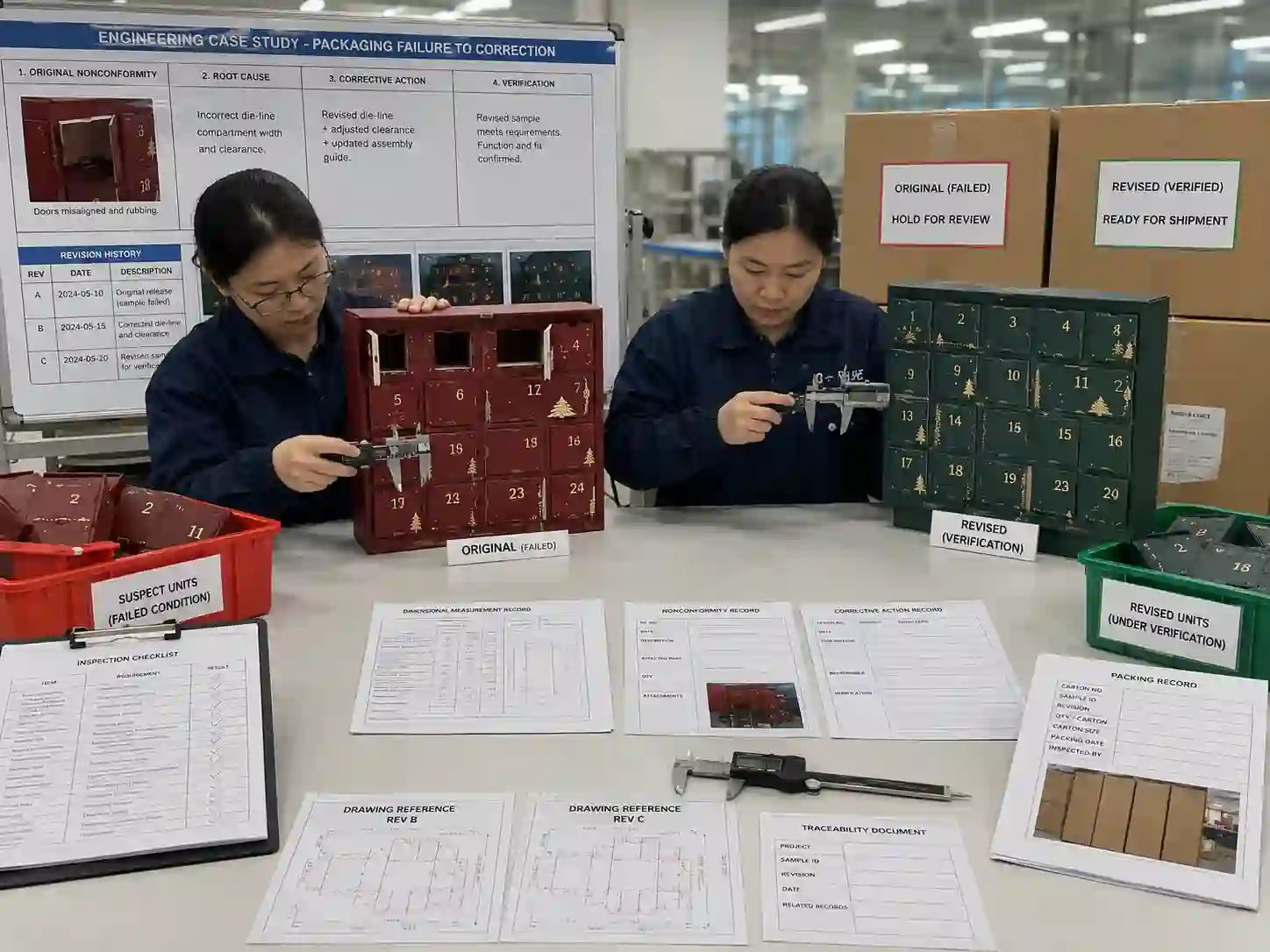
What risks can make a packaging failure case study misleading?
The main risk is presenting a polished story without enough traceable evidence to reproduce the decision logic. Selective photos, mixed revisions, missing failed samples, undocumented material changes, and non-comparable retests can make an apparently detailed case study unreliable.
Other warning signs include measurements without drawing references, test reports that cannot be linked to the project, corrective actions with no revision history, or claims that a single sample result proves general production performance.
The case study should also avoid hiding unresolved results. If a revised configuration produced a conditional result or required another correction, documenting that sequence can provide more useful evidence of engineering control than presenting an artificially perfect first revision.
What should the final case-study record contain?
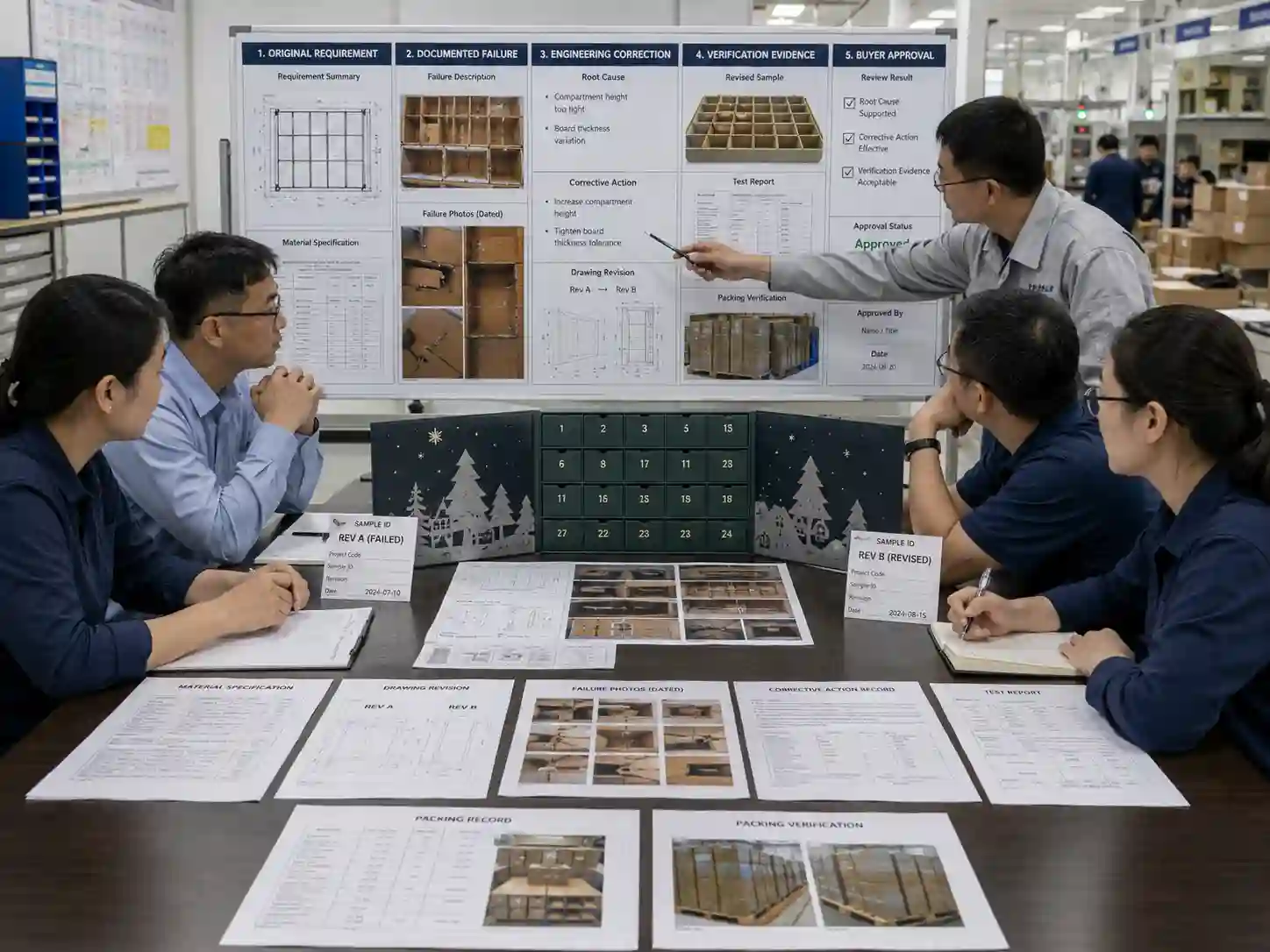
The final record should let a technically informed reviewer reconstruct the problem and its resolution without relying on verbal explanations. Keep the evidence concise, identifiable, and linked through revision and traceability references.
- Original requirement and controlled reference
- Affected sample, batch, or packing identity
- Failure description and objective evidence
- Relevant measurements, photographs, inspections, or tests
- Root-cause investigation and supporting evidence
- Corrective action and controlled revision
- Revised sample or configuration identity
- Verification or reinspection result
- Any remaining limitations or project-dependent conditions
- Required buyer or technical approval status
Frequently asked questions
Should a supplier show failures in a packaging case study?
Yes, when the failure can be presented with appropriate project confidentiality and traceable evidence. A documented failure can reveal more about engineering discipline than an unexplained successful sample because it shows how discrepancies are investigated, corrected, and verified.
Do before-and-after photographs prove that corrective action worked?
No. Photographs are supporting evidence, but verification normally requires the revised condition to be checked against the relevant requirement using appropriate measurements, inspection, or testing. The photographs should be linked to those records.
Does every packaging failure require laboratory testing?
No. The appropriate verification method depends on the failure. Some dimensional, assembly, fit, appearance, or packing discrepancies can be evaluated through controlled measurement and inspection, while other performance questions may require defined physical testing.
Can one successful revised sample close the case?
Only if that level of verification is appropriate to the project’s requirements and approval process. A revised sample can demonstrate that a design correction worked on that identified sample, but production controls, additional testing, or batch inspection may still be required depending on the risk.
If you are reviewing an advent calendar packaging project and want the supplier’s engineering evidence, revisions, samples, and verification records considered during development, request a custom quote and provide the product and packaging requirements that need to be evaluated.