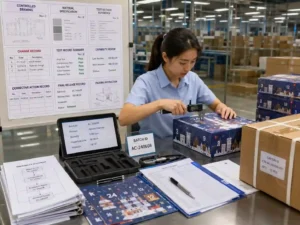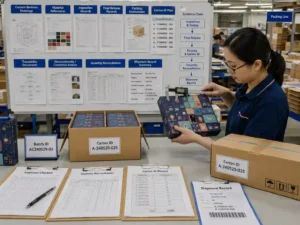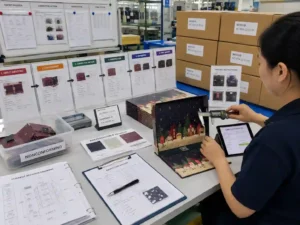
Quick answer: Useful export packing case study data should connect the actual packed product to its carton specification, packing configuration, inspection records, traceability references, transport-related checks and any corrective action. Buyers should be able to distinguish what was specified, what was actually packed, what was inspected and what was approved. Photos alone are weak evidence unless they can be linked to identified samples, production lots, cartons or controlled records.
What export packing case study data should buyers expect to see?
A credible case study should contain enough information to reconstruct the packing decision and verify the important claims. It does not need to disclose confidential customer information, but it should show identifiable technical evidence rather than unsupported statements such as “export-safe packing” or “reinforced cartons.”
For custom advent calendar packaging, useful evidence normally covers the packed product identity, packing configuration, carton specification, quantities, inspection method, observed results and approval status. The exact evidence varies with calendar construction, finished weight, shipment method and customer requirements.
| Information | Useful evidence | What the buyer can verify |
|---|---|---|
| Product or project identity | Sample ID, SKU reference, drawing revision or production reference | Which calendar configuration the evidence applies to |
| Unit packing method | Photos, packing instruction or controlled diagram | Orientation, protection and arrangement of each finished unit |
| Master carton specification | Carton specification sheet and dimensions | Board or construction specification and stated carton size |
| Carton quantity | Packing record or packing list | Number of finished units packed per carton |
| Packed condition | Dated photos and QC records | Whether the recorded configuration matches the physical packing |
| Measurements | Dimension or weight records where applicable | Whether recorded values correspond with defined requirements |
| Inspection or test | Method, sample identification and result record | What was checked and what actually happened |
| Nonconformity | Issue record, affected quantity and disposition | Whether problems were documented rather than omitted |
| Corrective action | Revised specification, packing change and reinspection record | Whether the claimed improvement was implemented and verified |
| Approval | Buyer approval or controlled internal release record | Which decisions were accepted and by whom |
How should the case study identify the packed advent calendar?
The evidence should identify exactly which product configuration was packed. This is essential because an export-packing result for one advent calendar construction cannot automatically prove suitability for another.
Useful identifiers can include the project reference, SKU, sample number, drawing revision, finished dimensions, product configuration and production or inspection date. Where confidentiality prevents publication of customer names, anonymized project references can still preserve traceability.
The identification should also make revision status clear. If the case study shows a revised carton or packing method, buyers should be able to determine whether the photographs and inspection records relate to the original or corrected version.
Which carton and packing specifications should be documented?
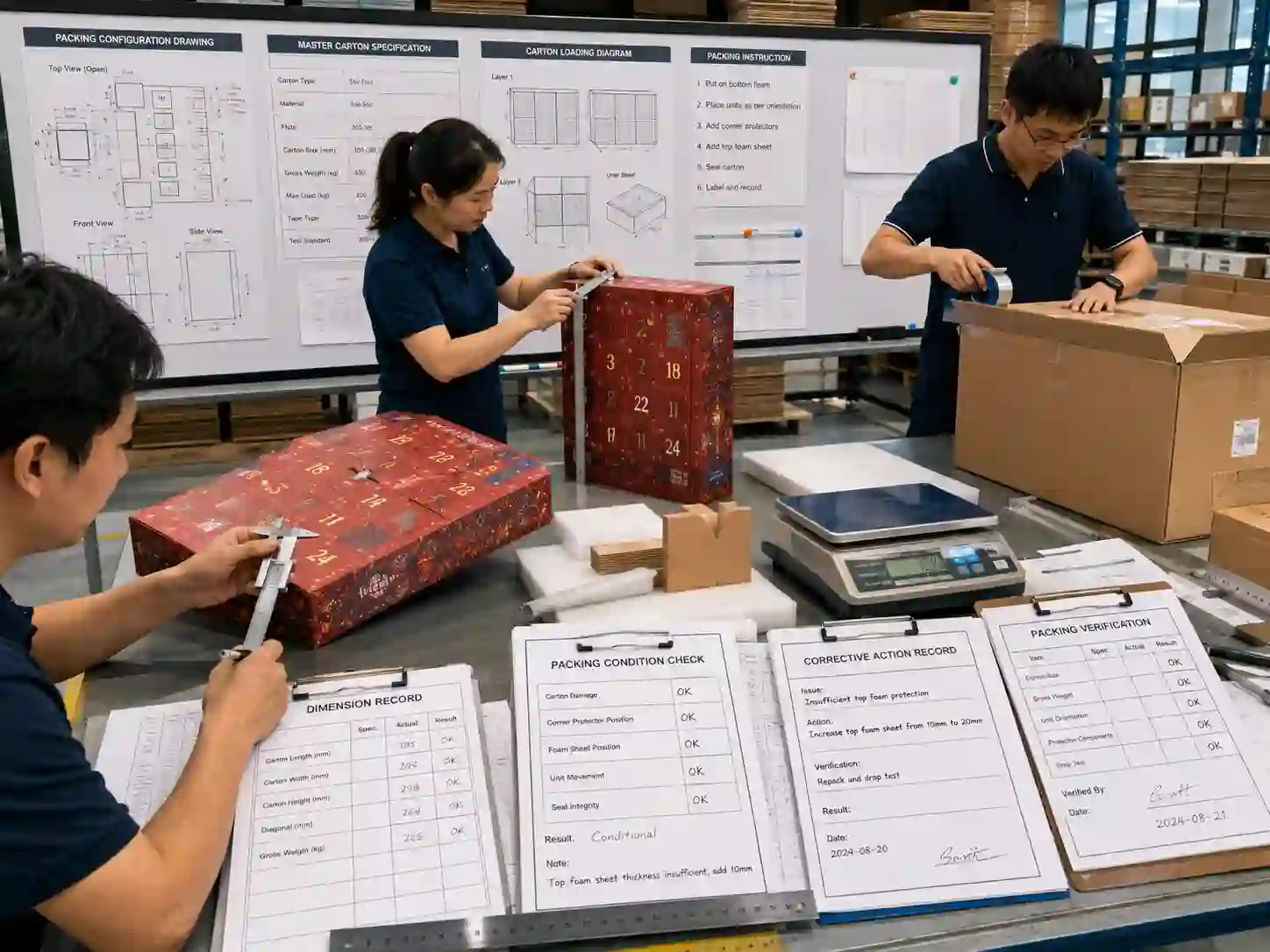
The case study should state the specifications that materially affected the packing decision and support them with controlled records. Dimensions, construction and packing quantity are more useful than vague descriptions such as “heavy-duty export carton.”
Depending on the project, relevant information may include:
- finished advent calendar dimensions and packed orientation;
- individual protection such as sleeves, bags, wraps or corner protection where used;
- units per master carton and their arrangement;
- master-carton internal or external dimensions, clearly identified;
- carton material or construction specification;
- dividers, pads or other internal protective components;
- closure and sealing method;
- gross or net weight where weight is part of the controlled packing requirement;
- carton identification and traceability marking.
A published case study does not need to expose commercially sensitive specifications. However, any claim about a specific packing feature should have corresponding evidence available for buyer review.
How should packing photos be connected to records?
Packing photos become stronger evidence when they are traceable to a defined stage, product identity and controlled record. A photograph of sealed cartons by itself cannot show what was inside, which specification was followed or whether the photographed cartons belonged to the reported project.
What should a useful photo sequence show?
A practical sequence can document the finished unit, protective materials, unit orientation, loading pattern, filled carton, closure condition and identified completed carton. When measurements or inspections are important, the corresponding photograph should be linked to the recorded result.
Dated photos, sample or batch references, carton identifiers and drawing or packing-instruction revisions help create this connection. The objective is not to produce more photographs; it is to make each important photograph verifiable.
What inspection and test evidence should appear?
The case study should identify what was actually inspected or tested, the method used and the recorded outcome. It should not turn an observation into a broader performance claim that the evidence cannot support.
For example, a dimensional inspection can verify recorded carton dimensions. A documented packing trial can demonstrate how identified units fit into a stated configuration. A project-specific handling or transport simulation can support only the conditions actually represented by that method.
Useful records therefore identify the sample or packed carton, requirement, inspection stage, method, measured or observed result, acceptance status and date. Where relevant, the equipment or measuring method should also be identifiable.
Buyers should be cautious when a case study claims that packing “passed testing” but does not identify the test, sample, acceptance criteria or result. The strength of the claim should never exceed the strength of the record behind it.
How should a case study document packing problems and corrective action?
A strong case study can be more credible when it shows a real packing problem and its controlled resolution. The important point is to document the sequence from detected condition to correction and verification.
| Weak documentation | Stronger documentation |
|---|---|
| “The carton was improved.” | The original carton or packing revision is identified, the observed problem is recorded, and the revised configuration has a new controlled reference. |
| Before-and-after photos with no labels | Photos identify the relevant sample, revision, inspection stage and affected feature. |
| “Extra protection was added.” | The record identifies what protection changed, why it changed and which revised packing instruction applies. |
| “Problem solved.” | A reinspection or repeat check records the result after corrective action. |
If cartons showed excessive movement, deformation, abrasion or another project-specific issue, the record should distinguish the observed condition from the proposed remedy. It should then identify the revised packing method and subsequent verification.
How can buyers verify that a case study reflects production capability?
Buyers should look for continuity between specifications, production evidence and QC records. A polished sample photograph demonstrates much less than a traceable sequence showing how the defined packing method was applied and checked.
A focused verification checklist is:
- Confirm that the product, sample or production reference is identifiable.
- Check that drawings, carton specifications and packing instructions show revision status.
- Match packing photos to the configuration described in the records.
- Verify important dimensions, quantities or weights against recorded requirements where applicable.
- Confirm that inspection or test claims identify a method and result.
- Look for nonconformity and corrective-action records when the case study describes a problem.
- Confirm that revised conditions were reinspected rather than merely photographed.
- Separate supplier verification records from decisions requiring buyer approval.
Commercial buyers assessing a potential supplier can also review broader manufacturing and QC capability through the Giftpackpro packaging factory information and custom advent calendar box services.
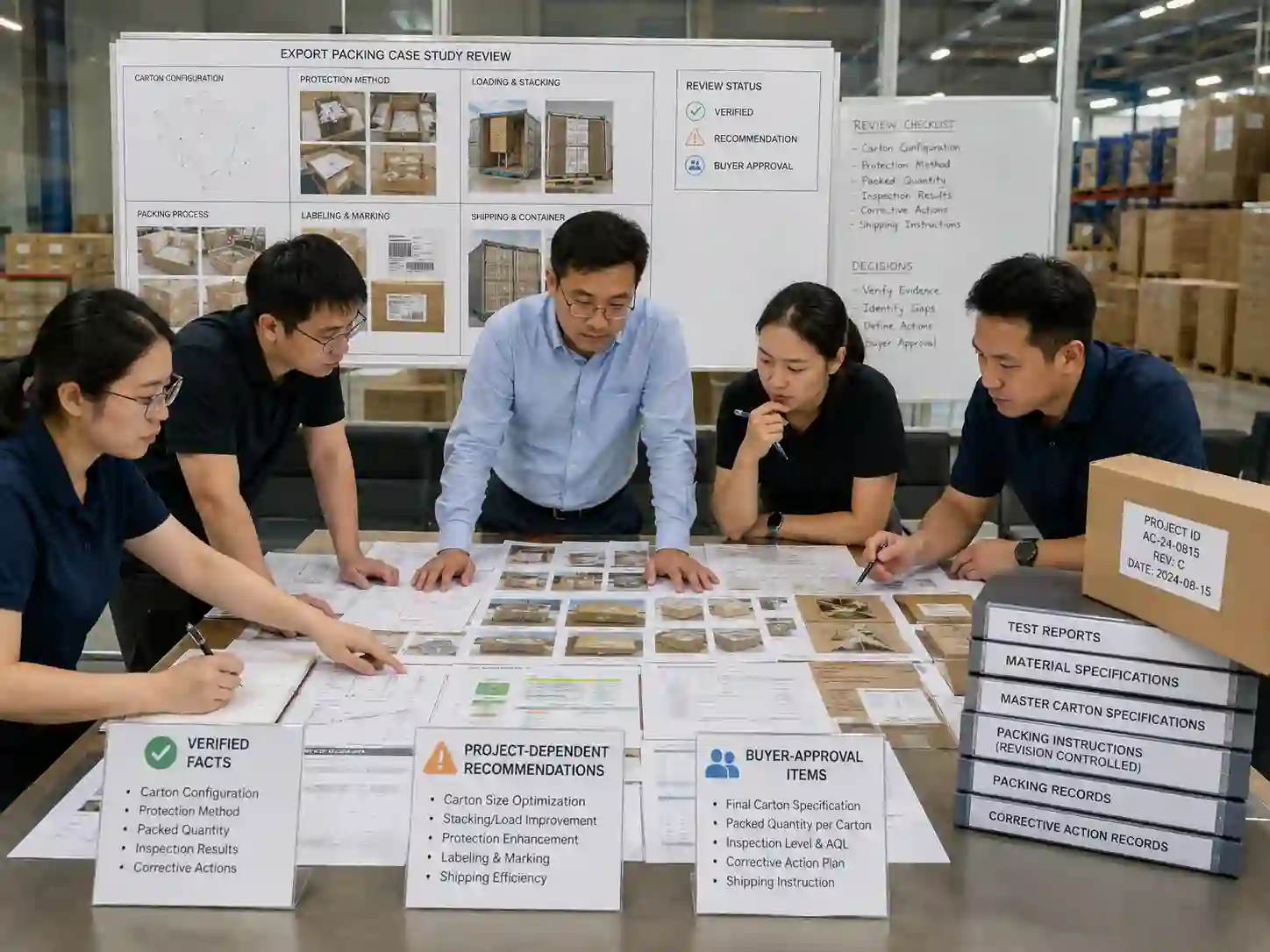
Which information is fact, recommendation or buyer approval?
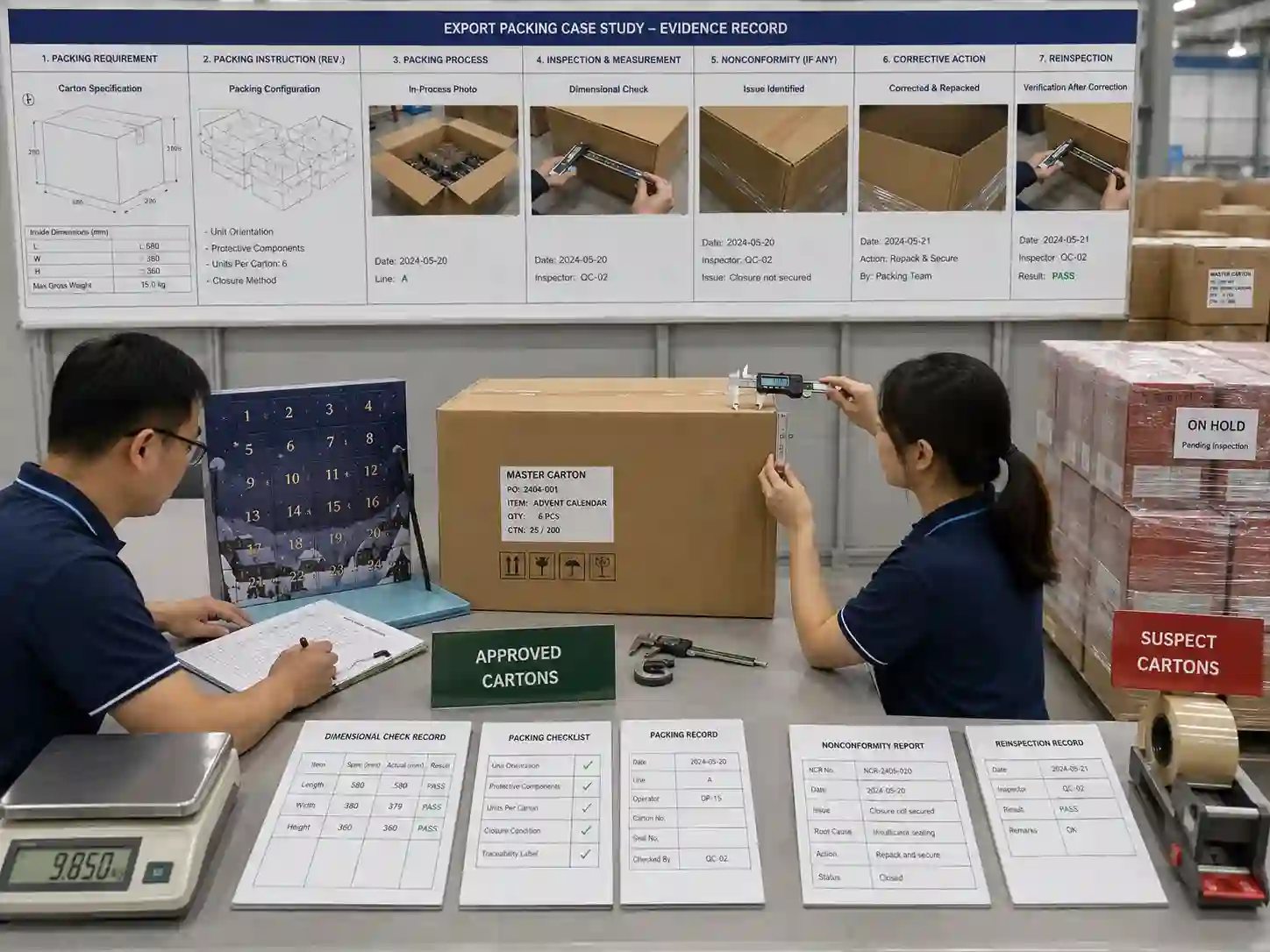
A well-structured case study should clearly separate recorded facts from engineering recommendations and commercial approvals. Mixing these categories can make evidence appear more conclusive than it actually is.
What should be treated as verifiable fact?
Recorded dimensions, identified materials, packing quantities, inspection dates, observed defects, documented test conditions and recorded results can be treated as verifiable facts when the supporting records are available.
What remains project-dependent?
Recommendations about carton construction, protective materials, packing orientation or additional verification remain project-dependent. The correct solution can change with calendar dimensions, structural design, contents, weight distribution, surface finish, handling route and customer requirements.
What requires buyer approval?
Buyer-controlled specifications, accepted samples, agreed packing configurations, artwork or marking requirements and authorized deviations should not be presented as unilateral supplier decisions when approval is required. The case study should identify the relevant approval status without implying approval that was never recorded.
What are the main warning signs in an export packing case study?
The main warning sign is a gap between a strong claim and weak traceability. Attractive warehouse photographs do not compensate for missing specifications, unidentified samples or unexplained test results.
- Photos have no project, sample, batch or carton identity.
- The carton specification is described only with marketing terms.
- Different sample revisions are mixed without explanation.
- Testing is claimed without stating what was checked.
- Measured results are absent where dimensional claims are important.
- A packing problem disappears between photographs with no corrective-action record.
- Reinspection after correction is not documented.
- A single previous project is presented as proof that the same packing will suit every future product.
These gaps do not automatically prove poor packing capability, but they reduce the case study’s value as supplier evidence and create additional questions for procurement and quality teams.
FAQs about export packing case study evidence
Does an export packing case study need to disclose the original customer’s identity?
No. Commercially sensitive customer information can be anonymized while retaining project references, sample identities, revision numbers, dates and technical records needed for traceability.
Are packing photos enough to verify export packing capability?
No. Photos are useful supporting evidence, but they are stronger when connected to specifications, identified samples or production units, packing instructions and inspection records. A photograph cannot independently verify an undocumented technical claim.
Should failed packing checks be included in a case study?
They can add useful evidence when the failure, affected condition, corrective action and subsequent verification are documented. Removing all evidence of problems can make it harder for buyers to evaluate how the supplier controls nonconforming conditions.
Can one successful case study prove that the same packing works for another advent calendar?
No. A previous case study can demonstrate relevant experience and documentation capability, but a new project’s product dimensions, construction, contents, weight, finishes and logistics conditions may require different packing decisions and verification.
For a project-specific review, provide the calendar construction, finished dimensions, product loading information and relevant packing requirements when you request a custom quote from Giftpackpro so the proposed evidence can be matched to the actual project.