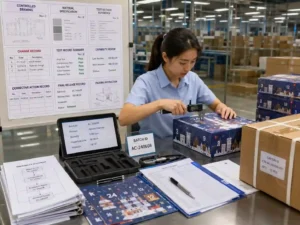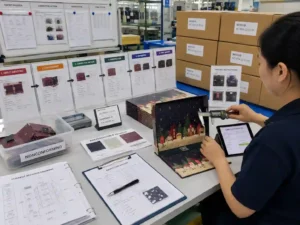
Quick answer: The most useful packaging production risk metrics are not isolated factory percentages. Buyers should compare defect rates by defect type, first-pass acceptance, rework frequency, dimensional nonconformities, process inspection results, corrective-action recurrence, traceability completeness, and packing nonconformities. Each metric should be supported by identifiable production records, inspection criteria, dates, sample or batch references, and corrective-action evidence. Comparable records reveal production control more reliably than unsupported claims such as “low defect rate” or “strict QC.”

Which packaging production risk metrics are most useful?
The strongest metrics show how often a defined production requirement is missed, where the problem occurs, and whether the supplier controls it before shipment. For custom advent calendar boxes, useful measures normally combine quality results with process and traceability evidence.
| Metric | What it can reveal | Evidence buyers should request | Main limitation |
|---|---|---|---|
| Defect rate by defect category | Recurring problems with structure, assembly, appearance, or function | Inspection records with defined defect classifications and quantities inspected | Percentages are not comparable if defect definitions differ |
| First-pass acceptance | How much production meets defined requirements before rework | Initial inspection records separated from reinspection records | A high rate means little without clear acceptance criteria |
| Rework rate | How frequently production requires correction | Rework records, affected quantities, reasons, and reinspection results | Different factories may record rework differently |
| Dimensional nonconformity frequency | Control of critical structural and fit dimensions | Controlled drawings, measurement sheets, gauges, tolerances, and sample identities | Only useful when measurements cover relevant critical features |
| Process inspection failures | Whether problems emerge repeatedly during production | First-piece and in-process inspection records with dates and production references | Inspection frequency varies by project and process |
| Corrective-action recurrence | Whether previously identified causes return | Nonconformity reports, corrective actions, revised controls, and later verification | Requires records across more than one inspection point |
| Traceability completeness | Whether a result can be linked to the correct material, sample, revision, or production lot | Batch references, revision identities, inspection sheets, and production records | Traceability structures differ between suppliers |
| Packing nonconformities | Whether finished goods are consistently packed to the approved requirement | Packing instructions, carton records, inspection photos, and nonconformity records | Relevant checks depend on the approved packing configuration |
Why is defect rate alone a weak supplier comparison?
A defect percentage is only meaningful when the denominator, inspection method, acceptance criteria, defect definitions, production stage, and period are known. Two suppliers reporting the same percentage may represent very different levels of risk.
For example, one supplier might count only rejected finished units, while another records every in-process structural, cosmetic, and assembly nonconformity. The second supplier could appear worse numerically while actually maintaining stronger visibility over its process.
Buyers should therefore ask what was inspected, how many units were checked, which requirements were applied, and whether reworked units were excluded from the original result. The objective is not to find the smallest percentage without context; it is to understand the production system behind the number.
How should buyers use first-pass acceptance and rework data?
First-pass acceptance helps distinguish production that initially meets requirements from production made acceptable through repeated correction. Rework records then show the type and frequency of intervention required.
For a multi-component advent calendar, rework could relate to door operation, component alignment, adhesive application, insert positioning, surface condition, or another approved characteristic. The relevant categories depend on the construction and specification.
A useful record separates the original inspection from the corrected condition. If failed units disappear into a final “pass” figure after rework, buyers lose evidence about actual process stability.
What should a credible rework record contain?
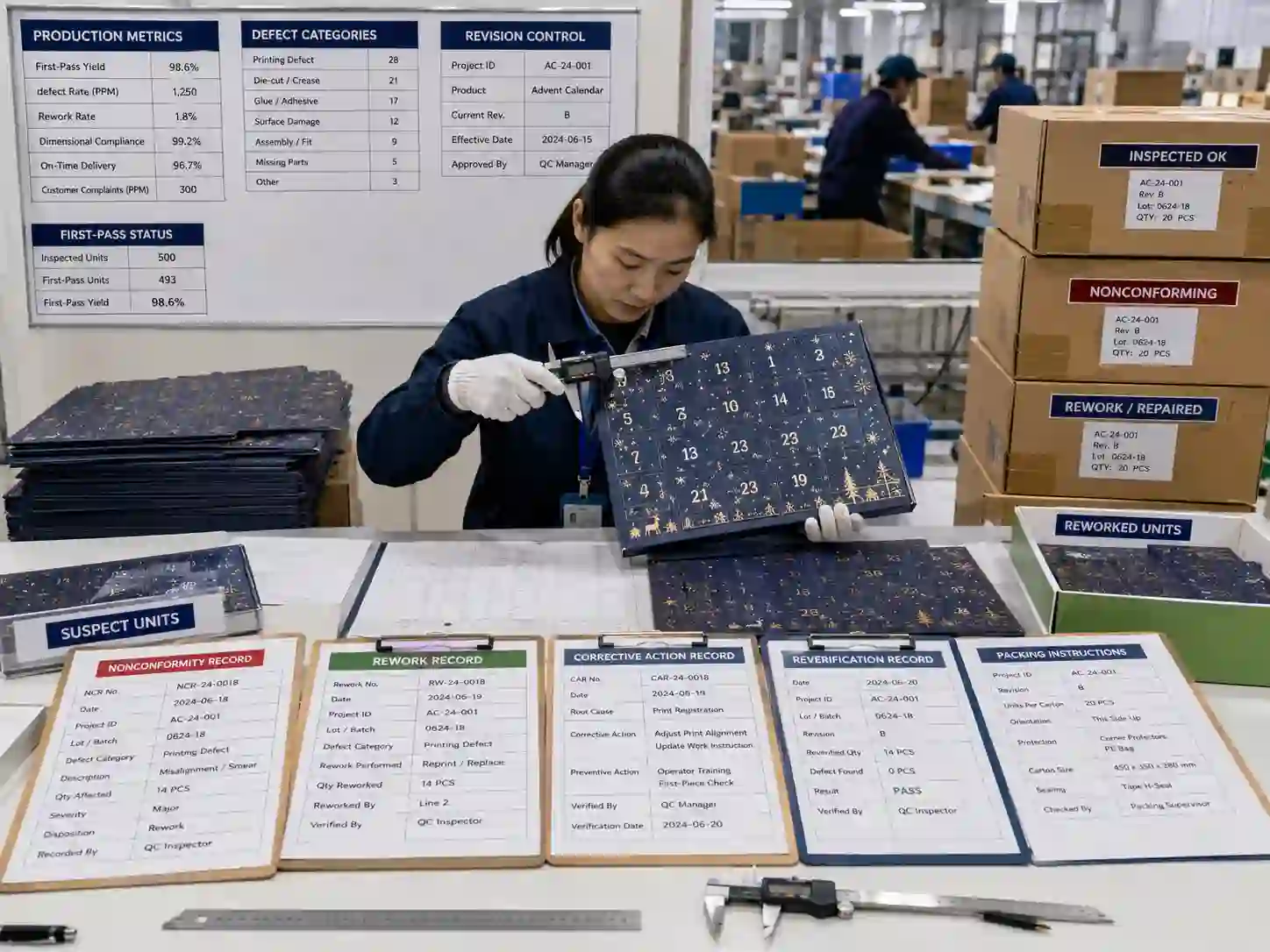
It should identify the affected production, nonconformity, quantity, disposition, correction, responsible inspection stage, and reinspection result. Where a design or process revision was required, the revised document or instruction should also be identifiable.
This creates an evidence chain rather than a standalone claim: requirement → observed failure → affected production → correction → reinspection → verified result.
Which dimensional metrics reveal structural production risk?
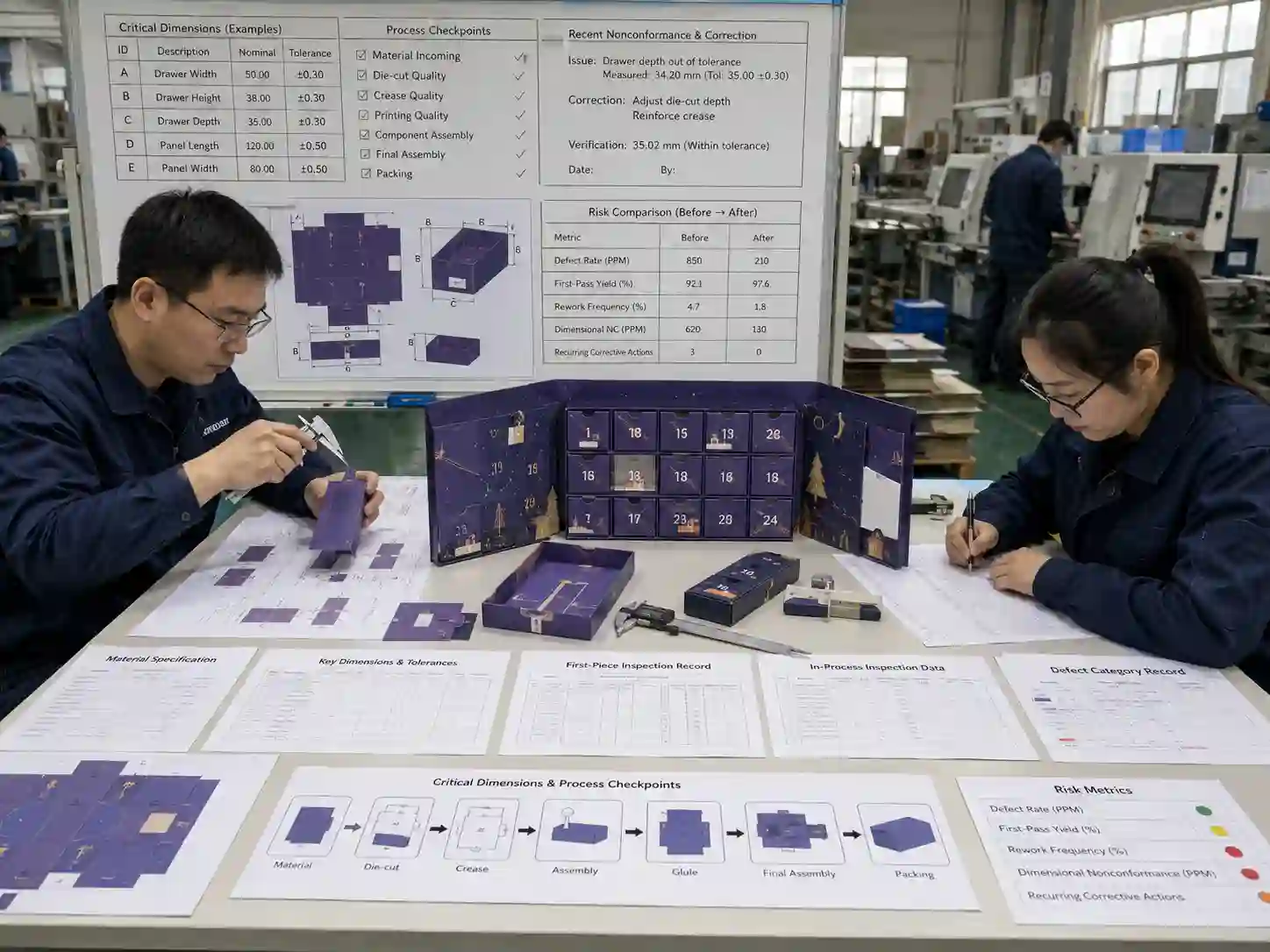
Dimensional data is useful when it focuses on characteristics that affect assembly, fit, alignment, or function. Buyers should prioritize controlled measurements rather than requesting large quantities of measurements with no connection to product risk.
For an advent calendar, the relevant characteristics might include compartment dimensions, drawer or door clearance, insert position, assembled depth, component alignment, or another drawing-controlled feature. Which dimensions are critical is project-dependent and should come from the approved structure and product requirements.
Measurement records are stronger when they show the drawing revision, specified dimension or tolerance, actual result, measuring method or equipment where relevant, sample identity, date, and inspection status.
How do corrective-action metrics expose recurring risk?
Corrective-action recurrence is often more informative than the number of corrective actions opened. A supplier can encounter a problem and still demonstrate effective control if the cause is documented, the correction is implemented, and later production verifies that the condition did not recur.
Buyers should look for repeated nonconformities involving the same feature, process, material, or assembly stage. Repeated closure of similar issues without evidence of changed controls may indicate that symptoms are being corrected without addressing the underlying production cause.
Useful evidence can include the original nonconformity record, root-cause analysis appropriate to the issue, revised drawing or work instruction, implementation record, and subsequent inspection evidence.
How can traceability make production metrics more credible?
A metric becomes more useful when buyers can trace it back to identifiable production evidence. Records should make it possible to understand which project, specification revision, sample or production reference, inspection stage, and result produced the reported number.
Traceability is especially important when a project changes during development or production. Combining results from different revisions can hide whether a problem belongs to the original condition or the corrected one.
Buyers reviewing a supplier such as a Giftpackpro packaging factory should therefore examine the relationship between records rather than treating a spreadsheet summary as sufficient evidence.
What does strong versus weak production-metric documentation look like?
Strong documentation defines the metric and preserves the underlying evidence. Weak documentation usually presents a favorable number without enough information for an independent buyer to interpret it.
| Weak documentation | Stronger documentation |
|---|---|
| “Defect rate: 0.8%” | Defined defect categories, inspected quantity, period, inspection stage, acceptance criteria, and linked inspection records |
| “QC pass: 99%” | Initial inspection result separated from rework and final reinspection |
| “Dimensions checked” | Drawing revision, required dimensions, tolerances, actual measurements, sample identity, and inspection date |
| “Problem solved” | Original nonconformity, documented cause, corrective action, revised control, and verification result |
| Unlabeled production photos | Dated photos linked to identifiable production, inspection stage, characteristic, and record |
| “Packing passed” | Approved packing requirement linked to identified cartons, inspection results, and packing records |
How should buyers verify packaging production risk metrics?
Verification should move from the summary metric to a small number of underlying records. Buyers do not necessarily need every factory record, but they need enough evidence to establish that the metric is defined, traceable, and calculated consistently.
- Define the metric. Confirm exactly what counts as inspected, accepted, defective, reworked, or rejected.
- Check the denominator. Establish whether the result relates to inspected samples, inspected production units, lots, cartons, or another defined population.
- Review acceptance criteria. Link results to controlled drawings, specifications, approved samples, inspection standards, or packing instructions as applicable.
- Separate inspection stages. Do not combine first-piece, in-process, final inspection, rework, and reinspection results without identifying them.
- Sample the source records. Select several reported results and trace them to dated inspection or production documents.
- Check revision status. Confirm that records relate to the correct structural, material, artwork, or packing revision where relevant.
- Investigate recurring failures. Review whether repeated issues generated corrective action and whether later evidence confirms the change.
- Compare equivalent definitions. Normalize supplier comparisons before drawing conclusions from percentages.
Which information is factual, project-dependent, or subject to buyer approval?
Keeping these categories separate prevents a production metric from being presented as a universal quality benchmark when it is actually dependent on the product and purchasing requirements.
| Category | Examples |
|---|---|
| Verifiable production facts | Measured dimensions, inspected quantity, recorded defects, rework quantity, inspection date, drawing revision, corrective-action status, identified packing records |
| Project-dependent recommendations | Critical dimensions to monitor, inspection frequency, defect categories, process checkpoints, required packing checks |
| Buyer approvals | Accepted specification, approved sample or revision, agreed tolerances where applicable, appearance criteria, permitted dispositions, final packing configuration |
A supplier can provide evidence for the first category and recommend controls for the second. The third category should remain tied to documented buyer requirements rather than being assumed by the supplier.
How should buyers compare two suppliers using production metrics?
Compare the quality of the evidence system before comparing headline numbers. A supplier with traceable, consistently defined records can provide a more meaningful risk picture than one presenting unusually favorable percentages with no source documentation.
A practical comparison should ask whether both suppliers use equivalent defect definitions, inspection stages, measurement criteria, rework treatment, and time periods. Buyers can then assess three questions: how frequently problems occur, how early they are detected, and how effectively they are prevented from recurring.
This approach also makes supplier capability discussions more concrete. Buyers evaluating custom advent calendar box services can request representative documentation relevant to the proposed construction instead of relying solely on general factory claims.
What should buyers avoid when interpreting production data?
Do not convert one project result into a permanent supplier performance claim. Production risk varies with structure, materials, tolerances, manual assembly content, specifications, production conditions, and the effectiveness of controls used for that particular project.
Buyers should also avoid setting arbitrary numerical targets without defining the inspection system behind them. A metric should support a purchasing or quality decision, not merely make a supplier scorecard look precise.
What should buyers request before relying on a supplier’s metrics?
Request a compact evidence package that allows representative metrics to be reconstructed from their source records. Sensitive commercial information can be appropriately controlled, but the documentation should still demonstrate how the supplier records and manages production performance.
- Metric definitions and calculation basis
- Representative inspection records
- Relevant controlled drawing or specification references
- Actual dimensional records for critical characteristics where applicable
- Initial failure and reinspection records for selected rework cases
- Nonconformity and corrective-action evidence for representative recurring or significant issues
- Sample, revision, batch, or other traceability references
- Packing records when packing performance is part of the metric being evaluated
Frequently asked questions about production risk metrics
Is a lower defect rate always evidence of a better packaging supplier?
No. A lower reported rate can result from different inspection coverage or defect definitions. Buyers should compare equivalent criteria and inspect the underlying records before treating the number as evidence of lower risk.
How much historical production data should a buyer request?
There is no universal period that fits every project. The evidence should be recent and sufficiently representative to show how relevant processes are measured, how nonconformities are recorded, and whether corrective actions remain effective over subsequent production.
Should buyers compare factory-wide metrics or project-specific records?
Factory-wide metrics can provide context, but project-relevant evidence is usually more useful for evaluating a specific packaging risk. A complex multi-component calendar should not be assessed only from aggregate figures covering unrelated packaging constructions.
Can production photos substitute for inspection records?
No. Photos can support verification when they are dated, identified, and linked to a requirement or recorded result, but they normally cannot establish quantities, tolerances, sampling basis, or corrective-action status by themselves.
To evaluate production controls for a specific advent calendar project, prepare the construction, product requirements, and key risk points, then request a custom quote and ask for the relevant supplier-evidence approach alongside the commercial review.