Quick answer: Buyers should define product sample production tolerance before approving production because samples and final units can vary slightly due to material behavior, manufacturing conditions, assembly methods, and product changes. For custom advent calendar packaging, tolerance should be controlled through approved drawings, measured samples, cavity validation, and documented acceptance criteria rather than relying only on visual comparison.

What does product sample production tolerance mean in packaging projects?
Product sample production tolerance describes the acceptable difference between an approved sample and the final production units. It defines which dimensional, structural, or fitting variations are acceptable before they affect product protection, appearance, or usability.
In advent calendar packaging, tolerance normally applies to areas such as:
- Product cavity length, width, and depth.
- Insert positioning and compartment alignment.
- Clearance between the product and surrounding materials.
- Overall box dimensions after assembly.
- Material thickness and folding behavior.
Verifiable tolerance decisions should be based on approved drawings, physical measurements, and production samples. A supplier and buyer should not rely only on photographs because small dimensional differences may not be visible.
Why can final production units differ from approved samples?
Final production units can differ slightly because packaging materials and manufacturing processes naturally have variation. The key is controlling the variation so it remains within an agreed range.
Which factors create sample-to-production differences?
The most common causes include:
- Material variation: paperboard, greyboard, inserts, and protective materials can change slightly with thickness, humidity, or supplier batches.
- Cutting and creasing variation: tooling accuracy and machine settings influence finished dimensions.
- Assembly variation: hand assembly, folding pressure, adhesive application, and insert placement can affect final fit.
- Product changes: the packaged item may differ from the original sample measurement after formulation, labeling, accessories, or protective packaging changes.
These differences should be reviewed against the approved specification rather than treated as automatic defects.
How should buyers define acceptable tolerance before production?
Buyers should define tolerance using measurable criteria before production approval. The acceptance standard should connect directly to product fit, function, and appearance requirements.
| Area to Check | Measurement or Evidence | Why It Matters |
|---|---|---|
| Cavity size | Length, width, depth measurements from drawings and samples | Ensures products fit without excessive movement or pressure |
| Clearance | Gap measurement around the loaded product | Prevents tight fitting or unstable positioning |
| Insert position | Alignment check against approved layout | Maintains consistent compartment presentation |
| Loaded weight behavior | Sample loading and structural observation | Confirms the package performs under realistic conditions |
Recommended tolerance ranges can vary by product type, insert material, cavity design, and production method. For this reason, buyers should approve project-specific limits instead of applying one universal tolerance value.
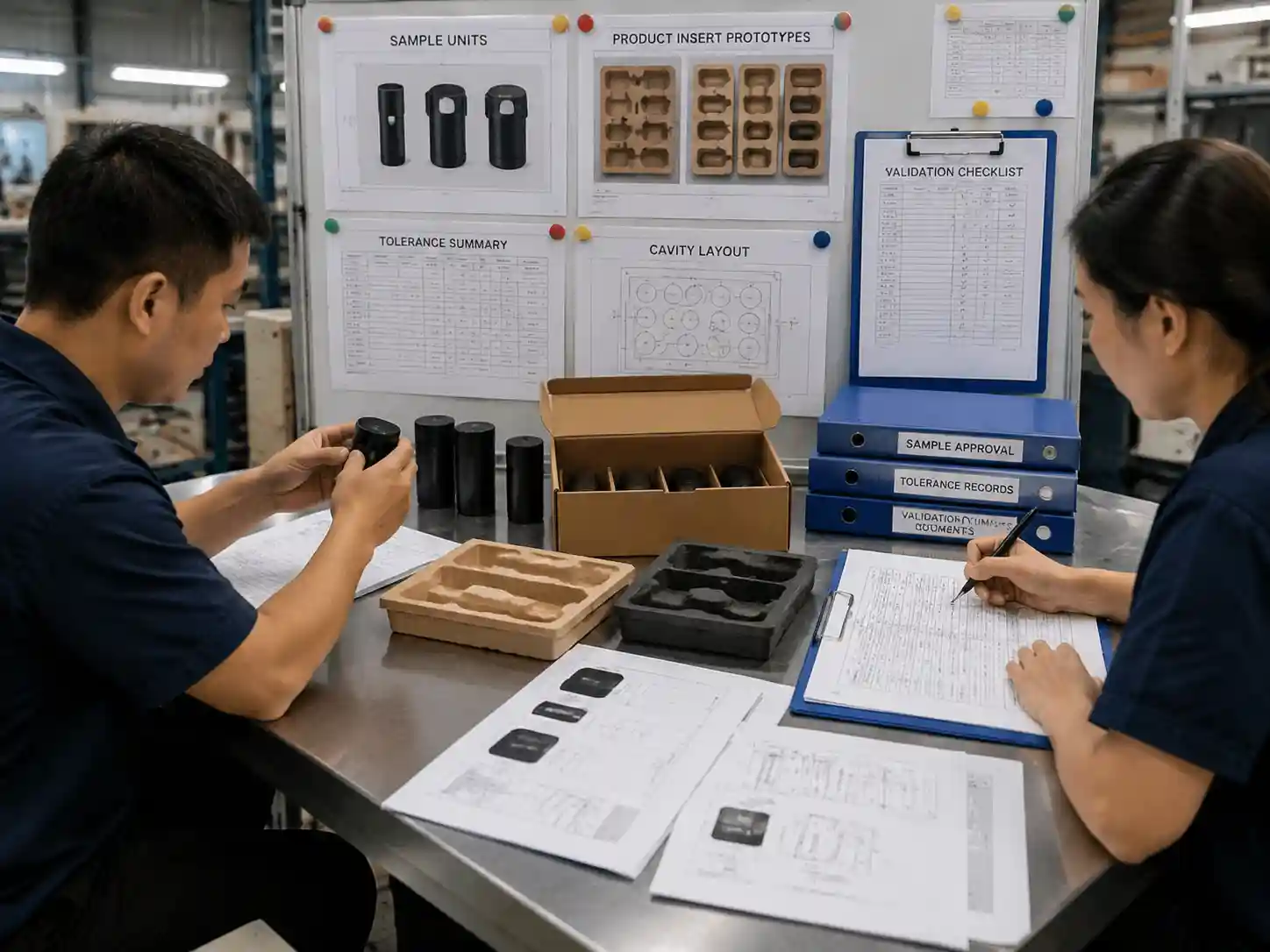
How do buyers compare product samples with final production units?
Buyers should compare production units using the same measurements and loading conditions used during sample approval. The comparison should focus on functional performance, not only appearance.
What measurement steps should be completed?
- Confirm that the production product samples match the approved product dimensions and packaging specifications.
- Measure critical cavity dimensions using the same reference points shown in the engineering drawings.
- Load actual products into the compartments to check fit, orientation, and movement.
- Record any differences between approved samples and production units.
- Review whether the difference affects protection, closing performance, or customer presentation.
For complex advent calendar projects, dimension matrices and cavity drawings provide a clearer approval reference than a single physical sample.
What evidence should support tolerance approval?
Tolerance approval should be supported by records that allow different teams to review the same information. Useful evidence includes:
- Approved product measurement sheets.
- Final cavity drawings with revision control.
- Sample inspection records.
- Loaded prototype photos or inspection references.
- Production verification measurements.
Quality inspections are most effective when they compare actual measurements against approved requirements rather than using general descriptions such as “looks acceptable.”
Which checks are important before accepting production units?
Before acceptance, buyers should verify that dimensional variation does not create functional problems. A loaded-sample review is especially important for multi-compartment packaging.
Loaded-sample tolerance checklist
- □ Product dimensions match the approved measurement record.
- □ Products enter and remove from cavities without excessive force.
- □ Products remain correctly oriented inside compartments.
- □ Lid closure does not create pressure on tall products.
- □ Inserts remain stable after the package is fully loaded.
- □ Final inspection records match the approved acceptance criteria.
The final approval decision should separate verified facts, project-dependent recommendations, and buyer approvals. Measurements confirm actual conditions, engineering recommendations explain acceptable ranges, and buyers approve the final standard.

What tolerance issues create the biggest risks?
The biggest risks occur when small dimensional differences affect product fit or package performance. A small cavity change may become significant when repeated across many compartments.
- Too little clearance: products may become difficult to insert or remove.
- Too much clearance: products may shift during handling and reduce presentation quality.
- Incorrect product assumptions: changed product dimensions may make approved inserts unsuitable.
- Missing records: teams may approve different standards without a shared reference.
How should buyers manage tolerance changes after sample approval?
Any important change after sample approval should be reviewed through documented change control. Buyers should confirm whether the change affects cavity dimensions, insert design, orientation, or final product protection.
For custom advent calendar packaging projects, Giftpackpro supports structured packaging development through custom advent calendar box services, product solutions through custom advent calendar box products, and technical discussions through request a custom quote.
Frequently Asked Questions
Is the sample expected to be exactly identical to mass production?
No. Samples and production units may have controlled differences caused by materials and manufacturing processes. The important requirement is that approved tolerances are maintained.
Should buyers approve tolerance before or after sampling?
Buyers should define key tolerance expectations before sampling and confirm them during sample approval so production teams have a clear reference.
Can product changes after sampling affect packaging tolerance?
Yes. Changes to product dimensions, labels, sleeves, caps, or accessories can affect cavity fit and should be reviewed before production.
For buyers developing custom advent calendar packaging, clear measurement records and tolerance approval procedures help reduce production uncertainty. Contact Giftpackpro to discuss your packaging requirements and validation process.