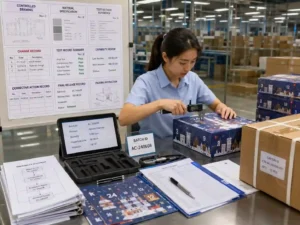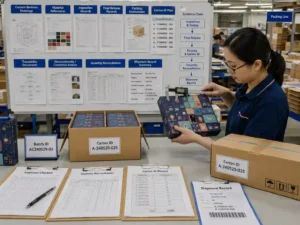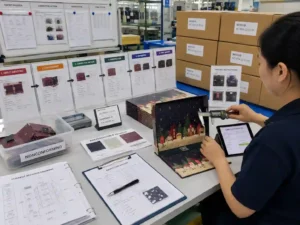
Quick answer: Good product fit test documentation should let a buyer trace every fit claim back to an identified product sample, a controlled packaging revision, actual measurements, a defined test method, and a recorded result. For advent calendars with multiple products, the supplier should document clearance, insertion, retention, removal, interference, and any failed or conditional fit. Photos can support the record, but measurements, revision references, and approval status make the evidence verifiable.

What should product fit test documentation contain?
A useful fit-test record should answer five questions: what product was tested, what packaging version was tested, how it was checked, what happened, and who accepted the result. A photograph of a product sitting inside a compartment is not enough on its own.
For a multi-component advent calendar, the supplier should normally identify each relevant product or SKU and connect it to its intended compartment. The record should reference the drawing, sample, or controlled specification used during the test.
| Evidence | What should be recorded | What the buyer can verify |
|---|---|---|
| Product identification | SKU or sample ID, product description, sample date or revision where applicable | The tested item matches the product intended for packing |
| Packaging identification | Drawing number, revision, insert or compartment reference, sample identity | The result applies to the correct packaging version |
| Dimensions | Relevant product and compartment measurements, units, and measurement points | Clearance claims are supported by recorded values |
| Functional checks | Insertion, retention, removal, movement, interference, orientation, or other relevant observations | The product does more than simply fit geometrically |
| Visual evidence | Dated or identified photos showing the test condition | The documented setup corresponds to an identifiable test |
| Result | Pass, fail, conditional acceptance, or engineering review required | Problems are not hidden behind an ambiguous “fit confirmed” statement |
| Approval status | Supplier review, buyer approval, or unresolved action as applicable | A technical observation is not mistaken for final commercial approval |
How should a supplier identify the products and packaging used in the test?
The supplier should use traceable sample identities rather than generic descriptions such as “bottle sample” or “final tray.” Each important result should point to the actual product sample and packaging revision that produced it.
This matters when dimensions change during development. A compartment that fitted an early prototype may not fit a later production-intent bottle, carton, jar, tube, sachet, or accessory.
A practical record can include the product SKU or internal sample code, date received, relevant dimensions, packaging drawing number, drawing revision, insert version, and test date. Where physical samples are retained, their identification should correspond to the record.
Which dimensions should be measured?
Measure the dimensions that actually control fit rather than automatically recording every possible dimension. Typical checks include maximum width, depth, height, diameter, cap or closure projections, irregular shoulders, and the usable internal dimensions of the compartment.
For irregular products, the controlling dimension may not appear on a basic product specification. Pumps, lids, tabs, handles, folded sachet edges, secondary cartons, and other projections can create interference even when nominal length, width, and height appear acceptable.
The measurement method and equipment should be appropriate to the required precision. Digital calipers, rulers, depth gauges, templates, or controlled go/no-go references may all be appropriate depending on the component and tolerance involved.
How should functional fit be documented instead of dimensional fit alone?
The supplier should record how the product behaves during insertion, retention, handling, and removal. Dimensional clearance is evidence of geometric compatibility; it does not automatically prove satisfactory functional fit.
Relevant observations can include whether the product can be inserted without excessive force, whether closures or surfaces contact structural edges, whether the item stays in its intended position, and whether it can be removed without damaging the product or packaging.
For an advent calendar, the supplier may also need to observe whether adjacent products interfere with each other or whether a product changes position sufficiently to affect a neighboring compartment. Which checks are necessary depends on product geometry, packaging structure, intended orientation, and the project’s acceptance criteria.

How should photos support the fit-test record?
Photos should make the recorded test easier to verify, not replace the controlled record. Useful photographs show an identifiable sample, the relevant compartment, and the condition being evaluated.
Where appropriate, the supplier can photograph the product before insertion, installed in its intended position, during a measurement, and after removal. A ruler, caliper, sample label, or compartment identifier can provide context when it is relevant to the claim.
Weak evidence is an isolated photo with no sample identity, date, drawing revision, measurement, or explanation. Buyers cannot reliably determine whether that image represents an obsolete prototype, an approved sample, or the packaging version being ordered.
What does strong versus weak product fit evidence look like?
Strong documentation connects the conclusion to controlled evidence. Weak documentation asks the buyer to trust a conclusion without enough information to reproduce or verify it.
| Weak documentation | Stronger documentation |
|---|---|
| “Product fits well.” | Identified product sample tested against a specified compartment and drawing revision, with recorded measurements and functional observations. |
| One unlabelled photo | Identified test photos linked to the fit-test record and sample references. |
| Only nominal product dimensions | Relevant actual sample measurements compared with controlled packaging dimensions. |
| “Approved” with no status explanation | Technical result separated from supplier review and buyer approval status. |
| Failed fit quietly replaced by a new sample | Failure recorded with the affected revision, corrective action, revised sample, and retest result. |
How should failed or conditional fit results be documented?
A failed fit should remain visible in the record rather than disappearing when the design is revised. The supplier should document the problem, affected product and packaging revision, corrective action, and subsequent verification.
For example, an engineering record might show that a closure contacted the compartment wall during removal. The supplier could then revise the structural drawing, produce an identified replacement sample, and repeat the relevant measurements and functional checks.
The retest should reference the new revision. This creates a traceable sequence from failure to corrective action to verification instead of presenting the latest sample as though no earlier problem existed.
What should happen with a conditional result?
A conditional result should identify the unresolved condition and the decision required. It should not be converted into a simple pass unless the agreed acceptance criteria have actually been met.
Examples can include a fit that works only in one orientation, depends on a product dimension that has not been frozen, or requires a buyer decision about acceptable removal force. These are project-dependent issues requiring explicit resolution rather than universal packaging rules.
How can buyers verify the supplier’s fit-test evidence?
Buyers should cross-check sample identity, drawings, measurements, photographs, and approval records instead of reviewing each document separately. Consistency between these records is often more informative than the volume of documentation supplied.
- Confirm that the tested product sample represents the intended product version.
- Match each test to the correct compartment and structural drawing revision.
- Check that recorded dimensions use clear measurement points and units.
- Compare important measurements with the applicable controlled specification.
- Review insertion, retention, removal, and interference observations where relevant.
- Check whether photographs can be linked to identifiable samples and test records.
- Look for failed or conditional results rather than reviewing passes only.
- Verify that corrective actions lead to an identified revised sample and documented retest.
- Separate supplier verification from items that still require buyer approval.
This review can also reveal supplier capability. A factory that maintains revision-controlled drawings, identified samples, measurement records, and closed corrective actions provides stronger evidence of a controlled engineering process than one relying mainly on informal photographs and messages. Buyers evaluating broader manufacturing controls can also review the Giftpackpro packaging factory information and related advent calendar box buying guides.
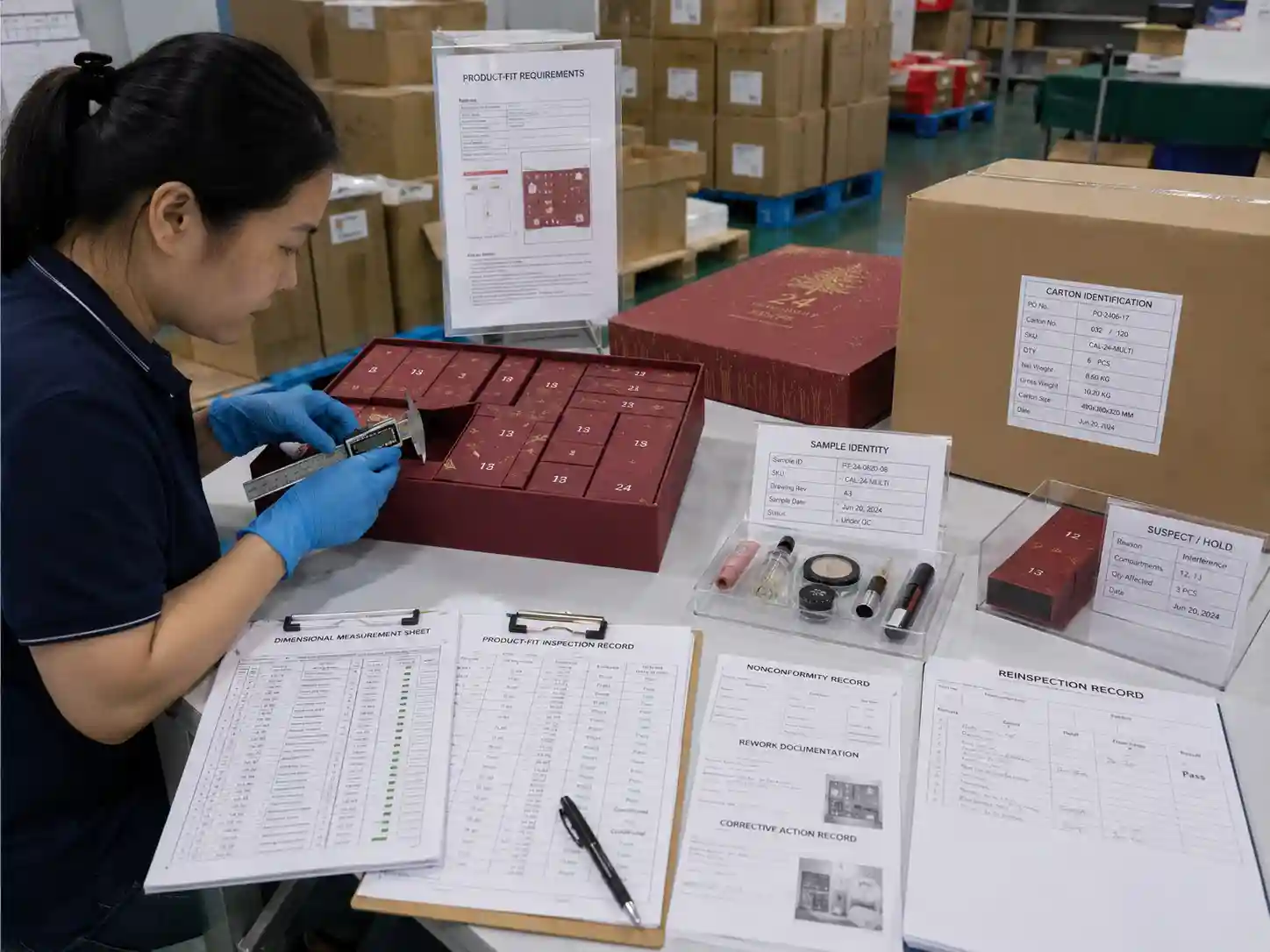
How should fit evidence connect with packing verification?
Where packing conditions can affect the fit conclusion, the supplier should verify the relevant condition using production-intent or otherwise clearly identified packing arrangements. A successful isolated bench test does not necessarily prove that the same result will occur when all calendar components are loaded together.
This does not require turning the fit record into a broad packing or transport test report. The objective is simply to preserve evidence needed to support the specific fit claim, such as intended orientation, neighboring-component interference, retention after normal handling, or the identity of the packing configuration tested.
Which conclusions are facts, project-dependent recommendations, or buyer approvals?
Keeping these categories separate prevents technical records from implying decisions that have not been made.
| Category | Examples |
|---|---|
| Verifiable facts | Sample identity, measured dimensions, drawing revision, test date, observed interference, recorded pass or failure against defined criteria |
| Project-dependent recommendations | Required clearance, measurement frequency, retention method, acceptable movement, need for loaded testing |
| Buyer approvals | Acceptance of conditional fit, approval of revised product orientation, acceptance of agreed appearance or usability criteria |
The supplier can provide evidence and engineering recommendations, but project-specific acceptance criteria should be confirmed by the appropriate parties rather than presented as universal standards.
What is the minimum documentation buyers should request before accepting a fit claim?
At minimum, request enough information to identify the product, identify the packaging revision, understand the test method, see the relevant measurements or observations, and determine the result. Higher-risk or more complex products may justify additional evidence.
- Identified product or reference sample.
- Controlled packaging drawing or sample revision.
- Relevant product and compartment measurements.
- Defined functional fit checks where applicable.
- Identified photographic evidence where useful.
- Pass, fail, conditional, or unresolved status.
- Corrective-action and retest records for failures.
- Clear separation between supplier verification and buyer approval.
FAQs about product fit test documentation
Should every advent calendar compartment have a separate fit record?
Not necessarily. The documentation structure should reflect the product mix and risk. Repeated identical products and identical compartments may be covered efficiently by a controlled test plan, while different SKUs, geometries, orientations, or compartment designs may require individually traceable results.
Can a CAD drawing prove that a product fits?
A drawing can demonstrate intended dimensional compatibility, but physical verification may still be necessary where material behavior, assembly variation, irregular geometry, insertion, retention, or removal affects actual performance. The appropriate level of verification depends on the project.
Should buyers approve the fit-test report or the physical sample?
They serve different purposes. The report documents evidence and results, while a physical sample can provide a controlled reference for characteristics that need direct evaluation. The project should state what constitutes buyer approval and which revision that approval covers.
When should fit testing be repeated?
Retesting should be considered when a change could invalidate the previous result, such as a relevant product dimension, packaging structure, compartment geometry, material, or assembly condition changing. The supplier should document which revision was retested rather than assuming an earlier result remains applicable.
For a custom project, buyers can discuss required fit-test evidence, controlled samples, and approval records through Giftpackpro’s custom advent calendar box services or request a custom quote.