
Quick answer: Packaging claim evidence requirements should match the type and consequence of the claim. Photos are useful for showing equipment, production stages, finished construction and packing conditions. Reports and measurement records are stronger for dimensional, functional and performance claims. Material specifications support claims about board, paper, adhesives or other defined inputs, while certificates should be used only for claims actually covered by their scope. High-risk claims often require several forms of evidence rather than one document.
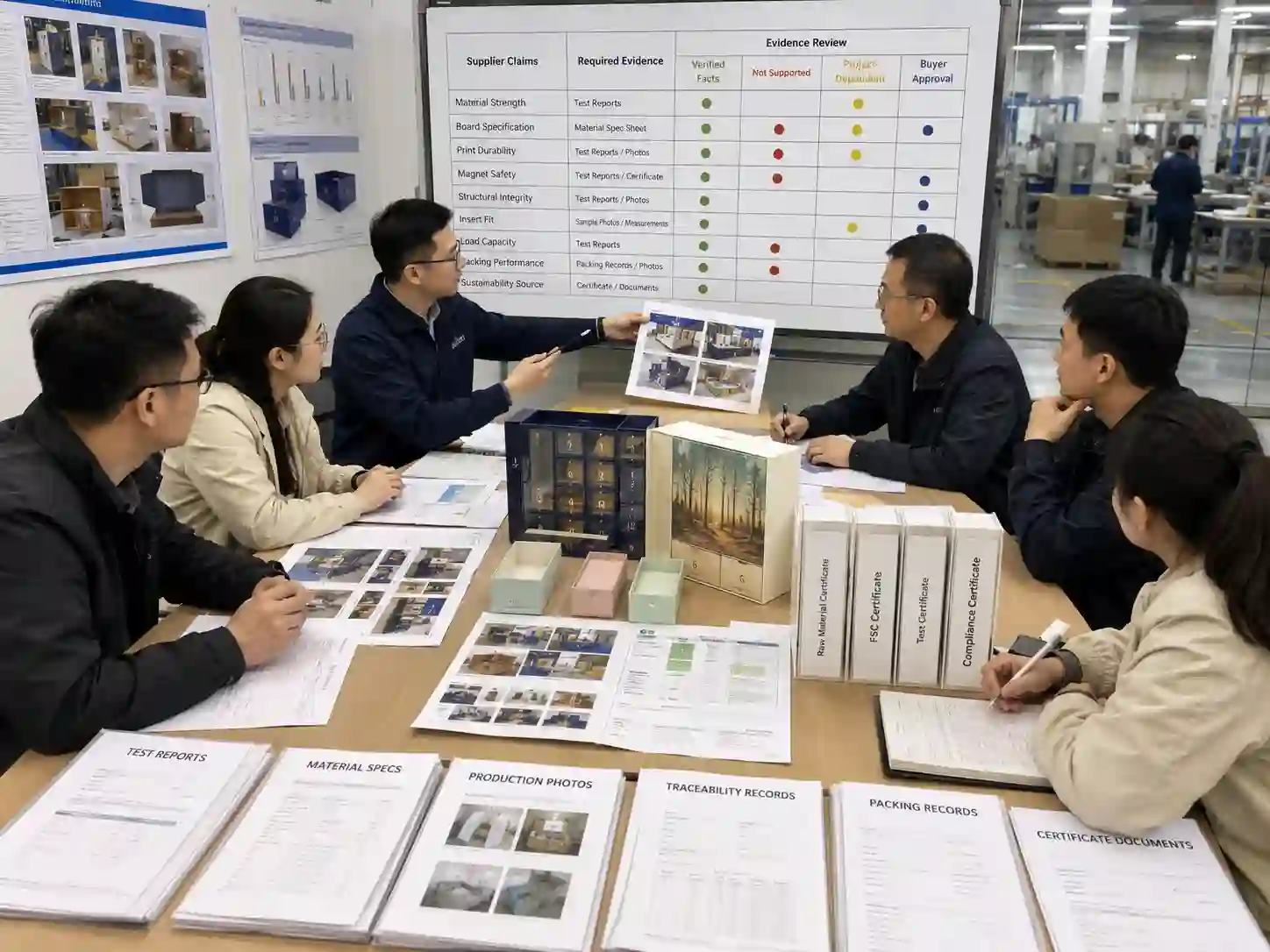
Which packaging claims need photos, reports, or certificates?
The required evidence depends on what the supplier is claiming. A photograph can demonstrate that something was present at a particular stage, but it normally cannot prove material composition, dimensional conformity, test performance or certification status.
For custom advent calendars and other multi-component paper packaging, buyers should first classify the claim and then request evidence capable of verifying it. This prevents a common sourcing problem: receiving substantial documentation that does not actually prove the statement being evaluated.
| Supplier claim | Useful primary evidence | What the buyer should verify |
|---|---|---|
| “We manufacture this type of structure.” | Dated production photos, process records, representative case evidence | Whether the evidence shows comparable construction and actual production capability |
| “This board meets the agreed specification.” | Material specification, purchase or receiving records, relevant test data | Material identity, grade, thickness or other controlled properties and lot relevance |
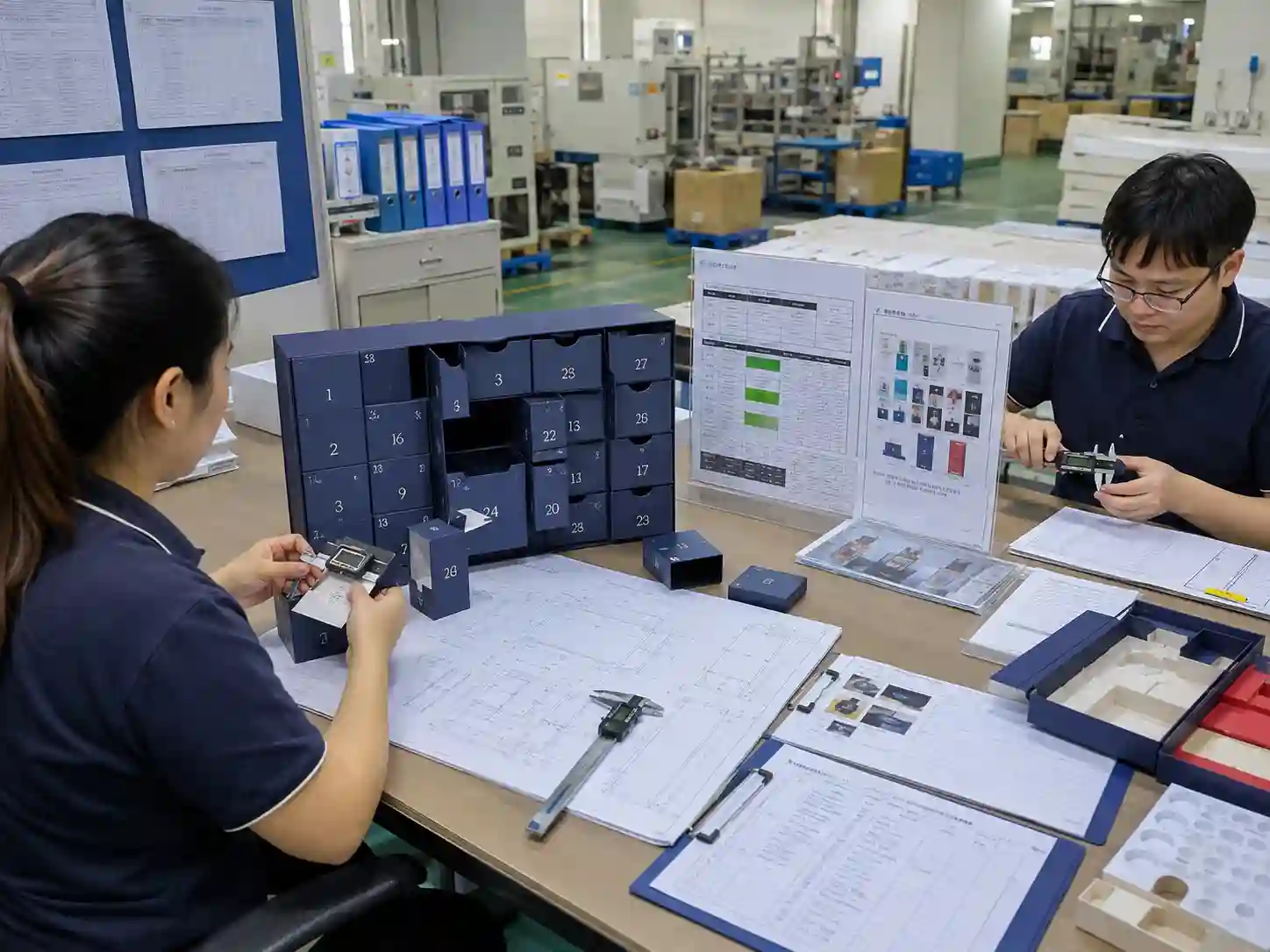
| “Dimensions are within tolerance.” | Controlled drawing plus measurement records | Measured characteristics, tolerance limits, sample identity and drawing revision |
| “The calendar passed a functional test.” | Test method and test report | Method, acceptance criteria, sample quantity, results and tested configuration |
| “Production is traceable.” | Lot identification and linked production, inspection or packing records | Whether records can connect finished goods to the relevant production history |
| “A quality problem was corrected.” | Nonconformity, corrective-action and reinspection records | Affected quantity, action taken, verification and final disposition |
| “The product or facility is certified.” | Applicable certificate and supporting scope information | Issuer, holder, validity, scope and relevance to the specific claim |
| “Export cartons follow the approved configuration.” | Packing specification, packing records and dated photos | Quantity, orientation, protection, carton identification and configuration |
When are photos enough to support a packaging claim?
Photos are most useful for visual claims about equipment, process stages, construction, packing configuration and finished appearance. They become more credible when they are dated, identifiable and linked to a specific project, sample, lot or production stage.
For example, photographs may help verify that a supplier has produced multi-drawer calendars, that finished units were packed in a stated orientation, or that inspection activity occurred. A sequence showing components, assembly and completed cartons usually provides more context than a single carefully framed factory image.
Photos become weak evidence when the claim concerns something the camera cannot reliably establish. An image of greyboard does not prove its specified thickness or grade. A photograph of a digital caliper beside a component is also weaker than a controlled measurement record identifying the characteristic, requirement, result and sample.
What makes production photos credible?
Useful production photography should establish context rather than simply show attractive finished packaging. Buyers should look for identifiable process stages, production-equivalent components, dates or traceability references where appropriate, and consistency with the construction being discussed.
Generic photographs reused across unrelated quotations should be treated as capability indicators at most. If capability is commercially important, the buyer can ask how the pictured work relates to the proposed construction and which operations are performed internally or externally.
Which claims require test reports or measurement records?
Claims involving measurable performance or conformity generally require records, not photographs alone. The evidence should connect a defined requirement with a method, sample and recorded result.
Examples can include dimensional conformity, opening or closing performance, component retention, loaded-box behavior, packing checks or other project-specific characteristics. The appropriate test depends on the design and agreed specification; buyers should not assume every advent calendar requires the same tests.
A useful report identifies what was tested, how it was tested and what constituted acceptance. Where dimensional verification is involved, the controlled drawing should define the relevant dimensions and tolerances, while the inspection record shows actual measurements.
What should buyers look for in a test record?
A strong record allows the result to be traced back to the item and requirement being evaluated. At minimum, the buyer should be able to understand the test object, specification or drawing revision, test or inspection method, acceptance criteria, actual result and relevant sample or production identity.
A statement such as “test passed” is considerably weaker if it does not identify the test conditions or the configuration tested.
When do material claims need specifications rather than certificates?
Material claims normally need specifications or controlled material records when the question is what material was ordered, approved or used. A certificate should not automatically replace project-level material verification.
For example, a project may define board thickness, paper type, surface finish or other construction requirements. The buyer can compare the approved specification with supplier material records and, where necessary, measurements or test results from relevant samples or production.
Certificates answer a different question. They can support a certification claim when their scope covers the organization, material, process or product being represented. They do not automatically prove that every component in a particular purchase order meets every project requirement.
Which claims actually need certificates?
Certificates are appropriate when the supplier explicitly makes a certification, management-system, chain-of-custody, material or compliance claim for which formal certification is relevant. Buyers should verify the document rather than relying on a certificate logo displayed in a presentation.
Check the legal entity or certificate holder, issuing body, certificate number where applicable, validity dates, stated scope and sites or activities covered. Then determine whether that scope supports the exact supplier statement.
The existence of a genuine certificate is a verifiable fact. Whether a particular certificate is mandatory for a project is project-dependent and may be determined by the buyer, destination market, product category, retailer requirements or contractual specifications.
How should packaging claim evidence requirements be checked?
Start with the claim, not with the supplier’s document folder. Each commercially important statement should have evidence that directly addresses what the buyer needs to establish.
- Write the claim precisely. Replace broad statements such as “high quality” with measurable or verifiable requirements.
- Classify the claim. Decide whether it concerns capability, material, dimensions, performance, traceability, packing, corrective action or certification.
- Choose appropriate evidence. Request photos for visual conditions, records for measurements and tests, specifications for defined materials, and certificates for formal certification claims.
- Check identity. Confirm that the evidence refers to the correct component, sample, revision, production lot or facility where relevant.
- Check dates and revisions. Old evidence may demonstrate general capability but may not verify the current production configuration.
- Compare evidence sources. Drawings, measurements, photographs and packing records should not contradict each other.
- Record unresolved items. Separate verified claims from open questions and conditions requiring buyer approval.
What does strong documentation look like compared with weak evidence?
Strong evidence creates a traceable chain between the supplier’s statement and an objective record. Weak evidence tends to be generic, undated, incomplete or disconnected from the project being evaluated.
| Weak documentation | Stronger documentation |
|---|---|
| Photo of an unidentified finished calendar | Dated production photo linked to a comparable structure or identified production reference |
| “Material is 2 mm board” in an email | Controlled material specification supported by relevant material or measurement records |
| Photo of a ruler beside a component | Drawing revision plus recorded actual measurements against specified tolerances |
| “Drop test passed” without details | Defined test method, identified sample, acceptance criteria and recorded result |
| Certificate logo on a quotation | Certificate showing holder, issuer, validity and relevant scope |
| “Defects were fixed” | Nonconformity record, affected quantity, corrective action and documented reinspection |
| One photograph of sealed cartons | Approved packing requirement linked to packing records, identification and verification evidence |
How should traceability and corrective-action claims be proven?
Traceability claims require linked identifiers and records; corrective-action claims require evidence of both the problem and its verified disposition. A narrative explanation alone does not establish either control.
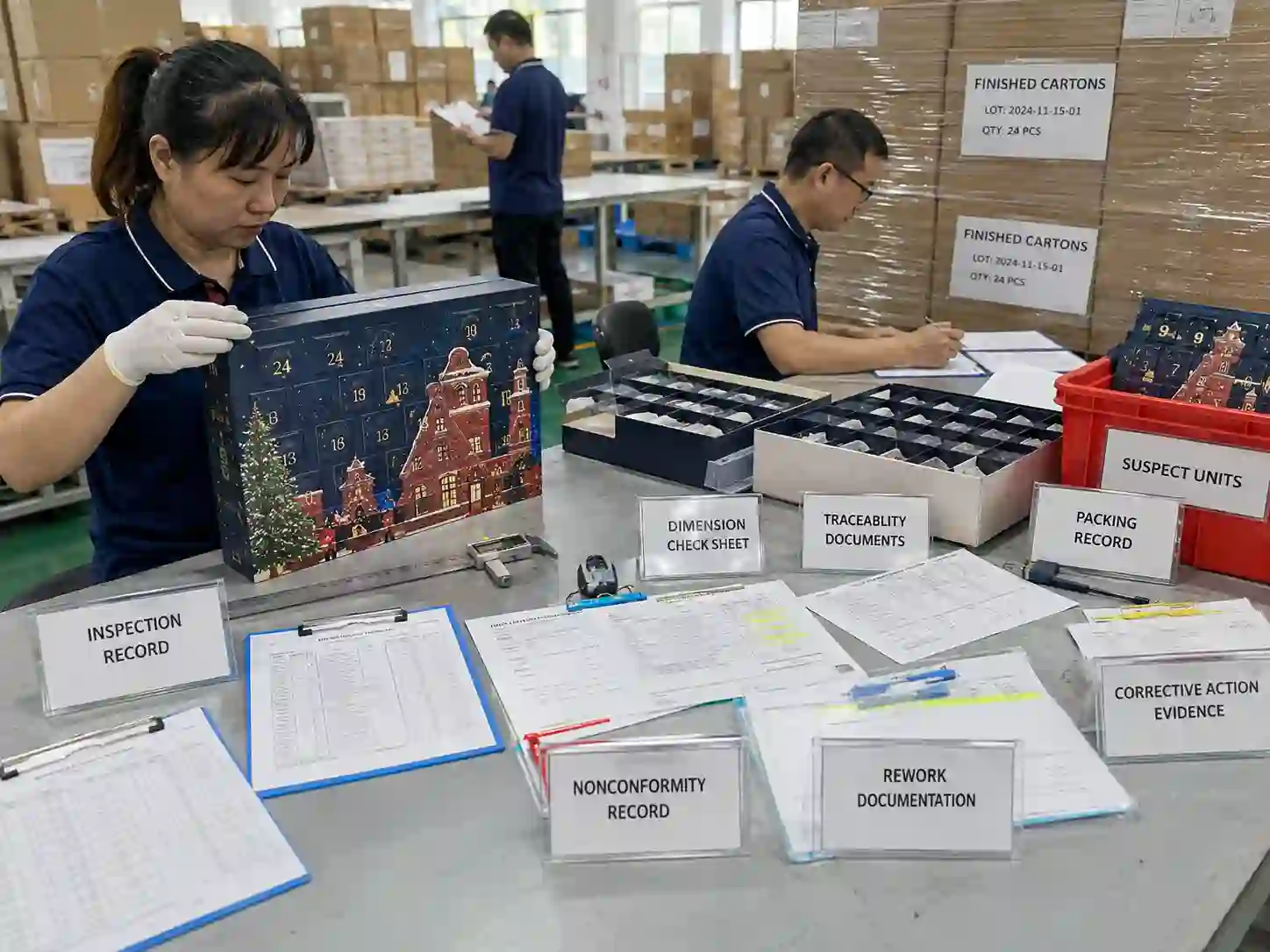
For traceability, buyers can examine whether finished cartons or production units carry identifiers that connect to relevant manufacturing, inspection or packing records. The required depth varies by project, so the buyer should define what needs to remain traceable before production.
If a nonconformity occurs, useful evidence can include the defect description, affected quantity or range, segregation status, disposition, rework instructions where applicable, corrective action and reinspection results. This helps distinguish “we corrected it” from a documented closed-loop response.
What evidence should support packing claims?
Packing claims should be supported by an approved packing requirement plus evidence that actual packed goods followed it. Photos are valuable here, but packing and inspection records provide the quantitative context that photographs lack.
Depending on the project, verification may cover units per carton, orientation, protective components, carton dimensions, identification, gross weight or other specified checks. These are project-dependent requirements rather than universal rules for every calendar.
Buyers evaluating a new supplier can review broader capability through the Giftpackpro packaging factory page and relevant custom advent calendar box services, but project-specific claims should still be tied to appropriate evidence.
Which decisions remain the buyer’s responsibility?
Evidence can establish facts, but it does not replace commercial or technical approval. Buyers still need to decide which requirements are critical, which evidence is acceptable and which deviations require approval.
A useful distinction is:
- Verifiable fact: a recorded measurement, material specification, test result, certificate scope, lot identifier or documented packing configuration.
- Project-dependent recommendation: the test method, inspection frequency, traceability depth or evidence level appropriate to the specific calendar.
- Buyer approval: acceptance of specifications, tolerances, samples, deviations, corrective actions or other contractual conditions.
This separation prevents a supplier’s general capability evidence from being mistaken for approval of the buyer’s specific production requirements.
What should buyers request before relying on a packaging claim?
Request the smallest set of evidence that can directly verify the important claim, then check whether those records belong to the correct product, process, facility and time period. More documents are not necessarily better evidence.
- Identify each commercially or technically important claim.
- Ask what objective record supports it.
- Confirm sample, drawing, material, lot or facility identity where relevant.
- Check dates, revisions, methods and acceptance criteria.
- Verify certificate scope instead of relying on logos.
- Distinguish previous-project evidence from current-project production records.
- Record discrepancies and request corrective evidence before closing the issue.
- Keep buyer approvals separate from supplier-generated evidence.
FAQs about packaging claim evidence
Can supplier photos replace an inspection report?
Usually not when the claim concerns measurable conformity. Photos can document visible conditions, while an inspection report can record the characteristics checked, actual results, sample information and acceptance criteria.
Does a previous case study prove current production capability?
It can support a capability assessment, but it does not prove that the current order will meet its specification. Buyers should determine whether the previous construction, materials and processes are sufficiently comparable and then verify the current project separately.
Should every packaging claim have a certificate?
No. Many important packaging claims are better verified through drawings, specifications, measurements, test reports, production records or photographs. Certificates are appropriate only when formal certification is relevant to the claim.
What should happen when evidence conflicts?
The discrepancy should remain unresolved until the supplier identifies which requirement or record is correct and provides appropriate supporting evidence. Where production is affected, revised documents, segregation, rework or reinspection may be necessary depending on the issue and buyer requirements.
For a project-specific review of which claims should be supported by drawings, records, photos, reports or certificates, request a custom quote and provide the proposed packaging specification and verification requirements.


