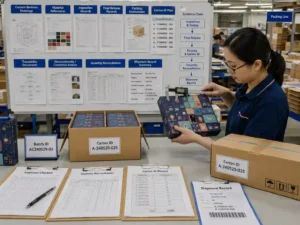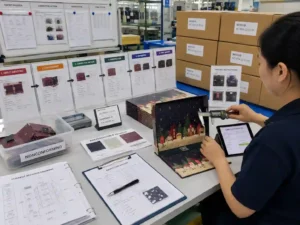
Quick answer: Useful packaging supplier test data should connect a stated requirement to a defined test or inspection method, an identified sample or production lot, measurable results, acceptance criteria, and a dated record. For advent calendar packaging, buyers should look beyond photographs and general quality claims. Material specifications, dimensional records, functional checks, packing evidence, traceability, and corrective-action records are more credible when they can be linked to controlled drawings, approved samples, revisions, or production references.
What packaging supplier test data is actually useful to buyers?
The most useful data helps a buyer verify a specific packaging claim rather than simply showing that testing occurred. A report should make it possible to determine what was checked, against which requirement, on which sample or production batch, and with what result.
For a multi-component advent calendar, relevant evidence may include material specifications, dimensional inspection records, functional test records, packing checks, traceability information, and records showing how nonconforming results were handled.
The exact evidence required varies by structure and product. A rigid calendar with drawers, doors, paperboard dividers, magnets, ribbons, or fitted components can require different checks from a simpler folding-carton construction.

Which test records should a packaging supplier be able to show?
A supplier should be able to show records for the characteristics that materially affect the approved packaging specification. Buyers should prioritize records tied to measurable requirements and known failure risks.
| Evidence | What it should identify | What the buyer can verify |
|---|---|---|
| Dimensional inspection | Measured feature, units, sample identity, drawing revision and result | Whether critical dimensions were checked against controlled tolerances |
| Material specification | Material type, grade, thickness or other specified property | Whether the material corresponds to the approved specification |
| Functional test record | Test method, sample, acceptance requirement and result | Whether doors, drawers, closures or other relevant functions were evaluated consistently |
| Visual inspection record | Defined defect categories, sample quantity and findings | Whether appearance decisions use stated criteria rather than undocumented judgment |
| Packing inspection | Packing configuration, quantities, identification and checks performed | Whether finished goods were packed according to the controlled packing requirement |
| Nonconformity record | Defect, affected quantity, disposition and status | How failures were contained and resolved |
| Corrective-action record | Problem, cause, action, responsibility and verification | Whether recurring problems were investigated rather than merely repaired |
Not every project needs every record. The evidence set should follow the approved specification, risk assessment, purchase requirements and agreed inspection plan.
How should material specifications support supplier claims?
Material claims are stronger when they are supported by controlled specifications rather than descriptions such as “premium board” or “high-quality paper.” The document should identify the material in terms that can be compared with the buyer-approved requirement.
Depending on the project, relevant properties may include paper or board grade, nominal thickness, basis weight, surface material, adhesive system, finishing specification, or other defined construction characteristics. Which properties require verification is project-dependent.
A specification sheet alone does not prove that every finished unit contains the specified material. Buyers should therefore look for a connection between the specification, purchasing or incoming-material records, production identification, and inspection evidence where that level of control is required.
What makes a material record credible?
A credible record has enough identification to establish what material it describes and where it belongs in the project. Revision status, supplier material code, project reference, date, or corresponding drawing information can help establish that link.
Buyer approval remains separate from supplier evidence. A supplier can document what material was used, while the buyer or authorized party decides whether that material satisfies the commercial and technical requirement.
How should dimensional and functional results be presented?
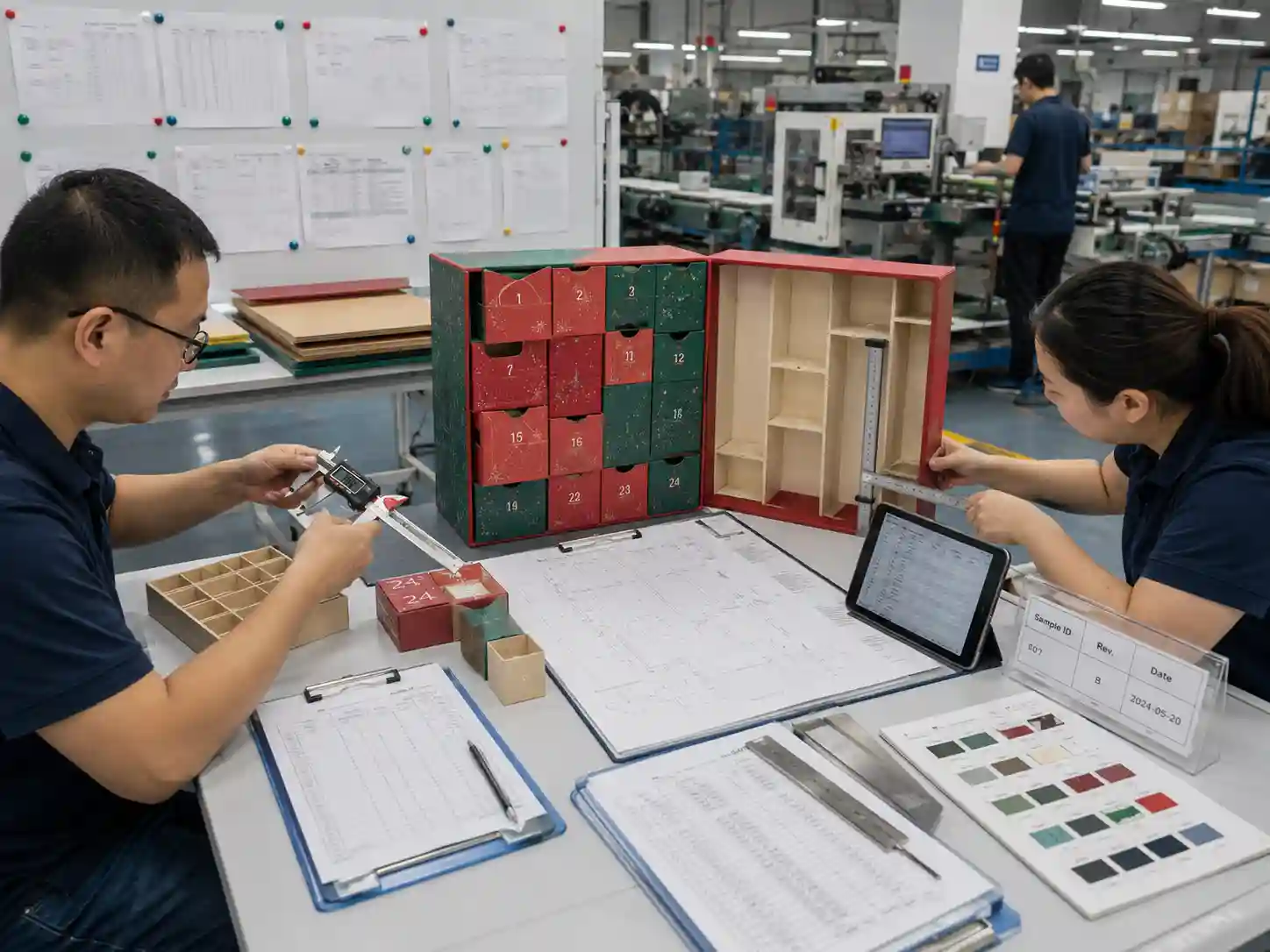
Measured values are more useful than statements such as “size passed.” A buyer should be able to compare actual results with the applicable nominal dimension, tolerance, or functional acceptance criterion.
For example, an inspection record may identify the drawing revision, measurement location, measuring device, sample identification, specified tolerance and actual readings. Functional checks should similarly state what action was performed and what constituted acceptance.
This distinction matters because advent calendars can contain interacting components. An individual part can appear acceptable while cumulative dimensional variation causes a drawer, insert, sleeve, door, or fitted component to perform poorly during assembly.
How can buyers distinguish strong documentation from weak documentation?
Strong documentation creates a traceable chain from requirement to evidence. Weak documentation usually provides conclusions without enough context to reproduce or verify them.
| Weak evidence | Stronger evidence |
|---|---|
| Photo of a caliper touching a box | Measurement record identifying the feature, sample, drawing revision, tolerance and measured value |
| “Material quality passed” | Controlled material specification linked to the relevant component and project reference |
| Undated production photos | Dated or otherwise traceable images associated with an identified sample, order, lot or production stage |
| Generic “QC passed” report | Inspection record showing criteria, sample quantity, findings and disposition |
| Photo of packed master cartons | Packing record linked to an approved packing configuration and identifiable production quantity |
| Statement that a defect was fixed | Nonconformity and corrective-action evidence showing containment, cause, action and verification where applicable |
Professional presentation is not the same as technical credibility. A simple controlled spreadsheet containing identifiable measurements can be more useful than a polished case study that omits sample identity, dates and acceptance criteria.
What should credible case-study evidence contain?
A case study should demonstrate a relevant capability without implying that one previous project proves future performance. Buyers should look for objective evidence behind the capability being claimed.
Useful case-study material may show the type of construction produced, controlled drawings or appropriately redacted specifications, production-stage evidence, inspection methods, packing configuration, and examples of how manufacturing problems were controlled.
Commercially sensitive customer information can be removed. Redaction should not prevent the buyer from understanding what process was performed, what was measured, and whether the evidence actually relates to the claimed capability.
Historical evidence is a capability indicator, not approval of a new project. A new advent calendar still requires its own specifications, samples, production controls and buyer approvals.
Why does traceability matter when reviewing test data?
Traceability establishes which physical product the record describes. Without it, even accurate measurements may be difficult to connect to the sample or production goods under review.
Useful identifiers can include project codes, sample numbers, drawing revisions, inspection dates, production references, lot references, packing references, or other controlled identifiers used by the supplier.
The appropriate traceability depth depends on project risk and the supplier’s control system. The objective is not paperwork for its own sake; it is the ability to determine whether a test result belongs to the relevant specification and product.
What corrective-action evidence should buyers request after a failed result?
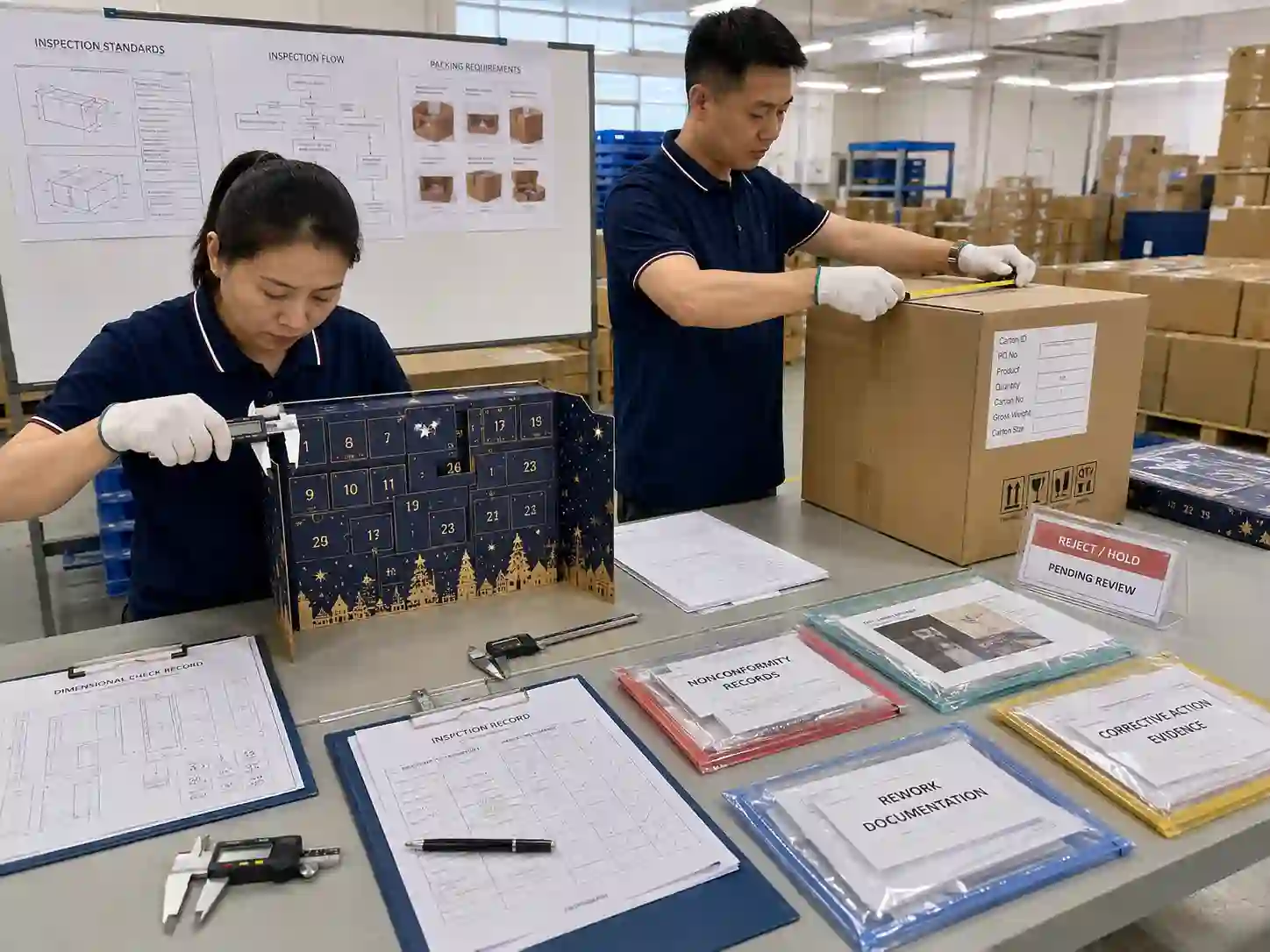
When an important requirement fails, the supplier should document more than the final rework. Buyers should be able to see the nonconformity, containment or affected quantity where applicable, corrective action, and evidence of reinspection or verification before release.
For recurring or significant defects, root-cause analysis may also be appropriate. The depth of investigation should reflect the severity, recurrence and project risk rather than applying the same corrective-action process to every minor defect.
Records should also distinguish supplier disposition from buyer authorization. If a deviation requires buyer acceptance, the supplier should not convert an internal decision into an assumed buyer approval.
What packing evidence belongs in a supplier evidence package?
Packing evidence is useful when it confirms that finished production was packed according to an approved configuration. It should not become a substitute for a separate transport or export-packing qualification when those activities are required.
Relevant records can include packed quantities, carton identification, packing orientation, protective components, carton dimensions or weight when specified, inspection status, and references linking cartons to the applicable production goods.
Photographs become more useful when they are dated or otherwise traceable and show defined checkpoints. Random warehouse photographs establish much less than records connected to an approved packing instruction or inspection.
How should buyers verify published supplier evidence before relying on it?
Buyers should test whether the documents form a consistent evidence chain. A report becomes more credible when its sample identities, revisions, materials and dates agree with other controlled project records.
- Identify the specific supplier claim being evaluated.
- Find the drawing, specification or acceptance requirement behind that claim.
- Check whether the test method actually evaluates that requirement.
- Confirm that the report identifies the tested sample or production reference.
- Compare actual results with stated acceptance criteria rather than relying on a pass/fail label.
- Check dates and revision numbers for consistency.
- Review failures, affected quantities and corrective-action records where relevant.
- Confirm which decisions remain subject to buyer approval.
For projects requiring deeper supplier evaluation, buyers can also review the Giftpackpro packaging factory and relevant custom advent calendar box services before defining the evidence required for a specific order.
What test information can legitimately vary from one advent calendar project to another?
Test methods, tolerances, sampling levels and acceptance criteria can vary because the product, structure, materials, loading conditions and identified risks vary. Suppliers should therefore avoid presenting project-dependent requirements as universal specifications.
Verifiable facts are the actual specification, identified samples, recorded measurements, inspection findings and documented actions. Recommendations such as which dimensions should be critical or which functional checks should be expanded depend on the project. Final acceptance of samples, deviations and buyer-controlled requirements belongs to the authorized buyer or other designated approval party.
What should a buyer expect before treating supplier test data as credible?
The evidence should answer five questions: what requirement was checked, how it was checked, what physical product was tested, what result was obtained, and who determined whether the result was acceptable. If those connections are missing, the documentation has limited verification value.
The objective is not to collect the largest possible document package. It is to obtain enough controlled evidence to support the claims that matter to the specific advent calendar project.
Frequently asked questions about packaging supplier test data
Should a supplier publish every internal QC record?
No. Buyers generally need evidence relevant to capability and project risk, while some internal information may be commercially sensitive. The supplier can provide representative or appropriately redacted evidence as long as enough context remains to verify the claimed process or capability.
Are production photos sufficient evidence of packaging quality?
No. Photos can support traceability and show manufacturing or packing stages, but they rarely establish dimensions, tolerances, material properties or inspection results by themselves. They are stronger when linked to identified records.
Does a passed test report mean the buyer should approve production?
Not automatically. A test report records evidence against defined criteria, while production approval may depend on additional specifications, samples, commercial requirements and buyer-controlled decisions.
Should buyers request raw measurements or only pass/fail results?
For critical measurable characteristics, actual readings usually provide stronger verification because they show how results relate to limits. The appropriate level of raw data depends on project risk, inspection scope and agreed documentation requirements.
If you are preparing an advent calendar project and need to define which drawings, samples, material records and test evidence should support supplier review, request a custom quote and include your available product and packaging specifications.