
Quick answer: Chocolate pieces should not rely on a paperboard advent calendar insert alone to control flavor or odor transfer. Effective chocolate flavor odor barrier packaging starts with suitable food-contact primary packaging around each piece or compatible product group, then uses compartments to maintain physical separation, protect wrappers, control movement, and prevent crushing. Packaging teams should verify the final arrangement with actual production-format chocolates, approved primary packs, dimensional records, loaded samples, and documented odor and fit checks.
Why can chocolate pieces transfer flavor or odor inside the same calendar?
Chocolate can pick up or contribute aromas when differently flavored products share a confined package, especially when the primary packaging provides insufficient barrier or is damaged. Strong inclusions and flavor systems make this issue more important than simple physical separation.
Examples requiring closer review include mint, coffee, citrus, spice, nut-flavored, caramel, and strongly aromatic filled chocolates. The exact risk depends on the formulation, primary wrapper or sealed pack, storage conditions, expected shelf life, and proximity to other products.
A cardboard divider can keep two chocolates from touching, but physical separation should not automatically be treated as an aroma barrier. The primary packaging specification should establish the required food-contact and barrier performance; the advent calendar structure then protects that primary pack and maintains the approved arrangement.

What should form the primary packaging boundary?
The primary packaging should provide the functional boundary required for the chocolate before the calendar insert is expected to separate individual pieces. Packaging engineers should therefore define the chocolate-to-wrapper relationship first and the wrapper-to-compartment relationship second.
Depending on the product, the approved format might involve individually sealed wrappers, flow wraps, pouches, formed trays with appropriate sealing, or another food-contact primary packaging system. The appropriate material and seal construction are project-dependent and should be selected by the responsible food-packaging team rather than inferred from the decorative calendar structure.
For each SKU, document:
- the chocolate formulation or flavor family relevant to odor risk;
- the approved primary packaging format and material specification;
- whether the piece is individually sealed or grouped;
- finished wrapped dimensions and weight;
- seal locations and areas that must not be folded, pinched, or abraded;
- orientation requirements inside the compartment; and
- any product-specific storage or handling requirements supplied by the product owner.
How should compartments separate different chocolate pieces?
Compartments should prevent direct contact, excessive movement, wrapper damage, and unintended migration between positions. Their job is primarily mechanical organization and protection rather than replacing the primary pack’s required barrier properties.
Start with a numbered cavity drawing that assigns every chocolate SKU to a defined position. Avoid designing a generic cavity and assuming that every wrapped piece with similar nominal dimensions will behave identically.
How much compartment clearance should you allow?
Allow enough clearance for repeatable loading and removal without allowing excessive movement. There is no universal clearance value because chocolate dimensions, wrapper folds, seal fins, product tolerances, cavity materials, and loading methods vary.
Measure finished primary-packed samples rather than only the unwrapped chocolate. Record maximum practical length, width, thickness, seal projections, and wrapper folds across representative samples.
A useful fit check asks whether the piece can be loaded without forcing it, remains in its intended position after handling, and can be removed without tearing or heavily scuffing the primary pack.
Should strongly flavored chocolates be placed farther apart?
Greater separation can be a useful project-specific precaution, but distance should not substitute for an appropriate primary barrier. If odor transfer is considered a meaningful risk, first confirm the primary packaging and then evaluate whether the calendar layout can further reduce exposure.
For example, a strongly mint-flavored piece and a delicately flavored plain chocolate may be assigned to distant compartments rather than adjacent cavities. This is a layout risk-reduction decision, not evidence that distance alone prevents aroma transfer.
What chocolate flavor odor barrier packaging risks should be reviewed?
The review should separate barrier risks from mechanical risks. A calendar can have well-separated cavities and still fail if wrappers are poorly sealed, while excellent primary packs can still be damaged by an overly tight insert.
| Risk | What to inspect | Useful evidence |
|---|---|---|
| Flavor or odor transfer | Primary-pack integrity, aromatic SKU combinations and product proximity | Approved packaging specification and documented product evaluation |
| Wrapper damage | Sharp edges, tight cavity walls, seal-fin interference and abrasion | Loaded samples and visual inspection records |
| Chocolate crushing | Cavity depth, retention pressure and stacking/contact points | Dimensional drawings and loaded fit checks |
| Piece movement | Excess cavity clearance and orientation changes | Handling samples and before/after position photographs |
| Bulging calendar panels | Product thickness, wrapper folds and cumulative internal height | Closed-calendar measurements and approved samples |
| Wrong SKU position | Cavity numbering and loading sequence | SKU map, packing instruction and inspection checklist |
How do crushing and bulging affect separation?
A compartment that is too tight can compress the chocolate or damage its wrapper, while an oversized or poorly retained piece can move into surrounding structures. Both conditions can undermine the intended separation system.
Thickness deserves particular attention. A chocolate may fit the cavity footprint but still sit too high because of its product profile, folded wrapper, seal, or decoration. When multiple raised products press against a common cover, door panel, or closing structure, the assembled calendar can bulge.
Check the calendar both open and fully closed. Record any contact between the product and structural surfaces that was not intended in the drawing.
How should weight be considered when separating chocolate pieces?
Heavier chocolates need cavities and supporting structures that maintain position without concentrating damaging pressure on neighboring products. Weight distribution becomes especially relevant when different chocolate formats are mixed in one calendar.
A dense filled piece, hollow molded piece, thin tablet, and small wrapped confection can behave differently even when their footprints appear similar. The cavity layout should therefore consider both dimensions and mass.
During sampling, record individual packed SKU weights where they materially affect fit or structural behavior. A loaded prototype can then reveal whether heavier pieces cause local deformation, movement, or uneven closure.
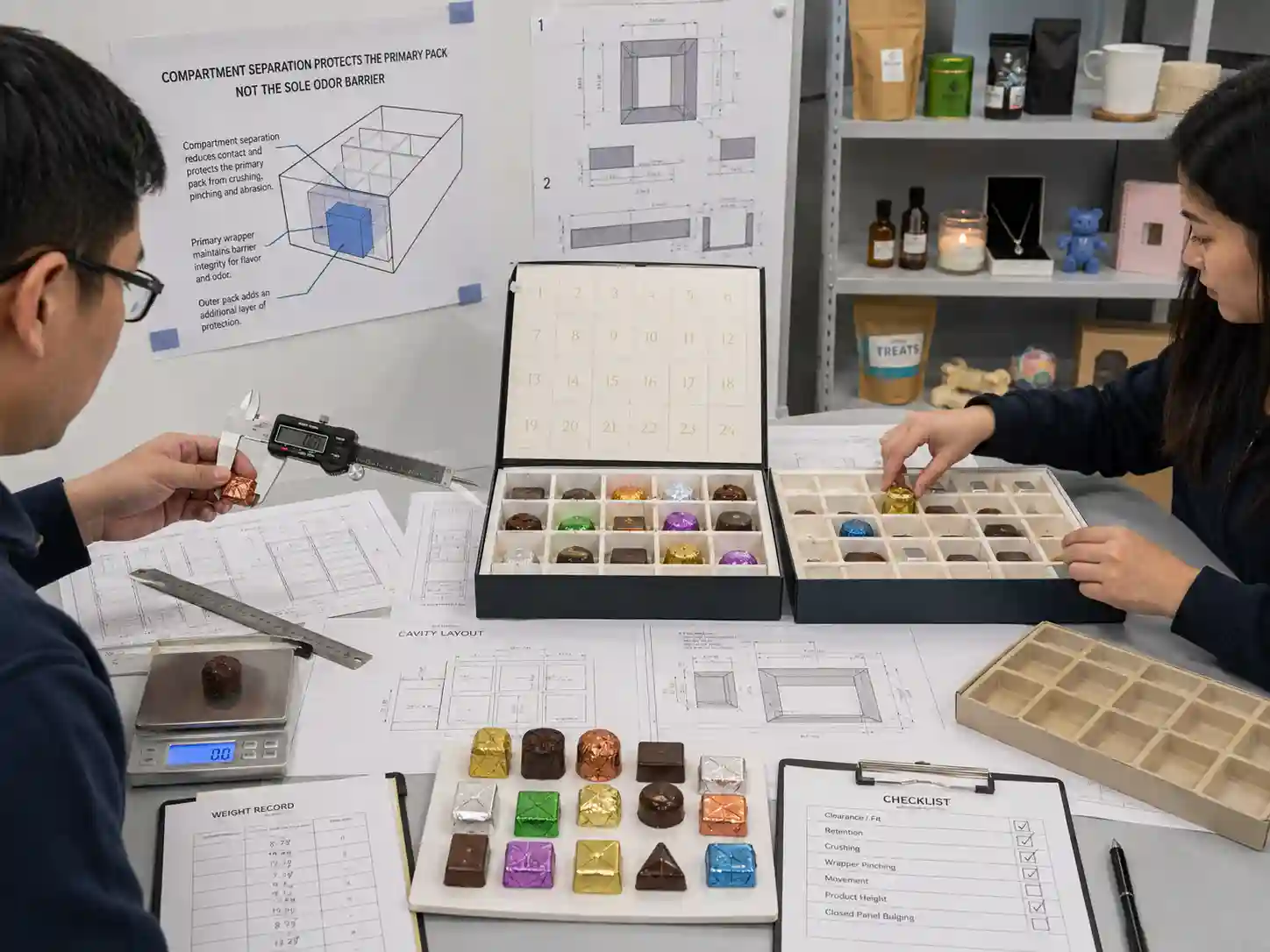
How should you test the completed chocolate compartment layout?
Test the calendar with actual or production-representative chocolates in their approved primary packaging. Empty inserts and unwrapped product dummies cannot verify all wrapper, odor-risk, crushing, and closure conditions.
A practical fit and separation checklist includes:
- Confirm every cavity contains the correct SKU.
- Check primary wrappers and seals before loading.
- Verify that no cavity edge pinches a seal or wrapper fold.
- Check that adjacent chocolates cannot contact each other through openings or shared spaces.
- Confirm strongly aromatic SKUs follow the approved layout.
- Inspect products for crushing, cracking indicators, wrapper abrasion, or deformation after handling.
- Check whether pieces rotate, migrate, lift, or escape their intended cavities.
- Close the calendar and inspect panels for localized bulging.
- Reopen it and compare product positions with approved orientation photographs.
- Record any noticeable unexpected odor differences using the project’s defined evaluation procedure.
Where shelf-life or flavor-transfer performance is a critical product requirement, the responsible food or quality team should define the appropriate evaluation conditions, duration, sample size, and acceptance criteria. A packaging supplier should not substitute an informal smell check for a required product validation program.
What should buyers approve before production?
Buyers should approve the product-to-cavity arrangement and the loaded packaging condition, while technical food-packaging decisions should remain tied to the responsible product and quality specifications. Approval records make later supplier verification much clearer.
A useful approval package can include the numbered cavity drawing, SKU list, primary-packed product dimensions, orientation photographs, loaded prototype photographs, identified high-odor SKUs, fit observations, and an approved reference sample where appropriate.
Any late change to chocolate dimensions, wrapper construction, seal geometry, flavor assortment, or piece weight should trigger a review of affected cavities. A replacement SKU that appears visually similar may have a different wrapper fold, thickness, aroma profile, or fit behavior.

What should QC verify during packing?
QC should verify that production follows the approved SKU map and that the separation system has not been compromised by loading errors or damaged primary packs. Inspection should focus on observable conditions rather than assumptions about barrier performance.
Useful checks include SKU identity, cavity position, wrapper integrity, seal condition, orientation, excessive movement, crushing, compartment deformation, panel bulging, and contamination or unexpected odor observations according to the project’s approved procedure.
Records can use cavity numbers so a recurring issue is traceable to a specific product and position. Photographs of approved loading orientation are also useful when similar-looking chocolates have different flavors or primary packs.
What changes require the separation design to be reviewed again?
Review the design whenever a change can alter barrier risk, dimensions, weight, wrapper integrity, or compartment fit. Do not limit revision control to visible changes in the chocolate itself.
Typical triggers include a new flavor, stronger aromatic ingredients, changed primary packaging material, different seal construction, increased wrapper folds, altered piece thickness, heavier fillings, revised assortment positions, or replacement products.
For example, replacing a small individually wrapped plain chocolate with a thicker coffee-filled piece can affect several variables at once: aroma risk, cavity height, weight, wrapper geometry, and proximity to neighboring chocolates. The revised SKU should therefore be checked in the actual assigned cavity rather than approved from nominal dimensions alone.
Can paperboard dividers prevent chocolate odor transfer by themselves?
No general assumption should be made that a paperboard divider provides the required aroma barrier. Its primary role in an advent calendar is typically physical separation and structural organization; required food-contact and barrier performance should be established through the specified primary packaging system and applicable product requirements.
Do all chocolate pieces need individual primary packaging?
Not necessarily as a universal rule. The correct format depends on the product, intended shelf life, food-safety requirements, packaging system, market requirements, and the product owner’s technical assessment.
What matters for calendar engineering is that the approved primary-packaging boundary is defined before the insert is finalized.
Can one cavity design be used for several chocolate SKUs?
Yes, when representative packed samples demonstrate acceptable fit across the intended SKU range. Check maximum dimensions, wrapper geometry, removal access, movement, product height, and weight rather than approving a shared cavity from nominal chocolate dimensions alone.
What documentation should a packaging supplier receive?
At minimum, provide enough controlled information to identify each SKU, its finished primary-packed dimensions, assigned position, orientation, and relevant fit constraints. Projects with higher flavor or odor sensitivity may also require product-specific handling instructions and approved reference samples from the responsible product team.
Giftpackpro can develop the paperboard calendar structure around approved primary-packed product specifications and cavity requirements. Review custom advent calendar box products and custom advent calendar box services, or request a custom quote with your SKU dimensions, weights, primary-pack formats, and proposed compartment layout.


