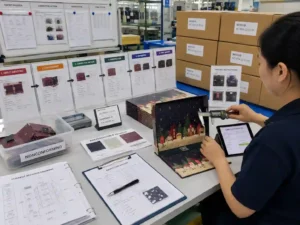
Quick answer: A paper insert for wrapped confectionery should locate each product securely without crushing the confectionery, pinching its wrapper, or allowing excessive movement. Start with the finished primary-wrapped product—not the bare chocolate or sweet—and design each cavity around its maximum dimensions, seal fins, folds, orientation, weight, and removal needs. Paperboard compartments provide physical separation and support, while odor and flavor protection should remain primarily dependent on suitable intact primary packaging.

What should a paper insert for wrapped confectionery actually do?
A paper insert wrapped confectionery design should keep individual products in their assigned positions while protecting their primary wrappers and controlling movement. It should not be treated as the primary odor or flavor barrier.
The insert normally has several mechanical jobs: separate adjacent pieces, support their weight, limit sliding and rotation, prevent wrappers from tangling, and maintain enough clearance so the outer calendar or gift box can close without bulging.
This distinction matters because confectionery can vary significantly even within one assortment. A small flow-wrapped chocolate bar, a foil-wrapped sphere, a pillow-packed sweet, and a flat wrapped wafer do not interact with a paper cavity in the same way.
Which product measurements should define each cavity?
Measure the finished wrapped product in its normal packing condition. Designing from nominal confectionery dimensions alone can produce cavities that interfere with seals, folded wrapper ends, or irregular product profiles.
For each SKU, record:
- maximum finished length, width, and thickness;
- wrapper seam, fin-seal, twist-end, or folded-end projection;
- weight and approximate center of mass;
- preferred presentation orientation;
- areas that should not carry concentrated pressure;
- amount of dimensional variation seen across representative samples;
- space needed for manual or automated loading; and
- finger access or another practical removal method.
Dimensions should be traceable to actual production-representative samples where possible. A cavity drawing can then identify the intended product orientation, contact points, clearance areas, and any tabs or retaining features.
How tight should the compartment fit be?
The correct fit restrains the wrapped confectionery without using damaging compression as the main retention method. The exact clearance is project-dependent and should be established through physical samples rather than a universal allowance.
A cavity that is too loose can allow products to rotate, migrate, rattle, or stack against one side of the calendar. A cavity that is too tight can pinch wrapper seals, abrade printed films or foils, deform softer confectionery, or make removal difficult.
What should you check during a physical fit trial?
Load representative wrapped pieces into the prototype insert and check them individually and as a complete assortment. A cavity that works on an empty insert may behave differently after all compartments are loaded and the calendar is closed.
| Fit check | What to look for | Possible design response |
|---|---|---|
| Insertion | Wrapper catches, folds, or seal fins snag | Increase local clearance or change entry geometry |
| Retention | Product slides, rotates, or leaves its intended position | Adjust cavity walls, tabs, shoulders, or orientation |
| Compression | Wrapper or confectionery is visibly squeezed | Reduce interference and redistribute contact |
| Removal | Product is difficult to grip without pulling its wrapper | Add finger clearance or change cavity exposure |
| Closed-box fit | Panel, drawer, or door bulges after loading | Review product height, insert depth, and stacking tolerance |
How should the insert protect the primary packaging?
The paper structure should contact stable areas of the wrapped product and avoid cutting, pinching, or repeatedly rubbing vulnerable wrapper features. This is especially important around heat seals, twist ends, folded foil, and projecting film edges.
Inspect the die-cut edges and retaining tabs as well as the cavity dimensions. A geometrically correct opening can still cause damage if a tab presses directly onto a seal or if loading drags a delicate wrapper across an exposed paper edge.
Where wrapper appearance is important, use actual finished primary-pack samples during approval. CAD dimensions alone cannot demonstrate whether a printed film, metallized wrapper, foil, or paper wrap will scuff under repeated contact.
Can paper compartments prevent flavor and odor transfer?
Paper compartments can create useful physical separation, but paperboard alone should not automatically be assumed to provide the required aroma or vapor barrier. Wrapped confectionery should therefore be evaluated as a primary-packaging system first.
Strongly aromatic products can require particular attention when positioned beside delicate flavors. The practical review should consider the barrier properties and seal integrity of the actual primary wrapper, storage duration, product formulation, temperature, and proximity of different SKUs.
If odor or flavor compatibility is critical, the buyer should define the acceptance requirement and determine whether additional product or packaging evaluation is needed. Visual inspection of the paper insert cannot verify aroma-barrier performance.
How do you prevent crushing, tangling, and wrapper damage?
Control these risks by separating products according to geometry and by preventing unnecessary load transfer between cavities. Products should not depend on adjacent wrapped pieces to hold them in position.
| Product risk | Typical cause | Insert consideration |
|---|---|---|
| Crushing | Tight cavity, high retention pressure, or panel contact | Provide controlled clearance and support stable surfaces |
| Wrapper tangling | Twist ends or loose film enter adjacent cavities | Separate projecting wrapper areas and control orientation |
| Abrasion | Movement against paper edges or adjacent products | Reduce movement and review contact surfaces |
| Seal damage | Tabs or cavity walls press against sealed areas | Create clearance around vulnerable wrapper features |
| Bulging | Product plus wrapper exceeds available closed depth | Check maximum loaded height before approval |
| Migration | Cavity is oversized or product orientation is unstable | Add geometry-based restraint without excessive compression |

How should product weight affect the paper insert design?
Heavier confectionery requires more than a correctly sized opening. The insert must also remain stable when the complete assortment is loaded, handled, tilted, and placed into the final box structure.
Check whether heavier pieces distort cavity walls, deflect unsupported paperboard, or shift the insert relative to the outer structure. Mixed-weight assortments may need different cavity geometries rather than one repeated compartment style.
Weight records are useful evidence during development because they allow the supplier and buyer to distinguish dimensional fit problems from load-related structural problems. Final decisions should be made using the intended product weights and representative loaded prototypes.
What is a practical fit checklist before approving the insert?
Approval should be based on a fully loaded sample using the intended SKU-to-cavity map. Record exceptions instead of approving the insert solely because each product can physically enter its opening.
- Confirm each cavity against the correct wrapped SKU and orientation.
- Check that wrapper seams, folds, fins, and twist ends have adequate clearance.
- Verify that products remain separated rather than contacting through openings or gaps.
- Check for crushing, denting, wrapper pinching, abrasion, and excessive movement.
- Tilt and handle the loaded structure to identify migration or unstable orientation.
- Confirm that products remain accessible for removal.
- Close the complete calendar or gift box and inspect for panel or door bulging.
- Compare the loaded sample with approved cavity drawings and the SKU position map.
- Record any failed positions and revise them before final approval.
Useful approval evidence can include dimension sheets, product weight records, cavity drawings, orientation photographs, wrapper samples, loaded prototype photographs, and a signed fit checklist. These records make later product changes easier to identify and evaluate.
What changes require the insert to be checked again?
Any change that alters the finished wrapped dimensions, weight, orientation, or wrapper behavior can affect cavity fit. A confectionery recipe change does not necessarily require an insert revision, but a new wrapper format, seal configuration, product size, or SKU substitution may.
For example, replacing a compact flow wrap with a longer wrapper that has projecting end seals can create interference even when the confectionery itself is unchanged. Likewise, a heavier replacement product may expose deflection that was not present during the original fit review.
The buyer should approve the final product list and the product-to-position map. The packaging supplier can verify the insert against those approved inputs, but product formulation, primary-pack barrier suitability, and food compatibility requirements remain separate product-level decisions.

What evidence should buyers review before approving paper inserts?
The most useful evidence shows that the actual wrapped assortment has been tested against the intended structure. Drawings establish design intent; loaded samples and inspection records show whether that intent works physically.
For a custom advent calendar, review the cavity drawing, finished product dimensions, wrapper configuration, loaded prototype, orientation map, and documented fit observations together. Buyers evaluating related structures can also review custom advent calendar box products and custom advent calendar box services when defining the overall packaging format.
FAQs about paper inserts for wrapped confectionery
Should every confectionery cavity have the same clearance?
No. Clearance should reflect the individual SKU’s geometry, wrapper projections, weight, orientation, and required retention. Applying one allowance to very different wrapped products can create both loose and over-tight cavities in the same insert.
Should the cavity be designed from the unwrapped chocolate dimensions?
No. The finished primary-wrapped product should normally be the dimensional reference because seams, folds, twist ends, and wrapper variation directly affect insertion and retention.
Can one paper insert handle several confectionery shapes?
Yes, when the cavity layout is designed around the individual products. Mixed bars, spheres, wafers, and wrapped sweets may require different cavity profiles, support points, and orientations within the same insert.
Who should approve odor-sensitive product combinations?
The buyer or responsible product and quality teams should approve product compatibility requirements. The packaging supplier can provide physical separation and fit evidence, but the paper insert alone does not establish that the primary packaging provides sufficient odor or flavor barrier performance.
If you are developing a mixed wrapped-confectionery calendar and need the paper insert evaluated against actual product dimensions, wrapper formats, weights, and cavity positions, request a custom quote from Giftpackpro with your product specifications and available samples.