Quick answer: Effective tea sachet crush protection starts with sizing each compartment around the finished, primary-packed sachet rather than the nominal tea portion. The cavity should support the pack without compressing the tea, folding sealed edges, trapping wrapper material, or creating excessive movement. Verify the design with actual production-representative sachets, dimensional records, loaded samples, closure checks, and documented fit inspection. The paper insert provides physical support and separation; the intact primary pack remains the critical product boundary.
Why Do Tea Sachets Get Crushed in Small Compartments?
Tea sachets are commonly damaged when the compartment is too tight, too shallow, poorly matched to the filled sachet profile, or loaded in an unsuitable orientation. A cavity that appears correct on a drawing can still create pressure after the actual packed product is inserted.
The critical dimensions are not limited to the tea bag itself. Packaging engineers should measure the complete primary-packed unit, including wrapper seals, folded edges, seams, trapped air, string-and-tag arrangements where applicable, and normal variation in the distribution of tea inside the sachet.
Typical crushing risks include:
- cavity width or length compressing the filled portion of the sachet;
- insufficient depth forcing the sachet against a closing panel or door;
- seal fins or wrapper corners becoming pinched against insert edges;
- strings or tags becoming trapped or tangled during loading;
- neighboring products transferring pressure through flexible partitions;
- excessive empty space allowing the sachet to shift, fold, or bunch during handling; and
- overfilled compartments causing visible panel or door bulging.

How Should Tea Sachet Crush Protection Be Designed?
Design the compartment around the maximum practical profile of the finished packed sachet, then provide controlled clearance rather than simply making the cavity as small as possible. The objective is stable positioning without meaningful compression of the product or its primary wrapper.
What should you measure before designing the cavity?
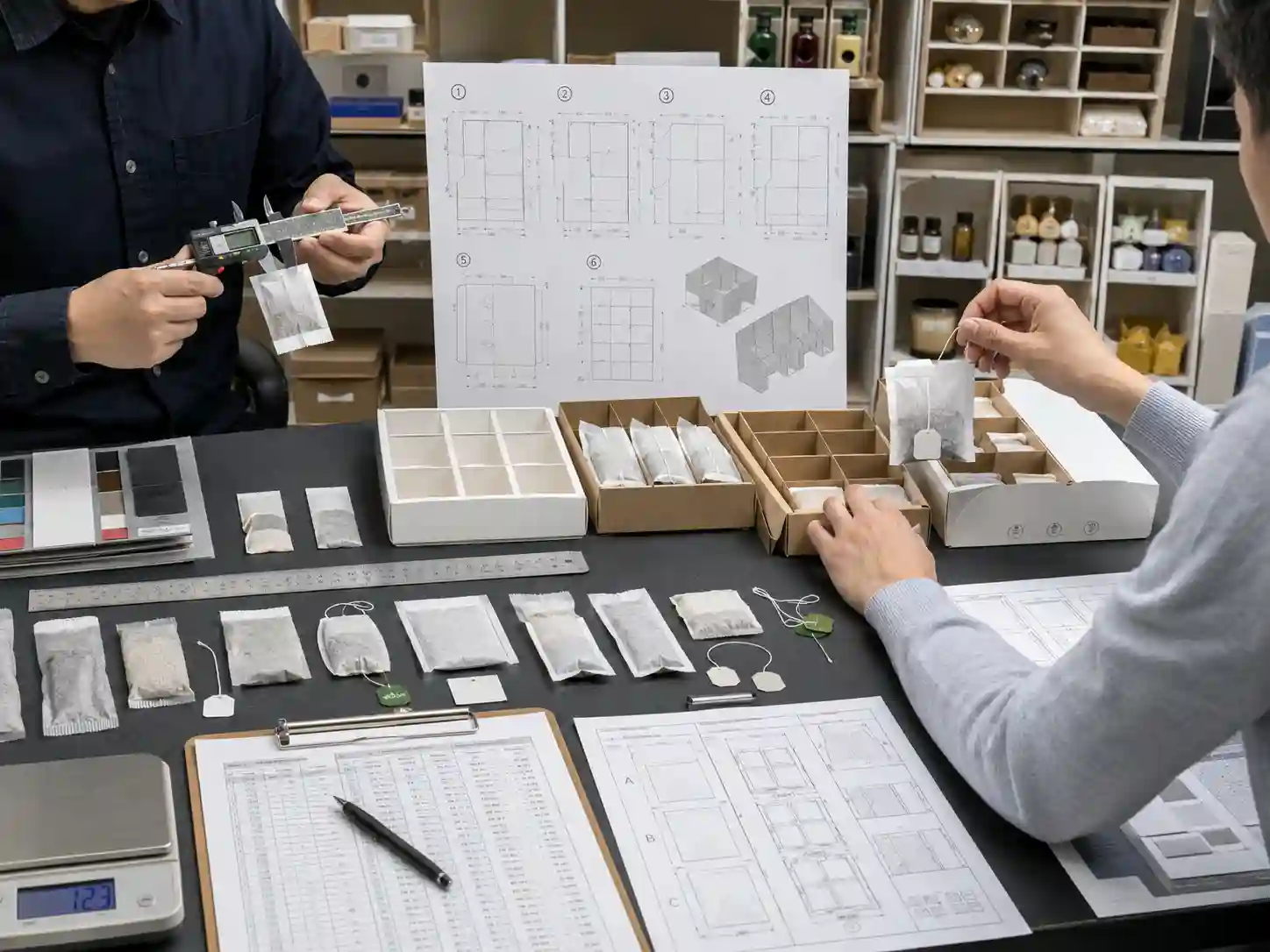
Measure physical samples from the intended primary-pack format. Record length, width, maximum filled thickness, seal dimensions, wrapper folds, and any projecting string, tag, or seam that affects loading.
For multiple tea varieties, do not assume identical outer wrapper dimensions mean identical fit. Different tea cuts, fill weights, sachet constructions, and trapped-air conditions can change the finished thickness or stiffness.
| Product characteristic | Potential packaging risk | Useful verification |
|---|---|---|
| High or uneven filled profile | Local compression or panel bulging | Measure maximum loaded thickness across representative samples |
| Wide wrapper seal | Seal pinching or folding | Compare seal position with cavity edges and retention features |
| String and tag | Tangling, snagging, or trapped tag | Perform repeated loading and removal checks |
| Flexible outer wrapper | Wrinkling or bunching in tight cavities | Inspect loaded samples for edge compression and folds |
| Mixed sachet sizes | Loose small packs or compressed large packs | Use a SKU-by-position cavity drawing and loaded fit sample |
| Strongly aromatic tea | Potential odor interaction if primary packs are unsuitable or damaged | Confirm primary-pack specification and wrapper integrity separately from insert fit |
How much clearance should a tea sachet compartment have?
There is no universal clearance value that is correct for every tea sachet. The appropriate allowance depends on sachet dimensions, wrapper construction, fill distribution, loading method, insert material, retention geometry, and expected manufacturing variation.
The practical test is whether representative sachets can be loaded and removed without forced compression while remaining sufficiently controlled inside the cavity. Buyers and suppliers should therefore approve the result from physical samples rather than relying only on a nominal CAD dimension.
Should the compartment grip the tea sachet tightly?
No. A flexible sachet generally should not depend on strong sidewall compression for retention. Excessive gripping can squeeze the tea, wrinkle the wrapper, distort seals, or make removal difficult.
Where more retention is required, the structural design can use appropriately positioned paper features to control movement without concentrating pressure on the filled area or sealed edges. The exact solution is project-dependent and should be validated with the intended product.
How Do You Check Whether the Compartment Is Too Shallow?
Load the sachet, close the calendar or relevant panel completely, and inspect for contact pressure, deformation, and bulging. Checking an open insert alone can miss interference created by the final closed structure.
A useful fit review should examine the complete stack-up: insert base, sachet thickness, any retention feature, compartment wall height, door or cover clearance, and surrounding structural layers.
Warning signs include a door that sits higher over one compartment, a visible impression from the sachet, resistance during closure, distorted partitions, or a sachet that emerges noticeably flattened after the calendar has been closed.
How Should Mixed Tea Sachets Be Assigned to Compartments?
Assign each tea SKU to a defined cavity position when sachet dimensions, weights, wrapper formats, or filled profiles differ. A position map prevents a cavity approved for one sachet from being assumed suitable for every variety.
For example, a thin individually enveloped herbal tea may fit differently from a fuller pyramid-style primary-packed product. Rather than enlarging every compartment automatically, engineers can evaluate each position against its assigned product and maintain the intended visual layout.
Separation also matters where products have different aromas. The paperboard compartment should be treated primarily as a physical separator, not automatically as an odor barrier. Odor and product-boundary requirements should be addressed through suitable, intact primary packaging and the relevant product specifications.
What Fit Checks Should Be Completed Before Approval?
A repeatable fit checklist gives buyers and suppliers better evidence than a visual statement that the sachets “fit.” Checks should cover loading, closed condition, removal, primary-pack integrity, and consistency across the intended SKU mix.
- Confirm the correct tea SKU is loaded into each assigned cavity.
- Check finished sachet length, width, thickness, seals, folds, and projections against recorded dimensions.
- Verify that the filled tea area is not being visibly compressed.
- Inspect wrapper seals and edges for pinching against paperboard.
- Confirm strings and tags, when present, do not snag or tangle.
- Check that sachets cannot move excessively or fold inside oversized cavities.
- Close the complete structure and inspect for panel or door bulging.
- Remove each sachet and check for abrasion, wrinkles, seal damage, or deformation.
- Compare the loaded sample with the approved cavity drawing and SKU-position map.
- Record deviations before approving the structure for the intended product configuration.
What Evidence Should Buyers Request for Compartment Fit?
Useful evidence connects the approved drawing to the physical packed product. Depending on the project, this can include product dimension records, cavity drawings, orientation photographs, loaded prototypes, SKU-position maps, and signed fit-check records.
For critical positions, photographs showing the sachet both loaded and removed can help document whether wrapper edges, tags, or seals are being trapped. Measurements taken with calipers or rulers should identify what was measured rather than presenting isolated numbers without reference points.
Buyer approval should define the accepted product version as well. A fit approval based on one sachet format may no longer be valid if the tea supplier later changes fill weight, envelope dimensions, seal width, tag arrangement, or primary wrapper construction.
What Should QC Inspect on Loaded Tea Calendars?
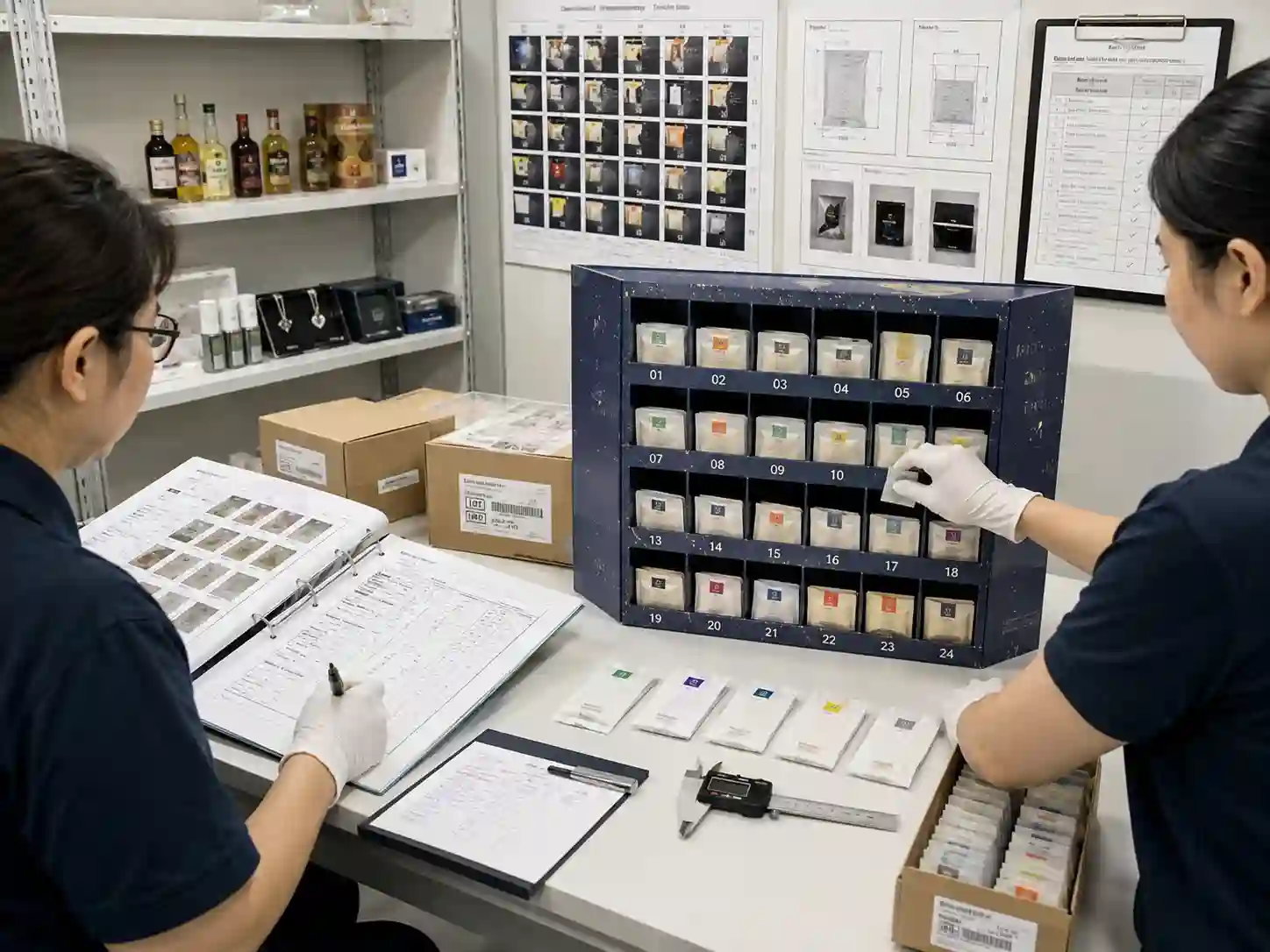
QC should verify that production follows the approved product-to-cavity relationship and that loading has not introduced crushing or primary-pack damage. Inspection should focus on observable, repeatable conditions rather than subjective appearance alone.
Relevant checks can include SKU position, sachet orientation, seating, excessive movement, wrapper pinching, string or tag entanglement, compartment deformation, closure condition, and panel bulging. Any project-specific acceptance limits should come from approved drawings, samples, specifications, or inspection documents rather than being invented during final inspection.
For calendars combining tea with coffee, confectionery, mini bottles, or other specialty products, each product type should be assessed according to its own weight, geometry, primary packaging, and retention requirements. A cavity strategy suitable for a lightweight tea sachet should not automatically be applied to a heavier adjacent item.
When Does a Tea Sachet Change Require a New Fit Review?
Repeat the fit review whenever a product change can alter the occupied space, loading behavior, or primary-pack condition inside the compartment. Even apparently minor changes can affect a tightly engineered cavity.
Examples include a new wrapper size, different seal width, increased tea fill, a new sachet shape, changes to string or tag placement, or substitution of one tea SKU for another. The supplier should compare the revised product against the approved cavity dimensions and loaded reference rather than assuming interchangeability.
Frequently Asked Questions
Can paperboard alone protect tea from odor transfer?
Paperboard compartments can physically separate products, but they should not automatically be treated as the primary odor barrier. The primary packaging specification and its integrity are important when aroma isolation is required.
Is a larger compartment always safer for tea sachets?
No. Extra space can reduce direct compression but may introduce excessive movement, folding, poor presentation, or wrapper abrasion. The goal is controlled clearance rather than maximum empty space.
Should fit testing use empty sachet packaging?
No, not for final fit approval. Empty wrappers can help during early structural development, but production-representative filled and primary-packed samples are needed to evaluate actual thickness, stiffness, seals, movement, and closure interference.
For projects requiring compartment layouts matched to specific tea sachets or mixed specialty products, review custom advent calendar box products and custom advent calendar box services, or request a custom quote from Giftpackpro with your product dimensions, primary-pack samples, and proposed SKU configuration.