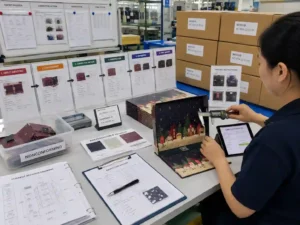
Quick answer: A coffee pod advent calendar insert should support each individually primary-packed pod or drip bag without crushing the coffee pack, pinching its seals, tangling drip-bag components, or allowing excessive movement. Start with finished product dimensions and weights, then design each cavity around the actual primary pack rather than nominal coffee weight. Check clearance, orientation, separation, odor-sensitive combinations, loaded panel height, and total calendar weight using physical samples before approving the structure.
What does the insert actually need to protect?
The insert mainly provides physical positioning, separation, and support. It should not be treated as the primary aroma, moisture, or food-contact barrier unless the complete packaging system has specifically been designed and verified for that purpose.
Coffee pods and single-serve drip bags normally arrive at calendar packing already enclosed in their intended primary packaging. That primary pack is therefore a critical boundary: the calendar structure should avoid damaging seals, films, foil surfaces, filter components, tabs, or folded sections.
For packaging development, record the dimensions and weight of the finished packed unit—not only the coffee dose. Useful evidence includes approved product samples, primary-pack specifications, dimension records, orientation photographs, and a SKU-position drawing.

How should a coffee pod advent calendar insert fit each product?
Design the cavity from measured finished products and their tolerances. The objective is controlled clearance: enough room to load and remove the pack safely, but not so much that it rattles, rotates excessively, or repeatedly strikes the compartment walls.
For a pod, measure its maximum diameter or width, total height, rim or flange geometry, and any flexible outer wrapper. For a drip bag, measure the sealed pouch rather than the unfolded filter inside it. Record length, width, filled thickness, seal-fin dimensions, and any areas where the packed coffee creates a thicker profile.
| Product feature | Main packaging risk | Insert check |
|---|---|---|
| Rigid or semi-rigid coffee pod | Rim damage, movement, concentrated pressure | Check support points, clearance and removal access |
| Individually wrapped pod | Wrapper abrasion or seal pinching | Inspect contact around seams and wrapper folds |
| Flat drip-bag pouch | Bending, compression or slipping | Check filled thickness and cavity retention |
| Drip bag with uneven coffee distribution | Local bulging or excessive compression | Measure the thickest loaded area |
| Mixed coffee formats | Uneven calendar depth and weight distribution | Review every SKU-position combination |
Should the cavity grip the coffee pack tightly?
Usually, no. Retention should come from appropriate cavity geometry and support rather than excessive compression of the primary pack.
A cavity that looks neat in a CAD drawing can still be too tight after product tolerances, seal fins, wrapper folds, or coffee distribution are considered. During sampling, load products repeatedly and inspect for creases, scuffing, distorted pods, stressed seals, or difficult removal.
How do you prevent coffee pods and drip bags from being crushed?
Avoid transferring closing, stacking, or panel pressure directly into the product. The insert and surrounding calendar structure should maintain sufficient internal height and support around the cavities.
This becomes important when products have different thicknesses. One thick pod or overfilled drip-bag pouch can become the local high point inside an otherwise shallow calendar. When the outer panel closes, that position may carry disproportionate pressure.
A practical fit review should include:
- maximum finished product height or filled thickness;
- clearance above the primary pack;
- contact between the product and cavity edges;
- compression around pod rims, pouch seals and wrapper folds;
- movement when the calendar changes orientation;
- ease of manual loading and customer removal;
- visible panel bulging after every compartment is filled.
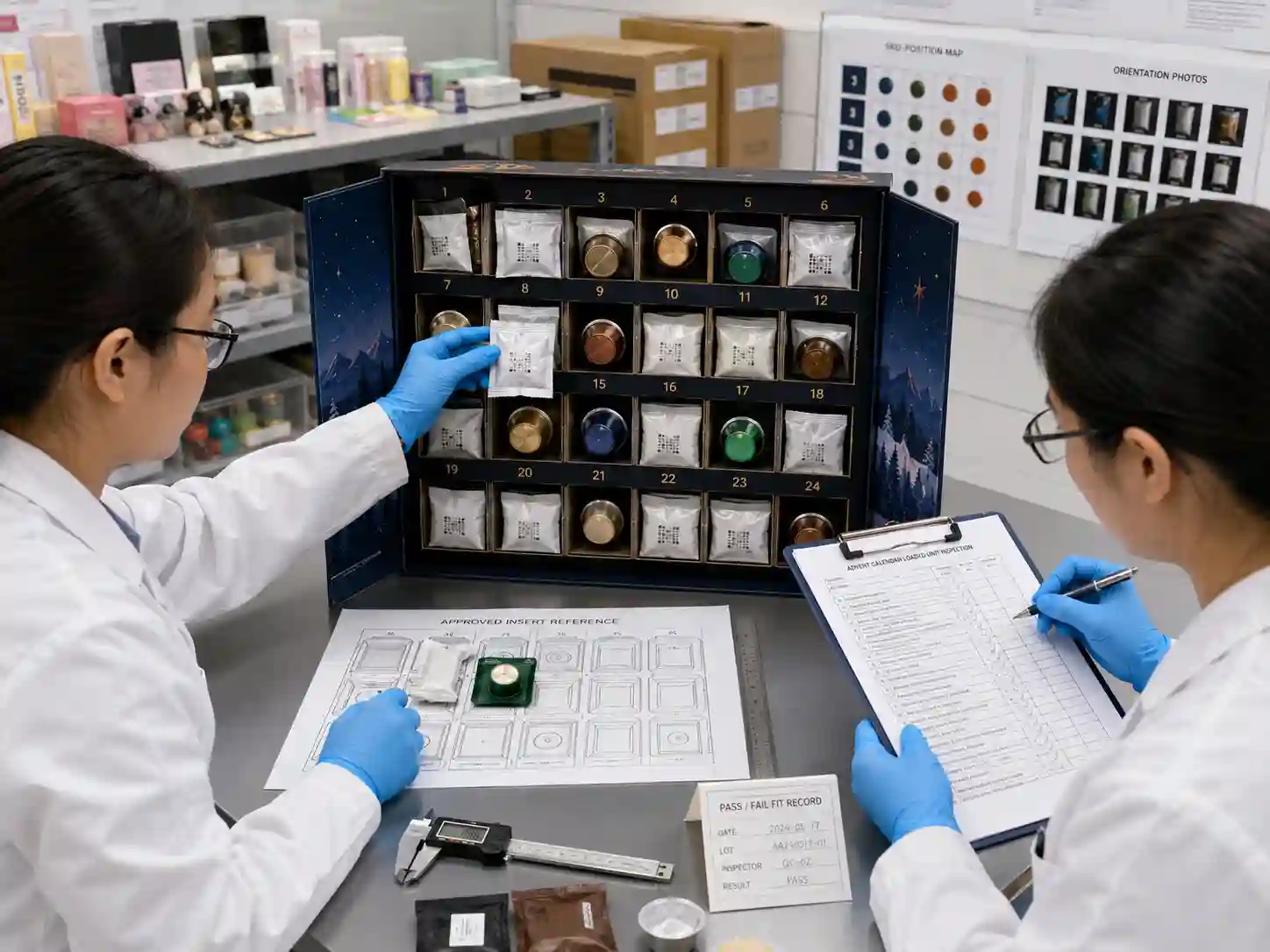
Approve the structure with a fully loaded sample whenever the products vary significantly. Checking one empty insert or one representative cavity cannot reveal interactions between multiple high points across the complete calendar.
How should drip bags be oriented to prevent folding or tangling?
Keep each primary-packed drip bag in a repeatable orientation that avoids forcing seals, folded components, or pouch corners into narrow structural features. The exact orientation depends on the finished primary pack.
If a drip-bag format contains protruding, folded, string-like, or easily snagged elements within or around its primary presentation, check them during repeated loading and removal. Do not assume the nominal pouch rectangle describes its complete fit behavior.
Engineering samples should document the approved orientation with photographs or a packing drawing. That gives production and QC a reference more useful than an instruction such as “place one coffee bag in each compartment.”

How do you manage coffee aroma and odor separation?
Use intact, suitable primary packaging as the principal product boundary and use calendar compartments to maintain physical separation. Paperboard dividers alone should not be assumed to provide an aroma or moisture barrier.
This distinction matters when a calendar combines strongly aromatic coffee varieties or mixes coffee with tea, confectionery, or other odor-sensitive products. Whether particular products can share the same calendar is project-dependent and should be assessed against their actual primary-pack specifications and product requirements.
During approval, buyers can request evidence identifying the final primary-pack format for every SKU. They should also confirm that calendar assembly does not puncture, abrade, fold, or otherwise compromise those packs.
How do weight and product position affect the calendar?
Map the weight of each finished packed SKU to its intended compartment. A calendar containing multiple pods or drip bags can develop uneven loads even when every individual item is relatively small.
Product weight can affect insert deformation, compartment retention, panel flatness, and handling behavior. If the calendar uses doors, drawers, or multiple insert levels, the effect of the loaded products should be evaluated in the actual structure rather than from an empty prototype.
What should be documented before the layout is approved?
The approval record should connect actual products to actual cavity positions. This makes later supplier verification much clearer.
- Measure finished primary-packed samples from each SKU.
- Record maximum relevant dimensions and finished unit weights.
- Assign each SKU to a numbered cavity layout.
- Define the approved product orientation.
- Load the complete insert and close the calendar.
- Inspect compression, movement, seal contact, tangling and bulging.
- Record accepted samples, drawings and orientation photographs.
For mixed-format projects, do not automatically approve one cavity because another coffee SKU fits. Pod diameter, flange geometry, wrapper construction, pouch thickness, seal width, and weight can all change the fit.
What should QC check on a loaded coffee advent calendar?
QC should compare production units with the approved loaded reference rather than checking only whether every compartment contains coffee. Fit and primary-pack condition are part of the inspection.
| QC point | Evidence or method |
|---|---|
| Correct coffee SKU | Compare with numbered SKU-position map |
| Primary-pack integrity | Visual check of wrappers, seals, folds and surfaces |
| Correct orientation | Compare with approved photographs or packing drawing |
| Cavity fit | Check retention, clearance and removal |
| Compression | Inspect products at cavity contact points after loading |
| Movement | Use the project’s approved handling or movement check |
| Closed-calendar condition | Inspect panels for local bulging or distortion |
Measurement tools such as rulers or digital calipers can verify dimensions where required, but the inspection criteria should come from approved project records. Buyer and supplier should agree which characteristics are dimensional checks, visual checks, or functional fit checks.
What changes usually require the compartment fit to be checked again?
Any change affecting the finished primary pack’s dimensions, shape, stiffness, weight, seal geometry, or orientation can affect the insert. Even a coffee product with the same nominal dose may not fit identically after a packaging change.
Examples include changing pod formats, altering outer wrappers, modifying pouch dimensions, moving seals, changing the quantity of coffee in a drip bag, or replacing one SKU with another. The appropriate response is project-dependent, but updated finished samples should be compared with the approved cavity and loaded structure before relying on the previous fit.
What is the safest practical workflow for mixed coffee formats?
Build the calendar around verified finished packs, not assumptions about standard pod or drip-bag sizes. Separate product containment from structural support, then verify the two systems together in a fully loaded sample.
Teams reviewing custom advent calendar box products can use the SKU list, primary-pack samples, dimensions, weights, and preferred opening layout as the starting information for structural discussion. For related application guidance, see the advent calendar box buying guides.
FAQs
Can coffee pods of different sizes share one insert?
Yes, but each format should have a cavity appropriate to its actual finished dimensions and retention requirements. Using one oversized universal cavity may increase movement, while forcing larger pods into a smaller standard cavity can create compression.
Can paper compartments prevent coffee aroma transfer?
They provide physical separation, but paperboard should not automatically be treated as the primary aroma barrier. Verify the suitability and integrity of each product’s primary packaging for the intended application.
Should every drip bag be measured individually?
Engineering does not normally depend on one arbitrary unit. Measurements should represent the finished product and relevant manufacturing variation, with the sampling approach agreed for the project. QC can then use approved dimensions, samples, and inspection criteria as references.
Why should the calendar be checked fully loaded?
A complete load reveals combined effects that isolated cavity checks can miss, including local high points, accumulated weight, insert deformation, product movement, and outer-panel bulging.
If you are developing a mixed coffee pod or drip-bag calendar, prepare the final SKU list, finished primary-pack samples, dimensions, weights, and preferred product positions, then request a custom quote for a project-specific packaging review.