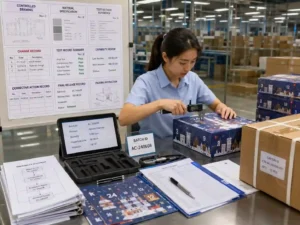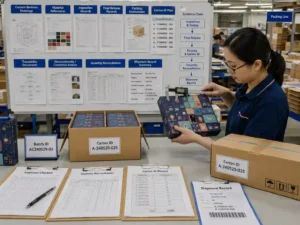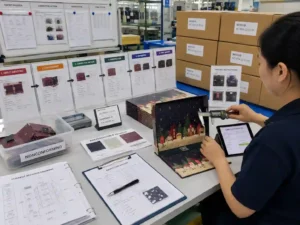
Quick answer: The most useful packaging sample before after changes are those that show a specific problem, a controlled engineering correction, and an objectively verified result. For advent calendar packaging, strong examples include corrected compartment fit, improved product retention, restored door clearance, better structural alignment, resolved surface damage, and improved packing protection. Each comparison should identify the sample revision, explain what changed, and support the result with drawings, measurements, test records, inspection evidence, or buyer approval where applicable.

Which packaging sample before after changes provide the strongest evidence?
The strongest comparisons show changes that are measurable, functionally important, and traceable to a defined revision. A buyer should be able to understand the original condition, the correction made, and the evidence that the revised sample performs differently.
For a multi-component advent calendar, useful before-and-after evidence commonly covers compartment geometry, product retention, door operation, structural alignment, assembly quality, surface protection, and packing performance. Cosmetic changes can also be relevant, but they are more persuasive when tied to an approved specification rather than presented only as photographs.
| Sample change | Useful before evidence | Useful after evidence | What the comparison can verify |
|---|---|---|---|
| Compartment dimensions | Measured opening or cavity, drawing revision, identified sample | New measurements and revised drawing | Whether geometry was deliberately corrected |
| Product retention | Movement, loose fit, lifting or removal observation | Repeated fit and handling check | Whether the revised structure controls the product more effectively |
| Door clearance | Interference, rubbing, incomplete opening or closing | Functional check using the revised sample | Whether the interference was removed |
| Structural alignment | Measured offset, uneven gap or assembly deviation | Equivalent measurement after correction | Whether alignment improved against the requirement |
| Surface protection | Scuffing, marking or contact location after a defined handling step | Result after the same relevant check | Whether the protection change addressed the observed failure mode |
| Packing protection | Identified packing arrangement and documented damage condition | Revised packing arrangement and equivalent verification | Whether the packing correction addressed the documented problem |
Why should the supplier show the original problem, not only the improved sample?
An improved sample alone proves very little about corrective capability. Showing the original condition establishes what actually failed or required adjustment and gives the revised result a meaningful baseline.
The before sample should be identifiable by sample number, date, drawing revision, or another controlled reference. The record should describe the issue precisely: for example, a compartment is too shallow for the approved product orientation, a door edge contacts an adjacent panel, or an assembled tray sits outside the specified position.
Photographs are useful for visible conditions, but dimensional or functional claims should normally be supported by corresponding measurements or test records. A photograph of a better-looking compartment does not by itself prove its depth, clearance, or retention performance.
How should dimensional and product-fit corrections be documented?
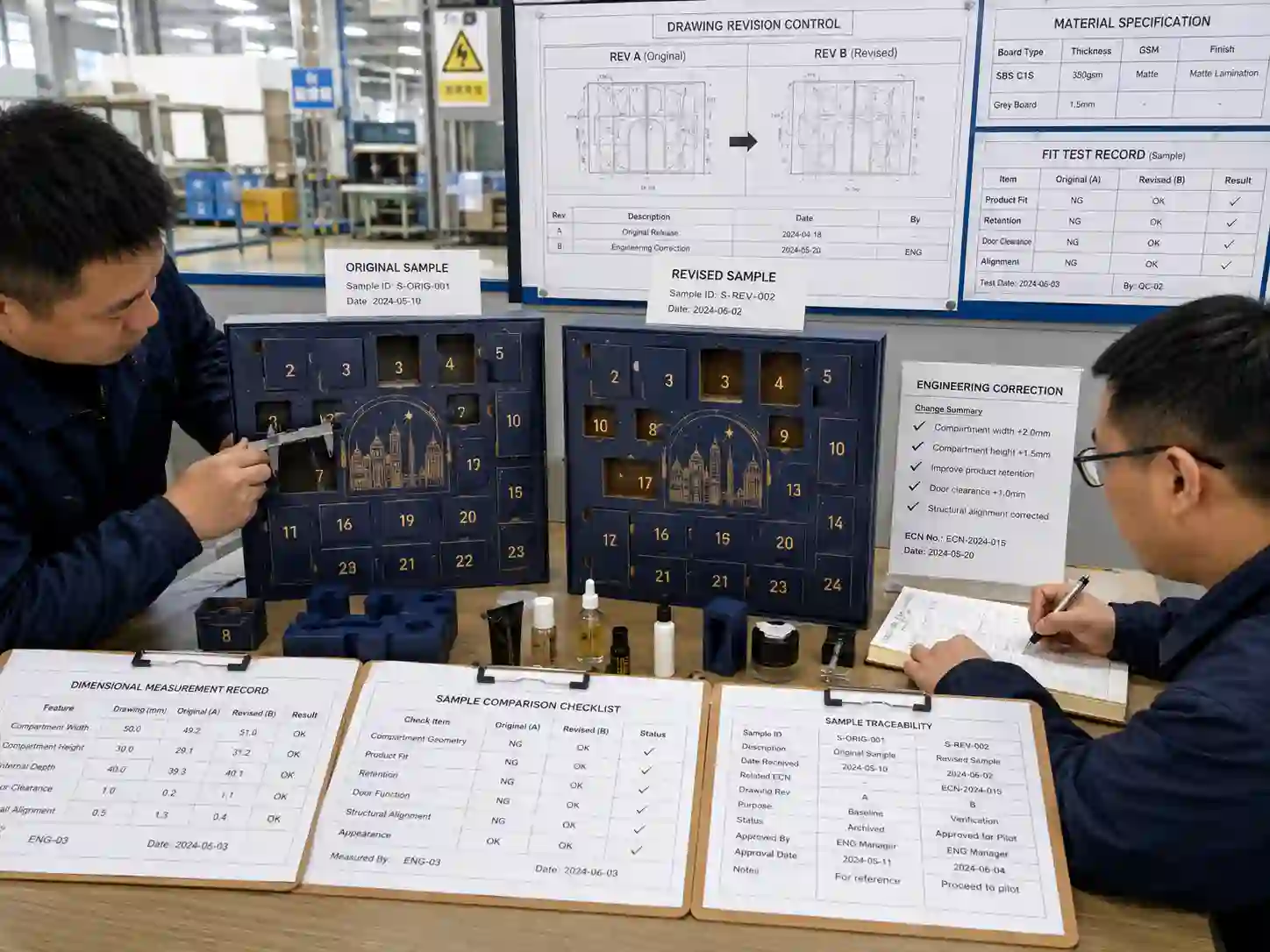
Dimensional corrections are especially useful because the before-and-after relationship can be checked against controlled drawings and actual measurements. The supplier should connect the changed dimension to both the identified sample and the relevant drawing revision.
A practical evidence sequence is:
- Identify the original sample and applicable drawing revision.
- Record the relevant actual dimension or functional condition.
- State the nonconformity or engineering concern without vague wording.
- Identify the revised dimension, geometry, material, or construction detail.
- Issue or reference the revised controlled drawing.
- Measure the new sample using the appropriate instrument or method.
- Repeat the relevant fit or functional check.
- Record the result and any required buyer approval.
For product-fit changes, the reference product also matters. A revised cavity should not be presented as verified if the supplier tested it against an unidentified substitute whose dimensions differ from the approved product.
Which functional changes are most valuable to compare?
Functional changes are valuable when the packaging must perform consistently rather than merely look correct. Door operation, drawer movement, product retention, removal access, closure behavior, and interference between components are common examples.
Should door and drawer corrections be shown?
Yes, when the original issue affected opening, closing, clearance, alignment, or usability. The evidence should show the defined condition being checked before and after the revision rather than simply displaying an open finished calendar.
For example, if a door rubbed against an adjacent panel, the record can identify the contact location, the structural revision, and the result of repeating the opening and closing check. If acceptance depends on a buyer-defined appearance or feel rather than a measurable tolerance, that decision should remain clearly identified as buyer approval.
Should product-retention changes be shown?
Yes, particularly when products could rotate, lift, migrate between positions, or become difficult to remove. A useful comparison records the actual product or approved reference, its orientation, the original failure mode, and the result after the retention feature is revised.
The exact verification method varies by project. A simple fit observation may be sufficient for one structure, while another project may require repeated handling, orientation checks, or a defined transport-related test. Suppliers should not present one method as universally sufficient.
When are material or construction changes worth showing?
Material changes are worth showing when they directly address a documented problem or specification requirement. The comparison should identify what material or construction attribute changed rather than relying on visual differences alone.
Relevant records may include material specifications, board or paper references, thickness measurements where applicable, approved component specifications, and the drawing or bill-of-material revision associated with the new sample.
Three categories should remain separate:
- Verifiable fact: the material reference, measured dimension, sample identity, drawing revision, or recorded test result.
- Project-dependent recommendation: whether a different board construction, reinforcement, clearance, retention feature, or packing method is appropriate.
- Buyer approval: acceptance of appearance, tactile feel, permissible variation, artwork-related presentation, or another commercially defined criterion.
This separation prevents a supplier recommendation from being presented as though it were already an approved requirement.
How useful are before-and-after photographs by themselves?
Photographs are strong supporting evidence for visible conditions but weak evidence for claims that depend on dimensions, materials, or controlled testing. Their credibility increases when each image is tied to an identified sample, date, revision, and inspection or test record.
A dated photograph can show a torn edge, shifted component, scuffed surface, misaligned panel, or revised packing arrangement. It cannot independently establish hidden dimensions, material composition, or compliance with an unshown specification.
| Weak documentation | Stronger documentation |
|---|---|
| Two unlabeled photographs marked “before” and “after” | Photographs linked to identified sample revisions and dated records |
| “Fit improved” | Original fit issue, engineering change, revised fit record, and sample identity |
| “Door problem solved” | Defined interference condition plus repeated functional check after revision |
| “Material upgraded” | Controlled material references showing the original and revised specification |
| “Packing is stronger now” | Original failure evidence, revised packing configuration, and comparable verification record |
What should buyers check before accepting a before-and-after comparison?
Buyers should check traceability first. If the samples, drawings, products, records, and revisions cannot be connected, the comparison may illustrate an improvement without proving that it belongs to the project being reviewed.
- Are both samples clearly identified?
- Is the original problem described specifically?
- Is the engineering or production change documented?
- Does the revised drawing or specification match the revised sample?
- Were comparable measurements or checks used before and after where appropriate?
- Are instruments, measurement points, and test conditions clear enough to interpret the result?
- Is the approved product or reference component identified for fit-related evidence?
- Are failed, conditional, and passed results distinguished?
- Can photographs be linked to the relevant sample and record?
- Is buyer approval recorded separately where acceptance requires a commercial decision?
This evidence can also help when reviewing broader supplier capability. A factory that can connect a detected issue to controlled drawings, revised samples, inspection records, and documented corrective action provides more useful evidence than one that only presents polished final samples. Buyers assessing manufacturing context can also review the Giftpackpro packaging factory and related custom advent calendar box services.
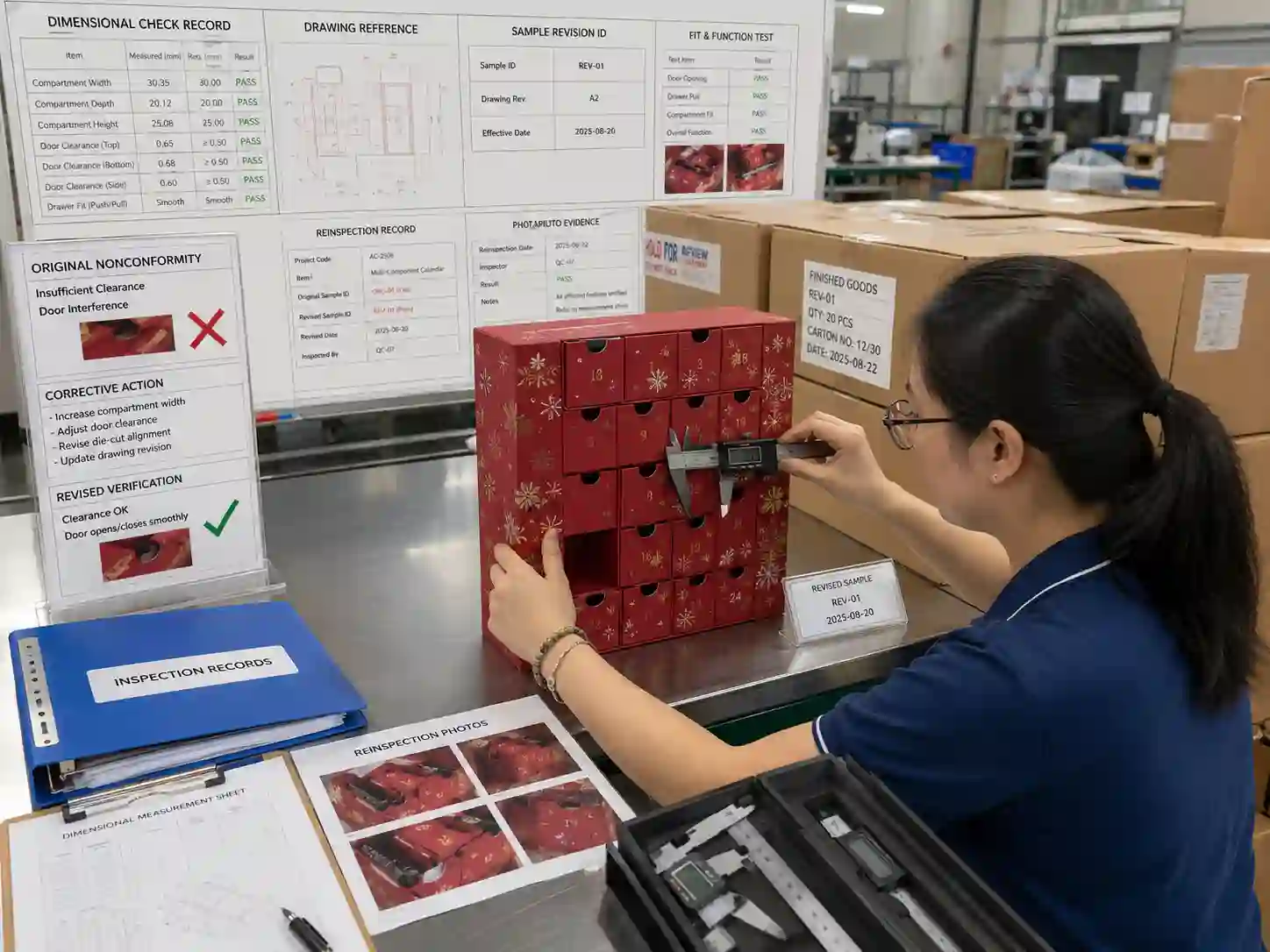
How should corrective action appear in the sample history?
A useful sample history shows a closed evidence loop: requirement, observed condition, correction, revised sample, and verification. It should not hide failed iterations when those iterations explain why the final construction changed.
For example, an identified sample may show insufficient clearance. Engineering records then identify the affected geometry and issue a new drawing revision. The revised sample is measured at the same relevant feature and the functional check is repeated. The resulting record shows whether the correction passed, remained conditional, or required another revision.
This is more credible than a case study that jumps directly from a vague problem statement to a successful final photograph.
Do all sample changes need the same amount of evidence?
No. Evidence should be proportional to the importance and verifiability of the claim. A critical product-fit or structural correction normally deserves more documentation than a minor appearance adjustment.
The required evidence also varies with the calendar structure, product mix, material system, acceptance criteria, test method, and stage of development. Buyers and suppliers should agree which characteristics require objective records and which remain subject to buyer approval.
What before-and-after evidence is most useful in a supplier review?
The most useful evidence lets a reviewer reconstruct what happened without relying on sales claims. Prioritize comparisons with identifiable samples, controlled revisions, objective records, and a clear relationship between the original problem and the verified correction.
For a focused review, ask for a small number of technically meaningful examples rather than a large gallery of finished packaging. A compartment-fit correction supported by measurements and drawing revisions usually says more about process control than numerous unlabeled final-sample photographs.
Frequently Asked Questions
Should the physical before sample be retained?
Retaining it can be useful when the issue is difficult to document adequately through records and photographs. Whether physical retention is necessary depends on project controls, sample-storage requirements, the significance of the change, and agreements between buyer and supplier.
Can a supplier use before-and-after evidence from another project?
It can support a general capability review if project confidentiality permits, but it does not verify performance on the buyer’s current project. The supplier should distinguish historical capability evidence from records belonging to the current order or development program.
What if the revised sample looks better but measurements are unavailable?
Treat only the visible improvement as verified. Do not infer dimensional compliance, material compliance, or functional performance from appearance alone; request the relevant measurement, specification, or test record when that claim matters to approval.
Who should approve the final revised sample?
The approval route depends on the project and purchasing controls. Engineering or QC can verify objective requirements, while designated buyer representatives should approve characteristics that require commercial acceptance. The approval record should identify the sample or revision being accepted.
For additional supplier-verification topics, see the advent calendar box buying guides. To discuss the evidence, drawings, sample controls, and verification requirements needed for a specific advent calendar project, request a custom quote.