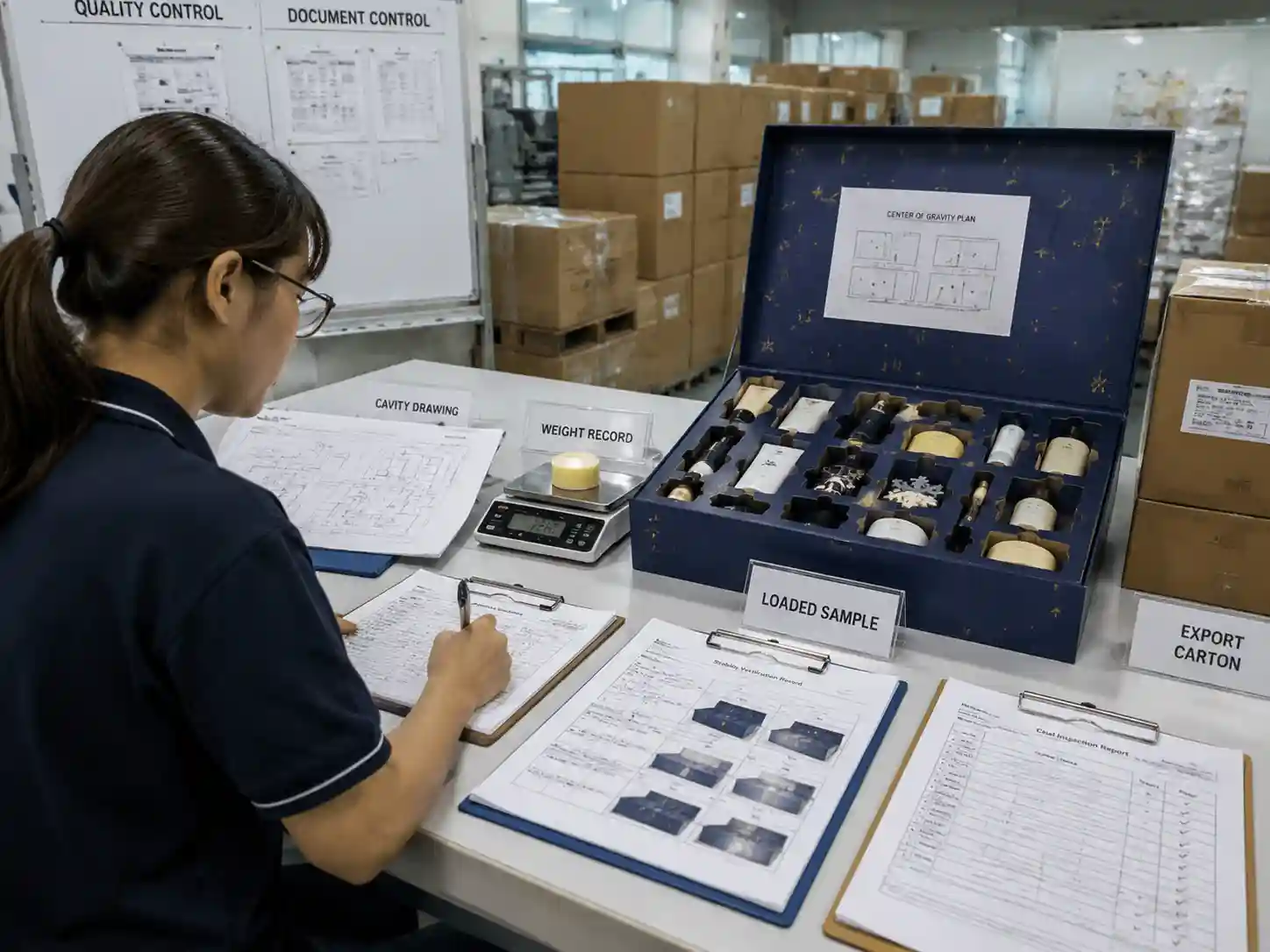
Quick answer: Product center of gravity should influence compartment design by determining product orientation, support points, retention method, and weight distribution inside the insert. A stable cavity keeps the product from tipping, rotating, or creating pressure on the box structure during handling. Engineers usually validate this through product measurements, loaded samples, orientation drawings, and physical fit checks before final production.
Why does product center of gravity matter in compartment design?
Product center of gravity matters because the position of the product’s weight affects stability inside each cavity. A product with a high center of gravity or uneven weight distribution can tilt, rotate, or place unexpected stress on the insert walls.
For custom advent calendar packaging, compartment design is not only about matching external dimensions. The cavity must also control how the product sits after loading, closing, transportation, and repeated handling.
How does center of gravity change the required support area?
The higher or more offset the center of gravity is, the more important the lower support area and side restraints become. A tall bottle, narrow tube, or irregular product may require deeper cavities, additional contact points, or a different orientation compared with a flat or balanced item.
Typical design considerations include:
- Bottom support area to carry the product weight.
- Side clearance to prevent excessive movement.
- Retention points that hold the product without damaging surfaces.
- Orientation control to keep the product facing the intended direction.
How should engineers measure center of gravity effects before insert design?
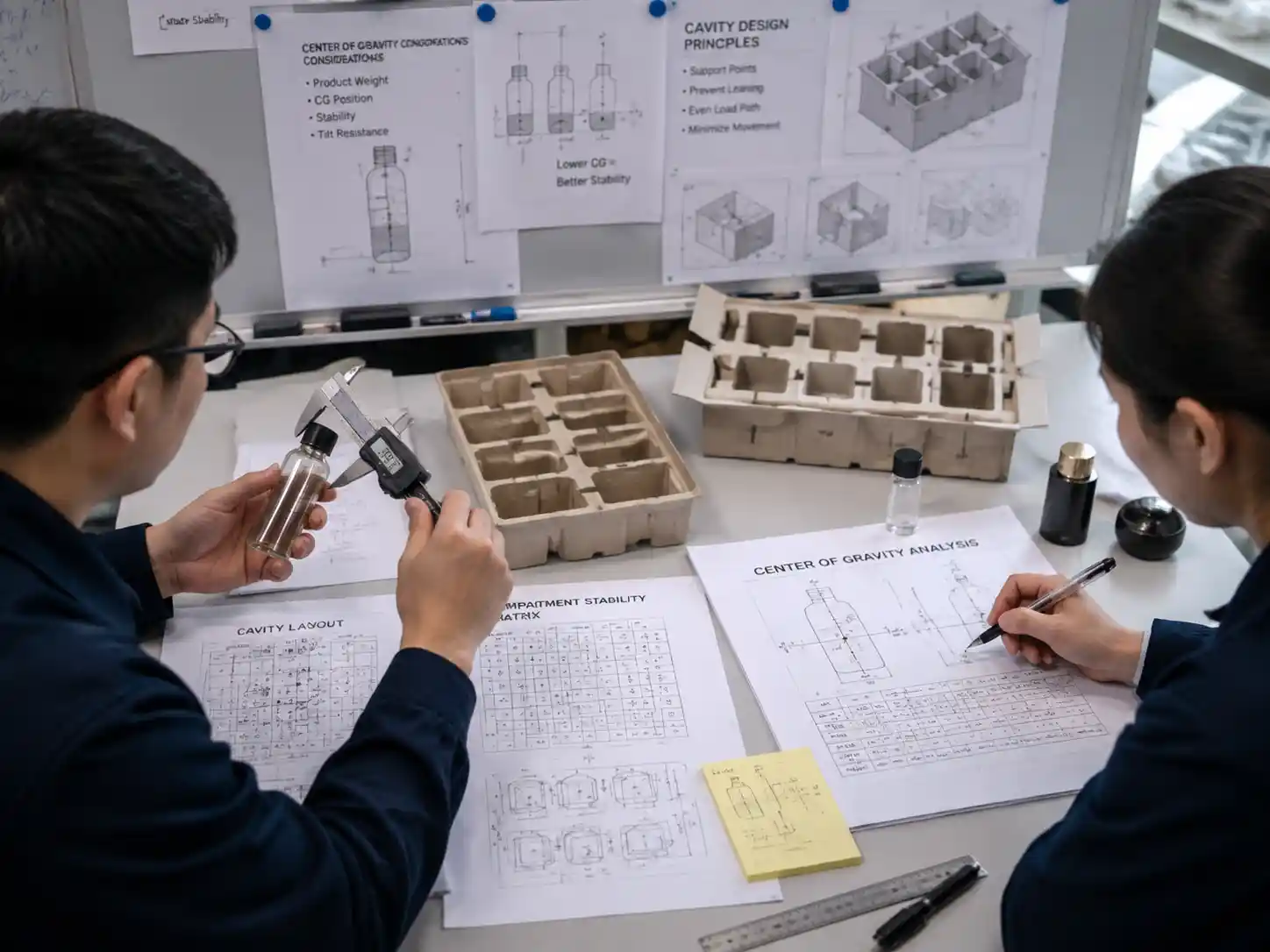
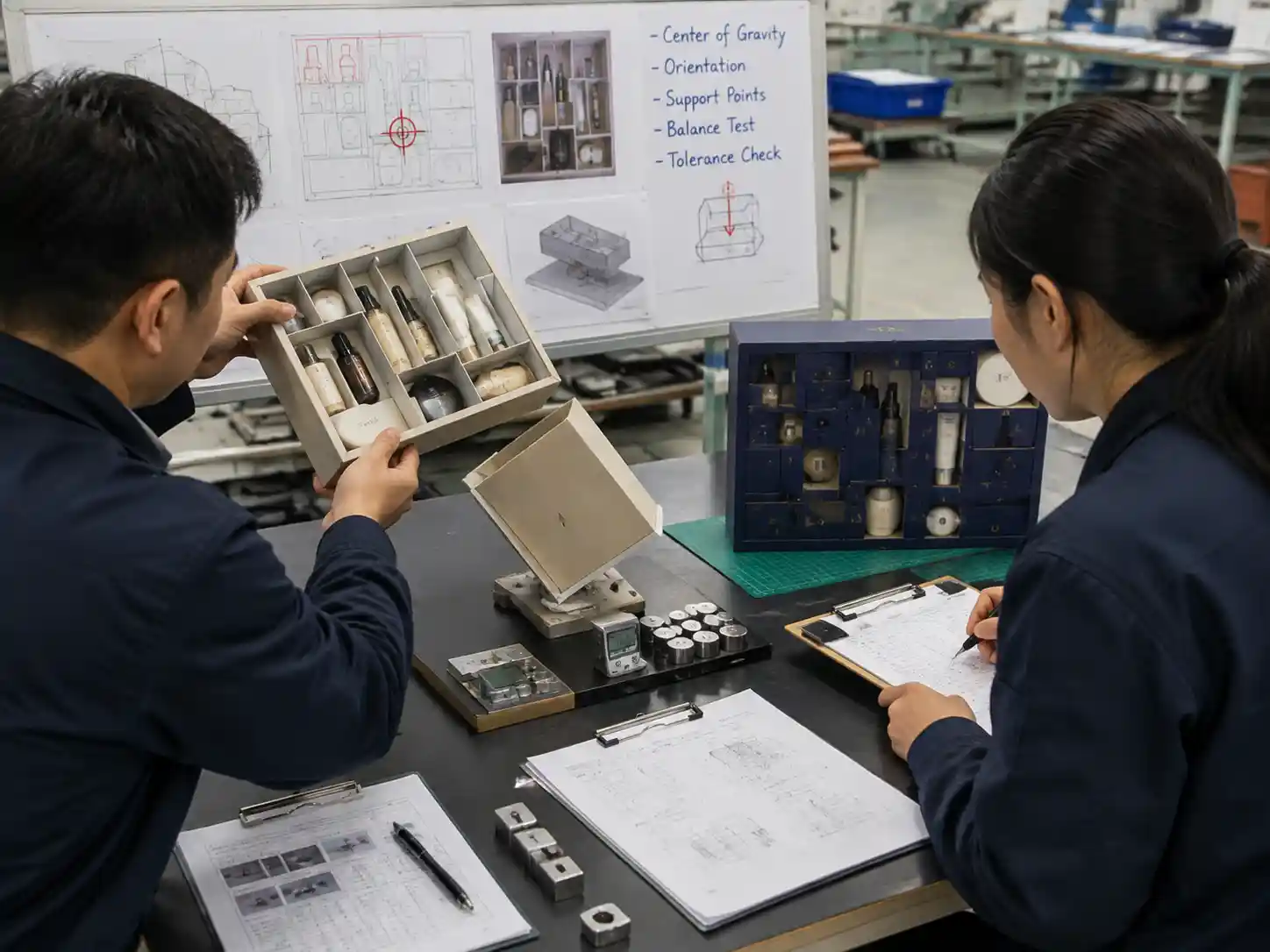
Engineers normally evaluate center of gravity effects by combining product dimensions with physical loading tests. The goal is to understand how the product behaves when placed inside a cavity, not only whether it fits.
- Measure product height, width, depth, and weight.
- Identify the approximate center of mass based on product shape and internal weight distribution.
- Record the preferred loading orientation.
- Create cavity dimensions around the support zones instead of only the outer product profile.
- Test loaded samples in prototype inserts.
| Measurement item | Why it matters | Validation method |
|---|---|---|
| Product height and footprint | Determines cavity size and stability base | Caliper measurement and dimension drawing review |
| Product weight | Affects insert strength and weight distribution | Loaded sample check |
| Center of gravity position | Indicates tipping or rotation risk | Physical balance observation and orientation testing |
| Contact points with insert | Controls retention and pressure areas | Prototype cavity inspection |
How does center of gravity affect cavity orientation?
Center of gravity often determines whether a product should stand vertically, lie horizontally, or be placed at a specific angle. The correct orientation reduces movement and avoids unnecessary pressure on compartment walls.
For example, a tall cosmetic container with a heavier lower section may remain stable when upright, while a top-heavy container may require additional side support or a different placement direction.
What happens if orientation ignores weight balance?
If the orientation does not match the product’s weight distribution, several problems may appear:
- The product may lean inside the compartment.
- Repeated handling may loosen the cavity fit.
- Products may collide with neighboring compartments.
- The lid or outer structure may receive uneven internal pressure.
These risks are usually identified during prototype review through loaded samples rather than predicted only from drawings.
How much tolerance should be allowed around a product with an uneven center of gravity?
The required tolerance depends on product material, weight, surface finish, insert material, and expected handling conditions. There is no single clearance value that applies to every product.
Project teams normally balance two opposite requirements: enough space for safe loading and removal, while maintaining enough support to prevent movement.
| Condition | Design consideration |
|---|---|
| Lightweight and balanced product | May allow more clearance if retention remains stable |
| Heavy or top-heavy product | Usually requires stronger support and controlled movement |
| Fragile surface product | Requires careful contact points and reduced pressure areas |
| Variable product dimensions | Requires confirmed tolerance range before production |
What checks should be completed during sample validation?
Sample validation should confirm that the designed cavity supports the product under realistic loading conditions. Measurements and records should connect the approved product sample, insert design, and final packaging structure.
- Confirm the product sits in the intended orientation.
- Check whether the product tilts after loading.
- Measure movement inside the cavity.
- Inspect contact areas for excessive pressure marks.
- Verify that closing the box does not create interference.
A useful loaded-sample checklist includes:
- Product sample version confirmed.
- Product weight recorded.
- Cavity drawing approved.
- Orientation instruction documented.
- Prototype loading result reviewed.
- Required adjustments recorded before production approval.
How can buyers verify that a supplier considered center of gravity correctly?
Buyers can verify the design approach by reviewing engineering evidence rather than only checking the finished appearance. Useful documents include dimension drawings, cavity layouts, sample approval records, measurement sheets, and inspection notes.
During supplier review, buyers should confirm that the supplier has considered:
- Product weight and balance characteristics.
- Final product orientation inside the compartment.
- Insert support areas and retention points.
- Prototype loading results.
Giftpackpro applies this measurement-focused approach when developing custom advent calendar packaging solutions. Related structural options can be explored through our custom advent calendar box products and custom advent calendar box services.
FAQs about product center of gravity insert design
Can product dimensions alone determine compartment design?
No. Dimensions define the space requirement, but weight distribution and center of gravity affect stability, orientation, and retention.
Does a heavier product always need a tighter cavity?
Not necessarily. A heavier product may require stronger support areas rather than simply reduced clearance. Excessive tightness can increase loading difficulty or create pressure damage.
When should center of gravity be reviewed?
It should be reviewed during the measurement and prototype stage, before compartment dimensions are finalized for production.
For projects requiring detailed cavity planning, dimensional review, and packaging structure evaluation, you can request a custom quote from Giftpackpro.