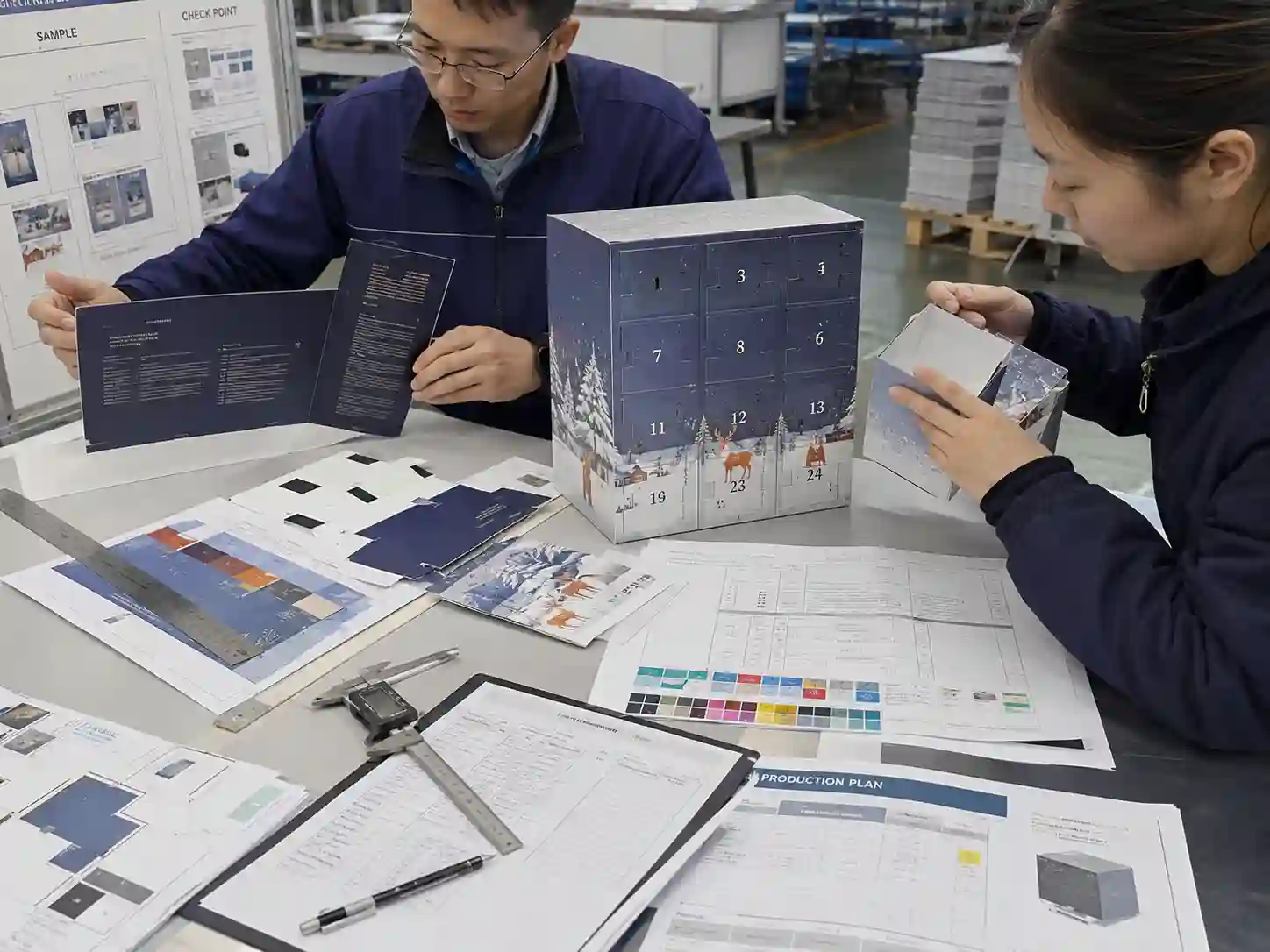
Quick answer: A successful legal copy advent calendar layout keeps mandatory information visible while avoiding door cuts, fold lines, opening numbers, perforations, and key graphics. Position legal text using the approved dieline, dedicated artwork layers, defined safe areas, and preflight verification before production. The final layout should be confirmed on both digital artwork and assembled physical samples because text that appears acceptable on a flat file may become hidden or interrupted after folding.
Why does legal copy placement matter on advent calendar packaging?
Legal copy must remain readable without interfering with how customers interact with the calendar. Unlike standard cartons, advent calendars contain numbered doors, folds, perforations, trays, windows, or drawers that create additional restrictions for text placement.
The objective is not simply fitting required information onto the artwork. The objective is ensuring mandatory content remains complete after printing, die-cutting, folding, gluing, and opening.
Typical mandatory content may include:
- Manufacturer or importer information
- Country of origin
- Material identification
- Safety warnings where applicable
- Recycling instructions
- Age recommendations when required
- Barcode quiet zones
- Multilingual legal statements
How should a legal copy advent calendar layout be planned?
Begin with the structural dieline rather than the finished artwork. Legal content should be positioned only after folds, glue flaps, perforations, door numbers, finishing effects, and barcode locations have been finalized.
Reserve dedicated safe areas
Create predefined areas for legal copy that stay outside:
- Perforated doors
- Door hinge areas
- Fold lines
- Glue flaps
- Magnet locations
- Embossing or debossing zones
- Foil stamping regions
- Large product windows
These reserved areas reduce last-minute artwork movement during production.
Separate artwork layers
Maintain legal copy on an independent artwork layer instead of merging it with decorative graphics. This makes multilingual revisions and regulatory updates easier without affecting approved artwork elements.
Which packaging features most often create problems?
Certain structural features increase the likelihood that legal text becomes partially hidden or difficult to read.
| Packaging feature | Potential issue | Recommended check |
|---|---|---|
| Perforated doors | Text split during opening | Keep copy outside door outlines |
| Fold lines | Characters distorted after folding | Maintain safe distance from folds |
| Glue flaps | Content covered during assembly | Exclude all mandatory information |
| Foil or embossing | Reduced readability | Review finishing layers separately |
| Barcode area | Quiet zone interference | Maintain scanner clearance |
| Multilingual blocks | Overcrowded layout | Prioritize hierarchy and spacing |
How do prepress teams verify the final position?
The artwork should be reviewed both digitally and physically. Flat PDFs alone cannot fully demonstrate how text appears once the package is folded and assembled.
A typical review includes:
- Artwork against the latest approved dieline
- Layer inspection for legal text and finishing
- Barcode position verification
- Safe-area confirmation
- Fold simulation
- Assembly mock-up review
- Opening sequence inspection
Engineering samples are especially valuable because they reveal whether copy disappears beneath doors, wraps around folds, or becomes difficult to read after assembly.
How should multilingual legal copy be handled?
Multilingual projects usually require more planning than single-language packaging because translated text often occupies different amounts of space.
Instead of compressing text into decorative areas, designers should reserve expandable copy blocks during the initial artwork layout. This minimizes later movement of structural graphics and reduces revision risk.
When language versions change, confirm that:
- Line breaks remain readable
- Minimum font size is maintained
- Text does not enter die-cut areas
- Barcode spacing remains compliant
- Copy hierarchy is preserved
What belongs in the preflight checklist?
Before artwork release, verify each item against the approved production file.
| Preflight item | Status to confirm |
|---|---|
| Latest structural dieline used | Yes |
| Legal copy on dedicated layer | Yes |
| Safe areas respected | Yes |
| Fold lines reviewed | Yes |
| Door openings checked | Yes |
| Barcode quiet zone protected | Yes |
| Finishing layers reviewed | Yes |
| Multilingual text approved | Yes |
| Physical sample inspected | Yes |
| Final approval record archived | Yes |
What evidence supports production approval?
Good approval records reduce confusion between design revisions and manufacturing changes.
A typical approval package may include:
- Approved PDF artwork
- Revision history
- Dieline version reference
- Layer separation screenshots
- Folded white sample
- Printed color proof
- Barcode verification record
- Final signed approval sheet
Example approval workflow
- Structural dieline approved.
- Legal copy positioned on dedicated artwork layer.
- Prepress checks safe areas and finishing overlap.
- Printed proof compared with digital file.
- Assembled sample inspected through the full opening sequence.
- Final artwork released with documented approval records.
Which items are fixed requirements and which depend on the project?
Generally verifiable
- Legal copy should not cross fold lines or perforations where readability is affected.
- Barcode quiet zones should remain unobstructed.
- Artwork should match the approved structural dieline.
- Final production files should pass preflight before release.
Project-dependent decisions
- Location of multilingual content.
- Available panel space.
- Font size and layout hierarchy.
- Use of varnish, foil, embossing, or specialty finishes.
- Regional regulatory requirements.
Buyer approvals
- Final legal wording.
- Language versions.
- Placement of mandatory information.
- Barcode location.
- Final assembled production sample.
Frequently asked questions
Can legal copy be printed across multiple panels?
It can, but readability after folding should be verified. Splitting important statements across moving panels is generally avoided where possible.
Should legal copy share the same layer as decorative graphics?
No. Maintaining independent artwork layers simplifies revisions, regulatory updates, and preflight inspection.
Is digital artwork review enough?
No. A folded sample is recommended because assembly may hide or interrupt text that appears acceptable on the flat artwork.
Need support with production-ready artwork?
If your project includes complex door layouts, multilingual requirements, or multiple finishing processes, review our advent calendar box buying guides, explore our custom advent calendar box services, browse our custom advent calendar box products, or request a custom quote. Early artwork coordination helps reduce revisions before production approval.