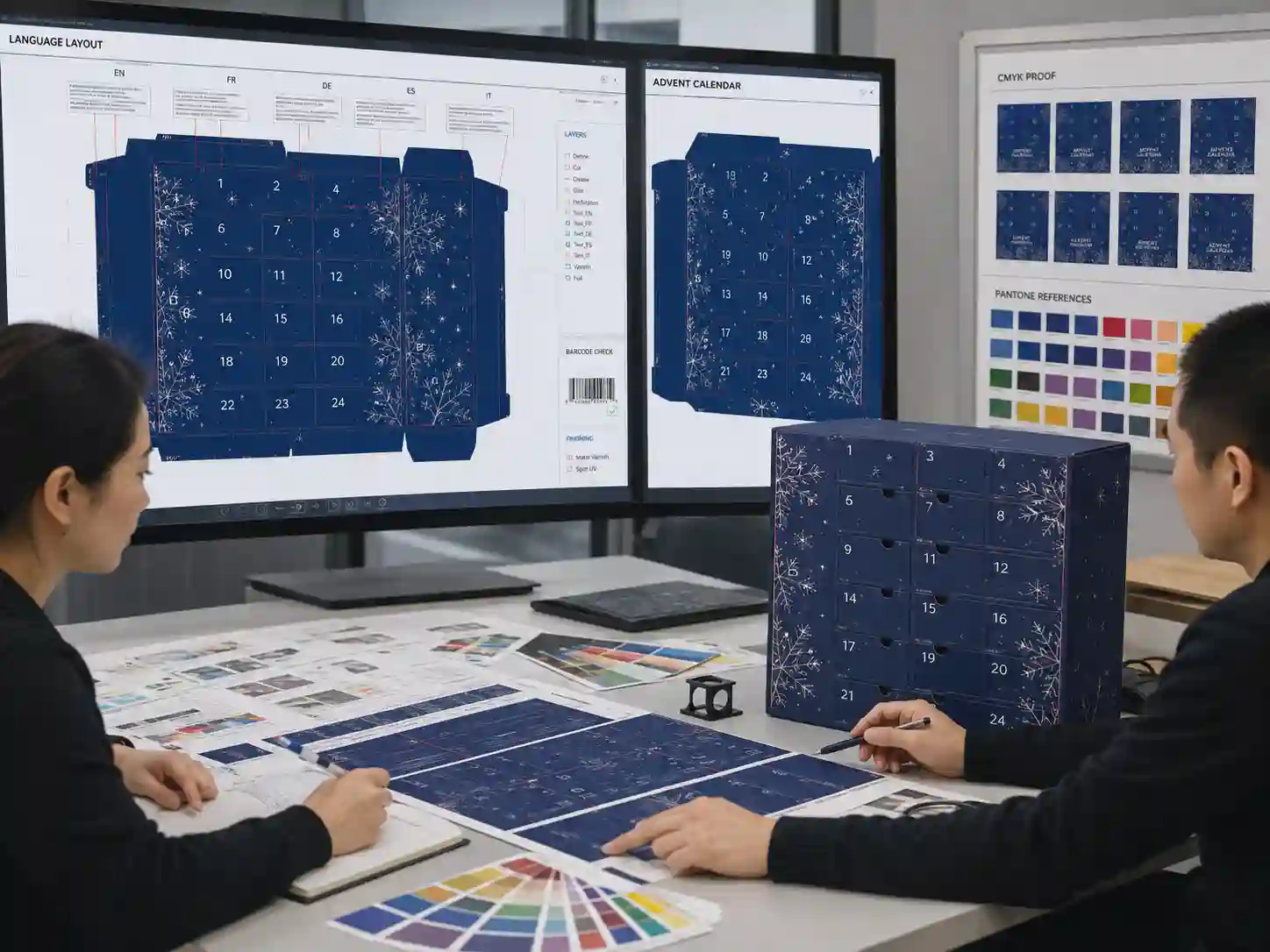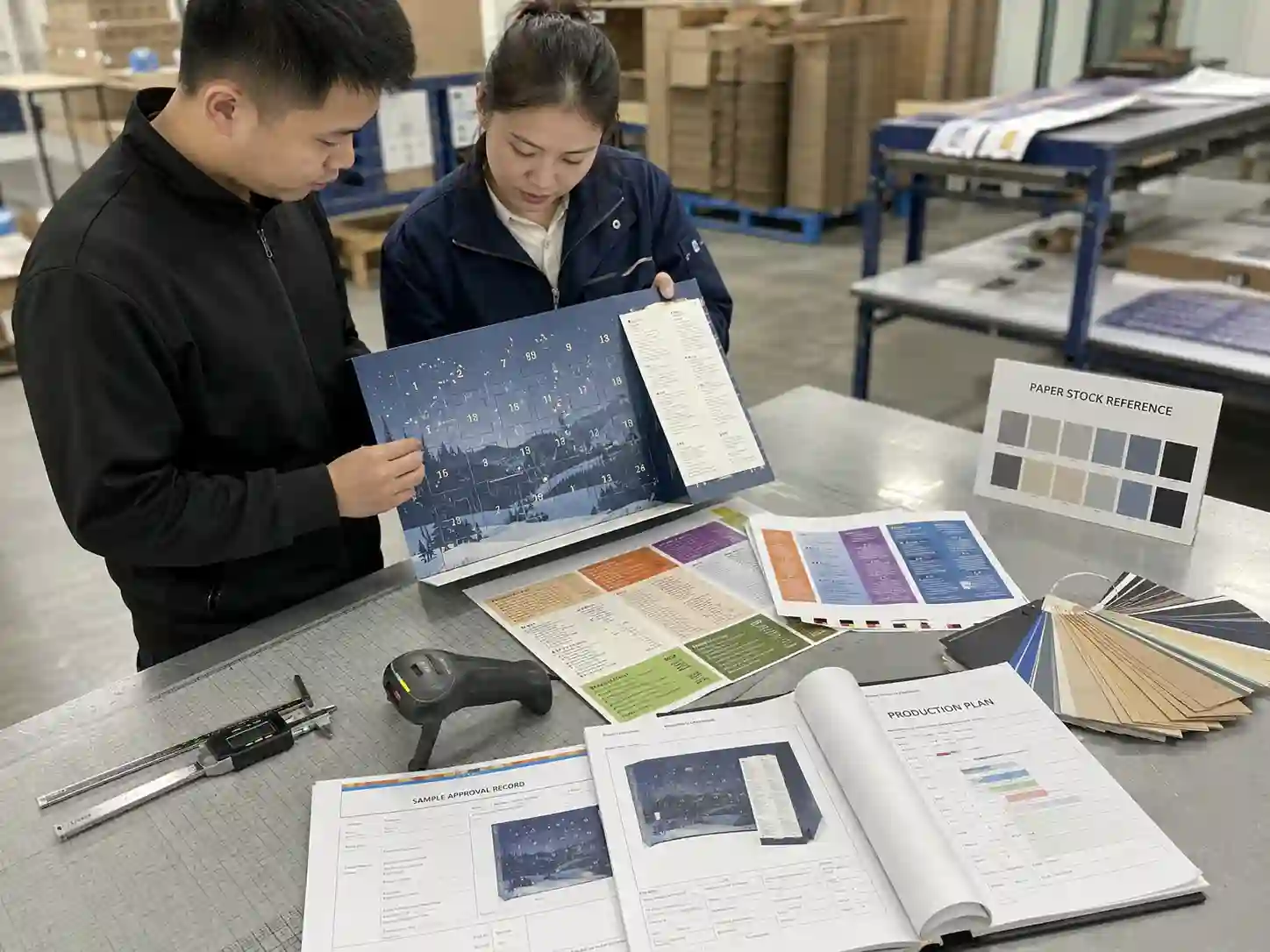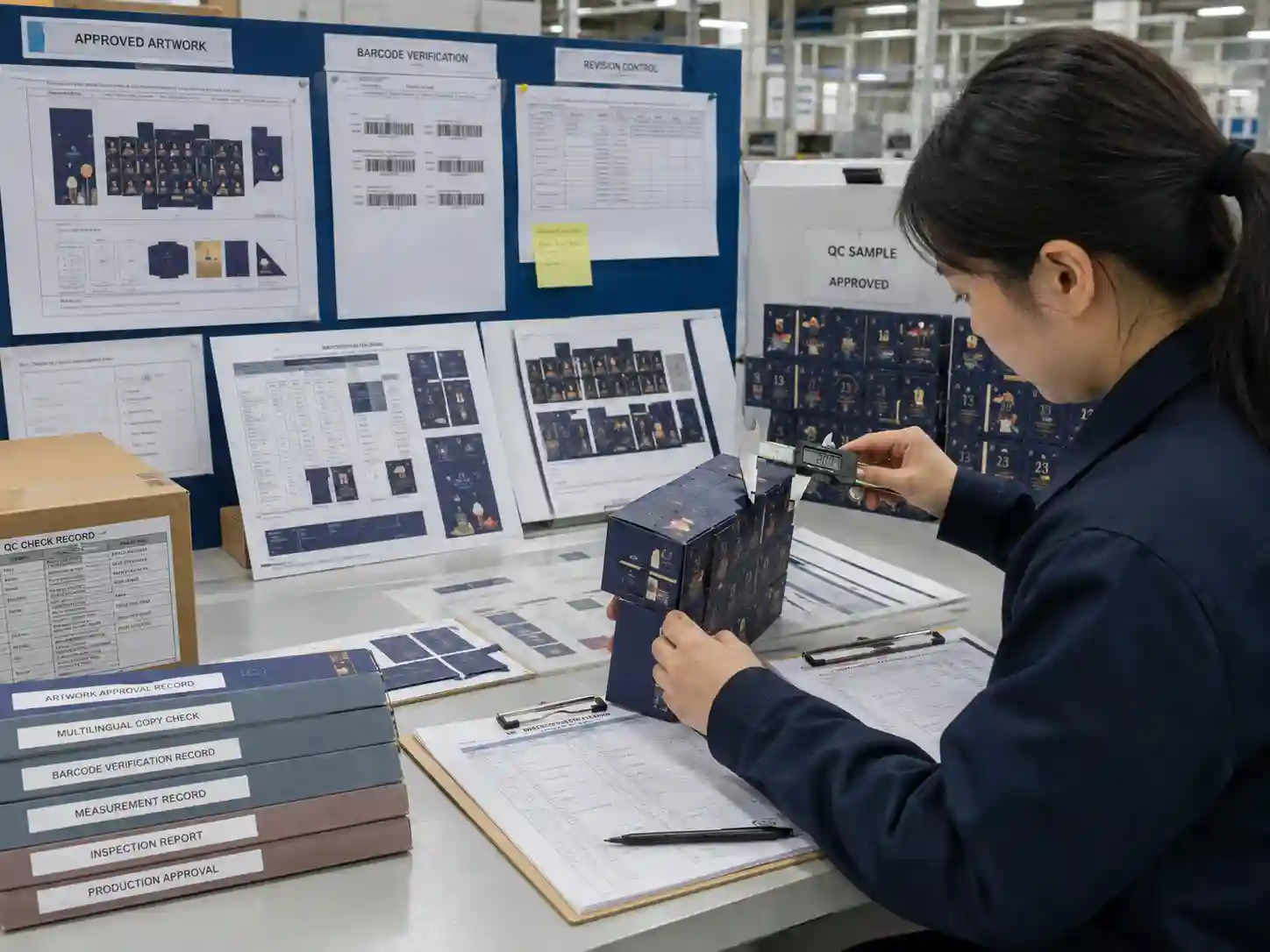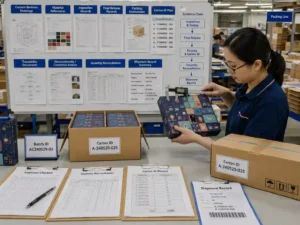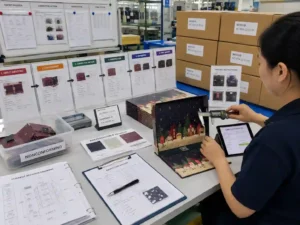
Quick answer: Creating multilingual artwork small compartments requires more than translating text. Every language must fit within the available print area after dielines, folds, perforations, and finishing are applied. A reliable workflow combines structured artwork layers, consistent typography, barcode protection, safe areas, preflight verification, and documented approvals using printed samples before production begins.
Why is multilingual artwork more difficult on small compartments?
Small compartment packaging leaves little room for multiple languages while still accommodating graphics, regulatory information, opening features, and production marks.
On advent calendar packaging, compartment doors, drawer fronts, and narrow side panels often become the most challenging areas because available space changes after folding, die-cutting, and assembly. Artwork that appears acceptable on screen may become crowded or partially hidden on the finished package.
The objective is not simply fitting more text. The goal is maintaining readability while protecting structural features and production accuracy.
How should multilingual artwork be organized before design begins?
Start with the packaging dieline rather than the translated copy. The available printable area determines how much content can realistically be included.
A practical preparation workflow includes:
- Lock approved structural dielines before placing copy.
- Separate languages into clearly named artwork layers.
- Define mandatory safe areas around folds, perforations, glue flaps, and opening mechanisms.
- Reserve protected zones for barcodes and regulatory markings.
- Confirm which languages are mandatory for each sales region.
This sequence reduces late-stage redesign caused by text expansion or structural conflicts.
How do artwork layers simplify multilingual revisions?
Independent artwork layers allow individual languages to be updated without affecting graphics, structural lines, or production information.
| Artwork Layer | Purpose | Typical Status |
|---|---|---|
| Dieline | Cutting, folding and glue references | Locked |
| Graphics | Illustrations and decorative artwork | Editable |
| Language A | Primary market copy | Editable |
| Language B | Secondary translation | Editable |
| Barcode | Scanning area | Protected |
| White ink or spot colors | Special printing layers | Locked after approval |
| Finishing | Foil, varnish, embossing or spot UV | Production only |
Layer separation also makes supplier reviews and future language updates easier because each element has a defined location.
How should safe areas be managed when multiple languages are used?
Safe areas become more important as text density increases.
Long translated phrases should never be positioned directly beside perforations, fold lines, or door edges. Even when technically printable, small production movement may reduce readability.
Project-dependent safe area dimensions vary according to:
- Board thickness
- Die-cut accuracy
- Printing method
- Door size
- Finishing processes
Instead of filling every available millimetre, designers should preserve consistent margins around structural features.
How can typography improve readability without enlarging the package?
Typography often solves space limitations better than reducing font size.
Consider:
- Using typefaces with efficient character widths.
- Applying consistent paragraph spacing.
- Avoiding unnecessary capitalization.
- Replacing repeated headings with icons where appropriate.
- Maintaining sufficient contrast between text and background.
Languages using longer words may require alternative layouts rather than identical formatting across every market.
How should barcodes and multilingual copy coexist?
Barcodes require protected scan areas that should never be compromised by translated copy.
Keep barcode placement independent from language expansion. During artwork review verify:
- Quiet zones remain clear.
- No text enters scanning areas.
- Finishing layers do not interfere with readability.
- Color combinations maintain scanner performance.
- Final printed samples scan successfully.
Barcode verification should always be performed using printed production-representative samples instead of PDF artwork alone.
What should be included in a multilingual artwork preflight?
A structured preflight reduces production corrections and approval delays.
Preflight checklist
| Checkpoint | Verification Method | Evidence |
|---|---|---|
| Correct language version | Artwork review | Revision record |
| Copy fits safe areas | Dieline overlay | Approved PDF |
| Fonts embedded or outlined | Preflight software | Preflight report |
| Artwork layers complete | Layer inspection | Native artwork file |
| Barcode protected | Visual and scan check | Scan report |
| Spot colours correct | Artwork inspection | Colour approval |
| Images linked correctly | Package check | Preflight log |
What evidence supports multilingual artwork approval?
Production decisions should be based on documented evidence rather than visual judgement alone.
Typical approval records include:
- Approved translated copy supplied by the customer.
- Artwork revision history.
- Layer naming records.
- Printed proof approval.
- Barcode scan verification.
- Color approval sheets.
- Supplier preflight reports.
Example approval workflow
- Customer supplies approved translations.
- Designer places copy onto locked dielines.
- Prepress verifies fonts, layers, colours, and barcodes.
- Printed proof is reviewed against structural samples.
- Final artwork receives documented production approval.
Which project decisions vary between packaging programs?
Some multilingual requirements depend entirely on the project rather than fixed production rules.
Examples include:
- Number of required languages.
- Regional regulatory wording.
- Compartment dimensions.
- Font hierarchy.
- Available panel size.
- Printing process.
- Special finishes covering text.
These decisions should be confirmed before final artwork approval instead of during production.
Frequently Asked Questions
Should every language use identical formatting?
No. Different languages expand by different amounts, so layouts often require minor adjustments while maintaining a consistent visual appearance.
Can multilingual text be placed across perforated compartment doors?
It can, but important words should avoid crossing cut lines whenever possible because opening features may interrupt readability.
Is a PDF proof sufficient for multilingual approval?
Not by itself. Printed proofs and structural samples help verify readability after folding, die-cutting, and finishing.
Who normally approves multilingual artwork?
Translation accuracy is typically approved by the customer or designated reviewer, while print readiness is verified by the prepress and production teams.
Conclusion
Reliable multilingual artwork combines careful planning, structured artwork layers, protected safe areas, typography control, barcode verification, and documented preflight procedures. By validating both digital files and printed samples before production, packaging teams can reduce revision cycles while improving consistency across regional packaging versions.
To learn more about seasonal packaging solutions, visit our custom advent calendar box products, explore our custom advent calendar box services, browse additional advent calendar box buying guides, or request a custom quote for your next packaging project.