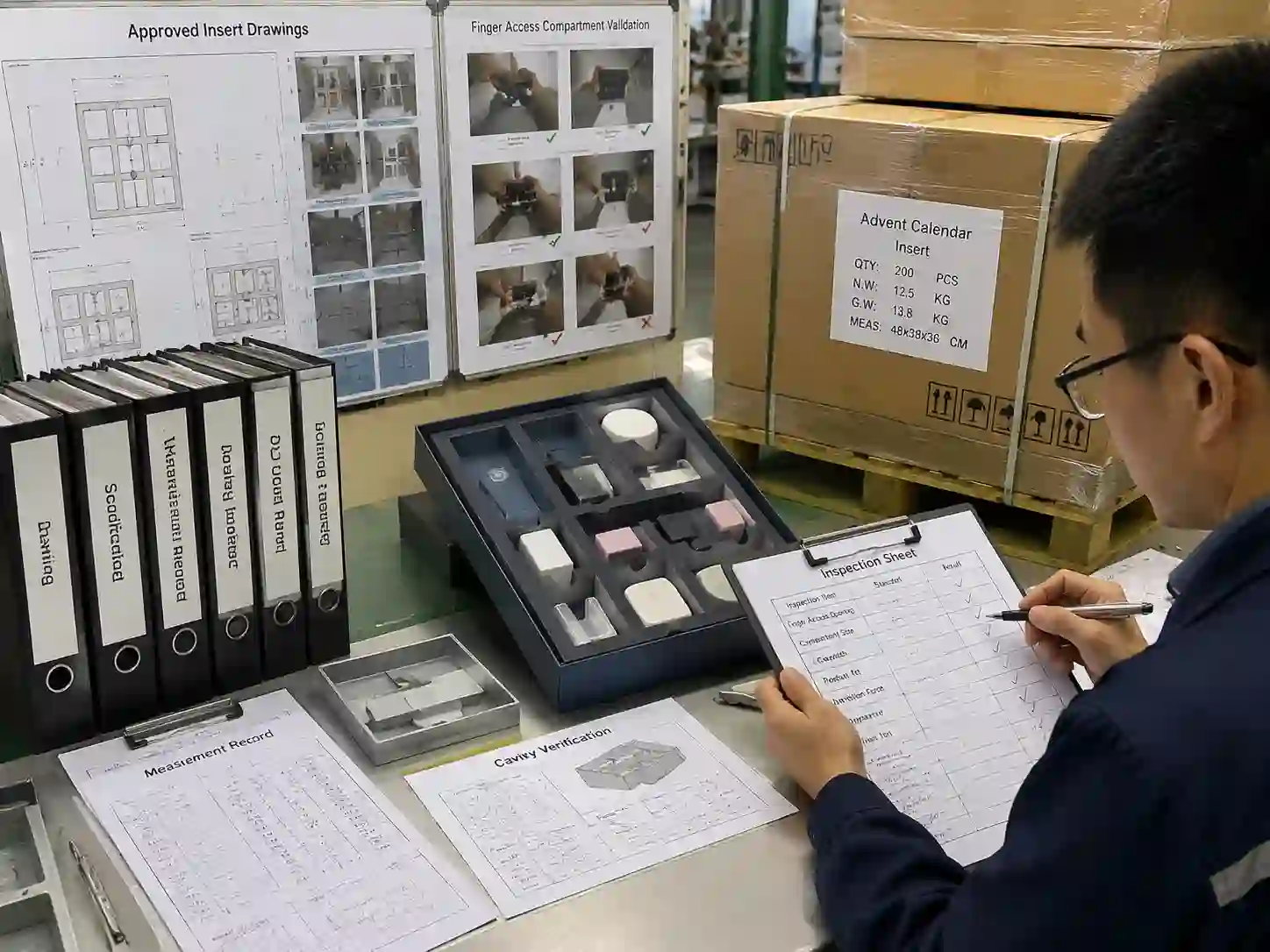
Quick answer: Finger access compartment design requires adding enough opening space for reliable product removal while controlling the cavity clearance around the product. The correct approach is to measure the product, define the minimum finger approach area, review orientation, test loaded samples, and validate that the insert still holds products securely after access features are added. A compartment should support easy handling without creating excessive movement, shifting, or a loose appearance.
What Is the Purpose of Finger Access in an Advent Calendar Compartment?
Finger access is designed to help users or operators remove products without damaging the product, insert, or surrounding compartments. It creates a controlled opening area rather than simply increasing the overall cavity size.
In packaging engineering, the access feature must be considered together with product dimensions, insert material behavior, product orientation, and retention requirements. A larger opening may improve usability but can reduce support around the product.
How Do You Balance Finger Access Compartment Design With Product Fit?
The balance is achieved by separating access clearance from product retention clearance. The finger opening should provide enough space for gripping while the main cavity walls continue supporting the product.
Which Measurements Should Be Recorded Before Designing the Access Area?
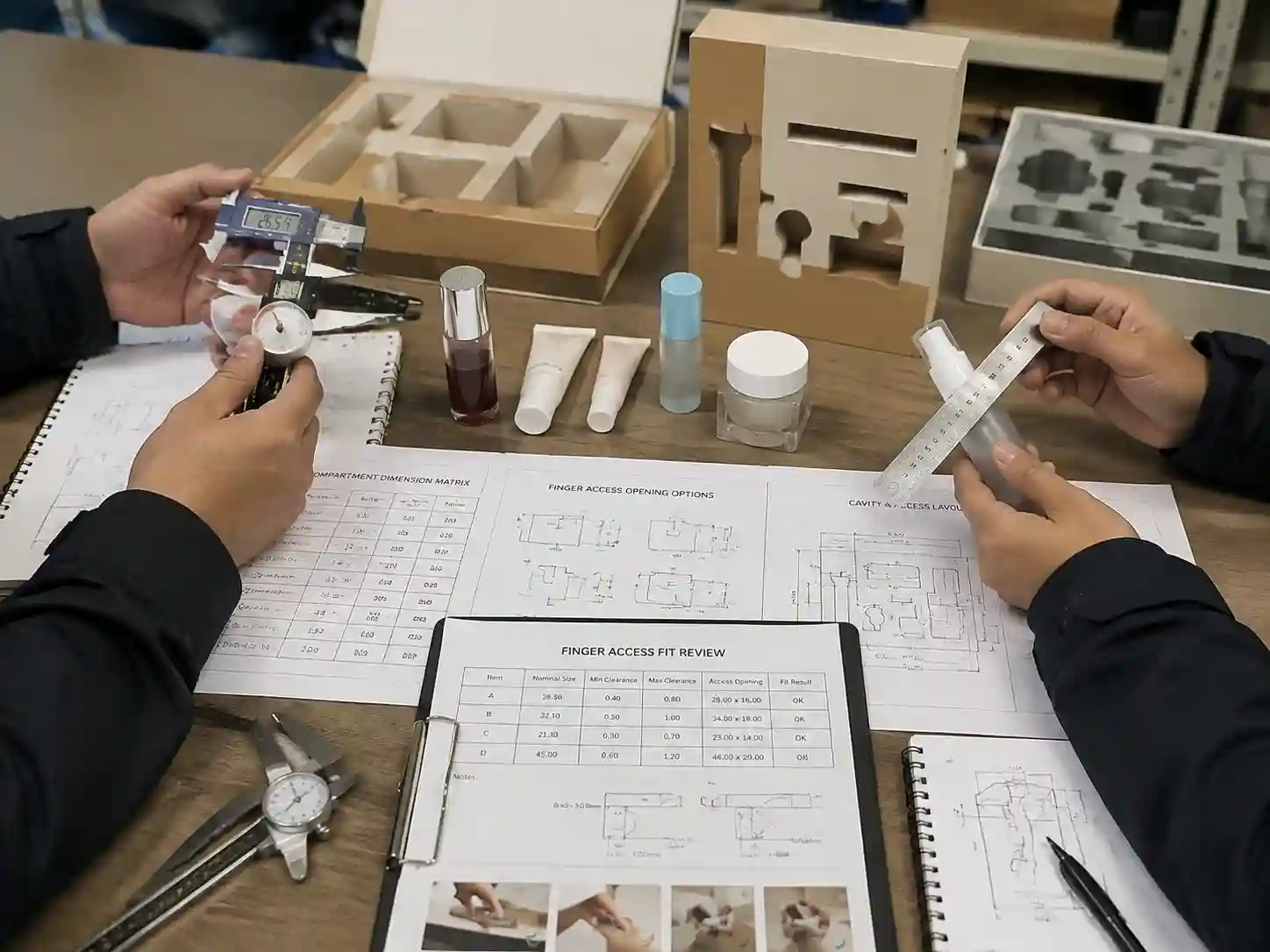
Before creating the insert layout, teams should record the product dimensions and identify the areas where fingers need to approach or lift the item.
- Measure product length, width, height, and any irregular protrusions.
- Record the product orientation inside the compartment.
- Identify grip points, lifting edges, or areas where pressure should be avoided.
- Measure the available finger approach direction based on the product shape.
- Review whether protective packaging, sleeves, or labels affect the final occupied size.
| Measurement Item | Why It Matters | Validation Method |
|---|---|---|
| Product outer dimensions | Defines the base cavity size | Caliper measurement and approved product sample |
| Finger approach area | Determines access opening requirements | Hand-fit review with loaded prototype |
| Side wall support | Prevents excessive movement | Loaded cavity inspection |
| Product movement clearance | Controls looseness after access is added | Physical sample testing |
How Much Clearance Should Finger Access Add to a Compartment?
There is no universal finger access dimension because the required space depends on product size, shape, weight, material rigidity, and removal method. The opening should be based on actual handling tests rather than a fixed allowance.
For small lightweight products, a limited access notch may be sufficient. Larger, heavier, fragile, or irregular products may require a wider opening or a different orientation to allow safe removal.
Project recommendations should be confirmed through drawings, physical samples, and buyer approval records. A supplier should be able to show how the access feature affects cavity dimensions and product retention.

How Do You Prevent Finger Openings From Making Compartments Too Loose?
Preventing looseness requires maintaining controlled contact points around the product while placing the access feature only where it improves handling.
What Design Checks Should Be Completed?
- Check remaining support surfaces: Confirm that enough insert material remains around the product to prevent shifting.
- Check product movement: Load actual samples and observe whether products tilt, rotate, or move during handling.
- Check orientation: Some products require a specific direction so the access area works without reducing stability.
- Check material behavior: Paperboard, molded pulp, PET, and foam inserts may react differently after openings are added.
- Check visual consistency: Compartments should maintain a structured appearance after access features are introduced.
How Do You Validate Finger Access During Prototype Testing?
Prototype testing should confirm both usability and retention before production decisions are finalized. The most reliable evidence comes from loaded samples using the actual product dimensions.
What Should Be Included in a Loaded-Sample Checklist?
- Approved product samples or equivalent dimensional samples.
- Insert prototype with final cavity structure.
- Recorded product orientation and loading method.
- Measurement notes showing cavity size and access opening dimensions.
- Inspection comments on removal, movement, and product protection.
- Approval records showing accepted design revisions.
Supplier drawings, cavity layouts, measurement sheets, and prototype inspection records provide traceable evidence that the finger access solution was reviewed before mass production.
Which Factors Can Change the Recommended Finger Access Design?
The final design varies by project because products differ in shape, weight, packaging layers, and handling requirements.
- Product shape: Round, narrow, tall, or irregular products require different access strategies.
- Product weight: Heavy products may need stronger surrounding support even when access openings are required.
- Insert structure: Folded paper inserts, trays, and formed inserts have different limitations.
- Buyer expectations: Some projects prioritize easier removal, while others prioritize maximum product retention.
What Should Buyers Approve Before Finalizing a Finger Access Compartment?
Buyers should approve the dimensional drawings, loaded sample results, and final insert structure before production release.
Important approval records include cavity dimensions, access opening locations, product orientation, tolerance notes, and comments from physical testing. These records help prevent misunderstandings between product teams, packaging engineers, and suppliers.
FAQ About Finger Access Compartment Design
Can a larger finger opening improve product removal?
Yes, but increasing the opening may reduce product support. The correct size depends on handling tests and the required retention level.
Should finger access be designed before or after the cavity size?
It should be considered together with cavity development. Adding access after the cavity is finalized may create unnecessary looseness or require structural changes.
How can buyers verify that an access feature is suitable?
Buyers can verify suitability through dimensional drawings, prototype samples, loaded product checks, and documented approval records.
For custom advent calendar projects, Giftpackpro supports structured product measurement, insert development, and packaging validation through its custom advent calendar box services. Contact the team through request a custom quote to discuss a compartment design based on your product dimensions and handling requirements.