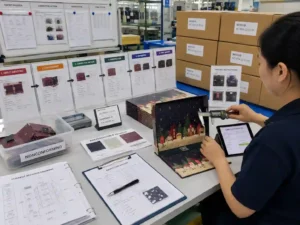
Quick answer: Perforation length and tie point selection for calendar doors should balance opening performance, panel strength, appearance, and transport stability. The correct design depends on board structure, door size, opening direction, hinge layout, magnetic or mechanical closure, and product weight behind the door. Engineers normally confirm the design through drawings, prototypes, opening tests, and inspection records before production approval.

What factors determine advent calendar perforation tie points?
The main factors are door geometry, material strength, opening force, and the expected user interaction with the panel. Perforations must allow controlled opening while keeping the door attached until intentional opening.
For custom advent calendar boxes, perforation lines are usually treated as a controlled weakening feature rather than a simple cutting pattern. The design team evaluates where the material should release and where reinforcement must remain.
- Door size: Larger doors generally require more carefully balanced perforation lengths because excessive weakening can cause tearing or loose panels.
- Board construction: Paperboard thickness, greyboard structure, surface paper, and finishing layers affect tear resistance.
- Opening direction: Doors opening upward, sideways, or downward create different stress patterns around the perforation.
- Closure method: Magnets, tabs, hinges, and folded panels influence how much holding strength remains before opening.
How should perforation length be selected for calendar doors?
Perforation length should be selected by defining the required opening path first, then reducing the cut ratio enough to maintain panel stability. A longer perforation improves opening convenience but reduces resistance to accidental opening.
| Design factor | Shorter perforation approach | Longer perforation approach |
|---|---|---|
| Door stability | Higher remaining material strength | Lower resistance if overextended |
| Opening experience | Requires more force and clearer breaking points | Easier controlled opening |
| Transport performance | Better protection against vibration opening | Requires stronger retention design |
| Visual appearance | May leave more visible connection points | Cleaner opening effect when correctly designed |
Project recommendations vary according to door size, paperboard combination, and the expected loading behind the door. The final perforation pattern should be confirmed through physical samples rather than drawings alone.
How are tie points positioned around perforated calendar doors?
Tie points should be placed where they maintain panel alignment without creating excessive opening resistance. Their purpose is to keep the door connected during handling, assembly, and transport while allowing a predictable opening action.
Common evaluation areas include:
- Corner areas where tearing can spread quickly.
- Hinge-side areas where repeated movement creates stress.
- Long unsupported edges where vibration may cause early separation.
- Areas close to magnets or closure points where pulling force concentrates.
Engineers often review tie point distribution using structural drawings and sample doors. The objective is not simply adding more tie points, but placing enough controlled connections to maintain stability without damaging the opening experience.
What testing confirms perforation and tie point performance?
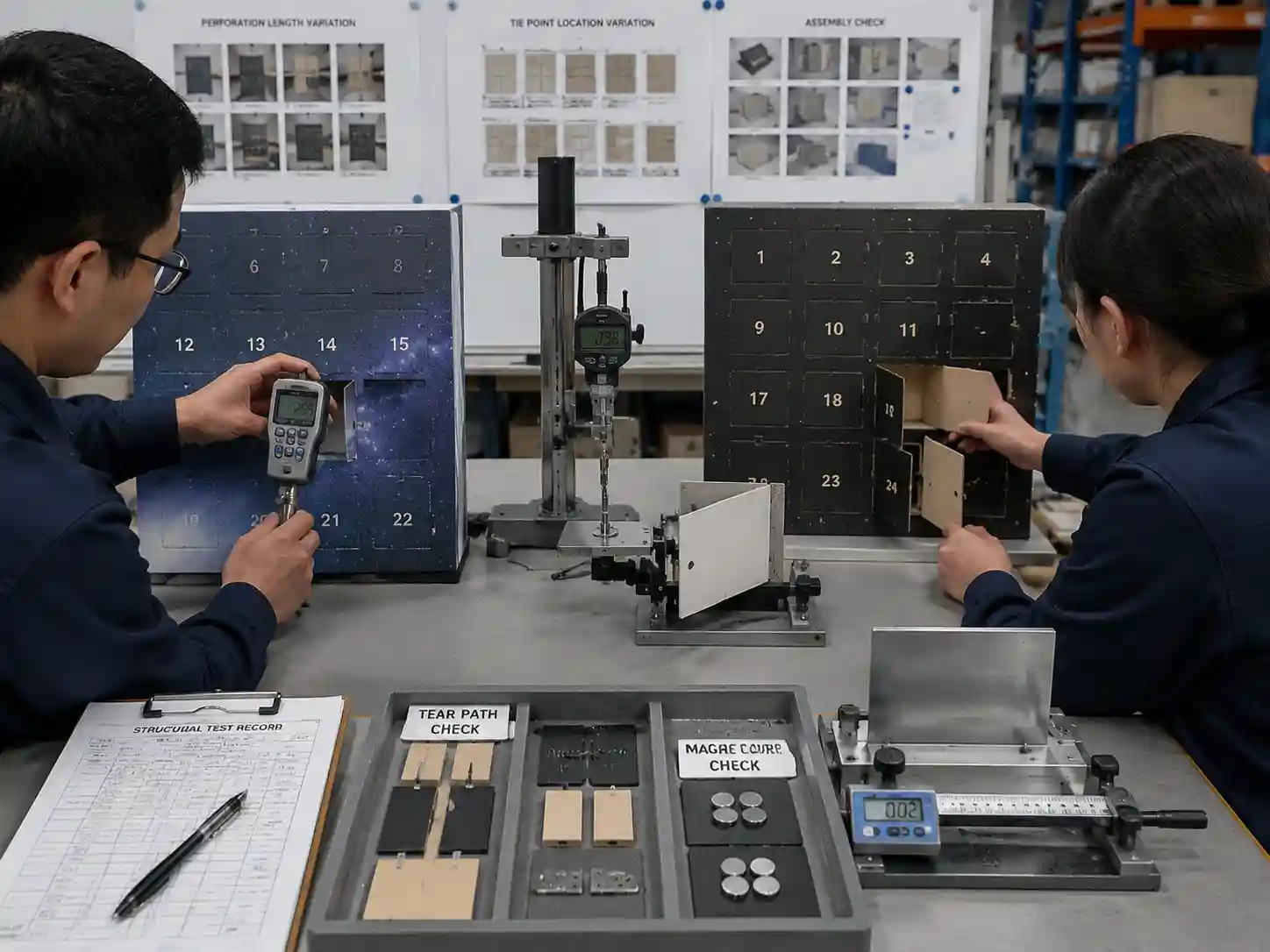
Testing should verify that the door opens as designed and remains stable before opening. Sample evaluation provides evidence that the perforation pattern works with the complete box structure.
- Review the structural drawing: Confirm door dimensions, perforation location, hinge position, and closure method.
- Produce prototype samples: Check the actual interaction between perforation lines, folds, magnets, and panels.
- Measure opening behavior: Record opening force, tearing direction, and whether the door separates cleanly.
- Check repeated handling: Simulate movement, storage, and handling conditions that may affect weak points.
- Approve final structure: Keep sample records, measurement notes, and approved drawings for production reference.
What failure modes should buyers check before production?
The following checklist helps identify common structural risks before large-scale manufacturing.
- Premature opening: Perforations release during transportation or handling before intended use.
- Uneven tearing: Door edges tear away instead of following the designed opening path.
- Panel deformation: Weak areas allow the door surface to bend or lose alignment.
- Closure conflict: Magnet or tab strength exceeds the perforation design and damages the panel.
- Appearance inconsistency: Perforation spacing or tie points create visible irregularities after finishing.
Which details require buyer approval before final production?
Buyers should approve the final structural sample, opening method, and acceptable appearance standard before production release. Important approval evidence includes marked drawings, prototype photos, measurement records, and sample comments.
Verified facts include the relationship between perforation design and material weakening. Project-dependent recommendations include the exact perforation length, tie point quantity, and opening force target because these vary by box size, board structure, and product requirements.
Giftpackpro supports custom advent calendar box development through structural review, prototype evaluation, and production documentation. Buyers can explore custom advent calendar box products or review custom advent calendar box services when preparing a new packaging project.

Frequently asked questions about calendar door perforation design
Can a longer perforation always improve opening performance?
No. A longer perforation may reduce opening resistance, but it can also weaken the door during transport. The correct balance depends on the complete structure.
Should tie points be identical on every calendar door?
Not always. Different door sizes, positions, and product weights may require different tie point arrangements within the same calendar structure.
Why are prototype checks important for perforated doors?
Because paper structures behave differently after printing, coating, folding, and assembly. Physical samples reveal tearing behavior and alignment issues that drawings may not show.
For a project requiring controlled door opening performance, request a custom quote and provide the door layout, product requirements, and structural expectations for evaluation.