
Perforated doors can open during transport when the closing force, panel stiffness, hinge design, or internal movement control are not properly matched. Preventing this requires validating the door structure, retention method, and assembly tolerance before mass production. A practical approach combines structural drawings, prototype checks, opening-force tests, and final inspection records to confirm that doors remain closed through handling and shipment conditions.
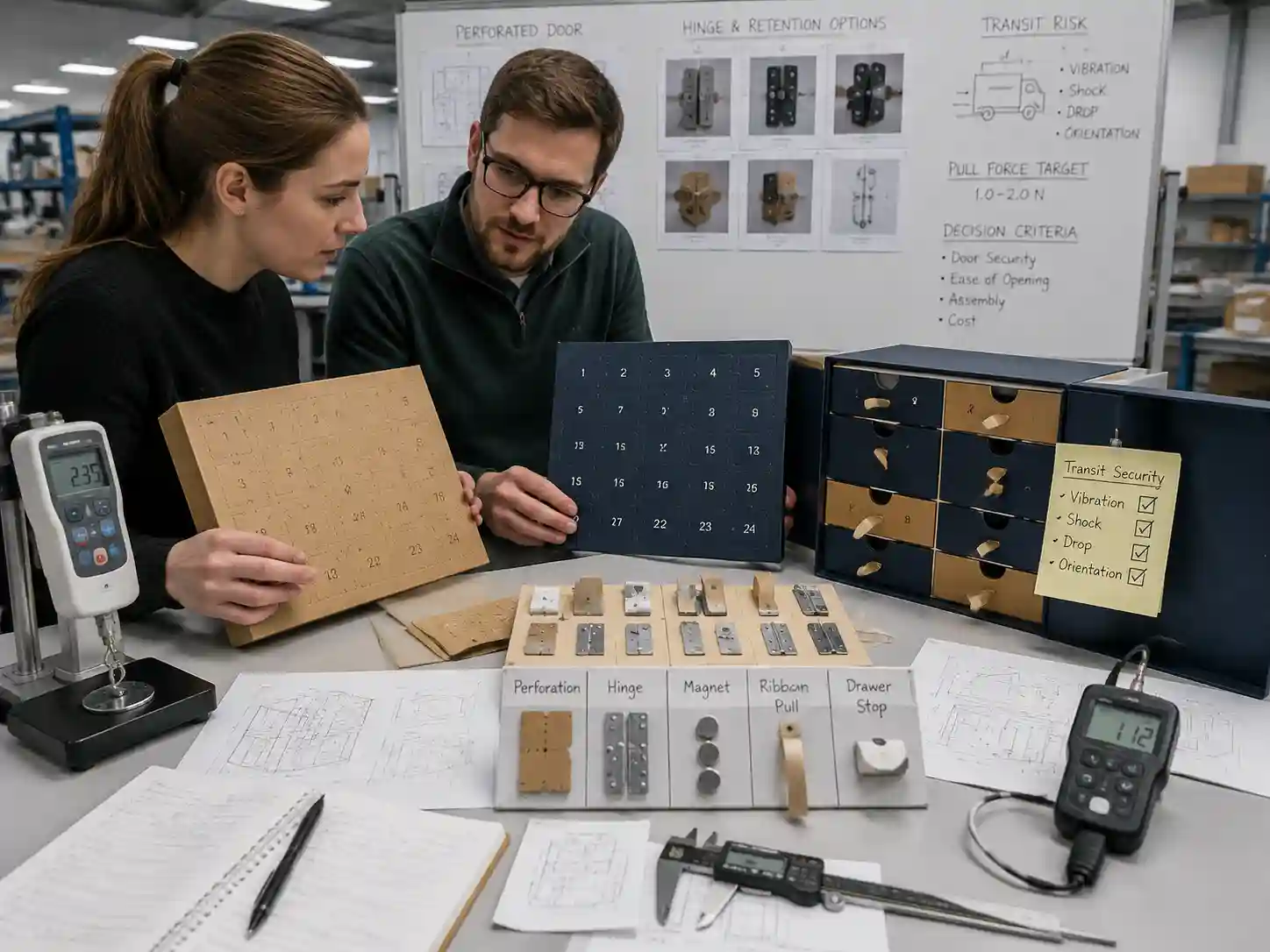
What causes perforated doors to open during transport?
The main causes are insufficient retention force, excessive panel flexing, hinge movement, and clearance variation between the door and surrounding structure. A perforated advent calendar door has many cut areas, which can reduce stiffness compared with a solid panel.
During transport, vibration, stacking pressure, and repeated handling can create small movements. If the magnet, tab, hinge, or locking feature does not provide enough resistance, the door may partially open or become misaligned.
Which structural areas should be checked first?
The first review should focus on the connection points that control movement:
- Door panel stiffness: confirm that perforation patterns do not weaken the supporting frame excessively.
- Hinge or fold-line performance: verify that the door rotates smoothly without excessive looseness.
- Magnet or retention strength: check that the closing force is suitable for the finished structure.
- Frame alignment: ensure the door edge does not interfere with surrounding panels during assembly.
- Material tolerance: confirm that board thickness and folding accuracy remain within approved specifications.
How does perforated door transit security testing work?
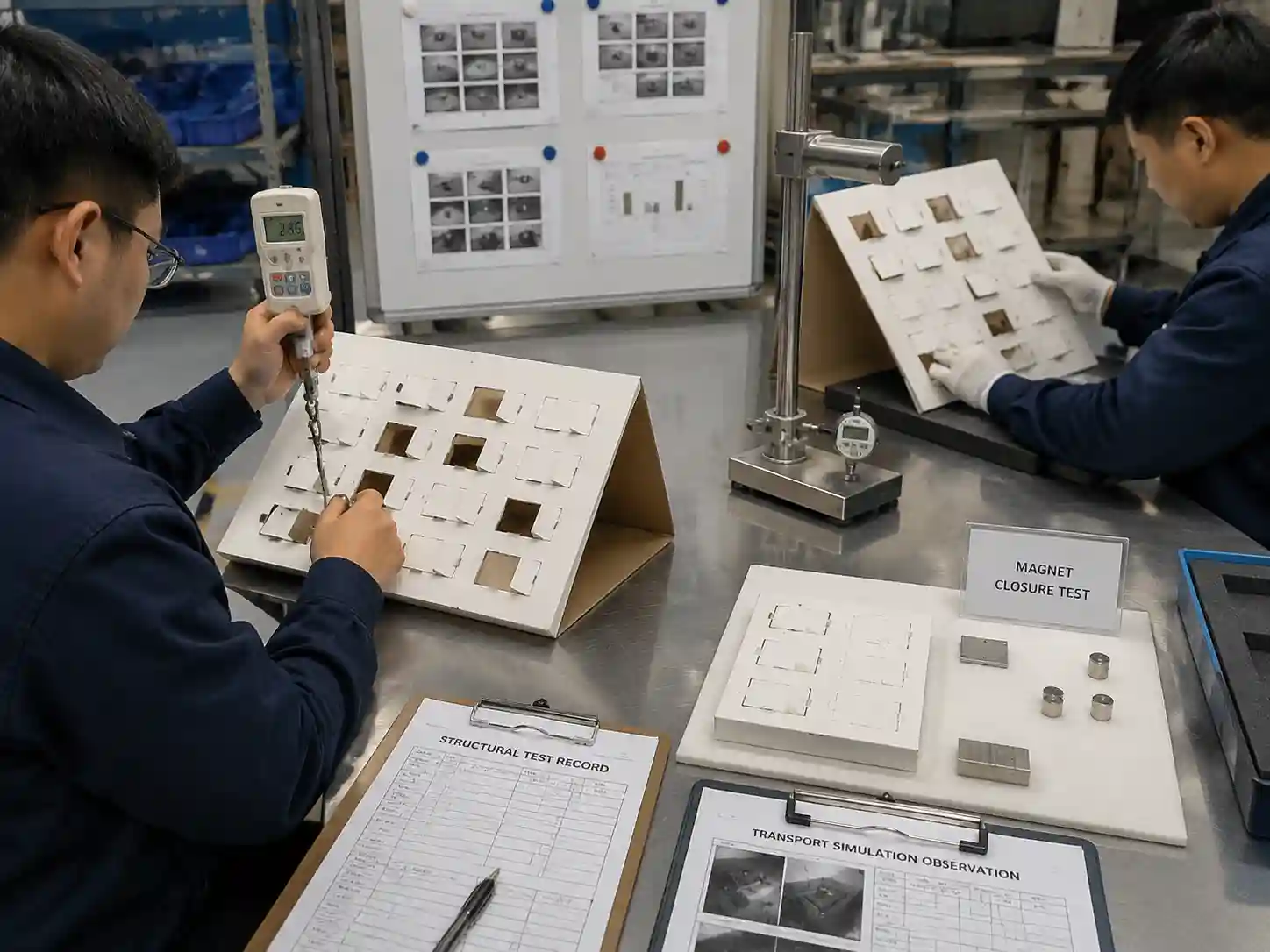
Perforated door transit security should be verified through prototype testing rather than only reviewing drawings. The purpose is to confirm that the finished assembly behaves correctly under realistic handling conditions.
- Inspect the approved structural drawing and identify door retention points.
- Build production-intent samples using the intended board, magnet, hinge, and finishing specifications.
- Measure opening resistance and check whether the door stays closed after repeated movement.
- Test assembled samples under transport-related handling conditions such as vibration simulation, tilting, and stacking pressure.
- Record results, adjustments, and approval decisions before production release.
| Structural area | Common risk | Verification method |
|---|---|---|
| Magnet or closure system | Door releases during movement | Opening-force measurement and repeated closing checks |
| Perforated panel design | Panel flex reduces contact accuracy | Visual inspection and dimensional measurement |
| Hinge or fold area | Door becomes loose after use | Open-close cycle review and sample inspection |
| Door frame clearance | Misalignment prevents secure closing | Assembly measurement against approved drawings |
How should designers improve door retention without damaging the user experience?
The best solution is usually a balanced retention design. Increasing closing force alone may make the door difficult to open, while weak retention can create transport failures.
Project-dependent options include:
- Adjusting magnet position to improve contact accuracy.
- Adding hidden retention tabs or support features where appropriate.
- Increasing local reinforcement around the door frame.
- Changing perforation layout to preserve more structural strength.
- Improving hinge geometry to reduce unwanted movement.
These decisions should be evaluated with physical samples because small changes in board thickness, coating, folding accuracy, or assembly method can affect the final result.
What evidence should buyers request before approving production?
Buyers should review documentation that shows the structure was checked, not only a finished appearance sample. Useful evidence includes:
- Approved structural drawings showing door construction and retention details.
- Sample inspection records with measured dimensions.
- Prototype testing notes showing closure performance.
- Photos of inspection points and assembly verification.
- Final approval records linking the tested sample to production specifications.
For custom seasonal packaging projects, these records help prevent differences between approved samples and bulk production units.

What are the common failure modes of perforated doors?
A failure-mode review helps teams identify problems before shipment.
- Door pops open: retention force is too low or contact position is inaccurate.
- Door bends outward: perforation layout removes too much supporting structure.
- Magnet loses alignment: assembly tolerance creates uneven closure.
- Hinge area tears: repeated movement exceeds the reinforcement capability.
- Door scratches or damages nearby panels: clearance design is insufficient.
Each issue should be connected to a corrective action in drawings, samples, or production inspection documents.
How do buyer approvals reduce transport-opening risks?
Buyer approval should confirm both appearance and functional performance. A door that looks correct in a showroom may still fail when exposed to movement during logistics.
The approval process should clearly define:
- Which structural sample is the approved reference.
- Which components must remain unchanged during production.
- Which measurements require inspection.
- Which test observations must be recorded.
Giftpackpro supports custom advent calendar box development through structural review, sampling coordination, and production verification. Learn more about custom advent calendar box services or explore custom advent calendar box products for different structural formats.
FAQs
Can stronger magnets always prevent perforated doors from opening?
No. Stronger magnets may help, but incorrect alignment, weak panels, or poor hinge control can still cause transport problems. The complete door structure must be evaluated.
Should perforated doors be tested before artwork approval?
Structural testing should begin with production-intent samples before final approval because perforation patterns and finishing choices can influence stiffness and closure performance.
What varies most between different advent calendar door designs?
The required retention method depends on door size, perforation layout, board construction, opening frequency, product weight, and assembly method.
For a project requiring specific structural evaluation, you can request a custom quote and provide the door design details for review.