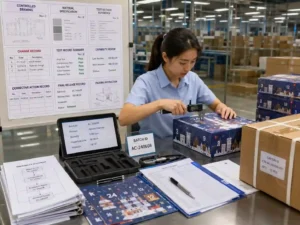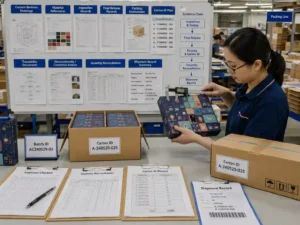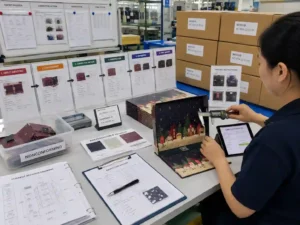
Quick answer: To protect a late design change launch timeline, first identify exactly which specifications and production operations are affected. Freeze unaffected work where practical, issue one controlled revision, confirm factory capacity and material status, and obtain a written recovery schedule before authorizing changed production. Buyer approvals, inspection points, subcontracting restrictions, payment milestones, and shipment-release conditions should then be aligned with the revised plan rather than relying on verbal promises.
What should you do immediately after a late design change?
Contain the change before trying to accelerate it. The first decision is whether production must stop completely or whether unaffected operations can continue safely under the existing approved specification.
Ask the supplier for the current production status by operation. For an advent calendar box, that may include material preparation, printed components, board cutting, mounting, die cutting, hand assembly, accessory fitting, final assembly, inspection, and packing. The exact routing varies by construction and supplier.
The buyer and supplier should identify:
- the latest approved drawing, artwork, specification, and reference sample;
- the exact component or requirement being changed;
- materials already purchased, converted, printed, or assembled;
- work in progress that can still conform to the new revision;
- work that must be stopped, segregated, reworked, or replaced;
- production operations that can continue without creating obsolete inventory;
- new approval and inspection points created by the change.
This containment step prevents a late revision from becoming a larger quality and schedule problem.

How do you protect the late design change launch timeline?
Rebuild the schedule from actual factory status rather than simply asking the supplier to “catch up.” A credible recovery plan should show what changed, which operations are on the critical path, available capacity, approval deadlines, and the revised completion sequence.
Request a dated production-status report and a revised schedule showing the affected operations separately. Evidence can include controlled production records, material status, equipment allocation, work-in-progress quantities, planned inspection dates, and capacity schedules.
Which work can continue while the change is being approved?
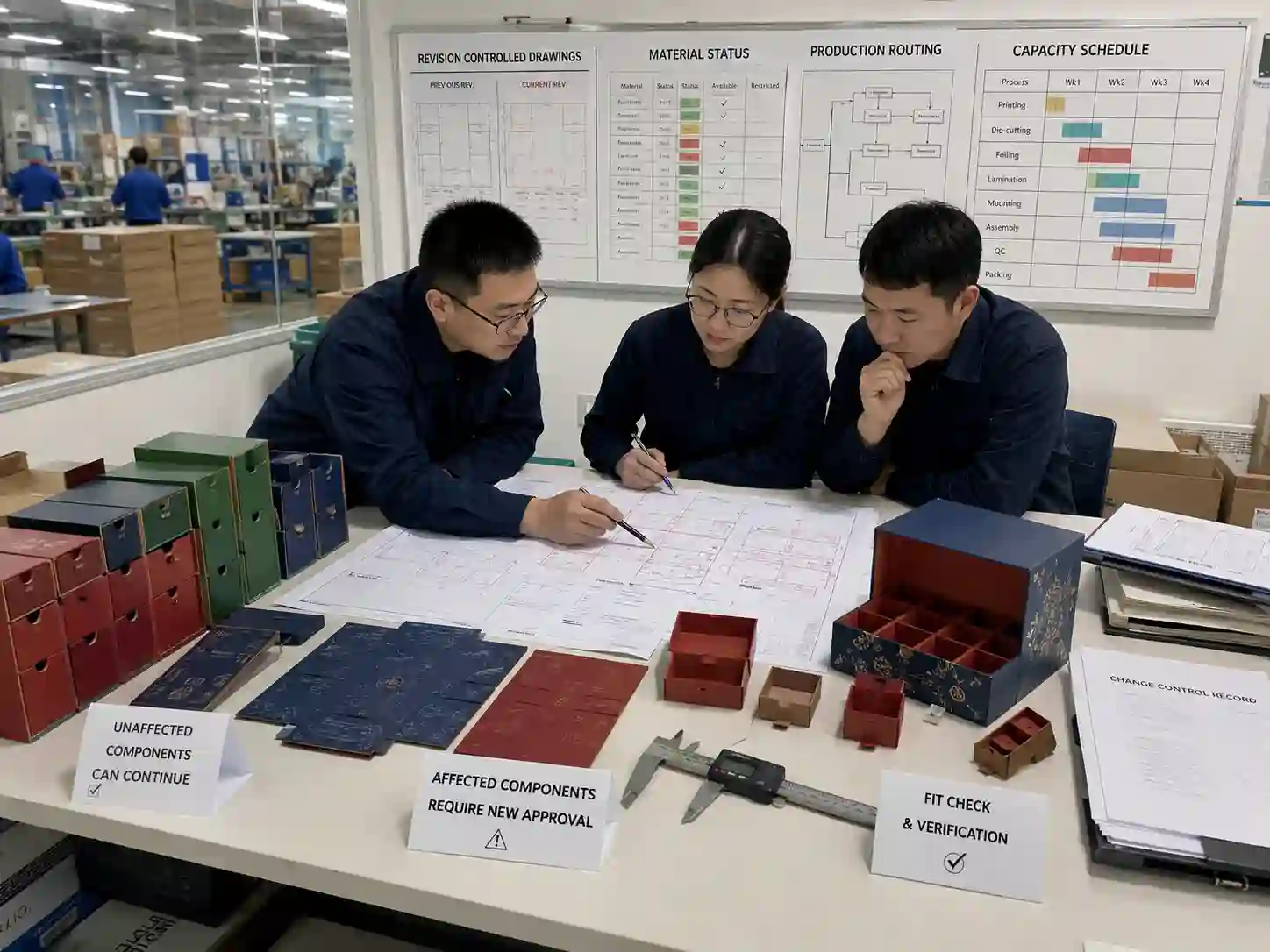
Only operations demonstrably unaffected by the revision should continue. The supplier should be able to explain why continued work cannot conflict with the revised specification.
For example, a change to one external component may not necessarily require stopping every unrelated component. However, if the change alters overall dimensions, assembly relationships, fit, structural alignment, or another downstream requirement, continuing production may create unusable work in progress.
The decision should therefore come from controlled drawings and production routing, not assumptions about whether a change appears visually minor.
What evidence should support the supplier’s recovery schedule?
A recovery date is more credible when it is supported by capacity evidence. Buyers should verify the resources behind the proposed schedule, especially when the supplier claims that lost time can be recovered through additional shifts, parallel operations, or reassigned equipment.
| Supplier evidence | What to verify | Schedule risk if unclear |
|---|---|---|
| Production-status record | Completed, in-process, held, and unstarted quantities by operation | The recovery plan may start from an incorrect production position |
| Capacity schedule | Machine, assembly, labor, and inspection availability for the revised dates | Promised acceleration may compete with other orders |
| Material records | Which materials remain usable and which require replacement | Hidden material replacement can become a new critical-path delay |
| Controlled revision | Drawing, artwork, specification, revision number, and approval status | Old and new requirements may be mixed in production |
| Subcontracting declaration | Whether recovery depends on work moving outside the approved factory | Unverified processes can create quality, traceability, and inspection gaps |
| Inspection plan | Where changed features will be checked before more value is added | Problems may only be discovered after full assembly |
How should revision control work after the design changes?
Issue one clearly identified production revision and withdraw obsolete instructions from active use. Every affected supplier function should work from the same approved drawing, artwork, specification, and change record.
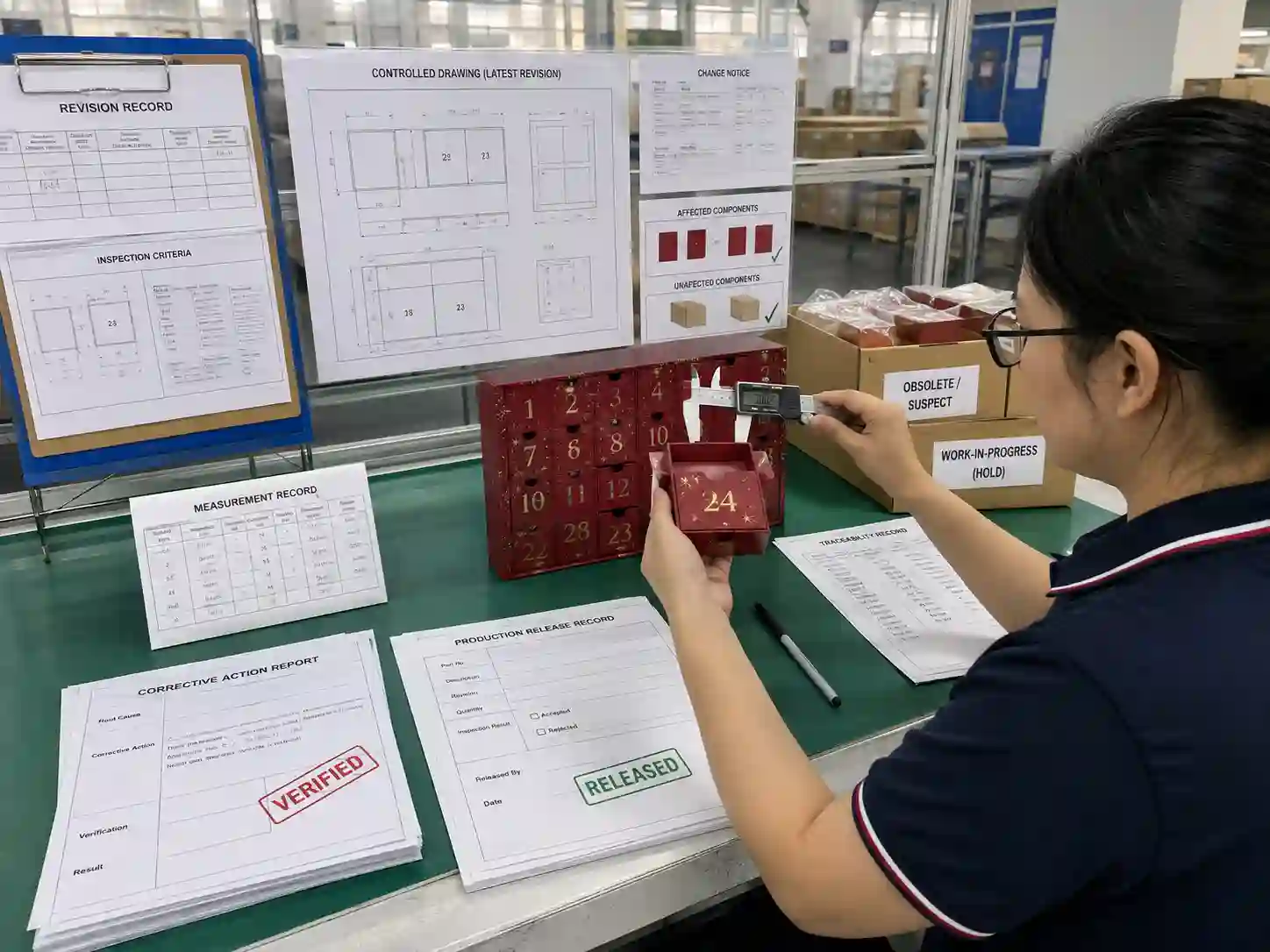
The change record should identify what changed, which components are affected, the effective revision, approval date, disposition of existing materials or work in progress, and any new inspection requirement.
For critical dimensions or assembly relationships, use measurable requirements rather than descriptions such as “make it slightly larger” or “adjust the position.” Updated drawings and specifications should define the production requirement sufficiently for the factory and inspector to verify it objectively.
Does every late change require a new physical sample?
No. The required approval method depends on the risk and extent of the change. A dimensional or structural change affecting fit, function, assembly, or appearance may justify physical verification, while some limited changes may be controlled through revised documents and appropriate production evidence.
The buyer should explicitly approve the verification method. A supplier should not independently treat a previously approved sample as authorization for a changed specification.
How should you verify factory capacity before accepting a recovery date?
Check whether the supplier has enough real capacity to execute the revised schedule without bypassing controls. A shorter promised lead time has little value if it depends on unavailable equipment, overloaded hand-assembly lines, reduced inspection, or undisclosed subcontracting.
Useful checks include comparing the revised schedule with production equipment, planned shifts, assembly resources, current order loading, inspection capacity, and the factory processes previously verified during supplier evaluation.
If the project depends heavily on the manufacturer’s actual production capabilities, buyers can also review the Giftpackpro packaging factory information as part of their supplier-assessment process.
When should subcontracting become a buyer-approval issue?
Subcontracting should require explicit buyer review when the purchase order, quality agreement, or approved sourcing plan restricts where critical production is performed. Late changes should not become an automatic justification for moving work to an unknown facility.
If subcontracting is proposed as a recovery action, request the subcontractor’s identity, assigned process, production location, capacity evidence, quality responsibilities, traceability method, and inspection arrangements as applicable to the project.
The buyer can then decide whether the proposed recovery route remains within the approved supply-chain controls.
How should the purchase order control a late change?
Use written change authorization rather than allowing the revised schedule to exist only in email fragments or messaging apps. The commercial record should connect the approved revision with responsibilities, inspection rights, payment conditions, and release criteria.
Depending on the project and contract, buyers may need to update or formally reference:
- revision-controlled specifications and drawings;
- approved change instructions;
- responsibility for obsolete or reworked material;
- revised production and inspection milestones;
- restrictions on material substitution or subcontracting;
- buyer or third-party inspection rights;
- conditions for production, packing, or shipment release;
- payment milestones affected by the revised approval sequence.
These are project-dependent commercial controls. Their exact wording should reflect the purchase agreement, change responsibility, and applicable legal requirements rather than being copied mechanically between orders.
Should payment milestones change when the design changes late?
They may need to. If the original payment milestone assumed completion or approval of work that has now changed, the buyer should confirm whether the milestone still represents meaningful progress.
For example, a payment linked to production completion should not automatically become due merely because the supplier has produced units to an obsolete revision. Where commercially appropriate, the revised milestone can be tied to objective evidence such as approved corrected components, verified production status, completed inspection, or another agreed deliverable.
This does not mean withholding payment arbitrarily. The purpose is to keep payment, verified progress, and buyer approval aligned under the revised order conditions.
Where should inspection be added after a late design change?
Inspect the changed requirement as early as practical and again at the appropriate production or pre-shipment stage. Waiting until finished goods are packed can make a correctable change much more expensive and disruptive.
Inspection criteria should come from the revised controlled specification. Depending on the change, verification might cover dimensions, alignment, component fit, assembly function, material identity, workmanship, or another measurable characteristic.
Records should identify the revision inspected, sample or lot inspected, measurement or check method, findings, nonconforming quantity where relevant, corrective action, and release decision.
What should buyers verify before authorizing continued production?
Authorize continuation only when the revised requirement and recovery controls are sufficiently clear. A short verification checklist helps prevent schedule pressure from replacing normal supplier control.
- Confirm the latest approved revision and withdraw obsolete production documents.
- Identify affected components, operations, materials, and work in progress.
- Document the disposition of existing material and partially completed units.
- Verify that unaffected operations can continue without conflicting with the new design.
- Review factory capacity supporting the revised production dates.
- Confirm whether any process will be subcontracted and obtain required approval.
- Define the approval method for the changed requirement.
- Update inspection criteria and inspection timing.
- Align purchase-order controls and relevant payment milestones with the revision.
- Require objective evidence before final production or shipment release.
What does a typical late-change sourcing risk look like?
Consider a project where bulk production has started and a buyer changes a dimension that affects final assembly. The supplier proposes maintaining the original completion date by continuing all production while engineering updates the drawing.
The risk is not simply that the schedule is tight. Continuing affected components before the new dimensional relationship is verified could create a large quantity of incompatible work in progress.
A better control sequence is to segregate affected work, determine which independent operations can continue, issue the controlled revision, verify the changed assembly relationship, and then restart affected production. If the supplier proposes additional capacity or subcontracting to recover time, that capacity should be verified before the buyer accepts the revised schedule.
The original launch date may still be achievable, but that conclusion should come from documented production status and capacity rather than optimism.
Which decisions belong to the supplier and which require buyer approval?
The supplier should provide production facts and technically feasible recovery options; the buyer should approve changes that alter the agreed specification or controlled sourcing conditions. Keeping these responsibilities separate reduces unauthorized decisions made under schedule pressure.
Verifiable supplier facts include production status, available equipment, material status, work-in-progress quantities, capacity allocation, inspection results, and whether subcontracting is proposed.
Project-dependent recommendations include whether parallel production is practical, whether additional inspection is useful, and which recovery sequence creates the lowest schedule risk.
Buyer approvals can include revised specifications, acceptance of changed samples or verification methods, material substitutions, authorized subcontracting, disposition decisions where contractually required, and final release under the agreed purchasing controls.
FAQs about late packaging design changes
Can a supplier guarantee the original launch date after a late design change?
A late change creates project-specific schedule risk, so the recovery date should be evaluated against actual production status, material availability, approval requirements, capacity, and inspection needs. Buyers should request a documented recovery plan instead of relying on an unsupported guarantee.
What if the supplier says the design change is too small to affect production?
Ask for evidence showing which dimensions, materials, components, tooling, assembly relationships, and operations remain unchanged. A visually small revision can still affect fit, alignment, tooling, or downstream assembly.
Should the buyer allow overtime to recover the schedule?
That depends on factory capacity and quality controls. If overtime is proposed, verify that appropriate supervision, equipment, trained operators, traceability, and inspection remain available rather than assuming additional labor hours automatically create safe capacity.
What is the most important document after approving a late change?
The controlled revision is central because production and inspection need one authoritative requirement. It should be supported by the change record, production-status evidence, revised schedule, and approval records necessary for that specific project.
How should you move a revised project forward?
Late design changes are best managed as controlled production changes, not informal requests for the factory to work faster. Establish the affected scope, verify actual capacity, control revisions and subcontracting, preserve inspection rights, align commercial milestones, and require evidence before each critical release.
If you are evaluating production controls for a revised custom advent calendar project, review our custom advent calendar box services and custom advent calendar box products, then request a custom quote with your current specifications and revision requirements.