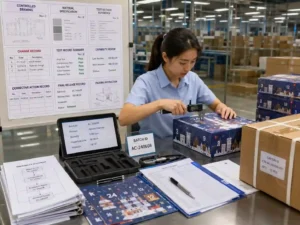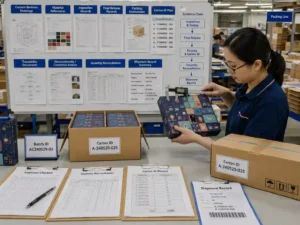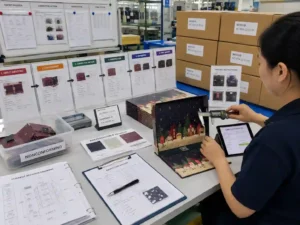
Quick answer: A third party packaging inspection plan for multi-component boxes should define what the inspector checks, when inspection occurs, which approved references control acceptance, how components are sampled and measured, and what evidence is required before shipment or payment release. For advent calendar boxes, the plan should cover not only finished appearance but also component completeness, structural fit, assembly accuracy, functional features, traceability, packing status, and closure of any nonconformities.
The objective is not simply to send an inspector to the factory. The objective is to turn the buyer’s approved specifications into measurable inspection instructions that an independent inspector can execute consistently.

What should a third party packaging inspection plan define before the inspector arrives?
The plan should define the inspection scope, timing, approved reference documents, measurable acceptance criteria, sampling method, reporting requirements, and release authority before the inspection is booked. Leaving these decisions until the inspector reaches the factory creates avoidable ambiguity.
A multi-component advent calendar may combine a rigid outer structure, printed wrap, doors or drawers, inserts, dividers, ribbons, magnets, trays, labels, and export cartons. The inspection scope should identify which of these components are critical and which characteristics must be verified.
The buyer should normally provide or approve a controlled inspection package containing relevant documents such as:
- purchase order and approved product specification;
- revision-controlled structural drawings or dielines;
- approved sample or clearly identified reference sample;
- approved artwork or visual reference where applicable;
- component list or bill of materials relevant to inspection;
- critical dimensions and permitted tolerances;
- workmanship and functional acceptance criteria;
- packing configuration and carton identification requirements;
- inspection report format and required photographic evidence.
Project-dependent requirements should be identified separately. For example, one design may require magnet alignment checks, while another may require drawer sequencing or door-opening checks. These should not be treated as universal packaging standards unless the purchase specification makes them requirements.
When should third-party inspection take place?
Inspection timing should match the risk that the buyer is trying to control. A final random inspection may be appropriate for verifying completed goods, while higher-risk projects may justify an earlier production-stage inspection as well.
When is an in-process inspection useful?
An in-process inspection is useful when problems need to be detected before the full quantity is completed. This can be particularly important when a box requires extensive hand assembly, multiple outsourced components, or repeated positioning operations.
Possible checks include component availability, board or material references, assembly sequence, dimensional consistency, gluing, alignment, component matching, and production progress. The inspection should focus on characteristics that can still be corrected without dismantling an entire finished production run.
What should a final inspection confirm?
A final inspection should confirm that sufficiently completed goods are available in the agreed inspection condition and can be compared with the approved requirements. The buyer and inspection provider should agree in advance how much production must be completed and packed before the visit.
The inspector may then verify quantities, workmanship, dimensions, functions, component completeness, assortment or sequence where relevant, packing configuration, carton identification, and other specified characteristics.
The buyer should also define whether a passed inspection is one condition for shipment release, payment authorization, or both. That commercial approval remains a buyer decision rather than an automatic conclusion made by the inspector.
How do you turn approved specifications into measurable inspection checks?
Convert each important requirement into a check that produces objective evidence. Statements such as “good quality,” “strong construction,” or “correct color” are too subjective unless they are linked to an approved reference or measurable criterion.
| Inspection area | Evidence or reference | Typical verification approach |
|---|---|---|
| Structure | Approved drawing and sample | Measure specified critical dimensions and compare construction |
| Components | Approved component list | Verify presence, type, position, and quantity |
| Assembly | Sample, drawing, or workmanship criteria | Check alignment, bonding, folding, positioning, and fit |
| Functional features | Defined test method | Open doors, operate drawers, close magnets, or perform specified functions |
| Appearance | Approved visual reference | Compare printing, finishing, cleanliness, and specified workmanship points |
| Packing | Approved packing instruction | Verify units per carton, protection, identification, and configuration |
| Traceability | PO and production records | Confirm inspected goods correspond to the intended order and revision |
Measurements should identify the actual feature being measured, the specified nominal dimension, any buyer-approved tolerance, the measuring instrument, and preferably the recorded result. Do not invent tolerances at inspection stage simply because the drawing omitted them.
How should multi-component boxes be checked differently from simpler packaging?
Multi-component boxes require inspection of relationships between components, not just each part in isolation. A component can meet its own dimensions yet still create a failed assembly if its position, orientation, clearance, or mating component is incorrect.
For example, an advent calendar with 24 doors may require verification that the internal structure sits in the correct position behind the printed door layout. A drawer-style design may require checking whether individual drawers move correctly after the complete structure is assembled.
The inspection plan can therefore divide checks into three levels:
- Component checks: verify specified materials, dimensions, quantities, and identifiable component characteristics.
- Assembly checks: verify positioning, alignment, bonding, fit, sequence, and interaction between components.
- Finished-unit checks: verify appearance, functionality, completeness, cleanliness, and packing readiness.
This hierarchy makes it easier to identify whether a defect originated in a component, an assembly process, or final handling.
How should sampling and defect classification be agreed?
The buyer and inspection provider should agree the sampling approach and defect classifications before inspection. The appropriate sample size and acceptance rules vary according to order quantity, inspection method, product risk, contractual requirements, and the buyer’s quality policy.
Critical, major, and minor classifications should be defined around the consequences of a defect rather than assigned casually. A missing structural component, for example, may have a different significance from a small cosmetic imperfection.
Some requirements may justify checks beyond the general random sample. Examples can include order quantity verification, carton marking checks, sequence verification, or specific functional characteristics that the buyer has designated for expanded or 100% checking.
These are project-dependent decisions. The inspection agency can advise on execution, but the buyer should approve the acceptance criteria that determine whether the order is commercially acceptable.
What evidence should the third-party inspector provide?
The report should provide enough objective evidence for someone who was not present at the factory to understand what was checked and what was found. A simple “pass” statement provides limited value without supporting observations.
A useful evidence package can include:
- inspection date, location, PO reference, product reference, and inspected quantity;
- production and packing completion status observed at inspection;
- sample selection and sampling information;
- measurement records for specified critical dimensions;
- photographs showing inspected units and relevant findings;
- functional check results;
- component and assembly observations;
- defect descriptions, quantities, classifications, and photographs;
- carton and packing verification where included in scope;
- clear identification of any requirement that could not be verified.
Traceable evidence matters because inspection results may later be used for corrective action, supplier discussion, payment decisions, or shipment authorization.
How do you verify that the inspector sees the correct production and documents?
Cross-check the inspected goods against the PO, product code, approved revision, production quantity, component records, and relevant factory documentation. This reduces the risk of inspecting an incomplete, obsolete, or unrepresentative batch.
This becomes particularly important where some processes or components are subcontracted. The purchase order should already define any subcontracting restrictions and disclosure requirements. The inspection scope can then require evidence that relevant components and finished goods correspond to approved production arrangements.
For buyers still evaluating manufacturing controls, reviewing the Giftpackpro packaging factory information can provide context for the supplier-evaluation process. The inspection plan itself, however, should rely on order-specific approved documents rather than general supplier descriptions.
What should happen when the inspection finds defects?
A failed or conditional inspection should trigger documented disposition and corrective action rather than an informal promise to “fix the goods.” The buyer should identify what must be corrected, what evidence is required, and whether reinspection is necessary.
What should a corrective-action record contain?
The record should identify the nonconformity, affected quantity or scope, proposed correction, responsible party, completion evidence, and verification method. For recurring or systematic problems, the buyer may also request an explanation of cause and preventive action.
Photographs of reworked samples can be useful but may not prove that the full affected quantity has been corrected. Where the defect is widespread, difficult to verify remotely, or functionally significant, a reinspection may provide stronger evidence.

What does a practical verification checklist look like?
A short pre-inspection checklist helps prevent the most common problem: booking an inspector before the inspection criteria are actually ready.
- Is the PO number and product identification confirmed?
- Is the current approved drawing revision clearly identified?
- Is an approved physical or documented reference available?
- Are all components that fall within inspection scope listed?
- Are critical dimensions and buyer-approved tolerances defined?
- Are functional checks and test methods written clearly?
- Are workmanship requirements linked to objective references where possible?
- Are defect classifications and sampling rules agreed?
- Is the required production and packing completion status defined?
- Are required photographs and measurement records specified?
- Are subcontracted components or processes traceable where relevant?
- Is the process for failed inspection, corrective action, and reinspection defined?
- Does the buyer retain final shipment and payment approval authority?
What sourcing risk does a poorly defined inspection plan create?
The main risk is false confidence: an inspection can be completed successfully while important order requirements remain unchecked. This often happens when the inspection brief contains a product name and quantity but lacks controlled drawings, component requirements, measurable criteria, or functional checks.
Consider a hypothetical multi-drawer calendar. The inspector checks printing and external dimensions, and the visible workmanship appears acceptable. However, the brief does not require drawer-by-drawer functional checks or comparison of internal components with the approved revision. A recurring internal fit problem may therefore remain outside the inspection scope.
The lesson is not that third-party inspection is ineffective. It is that inspection effectiveness depends on the quality of the instructions and evidence supplied to the inspector.
Who should approve the final inspection decision?
The inspection provider should report observations against agreed criteria, while the buyer should retain authority for commercial disposition unless the contract explicitly establishes another arrangement. Inspection results are evidence for a decision, not a substitute for buyer approval.
Before releasing a shipment or linked payment milestone, purchasing and quality teams can confirm that the report matches the correct PO and revision, significant defects are resolved, required corrective-action evidence is complete, and any necessary reinspection has been accepted.
Companies developing a new multi-component calendar can also review custom advent calendar box services and custom advent calendar box products when defining the product scope that will later need to be controlled through drawings, samples, production documents, and inspection criteria.
What should you send an inspection agency before booking the visit?
Send the agency enough controlled information to prepare the inspection rather than relying on factory explanations during the visit. At minimum, this normally means the PO or inspection reference, product specification, current approved drawings, applicable visual references, inspection criteria, sampling instructions, test requirements, and reporting expectations.
Confirm any unusual equipment or test setup in advance. If a specified check requires a particular gauge, fixture, reference sample, or access to packed cartons, the agency and factory need to know before the inspector arrives.
FAQ: Can one final inspection cover every risk in a multi-component box?
No. A final inspection can provide strong evidence about completed goods, but some process risks are easier to detect earlier. Projects involving complex manual assembly, outsourced components, or difficult-to-rework construction may justify additional in-process verification.
FAQ: Should the factory or buyer write the inspection criteria?
The supplier can contribute technical information, but the buyer should approve the criteria used for acceptance. Requirements should correspond to the PO, approved drawings, samples, specifications, and agreed quality conditions rather than being created unilaterally on inspection day.
FAQ: Is a passed third-party inspection enough to authorize payment?
That depends on the agreed commercial terms. Buyers can make an acceptable inspection report one required payment milestone while retaining checks for corrective-action closure, documentation, or other contractual conditions before authorizing payment.
If you are preparing specifications and inspection controls for a new multi-component advent calendar project, request a custom quote and provide the product layout, structural requirements, component details, and expected inspection checkpoints for review.