
Quick answer: A supplier corrective action evaluation should confirm four things: the problem is contained, the actual root cause is supported by evidence, corrective actions address that cause, and objective verification shows the problem is unlikely to recur. For custom advent calendar packaging, buyers should review affected quantities, production records, measurements, inspection results, subcontracting status, revised controls, and responsibility for release. A completed corrective-action form alone is not evidence that the issue has been solved.
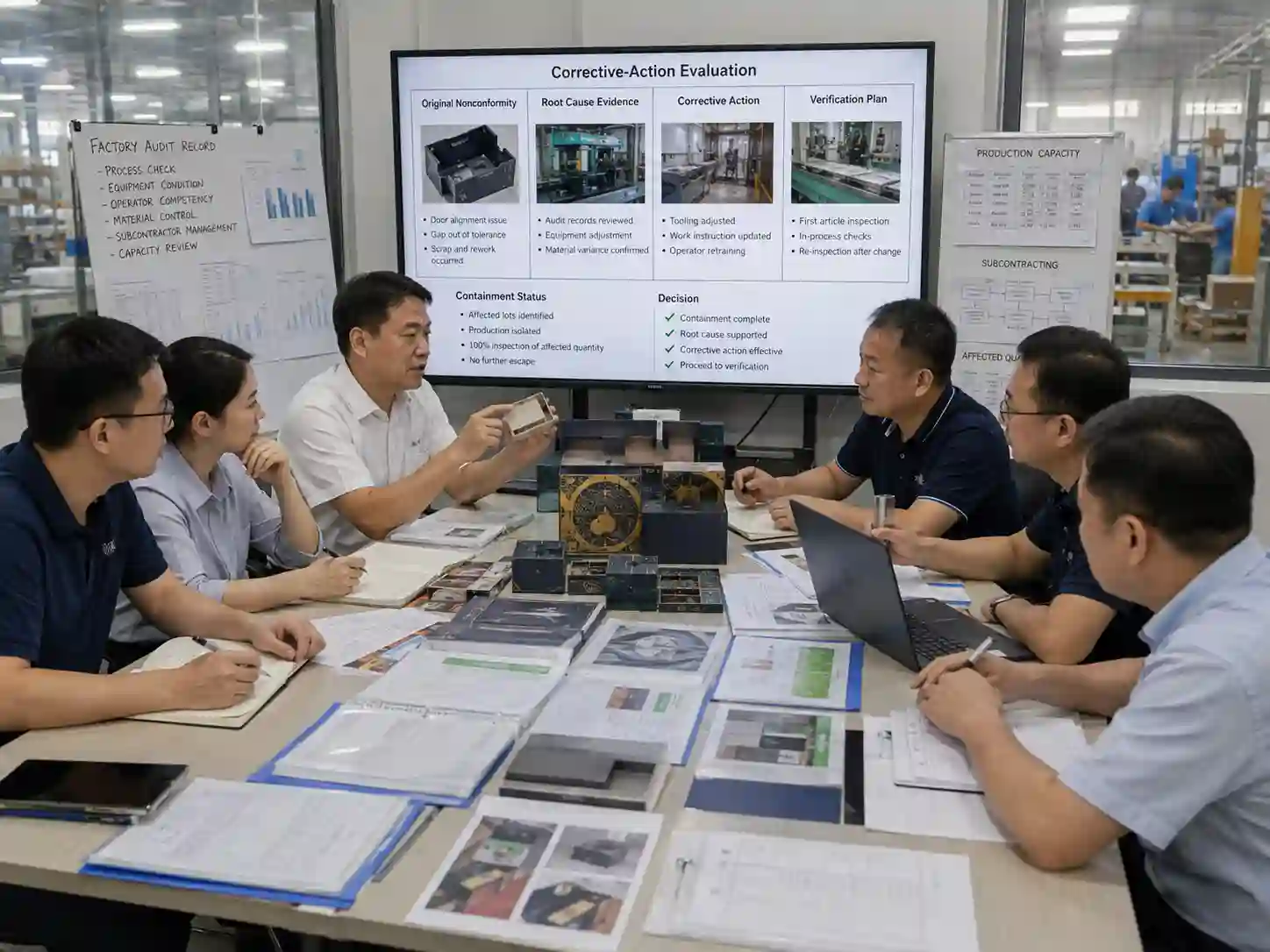
What should you evaluate in a supplier’s corrective-action response?
Evaluate the response as an evidence chain rather than as a written explanation. Each conclusion should connect the detected nonconformity to containment, root cause, corrective action, verification, and controlled release.
For multi-component paper packaging, the evidence may include approved drawings, purchase-order requirements, material specifications, production records, inspection reports, measurement sheets, approved samples, equipment settings, operator records, subcontractor information, photographs, and reinspection results.
The exact documents vary by defect. A dimensional problem may require measurement and tooling evidence, while a color, material, assembly, or subcontracting problem requires different records.
How do you perform a supplier corrective action evaluation?
Start with the original requirement and work forward. Do not begin by deciding whether the supplier’s proposed solution sounds reasonable; first establish exactly what failed and how compliance was originally defined.
- Confirm the nonconformity against the controlled requirement.
- Verify immediate containment and affected quantity.
- Test whether the stated root cause explains the evidence.
- Check whether corrective actions remove or control that root cause.
- Review implementation evidence rather than planned actions alone.
- Verify corrected production through measurements or inspection.
- Confirm preventive controls have been incorporated into normal production.
- Give buyer release only when the required evidence is complete.
How do you confirm the supplier understood the actual problem?
The problem statement should be specific enough to measure. “Assembly quality needs improvement” is weak; identifying a particular drawer dimension, board specification, glue location, print registration limit, component orientation, or other controlled characteristic gives the investigation a defined target.
Compare the reported defect with the latest approved drawing, specification, sample or written PO requirement. Also verify revision numbers. A supplier can investigate the wrong problem if production was working from an obsolete file.
How do you verify containment before accepting a root cause?
Containment should identify where potentially affected material is and prevent it from moving forward unintentionally. Ask for quantities and status by production stage rather than accepting a statement such as “all goods checked.”
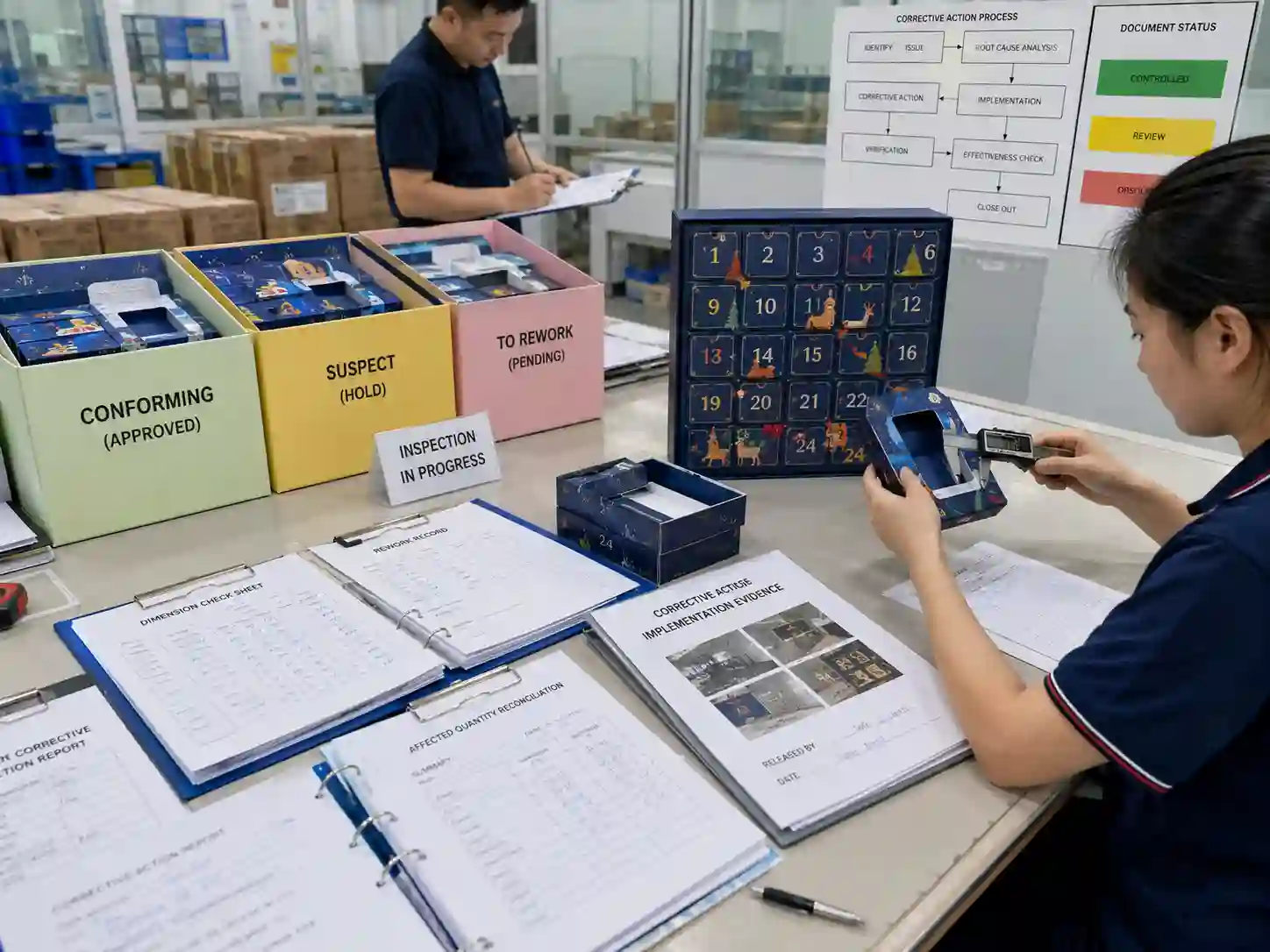
For an advent calendar project, potentially affected material could exist as printed sheets, greyboard components, wrapped shells, drawers, inserts, assembled calendars, packed units or subcontracted work in progress. The supplier should distinguish conforming, suspect, rejected and reworked quantities where relevant.
Useful evidence can include warehouse status records, production counts, segregation photographs, inspection records, rework logs and traceability information. If subcontractors performed the affected operation, containment should extend to that location.
What evidence makes a root-cause analysis credible?
A credible root cause explains why the defect occurred and is supported by production evidence. Repeating the defect description or blaming an operator without explaining the process failure is generally insufficient.
For example, if finished drawers are undersized, “incorrect size” is the problem, not the root cause. Investigation might instead identify an incorrect cutting file, uncontrolled tooling revision, material behavior not allowed for in the process, or an inspection step that failed to detect the dimensional change.
| Area to evaluate | Useful supplier evidence | Warning sign |
|---|---|---|
| Problem definition | Drawing, specification, approved sample, measured defect | Vague description without acceptance criteria |
| Containment | Quantity reconciliation, segregation and inspection records | No clear affected quantity |
| Root cause | Process records, revision history, measurements, equipment or material evidence | “Worker mistake” without explaining why the system allowed it |
| Corrective action | Revised process, tooling, instruction or control record | Promise to “pay more attention” |
| Implementation | Dated records showing the action is actually in use | Action exists only on the corrective-action form |
| Verification | Measurements, inspection results or appropriate test records | No objective result after correction |
| Recurrence control | Updated inspection plan, controlled document or process checkpoint | Temporary sorting presented as a permanent solution |
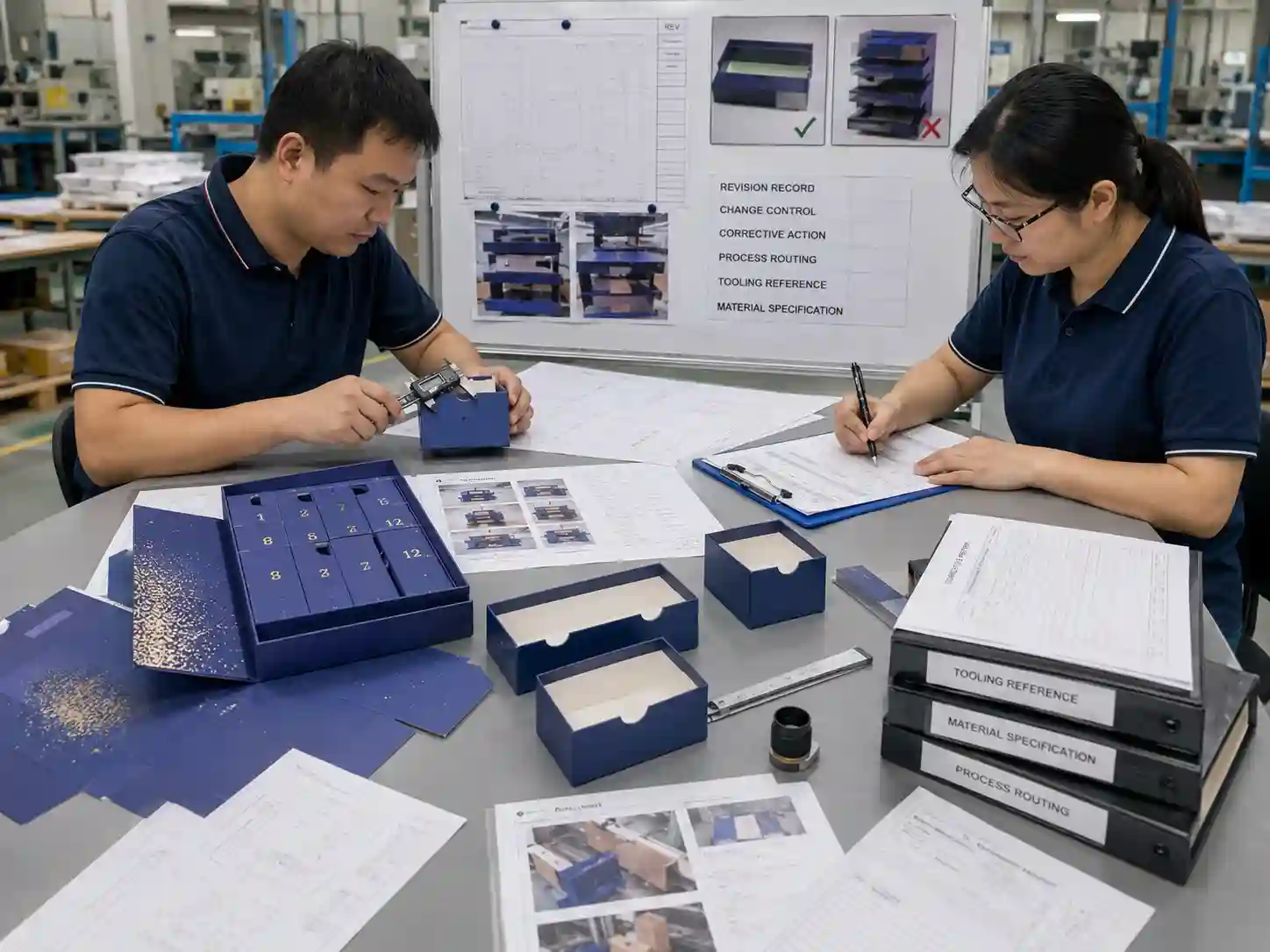
How should buyers judge the proposed corrective action?
The action should address the demonstrated root cause rather than simply repair defective units. Rework, sorting and replacement can contain current production, but they do not necessarily prevent the next batch from developing the same problem.
Suppose an advent calendar’s internal drawers do not fit consistently. If investigation shows that an uncontrolled cutting-tool revision caused dimensional variation, checking finished drawers may contain the current lot. A stronger permanent action could include restoring the approved tooling data, controlling future revisions and adding a defined dimensional check at an appropriate production stage.
Whether that is sufficient depends on the project, process capability and defect risk. Buyers should avoid prescribing factory processes without technical justification; the supplier should demonstrate how its proposed control achieves the approved requirement.
Should buyers review subcontracting during corrective action?
Yes, when the affected process may have been outsourced. Corrective action is incomplete if the supplier investigates only its own factory while printing, die cutting, lamination, hand assembly or another relevant operation occurred elsewhere.
Check whether the actual production route matches what was disclosed or approved. Review subcontractor production records, inspection responsibility and corrective-action evidence when they are relevant to the defect.
Unauthorized subcontracting can also be a commercial-control issue. The purchase order or supply agreement should define any required buyer approval, but the exact contractual response depends on the agreed terms.
How do PO controls and inspection rights support corrective action?
Written controls make verification easier because they establish what evidence and access the buyer can require. Relevant provisions can cover approved specifications, change authorization, inspection rights, subcontracting approval, nonconforming-product control and shipment release.
These controls should be established before a dispute occurs. A corrective-action request cannot reliably create contractual rights that were absent from the original agreement.
For future orders, purchasing teams can review whether their documentation clearly identifies controlled drawings, approved revisions, inspection access and the process for approving changes. Broader sourcing controls can be discussed with the custom advent calendar box services team where they relate to a specific packaging project.
How do you verify that corrective action actually worked?
Verification should test the corrected characteristic using an appropriate method and an agreed reference. Do not close the case simply because the supplier reports that rework or process adjustment is complete.
Depending on the defect, verification may involve dimensional measurements, visual inspection against controlled references, fit or functional checks, material-document review, process records, or a repeat inspection. The method should correspond to the failure being investigated.
- Confirm the latest controlled drawing or specification used for verification.
- Identify the production quantity covered by the corrective action.
- Review actual measurements or inspection results where applicable.
- Check whether rejected and obsolete components remain segregated.
- Confirm reworked units were reinspected when rework could affect conformity.
- Verify revised instructions or controls are active on the production floor.
- Check subcontracted operations when they contributed to the problem.
- Record who has authority to release production or shipment.
A third-party inspection can provide additional evidence when appropriate, but it does not replace root-cause analysis. Inspection can show whether inspected goods conform at that point; it does not by itself prove why the original failure happened or whether the process has been permanently corrected.
What does a practical corrective-action scorecard look like?
A scorecard helps purchasing and quality teams apply consistent logic across suppliers. It should support judgment rather than replace technical review.
| Question | Strong response | Escalation trigger |
|---|---|---|
| Is the defect defined against an approved requirement? | Yes, with controlled reference and evidence | Requirement or revision is unclear |
| Is affected production contained? | Quantities and locations reconciled | Suspect units cannot be traced |
| Is root cause demonstrated? | Evidence explains the failure mechanism | Assumption without records or investigation |
| Does the action address root cause? | Process-level control implemented | Sorting or rework is the only action |
| Has implementation been verified? | Dated records and production evidence available | Action is only promised |
| Does corrected output conform? | Objective verification supports conformity | Supplier requests release without results |
What sourcing risks should trigger deeper verification?
Escalate verification when evidence conflicts, traceability is incomplete, affected quantities cannot be reconciled, the supplier changes its explanation, or the corrective action depends on an undisclosed factory or process.
For example, a supplier may attribute inconsistent calendar assembly to operator handling. Production records then show that part of the assembly was transferred to another workshop during a capacity shortage. The buyer should not close the case based only on retraining records from the primary factory. The actual production route, subcontractor controls, affected quantities and inspection evidence need verification.
Capacity should also be considered when corrective action requires significant rework or replacement. A technically valid recovery plan can still create new quality risks if it requires unrealistic production compression. Capacity schedules, staffing, equipment availability and inspection resources can therefore be relevant evidence, particularly on seasonal packaging with a fixed launch date.
When should payment or shipment remain subject to buyer approval?
Buyer approval should follow the commercial terms already agreed for the project. Where a PO links payment milestones or shipment release to inspection, conformity or document approval, unresolved corrective actions should be reviewed against those conditions before authorization.
This is different from automatically withholding payment whenever a defect occurs. Purchasing teams should follow the actual contract, PO and applicable commercial requirements.
A useful release record identifies the issue, affected production, corrective-action reference, verification evidence, remaining concessions if any, and the person authorized to approve the next stage. Verbal factory assurances should not substitute for a required documented release.
When is a corrective action ready to close?
Close it when evidence supports containment, root cause, implemented corrective action and successful verification, and when any required buyer approvals are complete. Closure should mean the process is controlled, not merely that defective goods have disappeared from view.
Keep the relevant corrective-action record with the project quality documentation so repeated failures can be identified on later orders. Recurrence of the same issue may justify deeper review of factory controls, capacity, document management or subcontracting practices.
FAQs about evaluating supplier corrective actions
Is a supplier corrective-action report enough to approve production?
No. The report organizes the response, but approval should depend on supporting evidence such as controlled specifications, production records, measurements, inspection results and proof that required actions were implemented.
Does 100% sorting count as corrective action?
Sorting is normally a containment method for identifying nonconforming units in current production. Permanent corrective action should address the cause that allowed the defect to occur or escape detection.
Should every corrective action require a factory visit?
No. The appropriate verification method depends on defect severity, evidence quality, production stage and sourcing risk. Some issues can be verified through controlled records and inspection evidence, while higher-risk or contradictory cases may justify on-site verification.
Who should approve closure of a supplier corrective action?
The responsible buyer, quality function or other authorized party should follow the approval structure defined for the project. Technical verification and commercial release should remain clearly documented rather than assumed from supplier completion.
If you need to evaluate factory controls and corrective-action evidence for a custom advent calendar packaging project, review the capabilities of the Giftpackpro packaging factory and request a custom quote with your specifications and supplier-control requirements.


